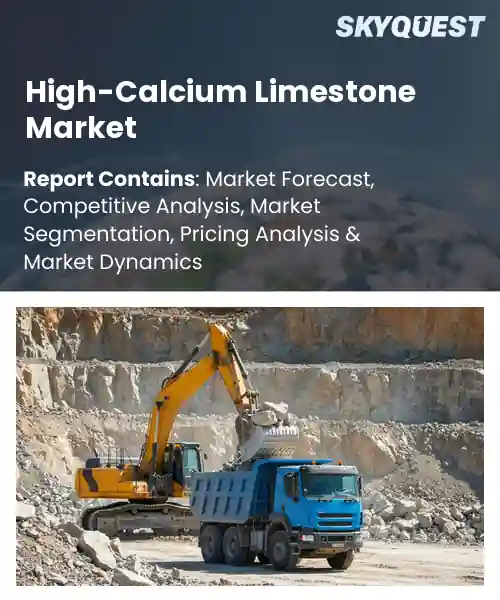
High-Calcium Limestone Market
Report ID: SQMIG15F2409
Report ID: SQMIG15F2409
[email protected]
USA +1 351-333-4748
Report ID:
SQMIG15F2409 |
Region:
Global |
Published Date: July, 2026
Pages:
157
|Tables:
146
|Figures:
78


Global High-Calcium Limestone Market size was valued at USD 1.62 Billion in 2024 and is poised to grow from USD 1.71 Billion in 2025 to USD 2.69 Billion by 2033, growing at a CAGR of 5.8% during the forecast period (2026-2033).
The global high‑calcium limestone market supplies a purer form of calcium carbonate used in construction, steelmaking, and agriculture. Its importance stems from the material’s ability to improve concrete strength, act as a flux in blast‑furnace processes, and neutralize acidic soils. Historically, demand surged during the post‑World‑II building boom when developers sought durable aggregates, and again in the 1990s as steel producers adopted production techniques. Regions such as North America and Europe pioneered quarrying, while recent expansions in China and India illustrate how rising infrastructure spending fuels extraction. Thus, the market’s evolution reflects a link between industrial growth and limestone supply. The dominant growth factor is the tightening of environmental regulations that compel steel mills and cement plants to lower emissions, prompting a shift toward high‑calcium limestone as an effective neutralizer. When a furnace injects limestone, sulfur dioxide converts to gypsum, which can be sold as a by‑product, creating a revenue stream that offsets raw‑material costs. This cyclical benefit has encouraged producers in the United States and Brazil to invest in quarrying and beneficiation technologies, expanding capacity while reducing waste. Consequently, the market attracts entrants seeking to serve renewable‑energy projects that require limestone for water‑treatment and soil‑stabilization, opening avenues for expansion
How is AI-driven automation influencing the high‑calcium limestone market?
AI‑driven automation is reshaping the high‑calcium limestone sector by embedding intelligent sensors and machine‑learning models into quarry operations. Real‑time monitoring now predicts equipment wear, allowing maintenance before failures occur, which keeps production lines running smoothly. Automated drilling and robotic loaders adjust feed rates based on rock hardness, improving extraction efficiency while reducing labor intensity. Data‑rich platforms also optimize blending processes, ensuring consistent calcium content that meets strict industrial specifications. Supply‑chain visibility is enhanced as AI forecasts demand spikes, aligning transport logistics with plant output. Together these technologies lower operating costs, boost product quality, and make the market more resilient to fluctuations.June 2026, a leading high‑calcium limestone producer integrated AI‑driven robotic extraction, streamlining quarry workflows and accelerating output while cutting energy use.
Market snapshot - (2026-2033)
Global Market Size
USD 1.62 Billion
Largest Segment
Construction Grade
Fastest Growth
Chemical Grade
Growth Rate
5.8% CAGR
To get more insights on this market click here to Request a Free Sample Report
Global high-calcium limestone market is segmented by grade, form, application, end user, distribution channel and region. Based on grade, the market is segmented into Chemical Grade, Industrial Grade and Construction Grade. Based on form, the market is segmented into Crushed Stone, Powder and Lumps. Based on application, the market is segmented into Cement Manufacturing, Steel Production, Flue Gas Desulfurization, Agriculture and Glass Manufacturing. Based on end user, the market is segmented into Construction, Metallurgy, Chemical Industry and Agriculture. Based on distribution channel, the market is segmented into Direct Sales and Distributors. Based on region, the market is segmented into North America, Europe, Asia Pacific, Latin America and Middle East & Africa.
Chemical Grade segment dominates because its high purity and consistent calcium carbonate composition meet the stringent specifications of cement manufacturers and steel producers, ensuring product quality and process efficiency. The ability to deliver predictable performance reduces operational risks, fostering strong supplier‑buyer relationships and encouraging long‑term contracts. Moreover, its suitability for sensitive applications such as flue‑gas desulfurization reinforces its strategic importance, positioning it as the preferred choice across multiple high‑value uses.
However, Industrial Grade segment is witnessing the strongest growth momentum because expanding infrastructure projects and cost‑sensitive construction activities increasingly favor its lower price point while still delivering adequate performance. Its broader availability and adaptable processing characteristics are attracting new entrants, driving market expansion and creating opportunities for diversified supply chains.
Powder segment dominates because its fine particle size enables uniform blending in cement kilns and facilitates rapid reaction kinetics in flue‑gas desulfurization, improving overall process efficiency. The high surface area enhances chemical reactivity, allowing lower dosage rates and reduced emissions, which aligns with environmental compliance goals. Its easy handling and compatibility with automated dosing systems further solidify its preference among manufacturers seeking consistent performance and operational simplicity throughout production cycles.
Meanwhile, Crushed Stone segment emerges as a high‑growth area because increasing demand for bulk construction aggregates and road‑base material boosts its use. Its coarse texture meets load‑bearing needs and offers logistical benefits for large projects, prompting capacity expansions that broaden market adoption and generate fresh revenue opportunities within the high‑calcium limestone industry.
To get detailed segments analysis, Request a Free Sample Report
Asia Pacific commands leadership in the high‑calcium limestone sector due to a confluence of abundant natural deposits, advanced processing capabilities, and diversified end‑use demand. The region’s extensive quarrying infrastructure supports large‑scale extraction, while strong engineering expertise enables value‑added production for cement, steel, and specialty chemicals. Rising urbanization fuels construction activities, and aggressive industrial modernization drives adoption of high‑purity limestone as a performance enhancer. Collaborative research initiatives across Japan and South Korea promote product innovation, reinforcing the region’s reputation for quality and reliability. Export‑oriented logistics networks further expand market reach, cementing Asia Pacific’s position as the preeminent source of high‑calcium limestone worldwide.
High-Calcium Limestone Market in Japan benefits from well‑established mining operations and a strong focus on high‑performance construction materials. Domestic manufacturers leverage the mineral for cement additives, steel refining, and advanced chemical processes. Stringent quality standards and a reputation for reliability drive demand from infrastructure projects and automotive supply chains. Ongoing collaboration between producers and research institutions further enhances product specifications, reinforcing Japan role as a key consumer.
High-Calcium Limestone Market in South Korea is propelled by a dynamic industrial base that relies heavily on mineral inputs for shipbuilding, petrochemical refining, and steel production. The strategic emphasis on sustainable manufacturing encourages the substitution of traditional raw materials with high‑calcium limestone to reduce emissions. Strong logistics networks and proximity to major ports facilitate efficient distribution, while government incentives support domestic quarry development and technology upgrades.
North America experiences robust growth in the high‑calcium limestone market as manufacturers pursue efficiency, regulatory compliance, and sustainability objectives. The United States and Canada host mature mining sectors that benefit from well‑established supply chains and technical expertise in material processing. Strong demand from infrastructure renewal, renewable energy projects, and advanced manufacturing creates a fertile environment for limestone applications in cement, steel desulfurization, and emission control technologies. Environmental stewardship policies encourage substitution of lower‑grade raw materials with high‑calcium alternatives to meet emissions targets. Investment in modern quarry operations and continuous improvement programs sustains product quality, positioning the region as a dynamic hub for high‑calcium limestone consumption.
High-Calcium Limestone Market in the United States is anchored by extensive domestic quarries and a sophisticated downstream network. The material is integral to cement plants seeking to lower clinker usage, to steel mills focused on desulfurization, and to emerging renewable fuel initiatives that require high‑purity limestone for carbon capture. Ongoing regulatory emphasis on emissions reduction sustains demand, while continuous investment in processing technology enhances product consistency for diverse industrial applications.
High-Calcium Limestone Market in Canada benefits from rich deposits in sedimentary basins and a strong tradition of mining excellence. The material is widely employed in construction aggregates, cement formulation, and environmental remediation aimed at soil and water quality improvement. Provincial initiatives encouraging low‑carbon building practices increase use of high‑calcium limestone as a sustainable alternative. Partnerships between quarry operators and research institutions advance beneficiation techniques, ensuring reliable supply of high‑purity limestone for industrial applications.
Europe strengthens its role in the high‑calcium limestone market through a focus on environmental performance, technological refinement, and integration within circular economy frameworks. Leading economies such as Germany, the United Kingdom, and France invest heavily in research that enhances limestone’s functionality in low‑carbon cement, steel decarbonization, and advanced polymer production. Tight emissions regulations incentivize the use of high‑purity limestone as a cost‑effective additive for reducing clinker factor and lowering greenhouse‑gas output. Collaborative industry‑academic partnerships drive innovation in beneficiation processes, improving consistency and reducing waste. Well‑developed logistics and proximity to major manufacturing hubs ensure reliable supply, reinforcing Europe’s strategic importance in the global high‑calcium limestone landscape.
High-Calcium Limestone Market in Germany is reinforced by extensive limestone beds across the Ruhr and Alpine regions, supporting a long‑standing mining sector. The material plays a critical role in low‑carbon cement production, steel desulfurization, and chemical synthesis for automotive components. Stringent climate policies motivate manufacturers to replace traditional raw inputs with high‑purity limestone to lower emissions. Ongoing collaboration between industry champions and technical universities drives process optimization, guaranteeing a stable supply of high‑quality product for diverse industrial applications.
High-Calcium Limestone Market in the United Kingdom draws on historic quarries in the Midlands and northern England, providing a dependable source for construction and manufacturing needs. The limestone is essential for eco‑focused cement blends, steel treatment, and emerging carbon capture initiatives. Governmental climate commitments encourage the adoption of high‑calcium limestone to reduce the carbon intensity of building materials. Research partnerships with engineering colleges emphasize innovative beneficiation and waste minimization, ensuring the United Kingdom remains a competitive participant in the high‑calcium limestone supply chain.
High-Calcium Limestone Market in France benefits from abundant deposits in the Paris Basin and southern regions, feeding a robust quarrying industry. High‑purity limestone is widely used in sustainable cement formulas, steel refining, and agro‑industrial applications that prioritize soil health. National environmental objectives promote its integration as a low‑impact additive to lower greenhouse‑gas emissions in construction. Collaborative efforts between French mining firms and research institutes focus on advancing processing technologies, enhancing product consistency and reinforcing France’s strategic position in the European high‑calcium limestone market.
To know more about the market opportunities by region and country, click here to
Buy The Complete Report
Increasing Use in Agriculture
Regulatory Push for Low‑Carbon Materials
High Production Energy Requirements
Limited Raw Material Availability
Request Free Customization of this report to help us to meet your business objectives.
The high‑calcium limestone market is dominated by a few multinational cement producers that compete through strategic acquisitions of regional quarries, joint ventures with construction material firms, and investments in carbon‑reduction technologies; for example, LafargeHolcim has recently acquired a major U.S. limestone asset, Cemex entered a partnership to supply high‑calcium limestone for asphalt paving, and HeidelbergCement is piloting low‑emission processing equipment to meet stricter environmental standards.
Top Player’s Company Profile
Recent Developments
SkyQuest’s ABIRAW (Advanced Business Intelligence, Research & Analysis Wing) is our Business Information Services team that Collects, Collates, Correlates, and Analyses the Data collected by means of Primary Exploratory Research backed by robust Secondary Desk research. As per SkyQuest analysis, the high‑calcium limestone market is being propelled primarily by stringent regulatory push for low‑carbon materials, which encourages manufacturers to replace high‑emission additives with this carbon‑neutral mineral; a second driver is the growing adoption of limestone in sustainable agriculture to improve soil health and boost yields. The market’s biggest challenge remains the energy‑intensive grinding and calcination process, raising costs and limiting price‑sensitive adoption. Asia Pacific leads the market thanks to abundant deposits and advanced processing, while the chemical‑grade segment commands the largest share because its purity meets the exacting standards of cement and steel producers. This combination of regulatory support and agronomic demand positions the sector for steady growth despite the energy hurdle.
| Report Metric | Details |
|---|---|
| Market size value in 2024 | USD 1.62 Billion |
| Market size value in 2033 | USD 2.69 Billion |
| Growth Rate | 5.8% |
| Base year | 2024 |
| Forecast period | (2026-2033) |
| Forecast Unit (Value) | USD Billion |
| Segments covered |
|
| Regions covered | North America (US, Canada), Europe (Germany, France, United Kingdom, Italy, Spain, Rest of Europe), Asia Pacific (China, India, Japan, Rest of Asia-Pacific), Latin America (Brazil, Rest of Latin America), Middle East & Africa (South Africa, GCC Countries, Rest of MEA) |
| Companies covered |
|
| Customization scope | Free report customization with purchase. Customization includes:-
|
To get a free trial access to our platform which is a one stop solution for all your data requirements for quicker decision making. This platform allows you to compare markets, competitors who are prominent in the market, and mega trends that are influencing the dynamics in the market. Also, get access to detailed SkyQuest exclusive matrix.
Table Of Content
Executive Summary
Market overview
Parent Market Analysis
Market overview
Market size
KEY MARKET INSIGHTS
COVID IMPACT
MARKET DYNAMICS & OUTLOOK
Market Size by Region
KEY COMPANY PROFILES
Methodology
For the High-Calcium Limestone Market, our research methodology involved a mixture of primary and secondary data sources. Key steps involved in the research process are listed below:
1. Information Procurement: This stage involved the procurement of Market data or related information via primary and secondary sources. The various secondary sources used included various company websites, annual reports, trade databases, and paid databases such as Hoover's, Bloomberg Business, Factiva, and Avention. Our team did 45 primary interactions Globally which included several stakeholders such as manufacturers, customers, key opinion leaders, etc. Overall, information procurement was one of the most extensive stages in our research process.
2. Information Analysis: This step involved triangulation of data through bottom-up and top-down approaches to estimate and validate the total size and future estimate of the High-Calcium Limestone Market.
3. Report Formulation: The final step entailed the placement of data points in appropriate Market spaces in an attempt to deduce viable conclusions.
4. Validation & Publishing: Validation is the most important step in the process. Validation & re-validation via an intricately designed process helped us finalize data points to be used for final calculations. The final Market estimates and forecasts were then aligned and sent to our panel of industry experts for validation of data. Once the validation was done the report was sent to our Quality Assurance team to ensure adherence to style guides, consistency & design.
Analyst Support
Customization Options
With the given market data, our dedicated team of analysts can offer you the following customization options are available for the High-Calcium Limestone Market:
Product Analysis: Product matrix, which offers a detailed comparison of the product portfolio of companies.
Regional Analysis: Further analysis of the High-Calcium Limestone Market for additional countries.
Competitive Analysis: Detailed analysis and profiling of additional Market players & comparative analysis of competitive products.
Go to Market Strategy: Find the high-growth channels to invest your marketing efforts and increase your customer base.
Innovation Mapping: Identify racial solutions and innovation, connected to deep ecosystems of innovators, start-ups, academics, and strategic partners.
Category Intelligence: Customized intelligence that is relevant to their supply Markets will enable them to make smarter sourcing decisions and improve their category management.
Public Company Transcript Analysis: To improve the investment performance by generating new alpha and making better-informed decisions.
Social Media Listening: To analyze the conversations and trends happening not just around your brand, but around your industry as a whole, and use those insights to make better Marketing decisions.
REQUEST FOR SAMPLE
 REQUEST FREE CUSTOMIZATION


Want to customize this report? This report can be personalized according to your needs. Our analysts and industry experts will work directly with you to understand your requirements and provide you with customized data in a short amount of time. We offer $1000 worth of FREE customization at the time of purchase.
Feedback From Our Clients


 USA (+1) 351-333-4748

