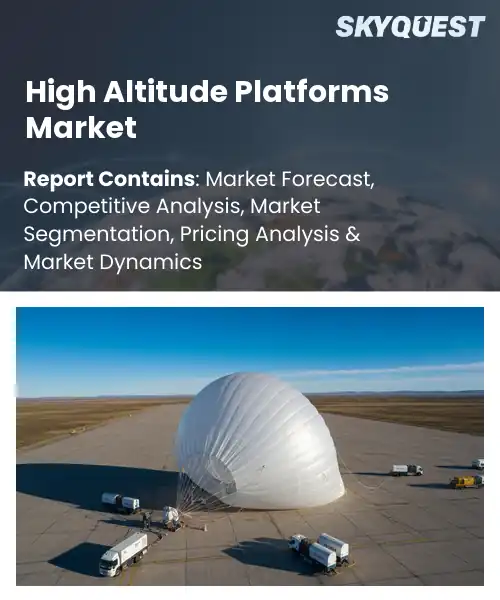
High Altitude Platforms Market
Report ID: SQMIG20A2668
Report ID: SQMIG20A2668
[email protected]
USA +1 351-333-4748
Report ID:
SQMIG20A2668 |
Region:
Global |
Published Date: June, 2026
Pages:
157
|Tables:
116
|Figures:
77


Global High Altitude Platforms Market size was valued at USD 0.85 Billion in 2024 and is poised to grow from USD 0.97 Billion in 2025 to USD 2.85 Billion by 2033, growing at a CAGR of 14.32% during the forecast period (2026-2033).
The high altitude platforms market encompasses aerial systems, balloons and solar powered aircraft that operate between 17 and 25 km to provide telecommunications, monitoring and remote sensing services. Its significance stems from the ability to deliver broadband connectivity and data without the latency and cost of terrestrial fiber or satellite constellations.
The catalyst driving the phase of HAP adoption is the convergence of 5G roll out demands with the scarcity of spectrum and fiber in locales. As operators seek to densify networks, HAPs can host millimeter wave antennas that extend coverage without the expense of tower construction, thereby translating bandwidth shortages into revenue opportunities. Deployments illustrate this effect: telecommunications firms in Africa are launching solar powered platforms to backhaul rural traffic, while disaster response agencies employ balloons to reestablish emergency links after earthquakes. Consequently, capital flows toward technologies and frameworks, unlocking new business models as on demand aerial as a service.
How is AI and IoT reshaping the high altitude platforms market?
AI and IoT are turning high‑altitude platforms into smart, self‑sustaining nodes in the sky. AI algorithms now handle autonomous flight planning, real‑time obstacle avoidance and predictive maintenance, allowing platforms to stay aloft longer with fewer human interventions. IoT connectivity equips each platform with a dense mesh of sensors that stream environmental data, communications traffic and system health metrics back to ground stations. The fusion of these technologies enables on‑board edge analytics, dynamic bandwidth allocation and rapid reconfiguration of payloads for tasks such as broadband delivery, disaster monitoring and agricultural surveying. Together they reduce reliance on costly ground infrastructure, improve reliability and open new revenue streams for operators seeking resilient, low‑latency services.
In May 2026, HAPSMobile announced the deployment of an AI‑powered high‑altitude long‑endurance drone, showcasing how intelligent autonomy and IoT‑linked sensors can boost coverage efficiency and operational uptime in the evolving market.
Market snapshot - (2026-2033)
Global Market Size
USD 0.85 Billion
Largest Segment
HAP Aircraft (Solar/Fuel Cell)
Fastest Growth
HAP Balloons
Growth Rate
14.32% CAGR
To get more insights on this market click here to Request a Free Sample Report
Global high altitude platforms market is segmented by platform type, application, end-user, altitude and region. Based on platform type, the market is segmented into HAP Aircraft (Solar/Fuel Cell), HAP Balloons and Airships (Stratospheric). Based on application, the market is segmented into Telecommunications (Broadband), Surveillance & Reconnaissance, Weather Monitoring and Disaster Response. Based on end-user, the market is segmented into Government & Defense, Telecom Operators and Research Organizations. Based on altitude, the market is segmented into 15-20 km (Stratosphere). Based on region, the market is segmented into North America, Europe, Asia Pacific, Latin America and Middle East & Africa.
HAP aircraft (Solar/Fuel Cell) dominates with large high altitude platforms market share because its ability to generate power continuously from sunlight eliminates the need for frequent refueling, enabling persistent operations over extended periods. This endurance aligns with market demand for reliable, long duration coverage, while the lightweight design reduces launch costs and facilitates rapid deployment. Consequently, operators prioritize these aircraft for critical communication and surveillance missions, reinforcing their leadership in the market across global networks and supporting emerging services.
As per high altitude platforms market outlook, HAP balloons emerge as the most rapidly expanding area because advances in envelope materials and autonomous navigation lower operational risk while extending flight endurance. These improvements attract interest from data intensive users, prompting increased investment and pilot programs that accelerate market penetration and create new revenue streams for commercial stakeholders.
As per high altitude platforms market forecast, telecommunications (Broadband) dominates because it directly fulfills the core promise of high altitude platforms to deliver pervasive, high capacity connectivity in underserved regions. By leveraging line of sight advantages at stratospheric heights, broadband services bypass terrestrial bottlenecks, offering low latency and resilience against congestion. This functional fit drives investment from operators seeking to expand coverage footprints, thereby cementing broadband as the principal revenue engine of the market and fostering new service models.
As per high altitude platforms market analysis, disaster response is witnessing the strongest growth momentum because the immediacy of crisis communication demands rapid, wide area coverage that only stratospheric platforms can provide. Emerging funding for emergency networks and successful field trials spur adoption, positioning this application as a catalyst for broader market expansion and collaboration.
To get detailed segments analysis, Request a Free Sample Report
The Asia Pacific region combines robust research ecosystems with aggressive fiscal incentives that accelerate technology maturation. Strong demand for resilient communication infrastructure across diverse geographies fuels deployment interest, while leading aerospace producers contribute sophisticated payload capabilities. Collaborative frameworks between governments, academia, and private innovators streamline regulatory pathways, encouraging rapid prototyping and commercial roll‑out. Moreover, strategic focus on disaster monitoring and border surveillance aligns with regional security priorities, reinforcing investment confidence. Collectively, these elements create a fertile environment where innovation, demand, and policy converge to sustain leadership in the high altitude platforms arena.
As per high altitude platforms market regional outlook, Japan benefits from a mature aviation sector and proactive governmental policies that prioritize next‑generation connectivity solutions. Integration with existing satellite and terrestrial networks enhances service redundancy, while local expertise in sensor technology supports advanced earth observation applications. Strong industrial partnerships accelerate component localization, reducing reliance on imports and fostering a resilient supply chain. The emphasis on disaster resilience further drives interest in platforms capable of rapid deployment for emergency communications and environmental monitoring.
As per high altitude platforms market regional forecast, South Korea leverages a highly digitized economy and a vibrant startup ecosystem focused on autonomous systems. Government initiatives encourage cross‑border collaboration, facilitating knowledge exchange that accelerates platform development and testing. Pioneering work in artificial intelligence enhances payload processing, enabling sophisticated data analytics for both commercial and defense uses. The nation’s strategic emphasis on secure, high‑capacity communications strengthens the case for integrating high altitude platforms into national broadband strategies, positioning South Korea as a pivotal contributor to regional market momentum.
North America experiences rapid expansion driven by intense investment in next‑generation connectivity and a regulatory landscape that supports innovative airspace usage. Strong emphasis on bridging connectivity gaps in rural and remote communities fuels demand for flexible, cost‑effective aerial solutions. Advanced research institutions collaborate closely with aerospace firms, accelerating the transition from prototype to commercial deployment. Additionally, heightened focus on climate monitoring and security surveillance creates diversified application opportunities, reinforcing the market’s appeal across multiple sectors. This convergence of technology readiness, policy support, and broad application scope propels the region to the forefront of high altitude platform growth.
United States thrives on a synergistic blend of federal research funding and private capital that nurtures rapid innovation cycles. Extensive test ranges and open airspace policies enable frequent flight trials, while deep talent pools in software, aerospace, and telecommunications drive sophisticated system integration. Partnerships between leading telecom operators and platform manufacturers aim to extend broadband reach, particularly in underserved territories. Concurrently, governmental emphasis on national security and environmental observation expands the platform’s utility across both commercial and public sectors.
Canada is shaped by a strong commitment to northern connectivity and a proactive regulatory framework that encourages aerial network experimentation. Collaboration between regional telecom providers and research institutions focuses on adapting platforms to harsh climatic conditions, ensuring reliable performance across vast territories. Emphasis on sustainable technology aligns with national priorities, prompting investment in low‑emission propulsion and renewable power sources. The strategic focus on indigenous community outreach and resource monitoring further diversifies platform applications, reinforcing Canada’s role as an emerging hub for high altitude solutions.
Europe strengthens its position through coordinated research initiatives and a unified regulatory approach that streamlines cross‑border operations. Emphasis on sustainable aviation fuels and low‑impact designs aligns with continent‑wide environmental objectives, encouraging eco‑friendly platform development. Robust aerospace heritage provides a foundation for advanced materials and propulsion technologies, while collaborative clusters integrate telecom, defense, and scientific stakeholders to broaden use‑case landscapes. Policy frameworks that support spectrum allocation and shared airspace management reduce operational barriers, fostering an ecosystem where innovation can translate swiftly into commercial services. This collective focus on sustainability, collaboration, and policy coherence reinforces Europe’s emerging leadership in the high altitude platforms market.
As per high altitude platforms industry analysis, Germany benefits from a deep engineering tradition and strong federal support for aerospace research. Integrated efforts between automotive, aerospace, and telecommunications sectors accelerate the development of high‑efficiency platforms and sophisticated payloads. Emphasis on renewable energy integration drives exploration of solar‑powered solutions, aligning with national climate goals. Collaborative test sites across varied terrains provide rigorous validation environments, enhancing reliability for both commercial broadband and precision agriculture applications.
United Kingdom is propelled by a vibrant innovation ecosystem centered around university research hubs and private venture investment. Clear regulatory guidance on unmanned aerial operations facilitates faster certification pathways, enabling quicker market entry. Focus on maritime surveillance and offshore connectivity leverages the nation’s extensive coastal geography, creating niche markets for platform deployment. Integration with existing fiber networks and satellite constellations enhances service redundancy, positioning the United Kingdom as a strategic node for multi‑layered communications.
France is anchored by strong governmental backing of aerospace excellence and a commitment to digital sovereignty. Collaborative programs link defense research agencies with civilian telecom operators, fostering dual‑use technologies that address both security and connectivity needs. Emphasis on climate data collection aligns with national environmental monitoring strategies, encouraging the use of high altitude platforms for atmospheric research. The presence of world‑renowned aerospace manufacturers provides a reliable supply chain for advanced components, supporting the scaling of platform production for domestic and export markets.
To know more about the market opportunities by region and country, click here to
Buy The Complete Report
Increasing Demand for Real‑Time Data
Advancements in Energy Storage Technology
Regulatory Uncertainty Across Regions
High Deployment and Maintenance Costs
Request Free Customization of this report to help us to meet your business objectives.
The competitive landscape of the high altitude platforms industry is shaped by rapid technology roll‑outs and strategic moves such as cross‑border expansions and targeted venture backing; firms are leveraging partnerships to integrate advanced payloads while pursuing M&A to consolidate niche capabilities, driving differentiation in a market where spectrum access and endurance are key competitive levers.
SkyQuest’s ABIRAW (Advanced Business Intelligence, Research & Analysis Wing) is our Business Information Services team that Collects, Collates, Correlates, and Analyses the Data collected by means of Primary Exploratory Research backed by robust Secondary Desk research.
As per SkyQuest analysis the global high altitude platforms market growth is expanding rapidly, driven first by the surging need for real‑time data that fuels broadband, surveillance and disaster‑response services, while advances in energy‑storage technology provide longer‑endurance solar‑powered aircraft that lower operating costs. The HAP aircraft (Solar/Fuel Cell) segment leads the market because its self‑sustaining power enables persistent stratospheric coverage, and Asia‑Pacific is the dominating region due to strong research ecosystems, fiscal incentives and high demand for resilient communications. However, regulatory uncertainty across countries remains a restraint, slowing approvals and adding compliance costs for multinational deployments. Together these factors, plus rising telecom investment, reinforce the market’s upward trajectory. The global high altitude platforms market trend driven by increasing demand for high-speed broadband connectivity, expanding 5G network deployments and the need for cost-effective communication infrastructure in remote and underserved regions.
| Report Metric | Details |
|---|---|
| Market size value in 2024 | USD 0.85 Billion |
| Market size value in 2033 | USD 2.85 Billion |
| Growth Rate | 14.32% |
| Base year | 2024 |
| Forecast period | (2026-2033) |
| Forecast Unit (Value) | USD Billion |
| Segments covered |
|
| Regions covered | North America (US, Canada), Europe (Germany, France, United Kingdom, Italy, Spain, Rest of Europe), Asia Pacific (China, India, Japan, Rest of Asia-Pacific), Latin America (Brazil, Rest of Latin America), Middle East & Africa (South Africa, GCC Countries, Rest of MEA) |
| Companies covered |
|
| Customization scope | Free report customization with purchase. Customization includes:-
|
To get a free trial access to our platform which is a one stop solution for all your data requirements for quicker decision making. This platform allows you to compare markets, competitors who are prominent in the market, and mega trends that are influencing the dynamics in the market. Also, get access to detailed SkyQuest exclusive matrix.
Table Of Content
Executive Summary
Market overview
Parent Market Analysis
Market overview
Market size
KEY MARKET INSIGHTS
COVID IMPACT
MARKET DYNAMICS & OUTLOOK
Market Size by Region
KEY COMPANY PROFILES
Methodology
For the High Altitude Platforms Market, our research methodology involved a mixture of primary and secondary data sources. Key steps involved in the research process are listed below:
1. Information Procurement: This stage involved the procurement of Market data or related information via primary and secondary sources. The various secondary sources used included various company websites, annual reports, trade databases, and paid databases such as Hoover's, Bloomberg Business, Factiva, and Avention. Our team did 45 primary interactions Globally which included several stakeholders such as manufacturers, customers, key opinion leaders, etc. Overall, information procurement was one of the most extensive stages in our research process.
2. Information Analysis: This step involved triangulation of data through bottom-up and top-down approaches to estimate and validate the total size and future estimate of the High Altitude Platforms Market.
3. Report Formulation: The final step entailed the placement of data points in appropriate Market spaces in an attempt to deduce viable conclusions.
4. Validation & Publishing: Validation is the most important step in the process. Validation & re-validation via an intricately designed process helped us finalize data points to be used for final calculations. The final Market estimates and forecasts were then aligned and sent to our panel of industry experts for validation of data. Once the validation was done the report was sent to our Quality Assurance team to ensure adherence to style guides, consistency & design.
Analyst Support
Customization Options
With the given market data, our dedicated team of analysts can offer you the following customization options are available for the High Altitude Platforms Market:
Product Analysis: Product matrix, which offers a detailed comparison of the product portfolio of companies.
Regional Analysis: Further analysis of the High Altitude Platforms Market for additional countries.
Competitive Analysis: Detailed analysis and profiling of additional Market players & comparative analysis of competitive products.
Go to Market Strategy: Find the high-growth channels to invest your marketing efforts and increase your customer base.
Innovation Mapping: Identify racial solutions and innovation, connected to deep ecosystems of innovators, start-ups, academics, and strategic partners.
Category Intelligence: Customized intelligence that is relevant to their supply Markets will enable them to make smarter sourcing decisions and improve their category management.
Public Company Transcript Analysis: To improve the investment performance by generating new alpha and making better-informed decisions.
Social Media Listening: To analyze the conversations and trends happening not just around your brand, but around your industry as a whole, and use those insights to make better Marketing decisions.
REQUEST FOR SAMPLE
 REQUEST FREE CUSTOMIZATION
Global High Altitude Platforms Market size was valued at USD 0.85 Billion in 2024 and is poised to grow from USD 0.97 Billion in 2025 to USD 2.85 Billion by 2033, growing at a CAGR of 14.32% during the forecast period (2026-2033).
The competitive landscape of the high‑altitude platforms market is shaped by rapid technology roll‑outs and strategic moves such as cross‑border expansions and targeted venture backing; firms are leveraging partnerships to integrate advanced payloads while pursuing M&A to consolidate niche capabilities, driving differentiation in a market where spectrum access and endurance are key competitive levers. 'Airbus (Zephyr Solar HAPS)', 'Boeing (SolarEagle program)', 'Loon LLC (Alphabet - Discontinued)', 'SoftBank (HAPSMobile - Sunglider)', 'AeroVironment', 'KAIST (Korean HAPS)', 'UAVOS Inc.', 'Sceye (HAP Airships)', 'Raven Industries (aerostar)', 'Near Space Corporation', 'JAXA (Japan)', 'Ball Aerospace', 'Lindstrand Technologies', 'Advanced Tactics Inc.', 'Stratospheric Platforms Ltd.', 'IRIDIUS (Maxar)', 'Altaeros Energies', '21st Century Aerospace Technology', 'ThoughtWave Inc.', 'BAE Systems (Project Loon partnership)'
The growing need for immediate, high‑resolution information across sectors such as disaster management, telecommunications, and environmental monitoring drives adoption of high altitude platforms, as they can deliver persistent coverage over large areas without reliance on ground infrastructure, enabling rapid response and continuous observation that traditional satellites or terrestrial networks struggle to provide, thereby positioning these platforms as essential assets for real‑time data acquisition and supporting market expansion. Their operation at stratospheric heights reduces latency and enhances line‑of‑sight communication, increasing attractiveness to providers seeking better connectivity and data reliability.
Persistent Connectivity Demand: Telecommunications providers and enterprise users are increasingly seeking uninterrupted, high‑capacity broadband coverage over remote and underserved regions, driving demand for aerial platforms that can bridge terrestrial gaps. High‑altitude platforms, positioned in the stratosphere, offer persistent line‑of‑sight connectivity, lower latency than satellite links, and rapid deployment compared with ground infrastructure. This capability aligns with the expanding Internet of Things ecosystem, emergency response requirements, and the push for digital inclusion, making continuous connectivity a core growth catalyst for the market globally today.
Why does Asia Pacific Dominate the Global High Altitude Platforms Market? |@12


Want to customize this report? This report can be personalized according to your needs. Our analysts and industry experts will work directly with you to understand your requirements and provide you with customized data in a short amount of time. We offer $1000 worth of FREE customization at the time of purchase.
Feedback From Our Clients


 USA (+1) 351-333-4748

