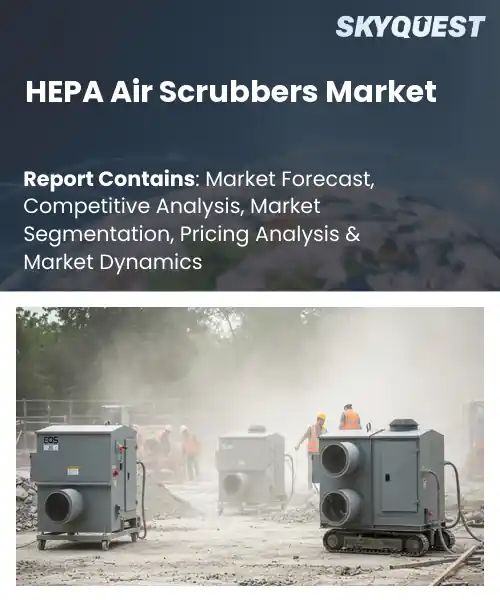
HEPA Air Scrubbers Market
Report ID: SQMIG20D2895
Report ID: SQMIG20D2895
[email protected]
USA +1 351-333-4748
Report ID:
SQMIG20D2895 |
Region:
Global |
Published Date: August, 2026
Pages:
157
|Tables:
172
|Figures:
79


Global Hepa Air Scrubbers Market size was valued at USD 1.90 Billion in 2024 and is poised to grow from USD 2.06 Billion in 2025 to USD 3.93 Billion by 2033, growing at a CAGR of 8.4% during the forecast period (2026-2033).
The HEPA air scrubbers market share comprises devices that combine high‑efficiency particulate air filtration with active air‑scrubbing technologies to remove contaminants from indoor environments. Its importance stems from rising awareness of airborne disease transmission, stricter occupational health regulations, and the need for clean air in critical facilities such as hospitals, data centers, and manufacturing plants. Historically, the market emerged in the early 2000s when hospitals adopted HEPA filters to combat nosocomial infections; by the mid‑2010s, commercial real‑estate developers integrated scrubbers to meet green‑building certifications. This evolution reflects a shift from reactive filtration toward proactive air‑quality management, driven primarily by public health concerns globally and sustainably.
The next major catalyst for HEPA air scrubbers market growth lies in the convergence of regulatory pressure and technological innovation, which together expand market opportunities across industrial, residential, and transportation sectors. As governments tighten indoor‑air‑quality standards, manufacturers respond by embedding IoT‑enabled sensors that provide real‑time performance data, enabling predictive maintenance and reducing energy consumption. For example, a logistics hub in Europe installed networked HEPA scrubbers that cut particulate levels by 85 % while lowering operating costs through automated fan speed adjustments. This cause‑and‑effect loop stricter rules prompting smarter devices creates a feedback cycle that accelerates adoption, attracts private‑equity investment, and fuels further R&D in nanofiber filter media for future applications.
How is AI-Driven Automation Influencing Efficiency in the HEPA Air Scrubbers Market?
AI‑driven automation is reshaping the HEPA air scrubbers market trends by streamlining filter monitoring, predictive maintenance, and energy management. Sensors now feed real‑time data into machine‑learning models that anticipate clogging, adjust fan speeds, and trigger cleaning cycles only when needed. This reduces downtime, extends filter life, and lowers operating costs while maintaining strict air‑quality standards. Manufacturers are integrating these capabilities into both standalone units and larger HVAC systems, making installations smarter and more responsive to fluctuating indoor environments. The result is a more reliable, cost‑effective solution that appeals to industries ranging from healthcare to clean‑room manufacturing, where consistent particulate control is critical.
Recent market activity shows that a leading air‑filtration company introduced an AI‑enabled HEPA scrubber model in early 2024, highlighting how intelligent control can boost overall system efficiency and support broader adoption of advanced filtration technologies.
Market snapshot - (2026-2033)
Global Market Size
USD 1.9 Billion
Largest Segment
Portable HEPA Air Scrubbers
Fastest Growth
Industrial HEPA Air Scrubbers
Growth Rate
8.4% CAGR
To get more insights on this market click here to Request a Free Sample Report
Global HEPA air scrubbers market is segmented by product type, mounting type, airflow capacity, application, end user, distribution channel and region. Based on product type, the market is segmented into portable HEPA air scrubbers, industrial HEPA air scrubbers and commercial HEPA air scrubbers. Based on mounting type, the market is segmented into portable and fixed. Based on airflow capacity, the market is segmented into up to 500 CFM, 501–1000 CFM and above 1000 CFM. Based on application, the market is segmented into construction, healthcare, industrial facilities and others. Based on end user, the market is segmented into contractors, hospitals, manufacturing facilities and others. Based on distribution channel, the market is segmented into direct sales, distributors and online retail. Based on region, the market is segmented into North America, Europe, Asia Pacific, Latin America and Middle East & Africa.
Portable HEPA air scrubbers segment dominates because its mobility aligns with the on‑site contamination control needs of construction and renovation projects, allowing rapid deployment in confined spaces. Users value the ease of transport, plug‑and‑play setup, and ability to move units as work progresses. This convenience drives higher purchase frequency and repeat orders, reinforcing its leadership in the overall market and contributes to lower downtime for crews, enhancing productivity and safety compliance.
However, industrial HEPA air scrubbers segment is witnessing the strongest growth momentum because manufacturers are integrating advanced filtration media and IoT monitoring, meeting stricter emission standards in heavy‑duty facilities. This innovation expands deployment across diverse processes, unlocking new revenue streams and positioning the segment as a catalyst for broader market expansion.
Fixed mounting segment leads because permanent installations provide consistent airflow performance and integrate seamlessly with building HVAC infrastructure, making them the preferred choice for long‑term air quality management in hospitals and large industrial plants. Engineers appreciate the reliability of fixed duct connections, reduced vibration, and optimized energy consumption, which together foster higher specification adherence and encourage OEMs to prioritize this configuration in their product portfolios and support extended service contracts.
On the other hand, portable mounting segment is emerging as the key high‑growth area because flexible units are being adopted for temporary clean‑room setups, emergency response, and modular manufacturing lines. Their adaptability addresses fluctuating demand, spurring investment in scalable designs that accelerate market diversification and open new application niches.
To get detailed segments analysis, Request a Free Sample Report
North America leads the market through a combination of advanced manufacturing capabilities, strong regulatory frameworks, and a mature customer base that prioritizes indoor air quality. The region benefits from a well‑established supply chain that supports rapid innovation and high‑performance product development. Robust demand from healthcare facilities, commercial buildings, and industrial sites drives continuous adoption, while extensive research institutions foster cutting‑edge filtration technologies. Additionally, a culture of environmental responsibility and stringent occupational health standards reinforce the preference for high‑efficiency particulate air solutions, cementing the region’s leadership position.
HEPA air scrubbers market outlook in the United States is propelled by a deep focus on health‑centric environments, where hospitals and laboratories demand reliable contamination control. Strong investment in cleanroom infrastructure and a proactive approach to indoor air standards encourage widespread deployment across commercial and residential sectors. The presence of leading manufacturers and a collaborative ecosystem of research universities further accelerates product refinement and market penetration.
HEPA air scrubbers market forecast in Canada reflects a commitment to sustainable building practices and stringent air quality regulations. Public awareness of respiratory health drives adoption in schools, offices, and public transport systems. The market benefits from a supportive policy environment that encourages energy‑efficient filtration solutions, while local manufacturers leverage expertise in cold‑climate performance to meet diverse application needs.
Europe’s expansion is fueled by rigorous environmental directives, a strong emphasis on occupational health, and a growing awareness of the impact of airborne pollutants on wellbeing. The region’s industrial base, particularly in precision manufacturing and pharmaceuticals, demands high‑grade filtration to meet quality standards. Collaborative research initiatives across borders foster innovation, while a network of certified suppliers ensures consistent product availability. Consumer demand for healthier indoor environments in residential and commercial spaces further amplifies market momentum, positioning Europe as a dynamic growth hub.
HEPA air scrubbers market regional outlook in Germany is anchored by a robust engineering tradition and a proactive stance on air quality legislation. The automotive and aerospace sectors require stringent particulate control, driving sophisticated system integration. Strong collaboration between research institutes and manufacturers accelerates technology transfer, while a culture of precision manufacturing sustains high demand for reliable filtration solutions across industrial and institutional settings.
HEPA air scrubbers market regional forecast in the United Kingdom experiences rapid growth due to heightened regulatory focus on indoor air standards and a surge in retrofit projects for older building stock. The healthcare and education sectors prioritize infection control, prompting widespread adoption of advanced filtration units. Innovation hubs and a vibrant start‑up ecosystem contribute to the development of next‑generation HEPA technologies, reinforcing the market’s fast‑moving trajectory.
HEPA air scrubbers market analysis in France is emerging as a key segment driven by increasing public health initiatives and a strong push for green building certifications. The hospitality and retail industries are integrating high‑efficiency filtration to enhance customer experience, while governmental incentives support the deployment of energy‑saving air cleaning systems. Collaborative efforts between academic research centers and equipment manufacturers nurture a pipeline of innovative solutions tailored to the French market.
Asia Pacific is advancing its role through strategic investments in clean technology, expanding industrial capacity, and rising consumer consciousness about air quality. Nations within the region are adopting stricter environmental guidelines, prompting manufacturers to integrate HEPA filtration into a broader array of applications, from electronics assembly to public transportation. Growing urbanization and the need for resilient infrastructure drive demand for reliable air purification, while regional research collaborations accelerate the development of cost‑effective, high‑performance filters. This confluence of policy support, market demand, and technological progress is elevating the region’s influence in the global landscape.
HEPA air scrubbers market penetration in Japan benefits from a legacy of precision engineering and a strong emphasis on public health safety. The electronics and semiconductor industries require ultra‑clean environments, fostering demand for sophisticated filtration solutions. Government initiatives promoting energy efficiency and indoor air quality standards encourage adoption across commercial and residential sectors, while partnerships between universities and manufacturers drive continuous innovation.
HEPA air scrubbers industry in South Korea is propelled by rapid urban development and a proactive approach to environmental health. The automotive and biotech sectors rely on stringent particulate control, creating a steady demand for advanced filtration systems. National policies supporting smart building technologies and a growing awareness of respiratory health among consumers further stimulate market expansion, positioning South Korea as a dynamic contributor to the regional ecosystem.
To know more about the market opportunities by region and country, click here to
Buy The Complete Report
Rising Awareness of Indoor Air Quality
Stringent Emissions Regulations Across Regions
High Initial Capital Expenditure
Complex Installation and Maintenance Requirements
Request Free Customization of this report to help us to meet your business objectives.
The global HEPA air scrubbers market is competitive and fragmented, comprising specialized air-scrubber and restoration-equipment manufacturers, industrial filtration companies, and diversified air-quality technology providers. Major participants include Abatement Technologies, Novatek Corporation, Omnitec Design, Dri-Eaz Products, XPOWER Manufacture, BlueDri, Pullman Ermator, Phoenix Restoration Equipment, Legend Brands, AlorAir Solutions, Aerus, Camfil, AAF International, IQAir, Nilfisk, Kärcher, FilterQueen, B-Air, AiroClean420, and Trotec. Competition centers on HEPA filtration efficiency, airflow capacity, pressure performance, portability, noise, energy consumption, filter-life management, contamination control, and suitability for construction, restoration, healthcare, industrial, and cleanroom environments. Specialized manufacturers such as Abatement Technologies and Novatek compete through high-CFM portable units designed for remediation and containment, while Camfil and AAF leverage broader filtration expertise and engineered HEPA solutions for healthcare, pharmaceutical, cleanroom, and industrial applications. Abatement's PAS2400, for example, provides up to 2,100 CFM with a tested 99.97% efficient HEPA filter, illustrating the importance of airflow and filtration performance in professional applications. The market is also shifting toward energy-efficient filtration, digital monitoring, lower-resistance media, and increasingly customized air-cleaning systems as healthcare, cleanroom, construction, and industrial customers place greater emphasis on indoor-air quality and operating costs.
Top Player’s Company Profile
Recent Developments in the HEPA Air Scrubbers Market
SkyQuest’s ABIRAW (Advanced Business Intelligence, Research & Analysis Wing) is our Business Information Services team that Collects, Collates, Correlates, and Analyses the Data collected by means of Primary Exploratory Research backed by robust Secondary Desk research. As per SkyQuest analysis the global HEPA air scrubbers market is propelled primarily by rising awareness of indoor air quality, which is pushing hospitals, construction sites and factories to adopt high‑efficiency filtration, while the second driver of increasingly stringent emissions regulations across major economies further accelerates purchases to meet legal standards. The market is led by North America, where advanced manufacturing, strong regulatory frameworks and a mature customer base sustain demand, and the portable HEPA air scrubber segment dominates because its mobility matches the fast‑moving needs of construction and temporary clean‑room projects. However, high initial capital expenditure remains a restraint, limiting adoption among cost‑sensitive small and medium enterprises.
| Report Metric | Details |
|---|---|
| Market size value in 2024 | USD 1.9 Billion |
| Market size value in 2033 | USD 3.93 Billion |
| Growth Rate | 8.4% |
| Base year | 2024 |
| Forecast period | (2026-2033) |
| Forecast Unit (Value) | USD Billion |
| Segments covered |
|
| Regions covered | North America (US, Canada), Europe (Germany, France, United Kingdom, Italy, Spain, Rest of Europe), Asia Pacific (China, India, Japan, Rest of Asia-Pacific), Latin America (Brazil, Rest of Latin America), Middle East & Africa (South Africa, GCC Countries, Rest of MEA) |
| Companies covered |
|
| Customization scope | Free report customization with purchase. Customization includes:-
|
To get a free trial access to our platform which is a one stop solution for all your data requirements for quicker decision making. This platform allows you to compare markets, competitors who are prominent in the market, and mega trends that are influencing the dynamics in the market. Also, get access to detailed SkyQuest exclusive matrix.
Table Of Content
Executive Summary
Market overview
Parent Market Analysis
Market overview
Market size
KEY MARKET INSIGHTS
COVID IMPACT
MARKET DYNAMICS & OUTLOOK
Market Size by Region
KEY COMPANY PROFILES
Methodology
For the HEPA Air Scrubbers Market, our research methodology involved a mixture of primary and secondary data sources. Key steps involved in the research process are listed below:
1. Information Procurement: This stage involved the procurement of Market data or related information via primary and secondary sources. The various secondary sources used included various company websites, annual reports, trade databases, and paid databases such as Hoover's, Bloomberg Business, Factiva, and Avention. Our team did 45 primary interactions Globally which included several stakeholders such as manufacturers, customers, key opinion leaders, etc. Overall, information procurement was one of the most extensive stages in our research process.
2. Information Analysis: This step involved triangulation of data through bottom-up and top-down approaches to estimate and validate the total size and future estimate of the HEPA Air Scrubbers Market.
3. Report Formulation: The final step entailed the placement of data points in appropriate Market spaces in an attempt to deduce viable conclusions.
4. Validation & Publishing: Validation is the most important step in the process. Validation & re-validation via an intricately designed process helped us finalize data points to be used for final calculations. The final Market estimates and forecasts were then aligned and sent to our panel of industry experts for validation of data. Once the validation was done the report was sent to our Quality Assurance team to ensure adherence to style guides, consistency & design.
Analyst Support
Customization Options
With the given market data, our dedicated team of analysts can offer you the following customization options are available for the HEPA Air Scrubbers Market:
Product Analysis: Product matrix, which offers a detailed comparison of the product portfolio of companies.
Regional Analysis: Further analysis of the HEPA Air Scrubbers Market for additional countries.
Competitive Analysis: Detailed analysis and profiling of additional Market players & comparative analysis of competitive products.
Go to Market Strategy: Find the high-growth channels to invest your marketing efforts and increase your customer base.
Innovation Mapping: Identify racial solutions and innovation, connected to deep ecosystems of innovators, start-ups, academics, and strategic partners.
Category Intelligence: Customized intelligence that is relevant to their supply Markets will enable them to make smarter sourcing decisions and improve their category management.
Public Company Transcript Analysis: To improve the investment performance by generating new alpha and making better-informed decisions.
Social Media Listening: To analyze the conversations and trends happening not just around your brand, but around your industry as a whole, and use those insights to make better Marketing decisions.
REQUEST FOR SAMPLE
 REQUEST FREE CUSTOMIZATION
Global Hepa Air Scrubbers Market size was valued at USD 1.9 Billion in 2024 and is poised to grow from USD 2.06 Billion in 2025 to USD 3.93 Billion by 2033, growing at a CAGR of 8.4% during the forecast period (2026-2033).
The HEPA air scrubbers market is shaped by intense rivalry as major manufacturers accelerate innovation, pursue strategic acquisitions, and forge technology partnerships to secure differentiated product portfolios; for example, Honeywell’s acquisition of a niche filtration specialist, AAF International’s joint venture with a sensor‑technology firm, and 3M’s launch of nanofiber‑enhanced HEPA modules, all driving faster product cycles and heightened competitive pressure. 'Abatement Technologies', 'Novatek Corporation', 'Omnitec Design', 'Dri-Eaz Products, Inc.', 'XPOWER Manufacture Inc.', 'BlueDri', 'Pullman Ermator', 'Phoenix Restoration Equipment', 'Legend Brands', 'AlorAir Solutions', 'Aerus LLC', 'Camfil AB', 'AAF International', 'IQAir AG', 'Nilfisk Group', 'Kärcher', 'FilterQueen', 'B-Air', 'AiroClean420', 'Trotec GmbH'
Increased public and corporate awareness of indoor air quality concerns is prompting organizations to adopt advanced filtration solutions, and healthcare facilities are prioritizing patient safety through cleaner environments. This heightened focus drives demand for HEPA air scrubbers, as stakeholders recognize their capability to remove particulates and pathogens effectively. Consequently, procurement cycles are accelerating, and budget allocations for environmental health technologies are expanding, reinforcing market growth across residential, commercial, and industrial sectors. Additionally, regulatory incentives encourage air quality management, further motivating enterprises to integrate these systems into building designs and retrofits.
Regenerative Energy Integration: Manufacturers are increasingly embedding energy sources, such as solar panels and wind turbines, into the power supply of HEPA air scrubber installations. This shift reduces reliance on grid electricity, lowers operational costs, and aligns with corporate sustainability commitments. Integrated energy storage systems further ensure uninterrupted performance during peak demand or outages. As regulatory pressure intensifies on carbon footprints, the ability to demonstrate green operation becomes a differentiator, prompting vendors to offer turnkey solutions that combine filtration efficiency with power generation.
Why does North America Dominate the Global HEPA Air Scrubbers Market? |@12


Want to customize this report? This report can be personalized according to your needs. Our analysts and industry experts will work directly with you to understand your requirements and provide you with customized data in a short amount of time. We offer $1000 worth of FREE customization at the time of purchase.
Feedback From Our Clients


 USA (+1) 351-333-4748

