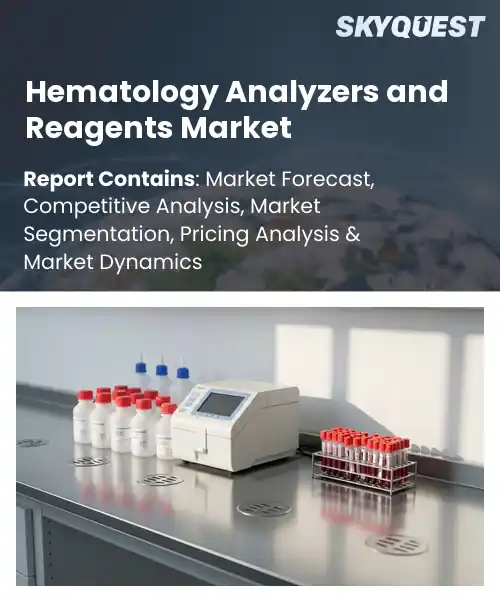
Hematology Analyzers and Reagents Market
Report ID: SQMIG35J2570
Report ID: SQMIG35J2570
[email protected]
USA +1 351-333-4748
Report ID:
SQMIG35J2570 |
Region:
Global |
Published Date: July, 2026
Pages:
157
|Tables:
152
|Figures:
78


Global Hematology Analyzers And Reagents Market size was valued at USD 7.9 Billion in 2024 and is poised to grow from USD 8.42 Billion in 2025 to USD 13.96 Billion by 2033, growing at a CAGR of 6.53% during the forecast period (2026-2033).
The global hematology analyzers and reagents market comprises equipment that automates the counting of blood cells and chemicals that support these measurements, a segment that is of importance to diagnostic laboratories and point-of-care environments. It’s important because we need accurate complete blood counts to guide treatment for everything from anemia to leukemia. The market has expanded over the last 20 years with hospitals being modernized, automation replacing manual microscopy and emerging economies investing in clinical infrastructure. High throughput analyzers were introduced in China’s 2020 health-care reform, for instance, and the US experienced a boom in reagent demand due to the introduction of outpatient clinic testing.
The integration of artificial intelligence and connectivity into hematology platforms is a rising key factor propelling the market forward by improving diagnostic precision and operational efficiency. When machines learn to flag abnormal morphologies, labs reduce retest cycles, which lowers costs and shortens patient turnaround times. Consequently, providers in resource-limited areas adopt compact, AI-enabled analyzers that require minimal specialist oversight, such as mobile units deployed in rural Indian clinics to screen for malaria-related anemia. This expansion is accompanied by a concurrent surge in demand for specialized reagents for algorithmic calibration, opening lucrative avenues for suppliers able to co-develop novel software-reagent packages.
How is AI Improving Accuracy In The Hematology Analyzers And Reagents Market?
Artificial intelligence improves hematology analyzers by incorporating deep learning models able to interpret cell images more accurately than traditional rule-based systems. These models are trained on huge reference libraries and can detect subtle morphological differences and reduce false flags. AI makes the real-time analysis of reagent reactions better by dynamically tuning calibration parameters, leading to more consistent results across different sample types. Shorter turnaround times are advantageous to laboratories because there is less need for manual confirmation and clinicians get clearer reports that help them to manage patients better. To summarize, the result is a more robust workflow that meets the increasing demand for high-quality diagnostic data.
In March 2024, Sysmex announced the integration of artificial intelligence algorithms in its latest hematology analyzer. This step has sharpened diagnostic accuracy and driven efficiency, reinforcing market growth.
Market snapshot - (2026-2033)
Global Market Size
USD 7.9 Billion
Largest Segment
Hematology Analyzers
Fastest Growth
Services
Growth Rate
6.53% CAGR
To get more insights on this market click here to Request a Free Sample Report
Global hematology analyzers and reagents market is segmented by product type, analyzer capability, application, distribution channel, end user and region. Based on product type, the market is segmented into Hematology Analyzers, Reagents and Consumables and Services. Based on analyzer capability, the market is segmented into 3-Part Differential Analyzers, 5-Part Differential Analyzers, 6-Part and Higher Differential Analyzers, Flow Cytometry Systems and Coagulation Analyzers. Based on application, the market is segmented into Anemia Screening, Blood Cancer Diagnosis, Hemorrhagic Disorders, Infection Monitoring, Immune System Diseases and Others. Based on distribution channel, the market is segmented into Direct Sales, Reagent Rental Contracts and Distributor Networks. Based on end user, the market is segmented into Hospitals, Specialized Diagnostic Centers, Commercial Laboratories, Blood Banks, Research Institutes and Others. Based on region, the market is segmented into North America, Europe, Asia Pacific, Latin America and Middle East & Africa.
The 5-part differential analyzers segment is the dominant segment owing to the balanced combination of detailed leukocyte classification and operational simplicity to meet the core diagnostic requirements of most clinical laboratories. They are widely used due to their ability to provide trustworthy six part like information at lower acquisition and maintenance costs. The additional diagnostic granularity for monitoring anemia and infection is appreciated by clinicians and has driven manufacturers to focus innovation and support on this capability across various hospital settings.
However, the flow cytometry systems segment is witnessing the highest growth momentum, as its multiparametric analysis enables precise immune profiling and emerging blood cancer diagnostics. The field is opening up to research institutes and specialty labs as laser technology and software integration advances make complexity simpler. This growth leads to more market acceptance and new sources of revenue for manufacturers.
Reagents and consumables segment is the largest segment as they are necessary for every hematology test, ensuring continuous workflow on all analyzer platforms. This regular buying pattern means stable demand and so manufacturers spend a lot of money to improve formulations to make them more stable and less wasteful. Regulatory standards demand strict quality controls, however, the ability to customize panels for particular clinical needs using customized kits underlines their critical position in diagnostic workflows.
Meanwhile, the services segment is emerging as a key high growth area with providers bundling instrument maintenance, software updates and data analysis to create value added offerings. The change towards outcome based contracts and the need for workflow optimization drives demand for full service models. This creates long term relationships and opens recurring sources of income that fuel market growth.
To get detailed segments analysis, Request a Free Sample Report
North America is leading because its healthcare systems have a mix of large laboratory networks and the willingness to integrate sophisticated diagnostic platforms. A strong presence of major equipment makers and reagent suppliers spurs constant innovation. Strong reimbursement structures prompt hospitals to replace legacy instruments with automated analyzers. Academic and clinical research institutions are early adopters of leading-edge assays, creating a feedback loop that speeds up product refinement. Also, the focus on precision medicine forces laboratories to use high throughput platforms with higher turnaround times, thereby increasing the need for analyzers and consumable reagents. This combination of innovation, funding and clinical need cements North America’s leading market position.
The United States hematology analyzers and reagents market is supported by the developed network of large academic medical centers and commercial laboratories dedicated to automation and data integration. Top manufacturers run regional R&D centers that tailor solutions to local clinical workflows, and extensive training programs ensure proficient use of sophisticated systems. Partnerships between insurers and providers also support the adoption of high-efficiency platforms and keep demand for both instruments and consumables robust.
The Canadian Hematology Analyzers and Reagents Market is driven by a public healthcare system that emphasizes cost-effective diagnostics and standardization across the country. Provincial lab networks invest in scalable automation to serve dispersed populations, driving the demand for reliable reagents and service agreements. Partnerships with leading global equipment suppliers bring the newest technologies to Canadian facilities, and a focus on quality assurance and patient safety drives continuous upgrading of analytical platforms across the country.
The rapid expansion of the Hematology Analyzers and Reagents Market in Europe is propelled by a convergence of regulatory harmonization, strong public‑private research collaborations, and a heightened focus on personalized diagnostics. Health systems across the continent prioritize laboratory efficiency and data interoperability, encouraging adoption of high‑throughput analyzers that support complex clinical pathways. Investment in innovative reagent formulations aligns with growing clinical demand for precise blood‑cell analyses, while reimbursement frameworks increasingly reward value‑based testing. Moreover, the presence of leading academic institutions drives continuous validation of emerging assays, reinforcing market confidence. This supportive ecosystem, combined with cross‑border trade facilitation, accelerates both product introduction and market penetration throughout European laboratories.
Hematology Analyzers and Reagents Market in Germany is anchored by a robust network of university hospitals and diagnostic centers that champion technological advancement. Domestic manufacturers benefit from close collaboration with clinical researchers, enabling rapid customization of instruments to meet complex testing protocols. Strong quality standards and a supportive regulatory climate foster confidence in new reagent chemistries, while healthcare providers pursue integrated automation to streamline workflow and enhance diagnostic accuracy nationwide.
Hematology Analyzers and Reagents Market in United Kingdom grows due to an NHS laboratory network that adopts transformation. Centralized procurement encourages use of high‑performance analyzers across acute and community settings, giving scale advantages for reagent suppliers. Collaborative research between universities and industry accelerates launch of novel assays, while policy incentives back point‑of‑care technologies that complement central testing. This ecosystem makes United Kingdom a leading European hub for hematology diagnostic progress.
Hematology Analyzers and Reagents Market in France is emerging as laboratories modernize to meet clinical demands. Health initiatives promote adoption of automated platforms that improve turnaround time and data consistency, stimulating interest in reagent suites. Partnerships with European manufacturers facilitate technology transfer and support, while research centers validate assays for applications. These factors nurture a growing ecosystem that positions France as an up‑and‑coming market within the European hematology diagnostics landscape.
The Asia Pacific region is steadily strengthening its position in the Hematology Analyzers and Reagents Market through a combination of rising disease prevalence, expanding laboratory infrastructure, and increasing governmental emphasis on modern diagnostic capabilities. Nations such as Japan and South Korea invest heavily in research and development, fostering collaborations between academia and device manufacturers that accelerate the introduction of sophisticated analyzer platforms. Health policies that prioritize early detection and efficient patient management drive demand for high‑throughput systems and specialized reagent formulations. Additionally, rising private‑sector participation and strategic partnerships enhance supply‑chain resilience, enabling rapid adoption of next‑generation technologies. Together, these dynamics elevate Asia Pacific’s role as a vibrant hub for innovation and market growth in hematology diagnostics.
Hematology Analyzers and Reagents Market in Japan benefits from a healthcare system that emphasizes precision diagnostics and laboratory networks. Collaboration between instrument manufacturers and research institutions accelerates development of high‑sensitivity analyzers tailored to clinical needs. Government initiatives support adoption of automated platforms to improve efficiency and reduce turnaround times, while a mature reagent market ensures supply of consumables. This ecosystem sustains demand for hematology solutions across hospitals and diagnostic centers.
Hematology Analyzers and Reagents Market in South Korea is bolstered by governmental funding for health transformation and a biotech sector. Domestic manufacturers collaborate with university hospitals to develop compact, high‑throughput analyzers suited for large institutions and emerging regional labs. Emphasis on disease screening drives demand for specialized reagent kits, while strategies expand the reach of Korean‑produced consumables. These dynamics create a supportive environment for growth and innovation in hematology diagnostics.
To know more about the market opportunities by region and country, click here to
Buy The Complete Report
Adopting Automated Testing Solutions
Growing Demand for Rapid Diagnostics
High Capital Investment Requirements
Regulatory Compliance Complexity
Request Free Customization of this report to help us to meet your business objectives.
The competitive landscape is shaped by leading firms such as Sysmex Corporation, Danaher Corporation and Nihon Kohden Corporation, each leveraging technology innovation to sustain market leadership. Sysmex highlighted new hematology analyzer developments in its 2023 investor briefing, while Danaher continues to integrate advanced diagnostic platforms across its portfolio. Nihon Kohden focuses on expanding reagent offerings in response to rising demand, driving intensified competition and prompting strategic partnerships and product upgrades across the sector.
SkyQuest’s ABIRAW (Advanced Business Intelligence, Research & Analysis Wing) is our Business Information Services team that Collects, Collates, Correlates, and Analyses the Data collected by means of Primary Exploratory Research backed by robust Secondary Desk research.
As per SkyQuest analysis the market is being propelled primarily by the adoption of automated hematology analyzers that let labs handle larger volumes with faster turnaround while a growing need for rapid diagnostics serves as a second catalyst pushing hospitals toward high‑throughput platforms. North America remains the dominant region due to extensive laboratory networks, strong reimbursement and leading OEM presence. The 5‑part differential analyzer segment leads the field, offering a balance of detailed leukocyte classification and cost efficiency. However, the high capital outlay required for advanced instruments continues to restrain uptake in smaller facilities and complex regulatory pathways add further hurdles for new entrants.
| Report Metric | Details |
|---|---|
| Market size value in 2024 | USD 7.9 Billion |
| Market size value in 2033 | USD 13.96 Billion |
| Growth Rate | 6.53% |
| Base year | 2024 |
| Forecast period | (2026-2033) |
| Forecast Unit (Value) | USD Billion |
| Segments covered |
|
| Regions covered | North America (US, Canada), Europe (Germany, France, United Kingdom, Italy, Spain, Rest of Europe), Asia Pacific (China, India, Japan, Rest of Asia-Pacific), Latin America (Brazil, Rest of Latin America), Middle East & Africa (South Africa, GCC Countries, Rest of MEA) |
| Companies covered |
|
| Customization scope | Free report customization with purchase. Customization includes:-
|
To get a free trial access to our platform which is a one stop solution for all your data requirements for quicker decision making. This platform allows you to compare markets, competitors who are prominent in the market, and mega trends that are influencing the dynamics in the market. Also, get access to detailed SkyQuest exclusive matrix.
Table Of Content
Executive Summary
Market overview
Parent Market Analysis
Market overview
Market size
KEY MARKET INSIGHTS
COVID IMPACT
MARKET DYNAMICS & OUTLOOK
Market Size by Region
KEY COMPANY PROFILES
Methodology
For the Hematology Analyzers and Reagents Market, our research methodology involved a mixture of primary and secondary data sources. Key steps involved in the research process are listed below:
1. Information Procurement: This stage involved the procurement of Market data or related information via primary and secondary sources. The various secondary sources used included various company websites, annual reports, trade databases, and paid databases such as Hoover's, Bloomberg Business, Factiva, and Avention. Our team did 45 primary interactions Globally which included several stakeholders such as manufacturers, customers, key opinion leaders, etc. Overall, information procurement was one of the most extensive stages in our research process.
2. Information Analysis: This step involved triangulation of data through bottom-up and top-down approaches to estimate and validate the total size and future estimate of the Hematology Analyzers and Reagents Market.
3. Report Formulation: The final step entailed the placement of data points in appropriate Market spaces in an attempt to deduce viable conclusions.
4. Validation & Publishing: Validation is the most important step in the process. Validation & re-validation via an intricately designed process helped us finalize data points to be used for final calculations. The final Market estimates and forecasts were then aligned and sent to our panel of industry experts for validation of data. Once the validation was done the report was sent to our Quality Assurance team to ensure adherence to style guides, consistency & design.
Analyst Support
Customization Options
With the given market data, our dedicated team of analysts can offer you the following customization options are available for the Hematology Analyzers and Reagents Market:
Product Analysis: Product matrix, which offers a detailed comparison of the product portfolio of companies.
Regional Analysis: Further analysis of the Hematology Analyzers and Reagents Market for additional countries.
Competitive Analysis: Detailed analysis and profiling of additional Market players & comparative analysis of competitive products.
Go to Market Strategy: Find the high-growth channels to invest your marketing efforts and increase your customer base.
Innovation Mapping: Identify racial solutions and innovation, connected to deep ecosystems of innovators, start-ups, academics, and strategic partners.
Category Intelligence: Customized intelligence that is relevant to their supply Markets will enable them to make smarter sourcing decisions and improve their category management.
Public Company Transcript Analysis: To improve the investment performance by generating new alpha and making better-informed decisions.
Social Media Listening: To analyze the conversations and trends happening not just around your brand, but around your industry as a whole, and use those insights to make better Marketing decisions.
REQUEST FOR SAMPLE
 REQUEST FREE CUSTOMIZATION
Global Hematology Analyzers And Reagents Market size was valued at USD 7.9 Billion in 2024 and is poised to grow from USD 8.42 Billion in 2025 to USD 13.96 Billion by 2033, growing at a CAGR of 6.53% during the forecast period (2026-2033).
The competitive landscape is shaped by leading firms such as Sysmex Corporation, Danaher Corporation and Nihon Kohden Corporation, each leveraging technology innovation to sustain market leadership. Sysmex highlighted new hematology analyzer developments in its 2023 investor briefing, while Danaher continues to integrate advanced diagnostic platforms across its portfolio. Nihon Kohden focuses on expanding reagent offerings in response to rising demand, driving intensified competition and prompting strategic partnerships and product upgrades across the sector. 'Danaher Corporation', 'Sysmex Corporation', 'Abbott Laboratories', 'Siemens Healthineers AG', 'F. Hoffmann-La Roche Ltd', 'Horiba, Ltd.', 'Bio-Rad Laboratories, Inc.', 'Mindray Medical International Limited', 'Nihon Kohden Corporation', 'Boule Diagnostics AB', 'Diagon Kft.', 'Drew Scientific, Inc.', 'Dymind Biotechnology Co., Ltd.', 'Nihon Kohden', 'Agappe Diagnostics Ltd.', 'Linear Chemicals S.L.', 'Rayto Life and Analytical Sciences Co., Ltd.', 'Convergent Technologies GmbH & Co. KG', 'Orphee SA', 'Cronus Diagnostics'
Adoption of automated hematology analyzers enables laboratories to process larger sample volumes with reduced manual intervention, thereby shortening turnaround times and improving diagnostic confidence. This operational efficiency encourages healthcare providers to expand testing capabilities, fostering broader market acceptance. As clinicians prioritize rapid, accurate results for patient management, the perceived clinical value of such technologies amplifies demand across hospital and reference lab segments. Consequently, manufacturers experience accelerated product development cycles, reinforcing growth momentum throughout the industry and driving sustained investment in related service infrastructures.
Personalised Diagnostics Growth: Laboratories and hospitals are increasingly adopting hematology platforms that support molecular profiling and customizable panels, enabling clinicians to tailor testing to individual patient phenotypes. This shift is driven by rising demand for targeted therapies and a broader understanding of disease heterogeneity. Manufacturers are responding by offering modular software, flexible reagent kits, and data‑analytics tools that integrate with electronic health records, fostering a more precise, outcome‑focused diagnostic workflow across diverse care settings throughout the treatment continuum and follow‑up phases globally efficiently.
Why does North America Dominate the Global Hematology Analyzers and Reagents Market? |@12


Want to customize this report? This report can be personalized according to your needs. Our analysts and industry experts will work directly with you to understand your requirements and provide you with customized data in a short amount of time. We offer $1000 worth of FREE customization at the time of purchase.
Feedback From Our Clients


 USA (+1) 351-333-4748

