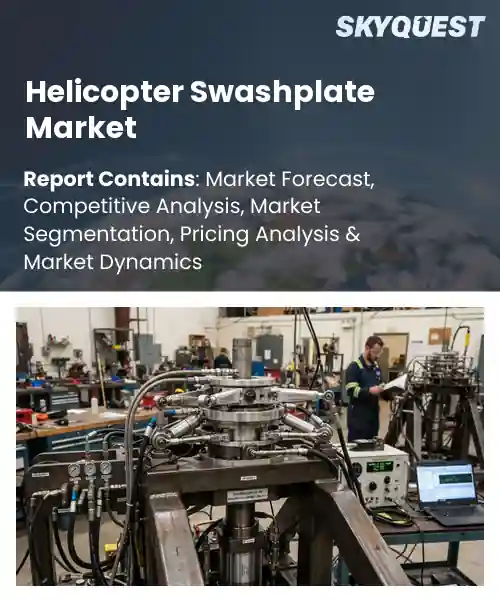
Helicopter Swashplate Market
Report ID: SQMIG20A2890
Report ID: SQMIG20A2890
[email protected]
USA +1 351-333-4748
Report ID:
SQMIG20A2890 |
Region:
Global |
Published Date: August, 2026
Pages:
157
|Tables:
143
|Figures:
78


Global Helicopter Swashplate Market size was valued at USD 1.76 Billion in 2024 and is poised to grow from USD 1.87 Billion in 2025 to USD 3.0 Billion by 2033, growing at a CAGR of 6.1% during the forecast period (2026-2033).
The global helicopter swashplate market supplies hubs that convert pilot input into blade pitch changes, a function essential for lift, maneuverability, and safety. Its importance lies in enabling cyclic and collective control, directly influencing aircraft performance and operating cost. The primary driver of expansion is rising demand for rotorcraft in civil and defense sectors, where operators seek higher payload capacity and reduced vibration. In the last two decades the market has moved from steel assemblies to lightweight composite and digitally monitored units, as seen in swashplates fitted to Airbus H145 and Sikorsky S‑92. This shift supports efficiency and reliability goals. Building on the shift toward lightweight, digitally monitored units, the key factor shaping the global helicopter swashplate market is the integration of health‑monitoring sensors and predictive‑maintenance algorithms. Embedding vibration and strain transducers within the hub enables condition assessment, which reduces inspections and extends component life. This capability has prompted operators such as the U.S. Army to retrofit UH‑60 Black Hawks with smart swashplates, while commercial fleets adopt maintenance contracts to lower operating costs. Consequently, demand for sensor‑rich swashplates fuels investment in R&D, expands aftermarket services, and opens revenue streams for OEMs seeking to meet global safety regulations and performance expectations.
How is AI-driven automation reshaping design and manufacturing efficiencies in the helicopter swashplate market?
AI‑driven automation is redefining how swashplates are designed and built for helicopters. By feeding large datasets of aerodynamic performance, material behavior and manufacturing tolerances into generative design tools, engineers can explore countless geometry variants in minutes rather than weeks. The resulting designs often feature lighter structures, reduced vibration and easier assembly. In production, machine‑learning models monitor tool wear, predict optimal cutting parameters and adjust robotic cell actions in real time, cutting down scrap and cycle time. This seamless loop of data‑rich design and smart manufacturing shortens development cycles and allows manufacturers to respond faster to new aircraft platforms while maintaining the high reliability required for rotorcraft components.Safran announced an AI‑optimized swashplate machining line in July 2023, demonstrating how predictive tooling and autonomous quality checks accelerate output and improve consistency, directly boosting efficiency in the helicopter swashplate market.
Market snapshot - (2026-2033)
Global Market Size
USD 1.76 Billion
Largest Segment
Complete Swashplate Assemblies
Fastest Growth
Rotating Swashplates
Growth Rate
6.1% CAGR
To get more insights on this market click here to Request a Free Sample Report
Global helicopter swashplate market is segmented by swashplate type, helicopter type, sales channel, material, end user and region. Based on swashplate type, the market is segmented into Stationary Swashplates, Rotating Swashplates and Complete Swashplate Assemblies. Based on helicopter type, the market is segmented into Civil Helicopters, Military Helicopters and Utility Helicopters. Based on sales channel, the market is segmented into OEM and Aftermarket. Based on material, the market is segmented into Aluminum Alloys, Titanium Alloys and Steel. Based on end user, the market is segmented into Aircraft Manufacturers, MRO Providers and Defense Organizations. Based on region, the market is segmented into North America, Europe, Asia Pacific, Latin America and Middle East & Africa.
Stationary Swashplates segment dominates because they provide a proven low‑maintenance solution that aligns with legacy helicopter designs and meets stringent certification standards. Their simplicity reduces failure points, enabling operators to prioritize safety and cost efficiency. This reliability drives OEM preferences and MRO confidence, reinforcing market adoption and sustaining a strong demand cycle for these components. The long‑standing supply chain and proven track record further cement its position as the go‑to choice for most new builds.
However, rotating swashplates segment is the fastest growing because they enable advanced flight control capabilities that support modern composite rotor systems. Emerging platforms demand higher precision and reduced vibration, prompting designers to adopt rotating configurations. Innovation in bearing technology and lighter materials fuels interest, creating retrofit opportunities and expanding aftermarket demand.
OEM segment dominates because it integrates swashplate procurement directly into aircraft assembly lines, ensuring tight engineering coordination and compliance with certification requirements. This close partnership streamlines supply chain logistics and reduces lead times, giving manufacturers confidence in component fit and performance. The resulting economies of scale lower unit costs, encouraging OEMs to specify their preferred designs across multiple platforms and reinforcing the segment’s central market role.
Meanwhile, aftermarket segment is the fastest growing because operators seek to extend aircraft life through retrofits and performance upgrades that rely on swashplate replacements. Rising fleet age and mission profiles drive demand for solutions, prompting MRO providers to stock innovative designs. This growth fuels an ecosystem of suppliers and creates revenue streams beyond initial production.
To get detailed segments analysis, Request a Free Sample Report
North America benefits from a mature aerospace ecosystem that combines deep engineering expertise with robust defense spending and a strong civil aviation sector. The region hosts leading original equipment manufacturers and a dense network of specialized suppliers, fostering rapid innovation and high reliability standards. Close collaboration between military programs and commercial operators drives continuous refinement of swashplate technology, ensuring performance that meets rigorous operational requirements. Additionally, extensive training infrastructure and regulatory frameworks support widespread adoption, while the presence of major research institutions accelerates the development of advanced materials and manufacturing processes, reinforcing the region’s leadership position.
Helicopter Swashplate Market in the United States thrives on extensive defense contracts and a vibrant commercial rotorcraft segment. Advanced research facilities and a culture of technological entrepreneurship enable rapid prototyping and integration of next‑generation features. Strong supply chain capabilities ensure timely delivery of precision components, while close ties between manufacturers and operators facilitate feedback loops that drive performance enhancements and reliability improvements.
Helicopter Swashplate Market in Canada is shaped by a strategic emphasis on northern operations and a growing offshore energy sector. Expertise in cold‑weather performance and remote‑access logistics fuels demand for robust, low‑maintenance solutions. Collaborative initiatives between government agencies and industry players promote the adaptation of swashplate designs to diverse mission profiles, reinforcing the country’s reputation for dependable rotorcraft support in challenging environments.
Europe’s expansion is propelled by a confluence of stringent safety regulations, substantial investment in modernizing legacy fleets, and a surge in specialized civil applications such as emergency medical services and offshore transport. The continent’s strong engineering heritage encourages integration of cutting‑edge materials and digital monitoring technologies that enhance reliability and reduce lifecycle costs. Collaborative research programs across borders accelerate knowledge sharing, while a competitive landscape among manufacturers spurs continuous product improvement. Growing environmental awareness also stimulates the development of lighter, more efficient swashplate designs, reinforcing Europe’s position as an innovation hub for rotorcraft components.
Helicopter Swashplate Market in Germany benefits from a robust industrial base and a tradition of precision engineering. Leading aerospace firms partner with research institutes to refine high‑performance components, emphasizing durability and weight reduction. The country’s active defense sector and expanding civilian rotorcraft services create a steady demand for advanced swashplate solutions that meet exacting quality standards.
Helicopter Swashplate Market in the United Kingdom experiences rapid growth driven by ambitious defense modernization programs and an emerging focus on urban air mobility concepts. Strategic collaborations between manufacturers and universities foster the adoption of smart sensor integration and predictive maintenance techniques. The market’s momentum is further amplified by supportive policy frameworks encouraging innovation in rotorcraft technology.
Helicopter Swashplate Market in France is emerging as a dynamic niche, supported by increasing investment in offshore wind operations and specialized rescue missions. Emphasis on lightweight composite development and modular design enhances adaptability across varied mission sets. Close coordination between aerospace clusters and governmental agencies nurtures a fertile environment for product differentiation and market entry.
Asia Pacific is strengthening its role through a combination of expanding civil rotorcraft demand, heightened defense modernization efforts, and a surge in indigenous manufacturing capabilities. Nations across the region are investing heavily in research and development, focusing on hybrid designs and advanced control systems that elevate performance in diverse climatic conditions. The rise of low‑cost, high‑efficiency production hubs enables competitive pricing while maintaining stringent quality standards. Moreover, growing participation in international aerospace collaborations accelerates technology transfer, positioning the region as a burgeoning center for innovative swashplate solutions.
Helicopter Swashplate Market in Japan is characterized by a strong emphasis on reliability and precision, driven by extensive use in disaster response and maritime operations. Partnerships between leading manufacturers and academic institutions promote the integration of advanced materials and real‑time health monitoring, enhancing safety margins. Domestic demand for next‑generation civil helicopters further fuels the development of lightweight, high‑efficiency swashplate configurations.
Helicopter Swashplate Market in South Korea is advancing rapidly through focused government support and aggressive private sector investment. Emphasis on smart system integration and additive manufacturing techniques reduces component weight and improves adaptability. The growing export orientation of the nation’s aerospace industry ensures that swashplate innovations meet global certification standards, reinforcing its competitive stance in the regional market.
To know more about the market opportunities by region and country, click here to
Buy The Complete Report
Increasing Demand for Advanced Avionics
Growth of Commercial Rotorcraft Services
High Certification and Regulatory Costs
Limited Availability of Skilled Technicians
Request Free Customization of this report to help us to meet your business objectives.
The competitive landscape of the global helicopter swashplate market is shaped by major OEMs and component specialists leveraging strategic M&A, joint ventures, and advanced material innovations. Safran’s acquisition of a composite‑blade supplier, Airbus Helicopters’ partnership with a defense electronics firm to integrate health‑monitoring sensors, and Leonardo’s rollout of a lightweight carbon‑fiber swashplate illustrate how firms are racing to differentiate performance, reduce weight, and capture market share.
Top Player’s Company Profile
Recent Developments
SkyQuest’s ABIRAW (Advanced Business Intelligence, Research & Analysis Wing) is our Business Information Services team that Collects, Collates, Correlates, and Analyses the Data collected by means of Primary Exploratory Research backed by robust Secondary Desk research. As per SkyQuest analysis the global helicopter swashplate market is set to expand at a 6.1% CAGR through 2033 driven primarily by increasing demand for advanced avionics that require precise control mechanisms while the growth of commercial rotorcraft services such as offshore transport and medical evacuation adds a second source of momentum. High certification and regulatory costs pose a restraint by raising entry barriers and limiting rapid innovation. North America remains the dominating region thanks to its mature aerospace ecosystem and strong defense spending. Stationary swashplates dominate the segment landscape because their proven low‑maintenance design aligns with certification standards and OEM preferences.
| Report Metric | Details |
|---|---|
| Market size value in 2024 | USD 1.76 Billion |
| Market size value in 2033 | USD 3.0 Billion |
| Growth Rate | 6.1% |
| Base year | 2024 |
| Forecast period | (2026-2033) |
| Forecast Unit (Value) | USD Billion |
| Segments covered |
|
| Regions covered | North America (US, Canada), Europe (Germany, France, United Kingdom, Italy, Spain, Rest of Europe), Asia Pacific (China, India, Japan, Rest of Asia-Pacific), Latin America (Brazil, Rest of Latin America), Middle East & Africa (South Africa, GCC Countries, Rest of MEA) |
| Companies covered |
|
| Customization scope | Free report customization with purchase. Customization includes:-
|
To get a free trial access to our platform which is a one stop solution for all your data requirements for quicker decision making. This platform allows you to compare markets, competitors who are prominent in the market, and mega trends that are influencing the dynamics in the market. Also, get access to detailed SkyQuest exclusive matrix.
Table Of Content
Executive Summary
Market overview
Parent Market Analysis
Market overview
Market size
KEY MARKET INSIGHTS
COVID IMPACT
MARKET DYNAMICS & OUTLOOK
Market Size by Region
KEY COMPANY PROFILES
Methodology
For the Helicopter Swashplate Market, our research methodology involved a mixture of primary and secondary data sources. Key steps involved in the research process are listed below:
1. Information Procurement: This stage involved the procurement of Market data or related information via primary and secondary sources. The various secondary sources used included various company websites, annual reports, trade databases, and paid databases such as Hoover's, Bloomberg Business, Factiva, and Avention. Our team did 45 primary interactions Globally which included several stakeholders such as manufacturers, customers, key opinion leaders, etc. Overall, information procurement was one of the most extensive stages in our research process.
2. Information Analysis: This step involved triangulation of data through bottom-up and top-down approaches to estimate and validate the total size and future estimate of the Helicopter Swashplate Market.
3. Report Formulation: The final step entailed the placement of data points in appropriate Market spaces in an attempt to deduce viable conclusions.
4. Validation & Publishing: Validation is the most important step in the process. Validation & re-validation via an intricately designed process helped us finalize data points to be used for final calculations. The final Market estimates and forecasts were then aligned and sent to our panel of industry experts for validation of data. Once the validation was done the report was sent to our Quality Assurance team to ensure adherence to style guides, consistency & design.
Analyst Support
Customization Options
With the given market data, our dedicated team of analysts can offer you the following customization options are available for the Helicopter Swashplate Market:
Product Analysis: Product matrix, which offers a detailed comparison of the product portfolio of companies.
Regional Analysis: Further analysis of the Helicopter Swashplate Market for additional countries.
Competitive Analysis: Detailed analysis and profiling of additional Market players & comparative analysis of competitive products.
Go to Market Strategy: Find the high-growth channels to invest your marketing efforts and increase your customer base.
Innovation Mapping: Identify racial solutions and innovation, connected to deep ecosystems of innovators, start-ups, academics, and strategic partners.
Category Intelligence: Customized intelligence that is relevant to their supply Markets will enable them to make smarter sourcing decisions and improve their category management.
Public Company Transcript Analysis: To improve the investment performance by generating new alpha and making better-informed decisions.
Social Media Listening: To analyze the conversations and trends happening not just around your brand, but around your industry as a whole, and use those insights to make better Marketing decisions.
REQUEST FOR SAMPLE
 REQUEST FREE CUSTOMIZATION


Want to customize this report? This report can be personalized according to your needs. Our analysts and industry experts will work directly with you to understand your requirements and provide you with customized data in a short amount of time. We offer $1000 worth of FREE customization at the time of purchase.
Feedback From Our Clients


 USA (+1) 351-333-4748

