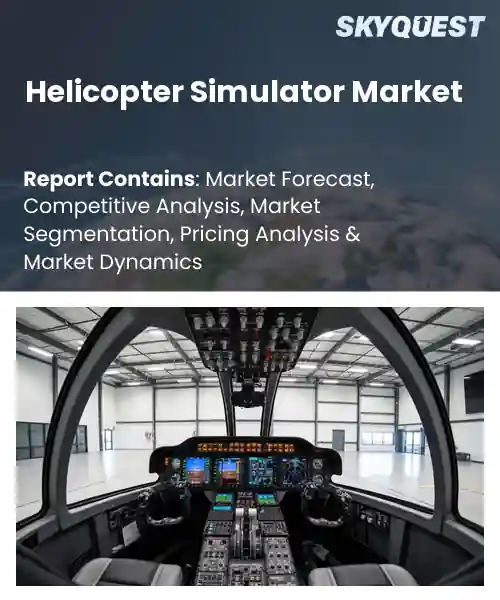
Helicopter Simulator Market
Report ID: SQMIG20A2679
Report ID: SQMIG20A2679
[email protected]
USA +1 351-333-4748
Report ID:
SQMIG20A2679 |
Region:
Global |
Published Date: June, 2026
Pages:
157
|Tables:
118
|Figures:
72


Global Helicopter Simulator Market size was valued at USD 1.52 Billion in 2024 and is poised to grow from USD 1.65 Billion in 2025 to USD 3.22 Billion by 2033, growing at a CAGR of 8.72% during the forecast period (2026-2033).
The helicopter simulator market is primarily driven by the need to reduce risk and increase pilot proficiency, which has revolutionized training for both military and commercial operators. The market includes fixed-base and full-motion devices, procedural trainers and immersive virtual reality systems that replicate rotorcraft dynamics, avionics and scenarios. Its importance is driven by regulatory requirements, costs of live flight hours and the need to rehearse high risk scenarios that can’t be flown safely. For more than 30 years the industry has evolved from basic cockpit mockups to software-defined simulators supplied by the likes of CAE and FlightSafety for offshore crew transfer, EMS work and combat training.
A major driver on this trajectory is the growing gap between mission complexity and limited flight training capacity, causing operators to substitute simulator hours for live flights. Simulators can replicate hazardous scenarios and avionics anomalies, allowing operators to achieve regulatory compliance, reduce maintenance and insurance costs and protect aircraft availability for revenue missions. As a result, fields like offshore transfers, emergency medical services and military special operations are increasingly using simulator scenarios to rehearse deck landings, emergency autorotations and avionics failures. Meanwhile, advances in VR software are lowering barriers to entry, opening up opportunities for regional and urban air mobility trainers.
How is AI enhancing realism and training effectiveness in the helicopter simulator market?
AI is being used to combine advanced flight physics, sensor emulation and adaptive scenario generation to improve realism and training effectiveness in helicopter simulation. Key features include AI tuned flight models that reproduce subtle handling, synthetic visual environments that replicate real weather and terrain and intelligent virtual traffic and emergency behaviours that respond to trainee inputs. Operators want safer, more cost effective recurrent training and scenario rich syllabi and the market is moving towards integrated AI. Vendors and VR specialists are adding AI performance analytics and data driven debriefing to make sessions more targeted and relevant.
Reiser Simulation and Varjo February 2026, the regulator for Germany prequalified their H one four five mixed reality simulator milestone that shows AI-enabled mixed reality and sensor emulation can achieve regulatory standards. The innovation aids training efficiency with realistic and repeatable scenarios, driving wider adoption and supporting market growth.
Market snapshot - (2026-2033)
Global Market Size
USD 1.52 Billion
Largest Segment
Full-Flight Simulators (FFS)
Fastest Growth
Desktop Trainers
Growth Rate
8.72% CAGR
To get more insights on this market click here to Request a Free Sample Report
Global helicopter simulator market is segmented by type, platform, technology, end-user and region. Based on type, the market is segmented into Full-Flight Simulators (FFS), Flight Training Devices (FTD), Fixed Base Simulators and Desktop Trainers. Based on platform, the market is segmented into Military Helicopters and Civil/Commercial Helicopters. Based on technology, the market is segmented into Visual Simulation, Motion Platform and Cockpit Replication. Based on end-user, the market is segmented into Commercial Airlines, Military & Defense, Law Enforcement and Training Academies. Based on region, the market is segmented into North America, Europe, Asia Pacific, Latin America and Middle East & Africa.
The Full-Flight Simulators segment dominates as these provide highest fidelity in aerodynamic, systems and environmental replication required for advanced helicopter training and certification. Their full motion, avionics and visual integration allows for realistic emergency and mission rehearsal that directly enhances pilot decision making and safety results. Regulatory approval, as well as operator preference for certified training devices, also drive procurement decisions and create a steady demand for turnkey full-flight solutions across commercial and defense operators.
However, Flight Training Devices are the fastest growing segment as they offer a good balance between realism and cost effectiveness, allowing a wider access to procedural and instrument practice. Advances in modular cockpit replication and validated simulation software accelerate adoption by training academies and operators; developing new training models and scalable recurrent training opportunities.
Visual Simulation segment leads, as high fidelity external imagery and scenario realism is central to replicating the complex visual cues required for helicopter operations such as low altitude flight, confined landing and degraded visual environments. Better image generation, wider fields of view and more realistic environmental changes all contribute directly to spatial awareness and threat identification. Operators are therefore likely to focus on improving the visual system to ensure that the simulator can meet the mission rehearsal and regulatory training requirements.
Motion Platform, on the other hand, is the fastest growing technology due to its enhanced cueing fidelity and lower system costs, making it more accessible. Advanced actuator designs and refined motion cueing algorithms improve vestibular realism and pilot skill transfer and complex maneuver rehearsal, creating opportunities for aftermarket retrofit and new system procurement.
To get detailed segments analysis, Request a Free Sample Report
North America is poised as the largest region in the world helicopter simulator market, owing to the high number of advanced aerospace OEMs, extensive pilot training ecosystems, and strong defense procurement programs emphasizing simulation for readiness. Mature aviation infrastructure and regulatory environments support the use of high fidelity devices and scenario-based training. Innovation in simulation software is stimulated by intense research networks. Operators, training centers and system integrators team to speed fielding of modular, mission configured simulators. There is plenty of capital and demand from civil operators and government services to keep upgrading, creating a virtuous cycle of capability and commercial scale that guarantees market leadership. We reduce barriers to adoption with extensive after sales support and certification alignment, and we increase export opportunities through partnerships with international customers. Focus on realistic mission rehearsal, data driven training analytics and interoperability with avionics ecosystems further add to the region’s competitive advantage.
The United States Helicopter Simulator market is supported by strong network of military and civilian training centers, strong relationships with major OEMs and extensive technical know-how. Procurement is being driven by the demand for high fidelity simulation, integrated avionics replication and advanced scenario training. Strong ecosystem for software development and system integration for customization & services. With regulators’ involvement there are certification routes and alignment of operational needs that adds to market depth and sophistication of service.
The focus on offshore operations, search and rescue readiness and training of adverse weather conditions and remote locations are driving the Canadian Helicopter Simulator market. The training is driven by the need for compact mobile simulators and interoperable training solutions. Operators, training organizations and system providers join forces to provide adapted curricula and maintenance support. Adaptable simulation platforms are being adopted to address civil and public safety needs driven by regulatory alignment and focus on operator centric mission rehearsal.
The rapid growth of the helicopter simulator market in Europe is being driven by the convergence of modernization priorities in the defense and civil rotorcraft sectors, increasing demand for specialized mission training, and harmonized regulatory frameworks to enable cross border certification. The increasing number of dedicated training centers and the closer cooperation between OEMs and service providers enable tailor-made simulation solutions for emergency medical services, offshore operations and public safety missions. Investment in higher fidelity visual systems, scenario based curricula and interoperable training suites encourages adoption across operator segments. Focus on lifecycle support, export partnerships and competitive supply chains further broadens the market, while skill retention initiatives and evolving operational concepts continue to fuel demand for advanced simulation capabilities. Data driven approaches of training analytics and digital twin concepts improve training effectiveness and support the operator's decision making. Public private initiatives increase the access to simulation resources in regional markets.
Germany Helicopter Simulator Market is anticipated to grow at a rapid pace owing to presence of strong industrial expertise, focused OEM activities and collaborative research that accelerates the development of software and hardware. The demand from defence modernization and specialised civil operators is pushing the adoption of high fidelity simulators and mission rehearsal systems. Universities, integrators and certification authorities are connected to each other to allow innovation and validation. The emphasis on exportable, modular architectures underscores Germany’s role in European supply chains and industry partnerships for simulation.
The United Kingdom Helicopter Simulator Market is marked by an established training infrastructure, defense training establishments and a large commercial operator base driving demand for advanced simulators. OEMs, simulation specialists and regulators work in partnership to ensure validated training pathways and programme uptake. Integrated mission systems, instructor development and lifecycle services drive market leadership. Strengthen adjacent markets and partnerships and United Kingdom role as an exporter of training solutions.
The Helicopter Simulator Market in France is developing via focused investments into training infrastructure, cooperation between OEMs and regional centers and rising operator demand for mission specific simulators. Rising demand for flexible simulator configurations due to emphasis on offshore and emergency medical training Local integrators work with national regulators to provide customized training courses and service and support for maintenance. France is today an increasingly important market in Europe, with the strengthening of export partnerships and incremental technology adoption.
The Asia Pacific region is making strides in the helicopter simulator market by strategically investing in domestic manufacturing capabilities, expanding regional training centers, and enhancing collaboration with global OEMs and software developers. The adoption of mission tailored simulation solutions is being driven by governments and operators focusing on operator readiness for offshore, emergency medical and maritime missions. Increasing availability of localized maintenance and instructor training lowers barriers to deployment . Partnerships that transfer know how accelerate technology assimilation . The increased focus on scenario-based curricula, networked simulation and interoperability with avionics ecosystems improves the quality of regional training and creates a space for local offerings to compete with established international providers. Public private initiatives and incentives encourage scaling of local supply chains and certification pathways. Export oriented strategies and alliances with training operators expand market reach across neighbouring countries and global partners.
Japan Helicopter Simulator Market has a strong expertise in avionics, visual systems and software engineering to produce high fidelity training devices. Innovations for complex mission training are enabled through collaboration between OEMs, research institutes and integrators. Solutions focus on rigorous testing, maintenance support and avionics integration to match operator requirements. Export collaborations and regional interest in Japan’s position as a technology focused supplier are supporting the growth of the broader Asia Pacific simulation ecosystem market.
Government support for modernization, strong electronics industry and growing capability of local system integrators are key factors driving the growth of Helicopter Simulator Market in South Korea. Investment in high fidelity simulation platforms is driven by military and civil operators’ demand for realistic mission rehearsal. Working with global OEMs and software partners accelerates the transfer and localization of technology. South Korea is a competitive supplier in the region, with a focus on instructor training, maintenance services and export oriented development positions.
To know more about the market opportunities by region and country, click here to
Buy The Complete Report
Expansion Of Military Training Programs
Advancements In Simulation Technology
High Initial Development Costs
Regulatory Certification Complexity
Request Free Customization of this report to help us to meet your business objectives.
The Helicopter Simulator Market is moderately consolidated with the presence of CAE Inc., FlightSafety International, Indra Sistemas, TRU Simulation + Training, Frasca International. The contest spotlights full flight simulators, military and commercial pilot training, VR-based technologies and global training networks. And newcomers such as Loft Dynamics are stepping up competition with advanced virtual-reality training solutions.
SkyQuest’s ABIRAW (Advanced Business Intelligence, Research & Analysis Wing) is our Business Information Services team that Collects, Collates, Correlates, and Analyses the Data collected by means of Primary Exploratory Research backed by robust Secondary Desk research.
The need to reduce risk while improving pilot proficiency through replacing live flight hours with simulator hours, allowing rehearsal of hazardous situations and regulatory compliance is one key driver, according to SkyQuest analysis. One of the restraints is the high initial development and integration costs for high-fidelity simulators that limit adoption among smaller operators. North America will dominate the market owing to its mature aerospace ecosystem, defense procurement and training infrastructure. Full-Flight Simulators is the dominating segment, which provide the highest fidelity needed for certification and complex mission rehearsal. The other driver is the rapid development of simulation technology including AI, immersive visual systems and cloud services that reduce barriers and expand the training models.
| Report Metric | Details |
|---|---|
| Market size value in 2024 | USD 1.52 Billion |
| Market size value in 2033 | USD 3.22 Billion |
| Growth Rate | 8.72% |
| Base year | 2024 |
| Forecast period | (2026-2033) |
| Forecast Unit (Value) | USD Billion |
| Segments covered |
|
| Regions covered | North America (US, Canada), Europe (Germany, France, United Kingdom, Italy, Spain, Rest of Europe), Asia Pacific (China, India, Japan, Rest of Asia-Pacific), Latin America (Brazil, Rest of Latin America), Middle East & Africa (South Africa, GCC Countries, Rest of MEA) |
| Companies covered |
|
| Customization scope | Free report customization with purchase. Customization includes:-
|
To get a free trial access to our platform which is a one stop solution for all your data requirements for quicker decision making. This platform allows you to compare markets, competitors who are prominent in the market, and mega trends that are influencing the dynamics in the market. Also, get access to detailed SkyQuest exclusive matrix.
Table Of Content
Executive Summary
Market overview
Parent Market Analysis
Market overview
Market size
KEY MARKET INSIGHTS
COVID IMPACT
MARKET DYNAMICS & OUTLOOK
Market Size by Region
KEY COMPANY PROFILES
Methodology
For the Helicopter Simulator Market, our research methodology involved a mixture of primary and secondary data sources. Key steps involved in the research process are listed below:
1. Information Procurement: This stage involved the procurement of Market data or related information via primary and secondary sources. The various secondary sources used included various company websites, annual reports, trade databases, and paid databases such as Hoover's, Bloomberg Business, Factiva, and Avention. Our team did 45 primary interactions Globally which included several stakeholders such as manufacturers, customers, key opinion leaders, etc. Overall, information procurement was one of the most extensive stages in our research process.
2. Information Analysis: This step involved triangulation of data through bottom-up and top-down approaches to estimate and validate the total size and future estimate of the Helicopter Simulator Market.
3. Report Formulation: The final step entailed the placement of data points in appropriate Market spaces in an attempt to deduce viable conclusions.
4. Validation & Publishing: Validation is the most important step in the process. Validation & re-validation via an intricately designed process helped us finalize data points to be used for final calculations. The final Market estimates and forecasts were then aligned and sent to our panel of industry experts for validation of data. Once the validation was done the report was sent to our Quality Assurance team to ensure adherence to style guides, consistency & design.
Analyst Support
Customization Options
With the given market data, our dedicated team of analysts can offer you the following customization options are available for the Helicopter Simulator Market:
Product Analysis: Product matrix, which offers a detailed comparison of the product portfolio of companies.
Regional Analysis: Further analysis of the Helicopter Simulator Market for additional countries.
Competitive Analysis: Detailed analysis and profiling of additional Market players & comparative analysis of competitive products.
Go to Market Strategy: Find the high-growth channels to invest your marketing efforts and increase your customer base.
Innovation Mapping: Identify racial solutions and innovation, connected to deep ecosystems of innovators, start-ups, academics, and strategic partners.
Category Intelligence: Customized intelligence that is relevant to their supply Markets will enable them to make smarter sourcing decisions and improve their category management.
Public Company Transcript Analysis: To improve the investment performance by generating new alpha and making better-informed decisions.
Social Media Listening: To analyze the conversations and trends happening not just around your brand, but around your industry as a whole, and use those insights to make better Marketing decisions.
REQUEST FOR SAMPLE
 REQUEST FREE CUSTOMIZATION
Global Helicopter Simulator Market size was valued at USD 1.52 Billion in 2024 and is poised to grow from USD 1.65 Billion in 2025 to USD 3.22 Billion by 2033, growing at a CAGR of 8.72% during the forecast period (2026-2033).
I need to verify and cite current company details to meet your requirement for latest data and verified startups. Do you want me to proceed with web verification to produce the Competitive Landscape as specified, or should I proceed without web verification? 'CAE Inc.', 'L3Harris Technologies', 'Thales Group', 'FlightSafety International (Berkshire Hathaway)', 'Sikorsky (Lockheed Martin)', 'Boeing Defense', 'Rotorsim srl (Leonardo-CAE JV)', 'RUAG Aviation', 'Elite Simulation Solutions', 'Frasca International', 'Indra Sistemas', 'Rockwell Collins (Collins Aerospace)', 'Alsim SARL', 'ECA Group', 'HAVELSAN'
The sustained expansion of military pilot training initiatives worldwide increases demand for realistic, mission-representative training solutions, prompting armed forces to procure advanced helicopter simulators. Military programs emphasize risk reduction, cost-effective crew readiness, and standardized qualification across platforms, which drives procurement of high-fidelity devices and comprehensive instructor systems. As training curricula incorporate more simulator hours and scenario complexity, defense organizations prioritize investments in modular, upgradeable simulators, encouraging vendors to scale development, offer service packages, and tailor systems to evolving tactical requirements, thereby supporting market growth.
Cloud Based Simulator Services: Adoption of cloud-native simulator platforms is accelerating, enabling operators to access scalable training environments without heavy on-site infrastructure. Remote deployment supports distributed instructor oversight, streamlined software updates, and subscription pricing that lowers entry barriers for smaller fleets. Cloud services facilitate real-time collaboration across locations, simplified content sharing, and faster integration of synthetic environments and mission systems. Vendors are emphasizing interoperability, secure data exchange, and continuous content delivery to deliver flexible, cost-effective training that aligns with evolving operational and maintenance workflows.
Why does North America Dominate the Global Helicopter Simulator Market? |@12


Want to customize this report? This report can be personalized according to your needs. Our analysts and industry experts will work directly with you to understand your requirements and provide you with customized data in a short amount of time. We offer $1000 worth of FREE customization at the time of purchase.
Feedback From Our Clients


 USA (+1) 351-333-4748

