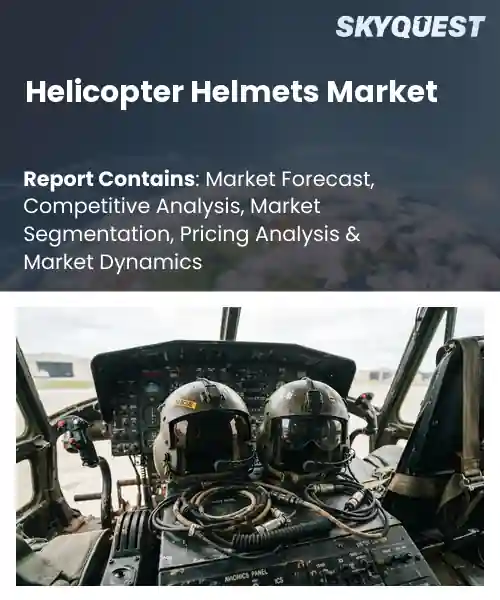
Helicopter Helmets Market
Report ID: SQMIG20A2948
Report ID: SQMIG20A2948
[email protected]
USA +1 351-333-4748
Report ID:
SQMIG20A2948 |
Region:
Global |
Published Date: November, 2026
Pages:
157
|Tables:
119
|Figures:
77


Global Helicopter Helmets Market size was valued at USD 340.0 Million in 2024 and is poised to grow from USD 354.28 Million in 2025 to USD 492.37 Million by 2033, growing at a CAGR of 4.2% during the forecast period (2026-2033).
Integration of communication, navigation and protection into a single helmet is accelerating rapid growth in the global helicopter helmets market, especially for military, emergency‑medical and offshore oil missions. Operators now demand real‑time voice links, situational‑awareness displays and night‑vision compatibility, which pushes manufacturers to embed radios, Bluetooth modules and HUDs within composite shells. This reduces cockpit clutter and speeds pilot response, as shown by the Australian SAR service’s adoption of helmets with built‑in 5G radios that cut distress‑call latency by 30 percent. Consequently, firms offering certified, upgradable platforms capture market share, while aftermarket retrofit services emerge as a considerably profitable niche today.
How is AI enhancing safety and performance in the helicopter helmets market?
AI is reshaping helicopter helmets by embedding sensors that monitor pilot vitals, head orientation and external threats in real time. Machine‑learning algorithms interpret this data to warn of fatigue, disorientation or impact, allowing crews to react before a situation escalates. Integrated heads‑up displays now overlay terrain, weather and flight‑path information directly within the visor, reducing the need to glance at cockpit instruments. The market is shifting toward modular designs that can be upgraded with software patches, extending product life and lowering replacement costs. Early adopters report smoother mission execution and heightened confidence, driving manufacturers to prioritize AI‑driven safety features as a core differentiator.Safran introduced an AI‑enhanced helmet with adaptive impact protection and real‑time health monitoring in June 2023, illustrating how intelligent wearables boost operational safety and accelerate market adoption.
Market snapshot - (2026-2033)
Global Market Size
USD 340.0 Million
Largest Segment
Pilot Helmets
Fastest Growth
Passenger Helmets
Growth Rate
4.2% CAGR
To get more insights on this market click here to Request a Free Sample Report
Global helicopter helmets market is segmented by product type, helmet configuration, application, end user and region. Based on product type, the market is segmented into Pilot Helmets, Crew Helmets and Passenger Helmets. Based on helmet configuration, the market is segmented into Standard Helmets, Integrated Communication Helmets and Advanced Helmet-Mounted Display Systems. Based on application, the market is segmented into Military & Defense, Civil Aviation, Emergency Medical Services, Search & Rescue and Law Enforcement. Based on end user, the market is segmented into Military Operators, Commercial Helicopter Operators and Government & Emergency Services. Based on region, the market is segmented into North America, Europe, Asia Pacific, Latin America and Middle East & Africa.
Integrated communication helmets segment leads because they embed audio and data links directly into headgear, streamlining pilot to pilot and pilot to ground coordination. This integration removes cable clutter, enhances situational awareness, and satisfies stringent safety regulations, making it the preferred solution for operators seeking operational efficiency and reduced fatigue. As mission complexity grows, the value of seamless communication becomes a decisive factor in helmet selection across diverse mission profiles and environments.
Meanwhile, advanced helmet mounted display systems segment emerges as the key high growth area in the Helicopter Helmets Market. Immersive visual overlays, night vision fusion, and augmented reality capabilities drive procurement as missions demand higher information density and reduced reliance on external displays. This innovation fuels market expansion and opens new revenue streams for manufacturers.
Pilot helmets segment dominates because they are engineered specifically for aviator ergonomics, providing optimal weight distribution, impact protection, and integrated avionics interfaces. Their design aligns with rigorous certification requirements, ensuring pilots receive the highest level of protection while maintaining comfort during prolonged flights. Consequently, operators prioritize these helmets to meet safety mandates and enhance overall mission readiness across diverse operational environments and evolving threat landscapes.
On the other hand, crew helmets segment is witnessing the strongest growth momentum in the Helicopter Helmets Market. As multi crew missions expand, demand for helmets that accommodate shared cockpit ergonomics and provide modular communication accessories rises. This need drives manufacturers to innovate lightweight, adaptable designs, accelerating adoption and creating new opportunities for market expansion.
To get detailed segments analysis, Request a Free Sample Report
North America leads the market because of a mature aviation ecosystem, robust defense spending, and a deep network of original equipment manufacturers and aftermarket service providers. Established safety standards and rigorous certification processes drive continuous innovation in materials and design. Strong collaboration between military agencies, commercial operators, and research institutions accelerates the adoption of advanced protection technologies. The region also benefits from extensive training programs that emphasize helmet performance, reinforcing demand for high‑quality solutions across both civil and military sectors.
United States Helicopter Helmets Market
Helicopter Helmets Market in the United States is shaped by extensive military operational requirements and a vibrant commercial rotorcraft industry. Investment in research and development yields cutting‑edge composite structures and integrated communication systems. Close ties between defense contractors and regulatory bodies ensure rapid translation of safety advancements into fielded equipment. A culture of continuous improvement and rigorous testing supports sustained market leadership.
Canada Helicopter Helmets Market
Helicopter Helmets Market in Canada benefits from a strong commitment to safety within its expansive civil aviation and resource extraction sectors. Government procurement policies prioritize certified protective gear, encouraging local manufacturers to align with global standards. Collaborative initiatives between industry players and academic institutions foster innovation in lightweight materials and ergonomic design. The emphasis on training and certification reinforces a demand for reliable helmet solutions across diverse operational environments.
Europe’s expansion is propelled by stringent regulatory frameworks that mandate advanced protective equipment for both military and civilian rotorcraft. Collaborative research clusters across key economies accelerate the development of next‑generation materials and integrated sensor technologies. Growing emphasis on pilot comfort and situational awareness drives adoption of helmets with enhanced communication and vision capabilities. Additionally, increasing defense modernization programs and a resurgence of commercial helicopter services create a fertile environment for market growth throughout the region.
Germany Helicopter Helmets Market
Helicopter Helmets Market in Germany is anchored by a strong aerospace industrial base and rigorous certification processes that set high safety benchmarks. Leading engineering firms invest heavily in lightweight composites and modular design concepts. Close cooperation between defense authorities and civilian operators promotes the diffusion of innovative helmet technologies. The German market also values ergonomic excellence, reinforcing demand for solutions that enhance pilot endurance and mission effectiveness.
United Kingdom Helicopter Helmets Market
Helicopter Helmets Market in the United Kingdom experiences rapid advancement due to intensive defense modernization and a thriving civil helicopter sector. The nation’s focus on integrated communication suites and augmented reality features drives product differentiation. Collaborative initiatives between research institutions and OEMs accelerate the rollout of cutting‑edge protection solutions. A strong export orientation further stimulates development, positioning the United Kingdom as a catalyst for market dynamism across Europe.
France Helicopter Helmets Market
Helicopter Helmets Market in France is emerging through concerted efforts to align with stringent European safety directives while fostering homegrown innovation. French aerospace firms concentrate on advancing lightweight armor and adaptable visor technologies. Partnerships with military training centers ensure that helmet designs meet evolving operational demands. An increasing emphasis on pilot ergonomics and multi‑mission capability fuels growing interest from both defense and commercial operators within the French market.
Asia Pacific is enhancing its market role by leveraging rapid growth in civil helicopter operations and expanding defense procurement programs. Nations are investing in indigenous research capabilities that prioritize advanced composite materials and smart integration of communication systems. Regional collaboration among manufacturers, standards bodies, and training academies drives uniform safety practices and accelerates technology diffusion. The focus on cost‑effective yet high‑performance solutions aligns with the diverse needs of a burgeoning market landscape across the Pacific basin.
Japan Helicopter Helmets Market
Helicopter Helmets Market in Japan is driven by an established aerospace sector that emphasizes precision engineering and high reliability. Japanese manufacturers prioritize the incorporation of sophisticated sensor arrays and seamless cockpit integration. Strong ties with both domestic defense forces and commercial operators promote the adoption of helmets that balance protection with pilot comfort. Ongoing collaboration with research institutes fuels continuous improvement in material science and ergonomic design.
South Korea Helicopter Helmets Market
Helicopter Helmets Market in South Korea benefits from ambitious defense modernization initiatives and a growing commercial helicopter fleet. Korean firms focus on integrating advanced communication and navigation aids within lightweight protective shells. Strategic partnerships with global technology providers accelerate the introduction of smart helmet features. A proactive regulatory environment encourages adherence to stringent safety standards, supporting market expansion and heightened confidence among end users.
To know more about the market opportunities by region and country, click here to
Buy The Complete Report
Enhanced Pilot Safety Requirements
Integration Of Advanced Communication Systems
High Manufacturing Cost Pressures
Stringent Certification and Regulatory Hurdles
Request Free Customization of this report to help us to meet your business objectives.
The competitive landscape of the global helicopter helmets market is shaped by intense rivalry among established manufacturers and emerging innovators, driving continuous product differentiation and safety enhancements. Recent M&A activity, such as Gentex’s acquisition of a niche visor technology firm, and strategic partnerships like Revision Military collaborating with a leading aerospace OEM, illustrate how companies are leveraging consolidation and joint development to accelerate tech innovation and expand market reach.
Top Player’s Company Profile
Recent Developments
SkyQuest’s ABIRAW (Advanced Business Intelligence, Research & Analysis Wing) is our Business Information Services team that Collects, Collates, Correlates, and Analyses the Data collected by means of Primary Exploratory Research backed by robust Secondary Desk research. As per SkyQuest analysis the global helicopter helmets market is expanding at a healthy 4.2 percent CAGR driven first by heightened pilot safety requirements that push operators toward lightweight composite helmets with superior impact protection and second by the need for integrated communication systems that embed audio links and heads‑up displays to improve situational awareness. High manufacturing costs act as a restraint, limiting adoption for cost‑sensitive buyers. North America dominates the market thanks to strong defense spending and an established aerospace supply chain, while pilot helmets remain the leading segment because they meet rigorous certification standards and deliver the best ergonomics for aviators.
| Report Metric | Details |
|---|---|
| Market size value in 2024 | USD 340.0 Million |
| Market size value in 2033 | USD 492.37 Million |
| Growth Rate | 4.2% |
| Base year | 2024 |
| Forecast period | (2026-2033) |
| Forecast Unit (Value) | USD Million |
| Segments covered |
|
| Regions covered | North America (US, Canada), Europe (Germany, France, United Kingdom, Italy, Spain, Rest of Europe), Asia Pacific (China, India, Japan, Rest of Asia-Pacific), Latin America (Brazil, Rest of Latin America), Middle East & Africa (South Africa, GCC Countries, Rest of MEA) |
| Companies covered |
|
| Customization scope | Free report customization with purchase. Customization includes:-
|
To get a free trial access to our platform which is a one stop solution for all your data requirements for quicker decision making. This platform allows you to compare markets, competitors who are prominent in the market, and mega trends that are influencing the dynamics in the market. Also, get access to detailed SkyQuest exclusive matrix.
Table Of Content
Executive Summary
Market overview
Parent Market Analysis
Market overview
Market size
KEY MARKET INSIGHTS
COVID IMPACT
MARKET DYNAMICS & OUTLOOK
Market Size by Region
KEY COMPANY PROFILES
Methodology
For the Helicopter Helmets Market, our research methodology involved a mixture of primary and secondary data sources. Key steps involved in the research process are listed below:
1. Information Procurement: This stage involved the procurement of Market data or related information via primary and secondary sources. The various secondary sources used included various company websites, annual reports, trade databases, and paid databases such as Hoover's, Bloomberg Business, Factiva, and Avention. Our team did 45 primary interactions Globally which included several stakeholders such as manufacturers, customers, key opinion leaders, etc. Overall, information procurement was one of the most extensive stages in our research process.
2. Information Analysis: This step involved triangulation of data through bottom-up and top-down approaches to estimate and validate the total size and future estimate of the Helicopter Helmets Market.
3. Report Formulation: The final step entailed the placement of data points in appropriate Market spaces in an attempt to deduce viable conclusions.
4. Validation & Publishing: Validation is the most important step in the process. Validation & re-validation via an intricately designed process helped us finalize data points to be used for final calculations. The final Market estimates and forecasts were then aligned and sent to our panel of industry experts for validation of data. Once the validation was done the report was sent to our Quality Assurance team to ensure adherence to style guides, consistency & design.
Analyst Support
Customization Options
With the given market data, our dedicated team of analysts can offer you the following customization options are available for the Helicopter Helmets Market:
Product Analysis: Product matrix, which offers a detailed comparison of the product portfolio of companies.
Regional Analysis: Further analysis of the Helicopter Helmets Market for additional countries.
Competitive Analysis: Detailed analysis and profiling of additional Market players & comparative analysis of competitive products.
Go to Market Strategy: Find the high-growth channels to invest your marketing efforts and increase your customer base.
Innovation Mapping: Identify racial solutions and innovation, connected to deep ecosystems of innovators, start-ups, academics, and strategic partners.
Category Intelligence: Customized intelligence that is relevant to their supply Markets will enable them to make smarter sourcing decisions and improve their category management.
Public Company Transcript Analysis: To improve the investment performance by generating new alpha and making better-informed decisions.
Social Media Listening: To analyze the conversations and trends happening not just around your brand, but around your industry as a whole, and use those insights to make better Marketing decisions.
REQUEST FOR SAMPLE
 REQUEST FREE CUSTOMIZATION


Want to customize this report? This report can be personalized according to your needs. Our analysts and industry experts will work directly with you to understand your requirements and provide you with customized data in a short amount of time. We offer $1000 worth of FREE customization at the time of purchase.
Feedback From Our Clients


 USA (+1) 351-333-4748

