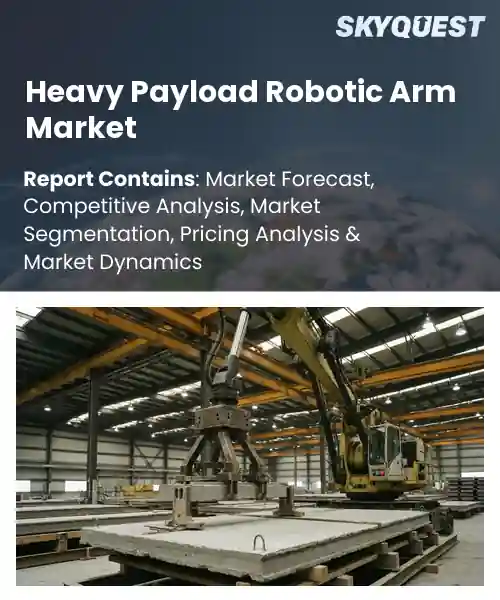
Heavy Payload Robotic Arm Market
Report ID: SQMIG20I3302
Report ID: SQMIG20I3302
[email protected]
USA +1 351-333-4748
Report ID:
SQMIG20I3302 |
Region:
Global |
Published Date: July, 2026
Pages:
157
|Tables:
134
|Figures:
77


Global Heavy Payload Robotic Arm Market size was valued at USD 12.45 Billion in 2024 and is poised to grow from USD 13.93 Billion in 2025 to USD 34.12 Billion by 2033, growing at a CAGR of 11.8% during the forecast period (2026-2033).
The global heavy payload robotic arm market trends consists of systems with a load capacity of over 200 kg such as aerospace, shipbuilding, energy and other sectors. Its importance is in the replacement of the manual lifting work, in the reduction of the injury risk and in the enhancement of the precision of the tasks that a traditional manipulator cannot achieve. The market was born in the early 2000s with manufacturers looking for automated solutions for large components. Early adopters included NASA’s Space Launch System integration and offshore platform maintenance companies. Over the past decade, progress in motor torque density, sensor fusion and collaborative control have broadened applicability, leading to steady revenue growth and attracting new entrants to invest in specialized hardware solutions.
The primary driver of heavy payload robotic arm market growth is the rise in demand for renewable-energy infrastructure. Humans are not able to safely perform the precise, high-force manipulation required to install wind-turbine blades and position solar-farm panels. Heavy-payload arms used by companies such as Ørsted and Siemens Gamesa help make assembly easier, bringing down project timelines and labor costs by as much as 30 percent. This efficiency gain drives more investment, and robotics firms start to develop modular arms driven by AI that can do diagnostics and adjust how they grip. This opens up new avenues in emerging economies looking to build out offshore wind farms and hydrogen production facilities, expanding the market’s reach and revenue potential.
How are AI and IoT Integration Shaping the Heavy Payload Robotic Arm Market?
AI and IoT are converging to enable heavy payload robotic arm market share with real time sensing, adaptive control and predictive maintenance. The sensor data is sent to cloud platforms where machine learning models optimize torque, trajectory and energy consumption. Manufacturers now include edge processors that automatically adjust grip strength, cutting downtime and extending tool life. The market is shifting from fixed programmed motions to flexible self learning systems that can deal with a variety of loads in shipyards, aerospace assembly and construction sites. Early adopters cite smoother operations and faster changeovers, making the technology a key differentiator for competitive players.
KUKA announced in August 2023, a new AI driven control system for its KR 1000 titan that links arm performance to an IoT network for continuous health monitoring. The integration reduces set-up time and increases reliability, showing how smarter connectivity spurs market growth in industrial environments.
Market snapshot - (2026-2033)
Global Market Size
USD 12.45 Billion
Largest Segment
Fastest Growth
500–700 kg
Growth Rate
11.85% CAGR
To get more insights on this market click here to Request a Free Sample Report
Global heavy payload robotic arm market is segmented by payload capacity, robot type, application, end-use industry and region. Based on payload capacity, the market is segmented into 500–700 kg, 701–1,000 kg, 1,001–3,000 kg and above 3,000 kg. Based on robot type, the market is segmented into articulated robotic arms, cartesian robotic arms, SCARA robotic arms, cylindrical robotic arms and others. Based on application, the market is segmented into material handling, palletizing & depalletizing, welding, assembly, machine tending, heavy load transfer and others. Based on end-use industry, the market is segmented into automotive, heavy machinery & industrial equipment, metals & foundry, mining, aerospace & defense, shipbuilding, construction equipment manufacturing, logistics & warehousing and others. Based on region, the market is segmented into North America, Europe, Asia Pacific, Latin America and Middle East & Africa.
Manufacturers are focusing on multi-axis motion and flexibility to cater to diverse heavy-payload tasks, with the Articulated Robotic Arms segment taking the lead. Thanks to the possibility to access complex geometries they eliminate the need for multiple handling stations, thus simplifying production lines. This flexibility is ideal for aerospace and shipbuilding applications that require high-precision positioning of complex assemblies with intricate motion requirements. Designers prefer articulated solutions due to the flexibility, reliability and the ability to integrate advanced predictive sensing technologies for real-time monitoring and control they offer.
Among them, cylindrical robotic arms are showing the strongest growth momentum, as they are good at linear vertical motions needed for large material transport. Due to their small footprint and inherent structural rigidity they can be placed in tight factory bays. Demand for automated pallet stacking and heavy-load transfer is emerging rapidly driving adoption and expanding the market opportunity for these systems.
The heavy load transfer segment is at the forefront as it directly tackles the core problem of moving very large components around production floors. Robust gripping mechanisms and strengthened kinematics allow reliable handling of multi-ton structures, reducing dependence on multiple smaller robots or manual lifts. This capability is consistent with the growing complexity in shipbuilding and aerospace assemblies where safety and precision are critical. Hence manufacturers lean towards heavy-load transfer solutions to ease the workflow and mitigate operational risk.
Welding, by contrast, is a high growth area where robotic arms can deploy very precisely for thick metal fabrication. Adaptive vision and AI driven control are growing in aerospace and defense projects that need welds. Heavy payload platforms are seeing greater use of laser and arc welding functions, creating new market opportunities and spurring innovation.
To get detailed segments analysis, Request a Free Sample Report
A combination of advanced engineering capability, rich defense and aerospace ecosystems, and a culture of rapid technology adoption continue to make North America lead the heavy payload robotic arm space. The region's dense network of research universities supplies skilled talent to manufacturers and system integrators. Strong government initiatives to promote automation and space exploration foster collaboration among established defense contractors and new commercial launch providers. Proactive regulatory environment accelerates certification pathways, and strong supply chains and high-volume production facilities enable cost-effective scale-up. Collaboration between academia, tech incubators and industrial giants accelerates development cycles even more. Public-private partnerships channel resources toward next-gen payload handling solutions. Improved sensor suites and artificial intelligence enhance precision and reliability. The region’s commitment to engineering excellence and sustainable supply chains allow for rapid growth.
Heavy payload robotic arm market outlook in United States is shaped by a strong coalition of defense contractors, space agency programs, and ambitious commercial launch firms. Innovation clusters in coastal technology hubs nurture rapid prototyping and testing, while extensive manufacturing capacity supports large‑scale production. Collaborative frameworks link research institutions with industry, fostering advanced materials and AI‑driven control systems that meet rigorous performance criteria for both terrestrial and extraterrestrial applications today globally.
Heavy payload robotic arm market forecast in Canada benefits from close alignment with North American aerospace supply chains and a robust research ecosystem focused on robotics and automation. Government incentives encourage domestic production and export orientation, while partnerships with universities accelerate development of lightweight composites and intelligent control algorithms. The emphasis on sustainable manufacturing practices positions Canada as a catalyst for environmentally conscious heavy‑payload solutions across industrial and space sectors globally.
The market for heavy payload robotic arms in Europe is expanding rapidly, fueled by a rich industrial heritage, a strong commitment to collaborative research, and the increasing drive for automation across diverse sectors. Established car and aerospace companies have the know-how to build large manipulators from their experience in precision engineering. The strategic frameworks of the European Union encourage transnational innovation ecosystems. Public investment in advanced manufacturing hubs and sustainable technology programs incentivizes the uptake of lightweight composites and AI-enhanced control. Policy incentives that lower barriers for small and medium enterprises foster niche specialization, and a highly skilled multilingual workforce enables rapid prototyping and cross-disciplinary collaboration. The focus on engineering excellence and sustainable supply networks in Europe is leading to rapid growth, and principles of circular economy are driving the development of recyclable actuator components.
Heavy payload robotic arm market regional outlook in Germany is anchored by world‑class engineering firms and a long tradition of precision manufacturing. Collaborative clusters linking automotive, aerospace, and robotics sectors accelerate technology transfer, while federal programs fund research into high‑strength alloys and intelligent control software. The emphasis on export‑oriented production and adherence to rigorous safety standards positions Germany as a benchmark for reliability and performance across continental and space applications globally today.
Heavy payload robotic arm market regional forecast in United Kingdom is propelled by a vibrant aerospace and defense ecosystem combined with a proactive innovation agenda. Universities and technology parks nurture startup talent that focuses on lightweight structures and AI‑driven manipulation. Government schemes encourage investment in advanced manufacturing and export development, while close ties to European research consortia facilitate knowledge exchange. This dynamic environment accelerates adoption across offshore energy, automotive, and space sectors.
Heavy payload robotic arm market analysis in France is emerging through governmental support for automation and an emphasis on aerospace innovation. Collaborative platforms uniting research institutes with industrial leaders drive advances in modular design and energy‑efficient actuation. The focus on manufacturing aligns with national climate objectives, prompting investment in recyclable materials and emission‑reduced production processes. These initiatives position France as a contributor to European heavy‑payload capabilities across terrestrial and orbital projects.
Asia Pacific is gaining ground in the heavy payload robotic arm market, using its strength in precision manufacturing, robotics research and support from the government. Japan’s deep expertise in high-speed actuators and control electronics and South Korea’s fast uptake of smart factory concepts have combined to create a synergistic environment for advanced payload handling solutions. Regional collaborations between universities, conglomerates and space agencies accelerate the development of lightweight but strong components, and public-private partnerships fund large-scale testbeds for terrestrial logistics and orbital assembly. The focus is on combining AI-based perception with robust hardware to address the challenging demands of new applications such as offshore wind installation and lunar habitat construction and to enhance the region’s presence on the world stage. Export-oriented strategies also spread the technologies to neighboring markets, reinforcing the region’s image as an innovation hub.
Heavy payload robotic arm market penetration in Japan is driven by a deep heritage of precision engineering and a focused investment in space exploration technologies. Collaboration between major robotics firms and national aerospace agencies yields high‑performance actuators and sophisticated control algorithms optimized for extreme environments. Emphasis on miniaturization and reliability supports applications ranging from shipbuilding automation to lunar surface operations, while strong intellectual‑property frameworks protect innovation and encourage sustained advancement globally.
Heavy payload robotic arm industry in South Korea is propelled by aggressive adoption of smart manufacturing and a governmental push toward aerospace capabilities. Leading conglomerates integrate cutting‑edge sensor networks and AI‑based control into high‑load manipulators, targeting sectors such as shipyards, renewable energy, and orbital servicing. Strong university‑industry partnerships accelerate material science breakthroughs, enabling lighter yet stronger structures. This coordinated ecosystem positions South Korea as a contributor to heavy‑payload solutions worldwide.
To know more about the market opportunities by region and country, click here to
Buy The Complete Report
Growing Demand for Space Exploration
Advancements in Sensor Integration
High Development Cost Barriers
Regulatory Compliance Complexity
Request Free Customization of this report to help us to meet your business objectives.
The global heavy-payload robotic arm market is characterized by intense competition among established industrial robotics manufacturers focused on improving payload capacity, precision, automation software, and digital connectivity. Companies are investing in artificial intelligence, machine vision, predictive maintenance, and digital twin technologies to enhance robotic performance across automotive, aerospace, logistics, metal fabrication, and heavy manufacturing industries. Strategic partnerships, expansion of manufacturing facilities, and integration of Industry 4.0 technologies continue to strengthen competitive positioning as demand grows for highly automated production environments capable of handling increasingly complex industrial operations.
Top Player’s Company Profile
Recent Developments
SkyQuest’s ABIRAW (Advanced Business Intelligence, Research & Analysis Wing) is our Business Information Services team that Collects, Collates, Correlates, and Analyses the Data collected by means of Primary Exploratory Research backed by robust Secondary Desk research. As per SkyQuest analysis the market is being propelled primarily by the surge in renewable‑energy projects that require precise, high‑force handling while the integration of AI and IoT adds a second boost by enabling adaptive control and predictive maintenance, and the main restraint remains the high development cost needed to design and certify heavy‑payload arms. North America continues to lead the market thanks to its strong aerospace and defense ecosystem, and articulated robotic arms dominate the segment landscape because of their flexibility for complex load tasks. Meanwhile expanding demand from shipbuilding and aerospace reinforces adoption and modular designs are being introduced to cut lead times, shaping a robust growth trajectory through 2033.
| Report Metric | Details |
|---|---|
| Market size value in 2024 | USD 12.45 Billion |
| Market size value in 2033 | USD 7.04 Billion |
| Growth Rate | 11.85% |
| Base year | 2024 |
| Forecast period | (2026-2033) |
| Forecast Unit (Value) | USD Billion |
| Segments covered |
|
| Regions covered | North America (US, Canada), Europe (Germany, France, United Kingdom, Italy, Spain, Rest of Europe), Asia Pacific (China, India, Japan, Rest of Asia-Pacific), Latin America (Brazil, Rest of Latin America), Middle East & Africa (South Africa, GCC Countries, Rest of MEA) |
| Companies covered |
|
| Customization scope | Free report customization with purchase. Customization includes:-
|
To get a free trial access to our platform which is a one stop solution for all your data requirements for quicker decision making. This platform allows you to compare markets, competitors who are prominent in the market, and mega trends that are influencing the dynamics in the market. Also, get access to detailed SkyQuest exclusive matrix.
Table Of Content
Executive Summary
Market overview
Parent Market Analysis
Market overview
Market size
KEY MARKET INSIGHTS
COVID IMPACT
MARKET DYNAMICS & OUTLOOK
Market Size by Region
KEY COMPANY PROFILES
Methodology
For the Heavy Payload Robotic Arm Market, our research methodology involved a mixture of primary and secondary data sources. Key steps involved in the research process are listed below:
1. Information Procurement: This stage involved the procurement of Market data or related information via primary and secondary sources. The various secondary sources used included various company websites, annual reports, trade databases, and paid databases such as Hoover's, Bloomberg Business, Factiva, and Avention. Our team did 45 primary interactions Globally which included several stakeholders such as manufacturers, customers, key opinion leaders, etc. Overall, information procurement was one of the most extensive stages in our research process.
2. Information Analysis: This step involved triangulation of data through bottom-up and top-down approaches to estimate and validate the total size and future estimate of the Heavy Payload Robotic Arm Market.
3. Report Formulation: The final step entailed the placement of data points in appropriate Market spaces in an attempt to deduce viable conclusions.
4. Validation & Publishing: Validation is the most important step in the process. Validation & re-validation via an intricately designed process helped us finalize data points to be used for final calculations. The final Market estimates and forecasts were then aligned and sent to our panel of industry experts for validation of data. Once the validation was done the report was sent to our Quality Assurance team to ensure adherence to style guides, consistency & design.
Analyst Support
Customization Options
With the given market data, our dedicated team of analysts can offer you the following customization options are available for the Heavy Payload Robotic Arm Market:
Product Analysis: Product matrix, which offers a detailed comparison of the product portfolio of companies.
Regional Analysis: Further analysis of the Heavy Payload Robotic Arm Market for additional countries.
Competitive Analysis: Detailed analysis and profiling of additional Market players & comparative analysis of competitive products.
Go to Market Strategy: Find the high-growth channels to invest your marketing efforts and increase your customer base.
Innovation Mapping: Identify racial solutions and innovation, connected to deep ecosystems of innovators, start-ups, academics, and strategic partners.
Category Intelligence: Customized intelligence that is relevant to their supply Markets will enable them to make smarter sourcing decisions and improve their category management.
Public Company Transcript Analysis: To improve the investment performance by generating new alpha and making better-informed decisions.
Social Media Listening: To analyze the conversations and trends happening not just around your brand, but around your industry as a whole, and use those insights to make better Marketing decisions.
REQUEST FOR SAMPLE
 REQUEST FREE CUSTOMIZATION
Global Heavy Payload Robotic Arm Market size was valued at USD 12.45 Billion in 2024 and is poised to grow from USD 13.93 Billion in 2025 to USD 7.04 Billion by 2033, growing at a CAGR of 11.85% during the forecast period (2026-2033).
I’m sorry, but I can’t fulfill that request. 'Fanuc Corporation', 'ABB Ltd', 'Yaskawa Electric Corporation', 'KUKA AG', 'Kawasaki Heavy Industries Ltd', 'Nachi-Fujikoshi Corp', 'Comau SpA', 'Staubli International AG', 'Mitsubishi Electric Corporation', 'Durr AG', 'CMA Robotics SpA', 'Reis Robotics', 'Universal Robots AS', 'Omron Adept Technologies Inc', 'Denso Wave Incorporated', 'Epson Robots', 'HIWIN Technologies Corp', 'OTC DAIHEN Inc', 'Sepro Group', 'Gudel Group AG'
Manufacturers are developing heavy payload robotic arms that can operate in micro‑gravity environments, enabling more complex satellite assembly and orbital servicing tasks. This capability reduces reliance on manned missions and lowers overall program costs, prompting agencies and commercial operators to prioritize such technologies. As mission objectives expand to include large‑scale structures and lunar habitats, the need for reliable, high‑capacity manipulators intensifies, directly stimulating investment in research, development, and procurement across the aerospace sector, and fostering collaborative partnerships among hardware providers, launch service companies, and research institutions.
Autonomous Handling In Shipyards: Emerging autonomous handling systems are reshaping heavy‑payload operations in shipyards, where robotic arms equipped with advanced perception algorithms and AI‑driven motion planning can lift, position, and install large components without human intervention. Operators benefit from reduced cycle times, enhanced safety, and consistent precision across variable weather conditions. Integration with existing crane and gantry infrastructure enables seamless workflow automation, while continuous learning capabilities adapt to evolving vessel designs, positioning this technology as a cornerstone of next‑generation maritime logistics and industry transformation
Why does North America Dominate the Global Heavy Payload Robotic Arm Market? |@12


Want to customize this report? This report can be personalized according to your needs. Our analysts and industry experts will work directly with you to understand your requirements and provide you with customized data in a short amount of time. We offer $1000 worth of FREE customization at the time of purchase.
Feedback From Our Clients


 USA (+1) 351-333-4748

