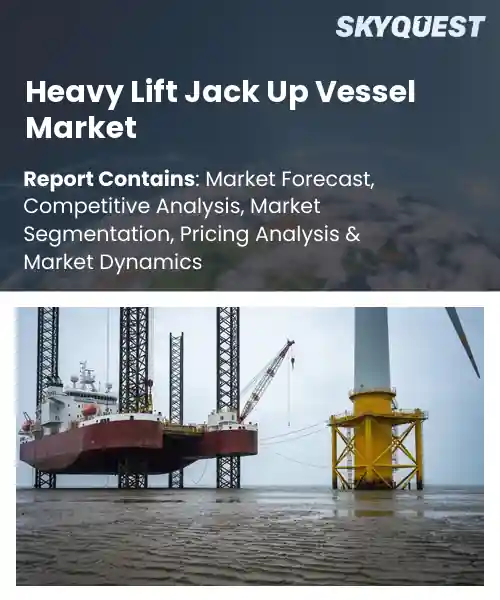
Heavy Lift Jack Up Vessel Market
Report ID: SQMIG20T2044
Report ID: SQMIG20T2044
[email protected]
USA +1 351-333-4748
Report ID:
SQMIG20T2044 |
Region:
Global |
Published Date: June, 2026
Pages:
157
|Tables:
175
|Figures:
79


Global Heavy Lift Jack Up Vessel Market size was valued at USD 4.87 Billion in 2024 and is poised to grow from USD 5.23 Billion in 2025 to USD 9.26 Billion by 2033, growing at a CAGR of 7.4% during the forecast period (2026-2033).
The heavy‑lift jack‑up vessel market revolves around marine platforms that mash a jack‑up unit together with a crane, so they can install offshore structures like wind‑turbine foundations, oil‑field modules, and subsea pipelines. Its relevance is mostly tied to that continuing shift toward renewable power and also the need to handle aging fossil‑fuel assets, especially once someone gets into deeper waters.
Moreover, the major factor driving the heavy‑lift jack‑up vessel market growth is the expansion of wind farms, because those projects generate contracts both to install foundations and to do turbine servicing. When developers chase deeper sites for stronger wind capture, demand rises for vessels able to jack‑up and lift loads beyond 10,000 tonnes. That, in turn, prompts shipyards to invest in cranes and propulsion systems , not just for performance, but also to meet the emissions rules. The trend is seen in the 12‑MW turbine installations off Taiwan, where one jack‑up vessel reportedly cut overall installation time by around 30 percent. As work is not only about the lift, ancillary services like crew coaching, spare‑part logistics, and equipment monitoring also grow, giving suppliers another set of revenue lines while strengthening resilience against oil‑price swings.
AI‑driven automation is reshaping the heavy lift jack‑up vessel market outlook by pushing intelligent systems into the core workflow, even for day‑to‑day operations. Machine learning models can forecast equipment wear, so maintenance happens before a failure shows up, and schedules stay intact. Autonomous positioning routines can reduce the time needed to set up the rig, while AI‑optimized lift planning matches the payload with the most efficient rig layout. Remote monitoring platforms then push real‑time data back to shore teams, which improves safety call making and lowers crew burden, even during complex lifts. Overall, these features reduce operating costs, increase reliability, and make the vessels more appealing for offshore contracts, so demand strengthens across the market.
Market snapshot - (2026-2033)
Global Market Size
USD 4.87 Billion
Largest Segment
Fastest Growth
Growth Rate
7.4% CAGR
To get more insights on this market click here to Request a Free Sample Report
The global heavy lift jack-up vessel market is segmented based on vessel type, lifting capacity, water depth capability, application, end user, and region. Based on vessel type, the market is segmented into self-propelled heavy lift jack-up vessels, non-self-propelled heavy lift jack-up vessels, conventional jack-up vessels, and hybrid jack up vessels. Based on lifting capacity, the market is segmented into below 1,000 tons, 1,000–3,000 tons, 3,000–5,000 tons, and above 5,000 tons. Based on water depth capability, the market is segmented into shallow water (up to 60 meters), medium water (60–100 meters), and deep water (above 100 meters). Based on application, the market is segmented into offshore wind farm installation, oil & gas platform installation and maintenance, decommissioning, offshore construction, and subsea infrastructure support. Based on end user, the market is segmented into offshore wind developers, oil & gas companies, engineering, procurement and construction (EPC) contractors, marine logistics and offshore service providers, and government & defense organizations. Regionally, the market is analyzed across North America, Europe, Asia-Pacific, South America, and the Middle East & Africa.
As per the heavy lift jack-up vessel market analysis, the conventional jack-up vessels segment dominates because they bring proven stability, an easy-to-follow deck arrangement, and operational routines that are already familiar, so they fit most client requirements well. Their long service background reduces owner risk, and they can manage a broad mix of cargo sizes, which lines up with the main need from oil and gas people. That reliability tends to pull in ongoing charter contracts, and it basically keeps them at the front of the market.
At the same time, the hybrid electric jack up vessels segment is the one that's growing the fastest, due to battery tech improvements and tighter emissions rules pushing operators to shift toward cleaner propulsion. The reduced fuel burn, plus a smaller environmental trace, makes them more attractive for charter deals. So, investment follows, and the market starts diversifying more quickly into sustainable heavy lift activities, which in turn supports the next wave of growth.
According to the heavy lift jack-up vessel market forecast, oil and gas platform installation & maintenance is still the standout application, simply because it stays as the backbone of offshore energy output. That sector keeps creating steady demand for heavy lift work, installing, servicing, and upgrading platforms and associated gear. The existing infrastructure and long term service contracts give predictable income, so owners lean toward vessel designs tuned for these exact jobs. Because of that, this use case keeps the central market momentum, and it helps anchor the overall market direction even as energy priorities keep evolving worldwide
Conversely, offshore wind farm installation application rises quickest because renewable mandates keep tightening , and turbine sizes keep getting larger. That means more demand for vessels that can move and place enormous components, especially in shallower waters where many projects are concentrated. Specialized deck layouts, together with upgraded winch setups, make operations more efficient, and developers can finish projects faster. This then opens up new market lanes and feeds continuous expansion in the Heavy Lift Jack Up Vessel Market
To get detailed segments analysis, Request a Free Sample Report
As per the heavy lift jack-up vessel market regional forecast, North America is dominating the market, through a mix of already- mature offshore energy jobs, a lot of coastline, and those deep water port systems that let big fleets work without too much slowdown. People there also bring real engineering know how and shipbuilding know-how, mostly concentrated in the United States and Canada, which makes it easier to deploy specialized jack up vessels fast. Then there’s the financing side that’s solid, plus rules that seem to encourage novelty, and a trained maritime workforce that keeps things reliable. And the whole thing stays strong because operators, equipment makers, and research groups work together, so vessel design improves, safety standards get updated, and day to day efficiency keeps climbing, which locks in the region’s pre eminence in the heavy lift jack up space.
United States Heavy Lift Jack Up Vessel Market
The Heavy Lift Jack Up Vessel sector in the United States grows because offshore wind efforts are showing up alongside legacy oil and gas platforms, so demand stays steady for versatile lift capacity. Gulf and Atlantic shipyards have deep bench strength for fast construction and retrofitting services. A forward leaning regulatory framework makes room for adoption of advanced technologies, while a wide talent base helps keep vessel operation and maintenance at a high level. Strategic alliances between energy firms and marine service providers, in practice make the market more resilient, and they also keep pushing capability upgrades, on repeat.
Canada Heavy Lift Jack Up Vessel Market
The Heavy Lift Jack Up Vessel industry in Canada leans on its long Arctic plus Atlantic edges, where new energy plans and remote infrastructure need dependable lift solutions. Shipbuilding is often concentrated in the Maritime provinces, and there modular design principles plus environmental compliance are emphasized. Research partnerships with universities and colleges help move innovation forward, especially for cold weather vessel performance. Government incentives push fleet modernization, and a capable maritime labor pool supports safe, efficient operations through tough water conditions, which keeps Canada positioned as an important contributor to the regional market.
The European heavy lift jack-up vessel market penetration expands because offshore wind development stays strong, renewable energy goals are very ambitious, and the older offshore oil and gas activity continues to feed demand for heavy lift capabilities. Well known shipyards and engineering organizations across the continent build high tech vessel concepts, and they’re heavily focused on sustainability, plus cutting emissions. On top of that, cross EU policy structures reduce friction on approvals, and that supports cross border projects. Add a dense port landscape, and logistics hubs that speed up vessel turnaround, plus ongoing spending in digitalization and automation, and Europe ends up looking like a fast moving growth engine for heavy lift jack up vessels.
Germany Heavy Lift Jack Up Vessel Market
In Germany, the Heavy Lift Jack Up Vessel Market is driven by advanced engineering, and a long history of precise manufacturing. Major shipyards combine advanced automation with modular construction methods, so vessels can satisfy strict environmental requirements. Energy companies working closely with maritime technology providers, encourages quicker uptake of new lift arrangements. A supportive regulatory climate also stimulates research into cleaner propulsion pathways, while a high skilled workforce handles careful vessel maintenance and operations across multiple offshore project types.
United Kingdom Heavy Lift Jack Up Vessel Market
The Heavy Lift Jack Up Vessel Market in the United Kingdom benefits from a strong offshore oil heritage plus a rapidly growing offshore wind pipeline. Established shipyards on the east coast focus on custom jack up designs, with an emphasis on safety and operational flexibility. Government programs aim at renewable infrastructure investment, so those efforts create practical synergies with existing heavy lift work. Technology transfer speeds up due to cluster style coordination among academia, industry, and service providers, which helps the United Kingdom keep a leading role in the European market.
France Heavy Lift Jack Up Vessel Market
The Heavy Lift Jack Up Vessel Market in France is taking shape through a deliberate diversification of offshore assets, mixing traditional energy operations with ambitious wind farm developments. Specialized yards along the western coast prioritize eco friendly building approaches, and they’re pushing modular vessel concepts. Strategic alliances with European energy consortia support knowledge sharing, and sometimes joint venture pathways too. Regulatory incentives encourage low emission technologies, while a growing group of maritime engineers supports the market’s ongoing expansion, step by step, without slowing down.
Asia Pacific is enhancing its heavy lift jack-up vessel market share, by linking heavy lift know how with the fast moving offshore energy and infrastructure buildup across the region. Countries tend to put serious money into updated shipyards, with intricate engineering, plus automation, fitted for the rough reality of deep‑water, and those demanding marine situations. Cross border cooperation helps technology travel faster, still government rules keep pointing at maritime safety, environmental responsibility, and export competitiveness. So when energy demand keeps climbing, ports get expanded, and a growing talent group shows up, the region takes a rather proactive stance on new vessel ideas and day to day operational excellence. Overall it becomes a meaningful player in the global market.
Japan Heavy Lift Jack Up Vessel Market
The Japan Heavy Lift Jack Up Vessel Market is centered on blending high precision manufacturing with sophisticated maritime systems. Major yards often rely on robotics, also on digital design platforms producing ships that perform with a strong level of dependability and efficiency. Collaboration with offshore wind developers, in close quarters basically, supports the deployment of specialized lift platforms for wind related work and related installation needs. Government support leaning toward sustainable maritime practices nudges research into hybrid propulsion and emissions reduction, while the maritime workforce, well trained, maintains strict operational benchmarks during complicated offshore operations and engagements.
South Korea Heavy Lift Jack Up Vessel Market
The South Korea Heavy Lift Jack Up Vessel Market is powered by a shipbuilding ecosystem that’s known for scale, plus consistent production capacity and speed in project delivery. Focus on new hull designs and modular construction improves how adaptable the vessels can be for a variety of offshore duties. Partnerships with energy companies across the region further push lift solution rollouts, especially for deep‑water programs. Meanwhile national initiatives promote eco efficient design and advanced automation, while a capable labor force keeps production steady, and quality high across the whole vessel lifecycle, from early build stages through service.
To know more about the market opportunities by region and country, click here to
Buy The Complete Report
Growing Demand for Offshore Wind
Adoption Of Deepwater Exploration Projects
High Capital Expenditure Requirements
Regulatory and Environmental Compliance Challenges
Request Free Customization of this report to help us to meet your business objectives.
The heavy lift jack-up vessel market is shaped by intense competition, like shipbuilders racing to grab contracts through strategic partnerships, doing tech upgrades and then selective acquisitions, the usual thing. Recent examples show this, Jumbo’s partnership with Dajin Heavy Industry to procure two new heavy lift vessels, and also the rollout of next generation lift systems described by Spinergie, which seems to underline a focus on advanced engineering, to differentiate what they offer.
Top Player’s Company Profile
Recent Developments in the Heavy Lift Jack Up Vessel Market
SkyQuest’s ABIRAW (Advanced Business Intelligence, Research & Analysis Wing) is our Business Information Services team that Collects, Collates, Correlates, and Analyses the Data collected by means of Primary Exploratory Research backed by robust Secondary Desk research.
As per SkyQuest analysis, the global heavy‑lift jack‑up vessel market is expected to expand because the offshore wind industry keeps booming, and it needs vessels that can manage ever larger turbine components, while deep‑water exploration adds another reason to invest, since remote sites still call for lift strength that stays reliable. Still, high capital intensity remains the main restraint, which tends to squeeze smaller firms out of the market. North America currently leads, largely due to its more mature offshore infrastructure, and a strong shipbuilding ecosystem. Meanwhile, the conventional jack‑up vessel segment keeps holding the lead because of its proven stability and a wide cargo range that fits a variety of offshore projects, even when conditions vary.
| Report Metric | Details |
|---|---|
| Market size value in 2024 | USD 4.87 Billion |
| Market size value in 2033 | USD 9.26 Billion |
| Growth Rate | 7.4% |
| Base year | 2024 |
| Forecast period | (2026-2033) |
| Forecast Unit (Value) | USD Billion |
| Segments covered |
|
| Regions covered | North America (US, Canada), Europe (Germany, France, United Kingdom, Italy, Spain, Rest of Europe), Asia Pacific (China, India, Japan, Rest of Asia-Pacific), Latin America (Brazil, Rest of Latin America), Middle East & Africa (South Africa, GCC Countries, Rest of MEA) |
| Companies covered |
|
| Customization scope | Free report customization with purchase. Customization includes:-
|
To get a free trial access to our platform which is a one stop solution for all your data requirements for quicker decision making. This platform allows you to compare markets, competitors who are prominent in the market, and mega trends that are influencing the dynamics in the market. Also, get access to detailed SkyQuest exclusive matrix.
Table Of Content
Executive Summary
Market overview
Parent Market Analysis
Market overview
Market size
KEY MARKET INSIGHTS
COVID IMPACT
MARKET DYNAMICS & OUTLOOK
Market Size by Region
KEY COMPANY PROFILES
Methodology
For the Heavy Lift Jack Up Vessel Market, our research methodology involved a mixture of primary and secondary data sources. Key steps involved in the research process are listed below:
1. Information Procurement: This stage involved the procurement of Market data or related information via primary and secondary sources. The various secondary sources used included various company websites, annual reports, trade databases, and paid databases such as Hoover's, Bloomberg Business, Factiva, and Avention. Our team did 45 primary interactions Globally which included several stakeholders such as manufacturers, customers, key opinion leaders, etc. Overall, information procurement was one of the most extensive stages in our research process.
2. Information Analysis: This step involved triangulation of data through bottom-up and top-down approaches to estimate and validate the total size and future estimate of the Heavy Lift Jack Up Vessel Market.
3. Report Formulation: The final step entailed the placement of data points in appropriate Market spaces in an attempt to deduce viable conclusions.
4. Validation & Publishing: Validation is the most important step in the process. Validation & re-validation via an intricately designed process helped us finalize data points to be used for final calculations. The final Market estimates and forecasts were then aligned and sent to our panel of industry experts for validation of data. Once the validation was done the report was sent to our Quality Assurance team to ensure adherence to style guides, consistency & design.
Analyst Support
Customization Options
With the given market data, our dedicated team of analysts can offer you the following customization options are available for the Heavy Lift Jack Up Vessel Market:
Product Analysis: Product matrix, which offers a detailed comparison of the product portfolio of companies.
Regional Analysis: Further analysis of the Heavy Lift Jack Up Vessel Market for additional countries.
Competitive Analysis: Detailed analysis and profiling of additional Market players & comparative analysis of competitive products.
Go to Market Strategy: Find the high-growth channels to invest your marketing efforts and increase your customer base.
Innovation Mapping: Identify racial solutions and innovation, connected to deep ecosystems of innovators, start-ups, academics, and strategic partners.
Category Intelligence: Customized intelligence that is relevant to their supply Markets will enable them to make smarter sourcing decisions and improve their category management.
Public Company Transcript Analysis: To improve the investment performance by generating new alpha and making better-informed decisions.
Social Media Listening: To analyze the conversations and trends happening not just around your brand, but around your industry as a whole, and use those insights to make better Marketing decisions.
REQUEST FOR SAMPLE
 REQUEST FREE CUSTOMIZATION
Global Heavy Lift Jack Up Vessel Market size was valued at USD 4.87 Billion in 2024 and is poised to grow from USD 5.23 Billion in 2025 to USD 9.26 Billion by 2033, growing at a CAGR of 7.4% during the forecast period (2026-2033).
The heavy lift jack‑up vessel market is shaped by intense competition as shipbuilders race to secure contracts through strategic partnerships, technology upgrades and selective acquisitions. Recent examples include Jumbo’s partnership with Dajin Heavy Industry to procure two new heavy lift vessels and the rollout of next‑generation lift systems described by Spinergie, reflecting a focus on advanced engineering to differentiate offerings. 'Cadeler A/S', 'Seajacks International Ltd.', 'DEME Group NV', 'Jan De Nul Group NV', 'Van Oord N.V.', 'Fred. Olsen Windcarrier AS', 'Havfram AS', 'Shimizu Corporation', 'China Merchants Industry Holdings Co., Ltd.', 'Zhenhua Heavy Industries Co., Ltd.', 'Boskalis Westminster N.V.', 'Penta-Ocean Construction Co., Ltd.', 'Mammoet Holding B.V.', 'SAL Heavy Lift GmbH', 'COSCO Shipping Heavy Transport Co., Ltd.', 'Lamprell plc', 'Seaway7 ASA', 'Heerema Marine Contractors Nederland SE', 'McDermott International, Ltd.', 'Saipem S.p.A.'
The expanding offshore wind sector requires installation of massive turbine components, prompting operators to seek vessels capable of handling heavier loads. Heavy lift jack up vessels provide the necessary stability and deck capacity, enabling swift deployment in challenging marine environments. As project pipelines extend across multiple regions, the need for versatile, high‑capacity vessels drives manufacturers to enhance designs, offering longer operational windows and reduced turnaround times, which in turn accelerates market adoption and reinforces growth momentum for global energy transition initiatives and climate resilience goals.
Offshore Renewable Integration: The accelerating deployment of offshore wind farms drives demand for heavy‑lift jack‑up vessels capable of transporting turbine components and substations. Shipyards are adapting designs to accommodate larger decks, higher load capacities, and integration features that streamline installation cycles. Operators value vessels that can operate in deeper waters and variable sea states, reducing mobilization time and project costs. This shift fuels strategic partnerships between equipment manufacturers and vessel owners, positioning jack‑up platforms as essential assets in the renewable energy supply chain.
Why does North America Dominate the Global Heavy Lift Jack Up Vessel Market? |@12


Want to customize this report? This report can be personalized according to your needs. Our analysts and industry experts will work directly with you to understand your requirements and provide you with customized data in a short amount of time. We offer $1000 worth of FREE customization at the time of purchase.
Feedback From Our Clients


 USA (+1) 351-333-4748

