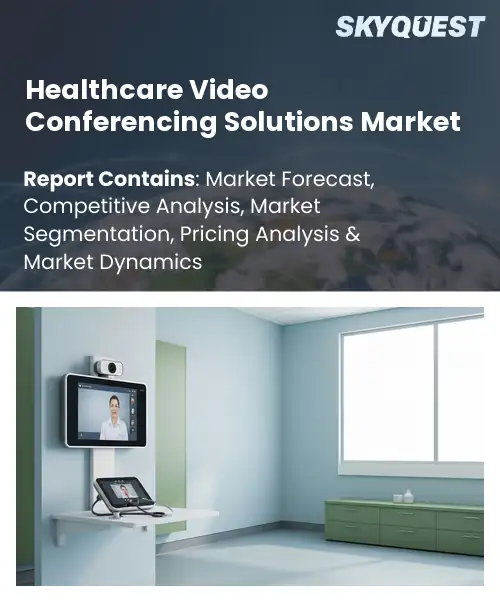
Healthcare Video Conferencing Solutions Market
Report ID: SQMIG35G2420
Report ID: SQMIG35G2420
[email protected]
USA +1 351-333-4748
Report ID:
SQMIG35G2420 |
Region:
Global |
Published Date: May, 2026
Pages:
157
|Tables:
145
|Figures:
78


Global Healthcare Video Conferencing Solutions Market size was valued at USD 2.52 Billion in 2024 and is poised to grow from USD 2.8 Billion in 2025 to USD 6.52 Billion by 2033, growing at a CAGR of 11.22% during the forecast period (2026-2033).
The healthcare video conferencing solutions market growth is largely driven by a growing need to maintain the ability to access clinical care remotely while maintaining continuity of care. The solutions in this market consist of cloud-based platforms with secure video endpoints and integrated telehealth workflows that connect clinicians and patients throughout multiple locations. This is important because when virtual consultations take place, patients do not have to travel which reduces travel burdens; patients can use specialists who may be located far from them; and cost savings through system efficiency are achieved (Teladoc, Amwell and Zoom Healthcare being examples). Over the last decade, the healthcare video conferencing solutions industry has transitioned dramatically from simply enabling ad hoc video calls to now having a regulated and inter-operable system that supports health-based organizations through policy initiatives guiding their adoption.
How is AI improving remote diagnostics in the healthcare video conferencing solutions market?
AI is improving remote diagnostics in healthcare video conferencing by adding clinical grade sensing and real time decision support to ordinary video visits. Key aspects include automated image and audio analysis that flags abnormal findings, AI guided exam workflows that help patients capture usable data, and clinical decision support that augments clinician judgment. The current market is shifting from basic teleconferencing toward integrated virtual care platforms that combine live video with AI driven tools and device captured vitals. This convergence raises clinician confidence in remote assessments and makes virtual visits more useful in routine diagnosis and follow up.
Teladoc Health November 2025, announced integration with TytoCare to embed FDA cleared AI enabled remote exam tools into its primary care programs, enhancing remote respiratory and physical assessments and increasing the diagnostic value and efficiency of video consultations.
Market snapshot - (2026-2033)
Global Market Size
USD 2.52 Billion
Largest Segment
Software
Fastest Growth
Software
Growth Rate
11.22% CAGR
To get more insights on this market click here to Request a Free Sample Report
Global healthcare video conferencing solutions market is segmented by component, deployment, application, end-user and region. Based on component, the market is segmented into Software, Hardware (Camera, Display) and Services. Based on deployment, the market is segmented into Cloud-Based and On-Premise. Based on application, the market is segmented into Telestroke, Tele-ICU, Telepsychiatry and General Telemedicine. Based on end-user, the market is segmented into Hospitals, Clinics and Home Care. Based on region, the market is segmented into North America, Europe, Asia Pacific, Latin America and Middle East & Africa.
Software segment dominates with large healthcare video conferencing solutions market share because platform capabilities drive end-to-end virtual care workflows, enabling secure clinical collaboration, scheduling, and EHR integration that clinicians require. Its flexibility allows rapid feature updates and interoperability with medical devices, which reduces friction for providers and accelerates procurement. Continuous improvement in user experience and built-in compliance controls lowers implementation risks, encouraging institutional adoption and creating a foundation for ancillary services and data-driven care management across provider networks.
As per healthcare video conferencing solutions market outlook, services are emerging as the most rapidly expanding area as providers increasingly outsource deployment, training, and workflow optimization to specialized vendors. Demand for turnkey implementations and outcome-focused managed services creates recurring revenue and lowers operational barriers, accelerating adoption by smaller providers and enabling scalable integration of virtual care into established clinical pathways.
As per healthcare video conferencing solutions market analysis, tele-ICU segment is leading because these two elements require video conferencing with an always-on integrated monitoring system which is critical to the hospitals because they want to ensure that they have the best critical care staff and to improve outcomes for their patients in critical care settings. This type of technology is used to help decrease the time it takes for a doctor to respond to a patient's needs by providing the doctor with access to a specialist that they do not normally have access to because they work in a different unit. Clinical dependency on real-time audio and video provides acute care providers with a continued demand for technology that allows for a seamless flow of information between patients and health care providers at acute care facilities.
As per healthcare video conferencing solutions market regional forecast, telepsychiatry has experienced the highest growth due to the need for access to mental health services and that more healthcare providers are using low bandwidth, more consumer-friendly video communication solutions. With changes in regulations and payers recognizing the value of delivering behavioral health services from home, there has been an increase in reimbursement and greater adoption of clinics and specialized tele-psychiatry platforms. The growth in this area has created new opportunities for tele-psychiatry platforms that are specifically targeted at patient engagement and integration into care management workflows.
To get detailed segments analysis, Request a Free Sample Report
As per healthcare video conferencing solutions market regional outlook, North America is dominating the market due to advanced technology infrastructure, institutional readiness and conducive governmental environment. Robust digital infrastructure and the extensive availability of internet underpin the reliable delivery of virtual care across a range of care settings. An established healthcare ecosystem and a focused vendor environment facilitates quick integration with electronic medical records and clinical workflows. Clear regulatory guidance and reimbursement systems provide incentives for adoption by providers, and significant investment from both public and commercial sources is used to support pilots and expand initiatives. High clinician engagement, patient digital literacy and a focus on expanding access to specialty care in underserved areas leads to greater sustained demand. The collaboration among tech companies, healthcare organizations, and colleges generates an environment of continual innovation and process improvement.
As per healthcare video conferencing solutions market regional forecast, United States is marked by extensive provider usage and strong vendor ecosystem focusing on interoperability and integration with clinical workflows. Leading health systems are focused on ease of integration with electronic medical records and specialty care platforms. Patient demand for easy remote consultations and institutional investment in telehealth infrastructure enable widespread deployment. Technology companies, academic centers and payers can collaborate to find solutions that meet the broad spectrum of clinical needs across the care continuum.
As per healthcare video conferencing solutions industry analysis, Canada encompasses public and private initiatives to broaden virtual care in urban and remote locations. Provincial health organizations and technology vendors stress integration with electronic records and multilingual patient demands. Focus on physician education, user experience and secure data interchange reinforces provider confidence Health authorities, telehealth companies and academic centers together can trial and scale specialist consultation and chronic care services.
The fast-growing healthcare video conferencing solutions market in Europe is driven by aligned digital health agendas, regulatory modernization and the increasing demand for accessible expert care in national healthcare systems. Vendors have focused on data protection and patient privacy, emphasizing secure, compliant platforms that meet the demands of strict regional regulations and, in turn, increase trust among providers and patients. Cross border collaboration and interoperability projects allow integration with a range of electronic record systems and facilitate the delivery of global telehealth services. Public funding schemes, improving physician expertise with virtual care workflows, and active vendor participation from both established and developing technology centers accelerate adoption. Momentum continues across major markets as patient expectations for convenient treatment combine with systemic initiatives to decrease care fragmentation and targeted investments by healthcare companies.
Germany reflects strong national commitment to digital health and active engagement from public institutions and private providers. Vendors prioritize secure, compliant platforms that integrate with hospital information systems. Focused efforts on clinician training and certified solutions increase institutional confidence. Collaboration among technology firms, healthcare providers, and research centers supports pilot programs and implementations to expand access to specialist consultations and enhance continuity of care.
United Kingdom benefits from integrated health systems and primary care networks that encourage use of virtual consultations. Priorities on interoperability with national electronic records and alignment with clinical workflows support clinician adoption. Policy focus on patient centered care and access reinforces demand for remote services. A vendor community and collaboration among health services and research institutions enable innovation, refinement, and scaling across care settings.
France market is gaining traction with the push of public initiatives and participation of regional health authorities and clinics. We assist uptake by focusing on secure, privacy compliant platforms adapted for multilingual populations. Providers incorporate virtual consults into chronic illness management and follow-up treatment pathways. Collaboration between technology vendors, hospitals and research centers is driving clinical validation and user experience, fueling expansion of telehealth services throughout urban and care networks.
Asia Pacific healthcare video conferencing solutions market is supported by the collaborative investments in digital infrastructure, the increasing health system modernization, and the proactive participation of technology makers and healthcare providers. With new mobile networks and increasing broadband availability, virtual consultations may be carried out reliably in city centres and more remote places. Governments and health authorities are establishing more transparent regulatory procedures and pilot programs that enable provider experimentation and integration with electronic medical records. Local technology businesses provide strong in-country platforms with language and workflow adjustments that fit the way care is delivered in the region. Demands are propelled by demographic pressures and the focus on good management of chronic disease. The partnership between suppliers, hospitals and research institutions promotes clinical validation and local innovation, cementing the region’s position as an increasingly important market for virtual care solutions.
Japan is driven by commitment to integrating advanced digital tools within hospital networks and care pathways. Domestic technology firms collaborate with healthcare providers to tailor secure platforms that align with clinical workflows and medical records. Focus on aging population needs and efficient chronic care management increases relevance of virtual consultations. Partnerships with academic centers support clinical validation, usability improvements, and scaling across institutional settings.
South Korea market is driven by high technology industry and clinician and patient contact. Some local manufacturers offer sophisticated platforms with emphasis on secure data exchange and integration with hospital information systems. Government-driven pilots and reimbursement systems foster provider experimentation and uptake in metropolitan and regional hospitals. Technology businesses partner with healthcare providers and research institutes to provide clinical validation, design iteration and implementation across care pathways.
To know more about the market opportunities by region and country, click here to
Buy The Complete Report
Expansion Of Telehealth Infrastructure
Regulatory Support For Remote Care
Data Privacy and Security Concerns
Technical Infrastructure and Interoperability
Request Free Customization of this report to help us to meet your business objectives.
Competitive landscape in the global healthcare video conferencing industry is intensifying as incumbents pursue targeted M&A, deep EHR integrations, and AI feature differentiation to secure provider workflows and payer contracts. Cisco strengthened Webex through acquisitions such as Slido and complementary audio technology. Pexip and similar vendors have pursued native Epic integrations to win in-chart launch workflows. Zoom has pushed meeting intelligence via its AI Companion to capture clinical documentation and operational value. Infrastructure SDK providers are scaling to enable white label telehealth products.
SkyQuest’s ABIRAW (Advanced Business Intelligence, Research & Analysis Wing) is our Business Information Services team that Collects, Collates, Correlates, and Analyses the Data collected by means of Primary Exploratory Research backed by robust Secondary Desk research.
As per SkyQuest analysis, the global healthcare video conferencing solutions market trend is propelled by the urgent need to expand remote clinical access and preserve continuity of care, which has driven rapid platform adoption across hospitals and clinics. North America remains the dominating region due to mature infrastructure, policy support and strong vendor ecosystems, while the software segment is the dominating segment because platforms enable secure interoperability and integrated workflows. Data privacy and security concerns represent a key restraint, complicating deployments and lengthening procurement. Regulatory support and expanded telehealth reimbursement act as a second driver by lowering adoption barriers, encouraging institutional investment and fostering vendor innovation.
| Report Metric | Details |
|---|---|
| Market size value in 2024 | USD 2.52 Billion |
| Market size value in 2033 | USD 6.52 Billion |
| Growth Rate | 11.22% |
| Base year | 2024 |
| Forecast period | (2026-2033) |
| Forecast Unit (Value) | USD Billion |
| Segments covered |
|
| Regions covered | North America (US, Canada), Europe (Germany, France, United Kingdom, Italy, Spain, Rest of Europe), Asia Pacific (China, India, Japan, Rest of Asia-Pacific), Latin America (Brazil, Rest of Latin America), Middle East & Africa (South Africa, GCC Countries, Rest of MEA) |
| Companies covered |
|
| Customization scope | Free report customization with purchase. Customization includes:-
|
To get a free trial access to our platform which is a one stop solution for all your data requirements for quicker decision making. This platform allows you to compare markets, competitors who are prominent in the market, and mega trends that are influencing the dynamics in the market. Also, get access to detailed SkyQuest exclusive matrix.
Table Of Content
Executive Summary
Market overview
Parent Market Analysis
Market overview
Market size
KEY MARKET INSIGHTS
COVID IMPACT
MARKET DYNAMICS & OUTLOOK
Market Size by Region
KEY COMPANY PROFILES
Methodology
For the Healthcare Video Conferencing Solutions Market, our research methodology involved a mixture of primary and secondary data sources. Key steps involved in the research process are listed below:
1. Information Procurement: This stage involved the procurement of Market data or related information via primary and secondary sources. The various secondary sources used included various company websites, annual reports, trade databases, and paid databases such as Hoover's, Bloomberg Business, Factiva, and Avention. Our team did 45 primary interactions Globally which included several stakeholders such as manufacturers, customers, key opinion leaders, etc. Overall, information procurement was one of the most extensive stages in our research process.
2. Information Analysis: This step involved triangulation of data through bottom-up and top-down approaches to estimate and validate the total size and future estimate of the Healthcare Video Conferencing Solutions Market.
3. Report Formulation: The final step entailed the placement of data points in appropriate Market spaces in an attempt to deduce viable conclusions.
4. Validation & Publishing: Validation is the most important step in the process. Validation & re-validation via an intricately designed process helped us finalize data points to be used for final calculations. The final Market estimates and forecasts were then aligned and sent to our panel of industry experts for validation of data. Once the validation was done the report was sent to our Quality Assurance team to ensure adherence to style guides, consistency & design.
Analyst Support
Customization Options
With the given market data, our dedicated team of analysts can offer you the following customization options are available for the Healthcare Video Conferencing Solutions Market:
Product Analysis: Product matrix, which offers a detailed comparison of the product portfolio of companies.
Regional Analysis: Further analysis of the Healthcare Video Conferencing Solutions Market for additional countries.
Competitive Analysis: Detailed analysis and profiling of additional Market players & comparative analysis of competitive products.
Go to Market Strategy: Find the high-growth channels to invest your marketing efforts and increase your customer base.
Innovation Mapping: Identify racial solutions and innovation, connected to deep ecosystems of innovators, start-ups, academics, and strategic partners.
Category Intelligence: Customized intelligence that is relevant to their supply Markets will enable them to make smarter sourcing decisions and improve their category management.
Public Company Transcript Analysis: To improve the investment performance by generating new alpha and making better-informed decisions.
Social Media Listening: To analyze the conversations and trends happening not just around your brand, but around your industry as a whole, and use those insights to make better Marketing decisions.
REQUEST FOR SAMPLE
 REQUEST FREE CUSTOMIZATION
Global Healthcare Video Conferencing Solutions Market size was valued at USD 2.52 Billion in 2024 and is poised to grow from USD 2.8 Billion in 2025 to USD 6.52 Billion by 2033, growing at a CAGR of 11.22% during the forecast period (2026-2033).
Competitive landscape in the global healthcare video conferencing market is intensifying as incumbents pursue targeted M&A, deep EHR integrations, and AI feature differentiation to secure provider workflows and payer contracts. Cisco strengthened Webex through acquisitions such as Slido and complementary audio technology. Pexip and similar vendors have pursued native Epic integrations to win in-chart launch workflows. Zoom has pushed meeting intelligence via its AI Companion to capture clinical documentation and operational value. Infrastructure SDK providers are scaling to enable white label telehealth products. 'Cisco Systems (Webex Health)', 'Microsoft (Teams for Healthcare)', 'Zoom Video Communications', 'Polycom (Poly/HP)', 'Calix Networks', 'InTouch Health (Teladoc)', 'Amwell (American Well)', 'Doxy.me', 'Vidyo (Enghouse)', 'GlobalMed', 'Hicuity Health', 'LifeSizeCommunications', 'Xfinity (Comcast Business)', 'AMD Global Telemedicine', 'VSee Health', 'Televox', 'Avaya Holdings', '8x8 Inc.', 'RingCentral', 'Updox LLC'
Expansion of telehealth infrastructure has improved connectivity, interoperability, and availability of secure video platforms across care settings, enabling providers to integrate virtual consultations into routine workflows. Improved broadband access in clinical and community sites, combined with investments in network resilience and platform scalability, reduces technical barriers and facilitates adoption by clinicians and administrators. This supports broader deployment of video conferencing solutions as part of care delivery models, encourages vendor investment in tailored offerings, and reinforces organizational confidence in virtual patient engagement capabilities.
Patient Centered Care Models: Healthcare providers are shifting toward video conferencing solutions that enhance patient engagement, convenience, and continuity of care. Platforms are being tailored to support personalized consultations, family involvement, and chronic disease management within familiar digital channels. Emphasis on user friendly interfaces, multilingual support, and accessibility features is driving adoption among diverse patient populations. Vendors are partnering with care teams to embed virtual visits into broader care plans, prioritizing experience design and clinician workflows to sustain adherence and satisfaction.
Why does North America Dominate the Global Healthcare Video Conferencing Solutions Market? |@12


Want to customize this report? This report can be personalized according to your needs. Our analysts and industry experts will work directly with you to understand your requirements and provide you with customized data in a short amount of time. We offer $1000 worth of FREE customization at the time of purchase.
Feedback From Our Clients


 USA (+1) 351-333-4748

