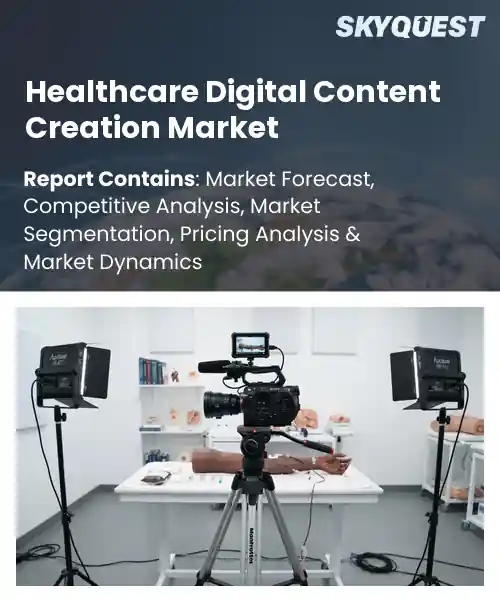
Healthcare Digital Content Creation Market
Report ID: SQMIG35G2552
Report ID: SQMIG35G2552
[email protected]
USA +1 351-333-4748
Report ID:
SQMIG35G2552 |
Region:
Global |
Published Date: August, 2026
Pages:
157
|Tables:
146
|Figures:
78


Global Healthcare Digital Content Creation Market size was valued at USD 4.82 Billion in 2024 and is poised to grow from USD 5.56 Billion in 2025 to USD 17.5 Billion by 2033, growing at a CAGR of 15.4% during the forecast period (2026-2033).
The Global Healthcare Content Creation market includes services that design, produce, and distribute medical videos, articles, apps, and simulations for patients, providers, and payers. Its importance lies in the shift toward patient care, where information drives engagement and outcomes. The driver is the adoption of telehealth, which exploded during the COVID‑19 pandemic and forced providers to replace in‑office brochures with online education. As broadband penetration rose, hospitals launched YouTube channels and Instagram feeds to explain procedures, while pharma firms invested in podcasts to convey drug mechanisms. This evolution turned static pamphlets into dynamic experiences that can be personalized in time. One factor shaping the market is the rise of AI‑powered content personalization, which converts health messages into narratives that resonate with preferences and clinical histories. AI algorithms analyze data from wearables and electronic health records, then automatically generate video scripts, infographics, or chat‑bot responses that match literacy levels and cultural contexts. This capability opens opportunities for insurers seeking to reduce claim costs by delivering guidance, and for biotech firms launching therapies that require onboarding. For example, a cardiology network uses an AI engine to produce exercise videos customized to patient risk profiles, resulting in increased adherence and lower readmission rates.
How are AI and automation reshaping healthcare digital content creation?
AI and automation are redefining how healthcare information is produced and delivered. Intelligent algorithms now generate patient education materials, clinical guidelines and marketing assets with speed that far exceeds manual processes. Natural‑language models tailor language to diverse audiences, ensuring clarity and cultural relevance while maintaining regulatory compliance. Automation pipelines link data sources to content platforms, allowing real‑time updates as medical evidence evolves. These capabilities reduce production costs, free clinicians to focus on care, and expand the reach of accurate health messaging across digital channels, driving broader adoption of evidence‑based content throughout the industry.In March 2024, a leading health‑tech firm launched an AI‑driven authoring suite that streamlines creation, review and distribution of clinical content, accelerating delivery and supporting the market’s rapid growth.
Market snapshot - (2026-2033)
Global Market Size
USD 4.82 Billion
Largest Segment
Software & Platforms
Fastest Growth
Services
Growth Rate
15.4% CAGR
To get more insights on this market click here to Request a Free Sample Report
Global healthcare digital content creation market is segmented by offering, content type, deployment mode, application, end user and region. Based on offering, the market is segmented into Software & Platforms and Services. Based on content type, the market is segmented into Text Content, Visual Content, Video Content and Interactive & Multimedia Content. Based on deployment mode, the market is segmented into Cloud-Based and On-Premises. Based on application, the market is segmented into Patient Education, Healthcare Marketing, Medical Training & Education, Clinical Communication and Scientific & Regulatory Content. Based on end user, the market is segmented into Hospitals & Healthcare Providers, Pharmaceutical & Biotechnology Companies, Medical Device Companies and Healthcare Agencies & Publishers. Based on region, the market is segmented into North America, Europe, Asia Pacific, Latin America and Middle East & Africa.
Software & Platforms segment leads because it consolidates content creation, management, and distribution within unified interfaces that leverage artificial intelligence for personalization. Providers value the ability to rapidly produce compliant assets while scaling across multiple channels, which reduces reliance on disparate tools. The integrated ecosystem also simplifies licensing and data governance, fostering trust among clinicians and regulators, accelerating adoption across the market and supporting continuous innovation across the sector.
Meanwhile, Services segment is witnessing the strongest growth momentum as providers outsource creative execution to specialized agencies. Demand for bespoke storytelling, regulatory review, and multilingual adaptation fuels this rise. Outsourced expertise accelerates time to market, expands content diversity, and creates new revenue streams, propelling broader market expansion for stakeholders globally.
Video Content segment stands out because it delivers high emotional impact and measurable comprehension, making it ideal for patient education and brand storytelling. Visual narratives simplify complex medical concepts, fostering trust and adherence. Healthcare marketers favor video for its shareability across digital channels, while clinicians appreciate its ability to illustrate procedures in a concise format. This utility drives widespread adoption and positions video as a driver of digital content strategies.
On the other hand, Interactive & Multimedia Content segment is emerging as a high‑growth area because immersive experiences are increasingly required for medical training and patient engagement. Advances in AR, VR and adaptive learning enable feedback and pathways, expanding use cases beyond static media. This dynamism fuels partnerships and accelerates content diversification, reshaping healthcare information consumption.
To get detailed segments analysis, Request a Free Sample Report
North America leads the market through a combination of sophisticated digital infrastructure, deep investment in health‑technology ecosystems, and a culture that embraces innovative patient engagement. The region benefits from a concentration of world‑class research institutions, leading technology firms, and a regulatory environment that encourages the development and dissemination of high‑quality digital health content. Strong collaboration between healthcare providers, content creators, and payers fuels continuous improvement, while a skilled workforce adept at blending clinical expertise with creative storytelling ensures that content remains both accurate and compelling. These strengths collectively reinforce North America’s position as the benchmark for digital health communication worldwide.
Healthcare Digital Content Creation Market in the United States thrives on a vibrant ecosystem where leading hospitals, technology giants, and specialized agencies intersect. The focus on personalized patient journeys drives the creation of interactive and data‑rich content, often integrated with artificial intelligence tools. Robust funding channels and a competitive landscape encourage rapid experimentation, while stringent quality standards maintain clinical credibility. This dynamic environment sustains a steady flow of innovative digital assets that support both preventive care and chronic disease management.
Healthcare Digital Content Creation Market in Canada is shaped by a universal health system that prioritizes equitable access to information. Content developers emphasize bilingual delivery, ensuring that both English and French speaking populations receive clear, culturally appropriate material. Strong privacy regulations guide the handling of patient data, fostering trust in digital platforms. Collaborative initiatives between provincial health authorities and creative firms promote the development of educational resources that align with public health goals, reinforcing Canada’s reputation for patient‑centered digital communication.
Europe’s expansion is propelled by coordinated digital health strategies, substantial research funding, and a multilingual environment that demands diverse content solutions. The region’s robust regulatory frameworks support the safe deployment of digital assets, while strong public health initiatives create a steady demand for educational material. Collaboration among leading universities, pharmaceutical companies, and creative agencies accelerates the production of high‑quality content tailored to varied cultural contexts. Additionally, the emphasis on patient empowerment and preventive care across European health systems fuels continuous investment in innovative digital storytelling, positioning Europe as a dynamic hub for health communication.
Healthcare Digital Content Creation Market in Germany benefits from a well‑established pharmaceutical sector and rigorous quality standards that guide content development. Integration with advanced digital health platforms enables the delivery of precise, evidence‑based information to both clinicians and patients. Collaborative networks between research institutions and creative firms foster the production of multilingual assets that address the country’s diverse population. This ecosystem supports a steady flow of sophisticated digital content that aligns with Germany’s commitment to clinical excellence and patient education.
Healthcare Digital Content Creation Market in the United Kingdom is energized by a national health service that actively embraces digital transformation. Rapid adoption of online health portals and public health campaigns creates a fertile ground for innovative content that reaches broad audiences. The country’s strong creative industry contributes high‑quality storytelling techniques, while partnerships with technology providers enable interactive and personalized experiences. This synergy accelerates the growth of digital health communication, positioning the United Kingdom as a leading driver of market expansion in Europe.
Healthcare Digital Content Creation Market in France is emerging as a vibrant sector supported by growing digital health startups and a focus on patient empowerment. Content creators prioritize culturally resonant narratives that address the specific health concerns of French audiences. Collaborative efforts between health authorities and media agencies enhance the reach of preventive health messages, while an increasing emphasis on multilingual resources expands accessibility. These developments signal a rising momentum that positions France as an important contributor to Europe’s digital health content landscape.
Asia Pacific advances its position through strategic government initiatives, high internet penetration, and a demographic shift toward aging populations that heighten demand for accessible health information. Nations in the region invest heavily in digital health infrastructure, fostering environments where innovative content can thrive. The convergence of cutting‑edge technology, such as mobile health applications and wearable devices, with culturally attuned storytelling creates compelling digital assets that resonate with diverse audiences. Collaborative ecosystems linking hospitals, tech firms, and creative agencies further accelerate the production of tailored content, reinforcing the region’s emerging leadership in digital health communication.
Healthcare Digital Content Creation Market in Japan focuses on delivering content that addresses the needs of an aging society. Emphasis on culturally sensitive narratives ensures relevance for older adults, while partnerships with technology firms enable the integration of interactive features and real‑time health monitoring data. Content developers prioritize clarity and simplicity, reflecting the country’s high standards for user experience. This approach supports the widespread adoption of digital health resources that enhance patient understanding and self‑management across the nation.
Healthcare Digital Content Creation Market in South Korea leverages the nation’s rapid digital adoption and high smartphone usage to disseminate health information swiftly. Creative agencies collaborate closely with tech innovators to produce engaging, preventive health content that resonates with a tech‑savvy population. The market benefits from a strong culture of innovation, where gamified health experiences and personalized messaging are commonplace. These dynamics drive the creation of dynamic digital assets that empower individuals to take proactive steps toward better health.
To know more about the market opportunities by region and country, click here to
Buy The Complete Report
Increasing Patient Engagement Platforms
Advancements In AI‑Powered Content
Regulatory Compliance Complexities
Limited Digital Literacy Among Stakeholders
Request Free Customization of this report to help us to meet your business objectives.
The Global Healthcare Digital Content Creation market is intensely competitive, driven by the surge in demand for personalized, AI‑generated clinical media. Leading firms accelerate growth through strategic M&A, such as Health Management Solutions’ acquisition of an AI content‑generation startup, and partnerships with EHR vendors to embed interactive modules, while investing heavily in proprietary video‑creation platforms to differentiate their offerings.
Top Player’s Company Profile
Recent Developments
SkyQuest’s ABIRAW (Advanced Business Intelligence, Research & Analysis Wing) is our Business Information Services team that Collects, Collates, Correlates, and Analyses the Data collected by means of Primary Exploratory Research backed by robust Secondary Desk research. As per SkyQuest analysis, the global healthcare digital content creation market is being propelled primarily by the surge in patient‑engagement platforms that demand high‑quality, personalized material, while AI‑driven content personalization serves as a second major catalyst by automating creation and adapting messages to individual clinical profiles. The market’s fastest growth is seen in North America where sophisticated digital infrastructure and strong health‑tech ecosystems fuel adoption. Within the market, software and platforms dominate because they integrate creation, management and AI‑based personalization in a single interface. However, strict regulatory compliance complexities can slow deployment and increase costs, tempering the overall expansion significantly.
| Report Metric | Details |
|---|---|
| Market size value in 2024 | USD 4.82 Billion |
| Market size value in 2033 | USD 17.5 Billion |
| Growth Rate | 15.4% |
| Base year | 2024 |
| Forecast period | (2026-2033) |
| Forecast Unit (Value) | USD Billion |
| Segments covered |
|
| Regions covered | North America (US, Canada), Europe (Germany, France, United Kingdom, Italy, Spain, Rest of Europe), Asia Pacific (China, India, Japan, Rest of Asia-Pacific), Latin America (Brazil, Rest of Latin America), Middle East & Africa (South Africa, GCC Countries, Rest of MEA) |
| Companies covered |
|
| Customization scope | Free report customization with purchase. Customization includes:-
|
To get a free trial access to our platform which is a one stop solution for all your data requirements for quicker decision making. This platform allows you to compare markets, competitors who are prominent in the market, and mega trends that are influencing the dynamics in the market. Also, get access to detailed SkyQuest exclusive matrix.
Table Of Content
Executive Summary
Market overview
Parent Market Analysis
Market overview
Market size
KEY MARKET INSIGHTS
COVID IMPACT
MARKET DYNAMICS & OUTLOOK
Market Size by Region
KEY COMPANY PROFILES
Methodology
For the Healthcare Digital Content Creation Market, our research methodology involved a mixture of primary and secondary data sources. Key steps involved in the research process are listed below:
1. Information Procurement: This stage involved the procurement of Market data or related information via primary and secondary sources. The various secondary sources used included various company websites, annual reports, trade databases, and paid databases such as Hoover's, Bloomberg Business, Factiva, and Avention. Our team did 45 primary interactions Globally which included several stakeholders such as manufacturers, customers, key opinion leaders, etc. Overall, information procurement was one of the most extensive stages in our research process.
2. Information Analysis: This step involved triangulation of data through bottom-up and top-down approaches to estimate and validate the total size and future estimate of the Healthcare Digital Content Creation Market.
3. Report Formulation: The final step entailed the placement of data points in appropriate Market spaces in an attempt to deduce viable conclusions.
4. Validation & Publishing: Validation is the most important step in the process. Validation & re-validation via an intricately designed process helped us finalize data points to be used for final calculations. The final Market estimates and forecasts were then aligned and sent to our panel of industry experts for validation of data. Once the validation was done the report was sent to our Quality Assurance team to ensure adherence to style guides, consistency & design.
Analyst Support
Customization Options
With the given market data, our dedicated team of analysts can offer you the following customization options are available for the Healthcare Digital Content Creation Market:
Product Analysis: Product matrix, which offers a detailed comparison of the product portfolio of companies.
Regional Analysis: Further analysis of the Healthcare Digital Content Creation Market for additional countries.
Competitive Analysis: Detailed analysis and profiling of additional Market players & comparative analysis of competitive products.
Go to Market Strategy: Find the high-growth channels to invest your marketing efforts and increase your customer base.
Innovation Mapping: Identify racial solutions and innovation, connected to deep ecosystems of innovators, start-ups, academics, and strategic partners.
Category Intelligence: Customized intelligence that is relevant to their supply Markets will enable them to make smarter sourcing decisions and improve their category management.
Public Company Transcript Analysis: To improve the investment performance by generating new alpha and making better-informed decisions.
Social Media Listening: To analyze the conversations and trends happening not just around your brand, but around your industry as a whole, and use those insights to make better Marketing decisions.
REQUEST FOR SAMPLE
 REQUEST FREE CUSTOMIZATION


Want to customize this report? This report can be personalized according to your needs. Our analysts and industry experts will work directly with you to understand your requirements and provide you with customized data in a short amount of time. We offer $1000 worth of FREE customization at the time of purchase.
Feedback From Our Clients


 USA (+1) 351-333-4748

