
Healthcare CRM Market
Report ID: SQMIG35G2316
Report ID: SQMIG35G2316
[email protected]
USA +1 351-333-4748
Report ID:
SQMIG35G2316 |
Region:
Global |
Published Date: February, 2025
Pages:
194
|Tables:
117
|Figures:
69


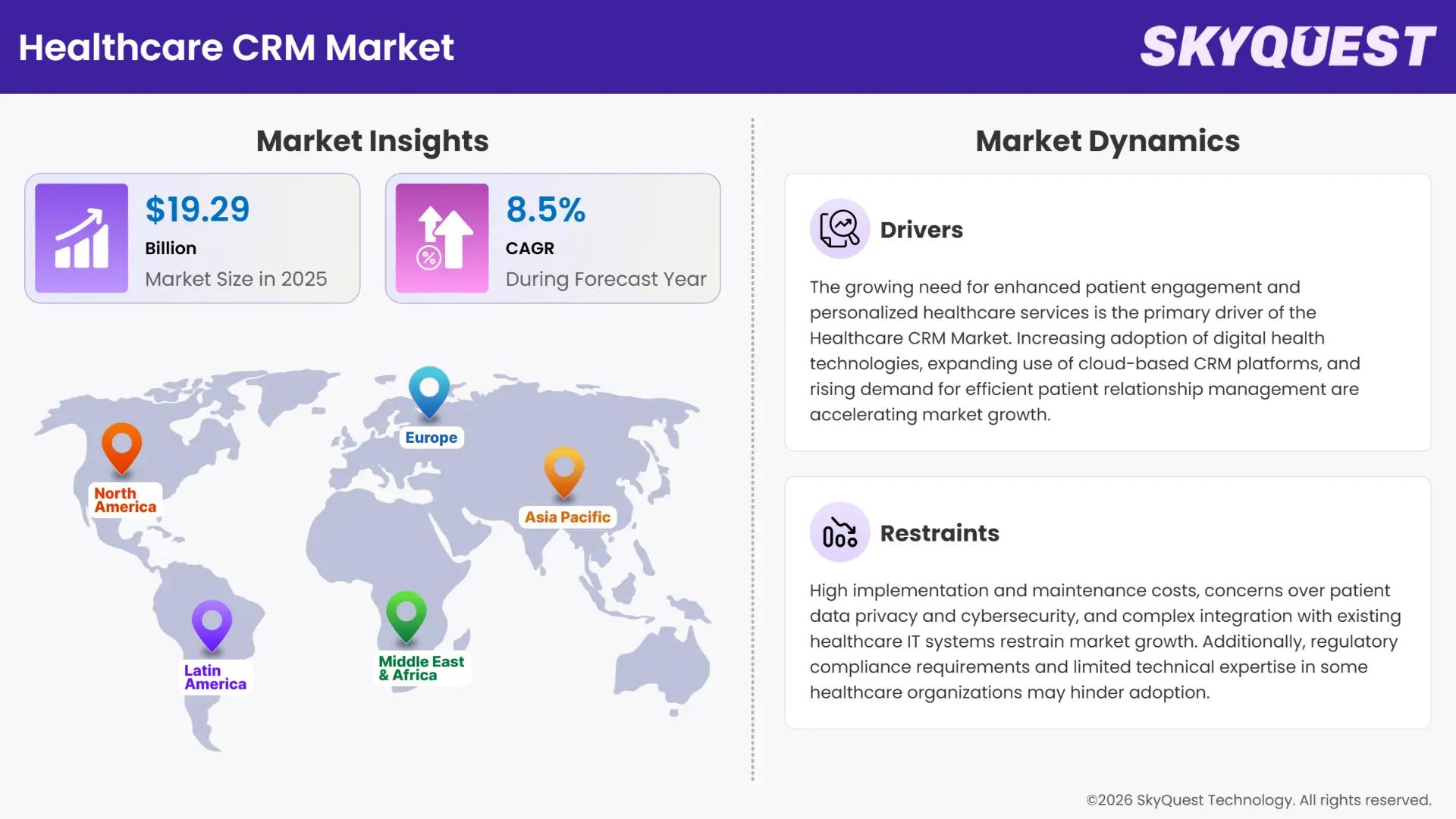
Global Healthcare CRM Market size was valued at USD 17.78 Billion in 2024 and is poised to grow from USD 19.29 Billion in 2025 to USD 37.06 Billion by 2033, growing at a CAGR of 8.5% during the forecast period (2026–2033).
Key Takeaways: Market Trends & Insights
The increasing utilization of digital health technologies is driving the healthcare CRM market growth. In recent times, the medical sector is using technologies like electronic health records, telemedicine, and mobile, along with the incorporation of AI and ML for improving operational efficiency and patient care, which is boosting the market.
The healthcare CRM services is offering various kinds of tools and services that can efficiently improve and increase communication between patients and healthcare providers, increasing its demand in the medical field. These CRM tools consist of messaging services, text messages, comment forms, online forms, and emails. In recent times, many healthcare organizations are utilizing these CRM platforms because they help in reducing the manpower for decreasing any risk of error, achieve more profitability, and improve the channels of communication. Such benefits offered by the CRM tools is making them more popular among healthcare sector globally, which is driving the growth of the market.
Moreover, CRM also offers marketing automation, sales force automation, and service automation. The healthcare customer relationship management system is mostly used in public clinics, hospitals, private clinic, and different research labs.
CRM also has the potential for automating various processes like appointment reminders, billing notifications, and follow-ups, which are especially beneficial for reducing administrative expenses. The CRM systems can also conduct patient segmentation, allowing medical providers to target specific groups with tailored communications, which is increasing its demand in the medical sector leading to the market growth.
In the last few years, the popularity of healthcare CRM has immensely increased because of patient-centric care and digital technology. Medical providers are moving towards CRM systems for better management of patient data and interacting with patients, which is driving the healthcare CRM market growth. These systems have improved the departmental integration, reduced expenses, and increased patient satisfaction, driving its usage in the medical sector.
However, the majority of such tools do not possess efficient interoperability. They frequently function independently and hardly engage in communication. This leads to laborious and mistake-prone human input of data and coordination. Heightening the cognitive burden on healthcare providers and impeding overall efficiency. Their technology helps in instantly organizing patient data across various applications, such as electronic health records (EHRs), CRM systems, and billing software. The incorporation of different instruments is vital for decreasing manual labor in patient care, which can improve therapeutic results. Keragon is a specialized workflow automation solution that caters to the healthcare business.
To get more insights on this market click here to Request a Free Sample Report
Global Healthcare CRM Market is segmented by Type, Component, Mode of Delivery, End-User, Application and region. Based on Type, the market is segmented into Operational CRM, Analytical CRM and Collaborative CRM. Based on Component, the market is segmented into Software and Service. Based on Mode of Delivery, the market is segmented into Cloud-Based and On-Premise. Based on End-User, the market is segmented into Healthcare Providers, Healthcare Payers and Life Sciences Companies. Based on Application, the market is segmented into Communication Module, Patient Management, Task Management and Report Module. Based on region, the market is segmented into North America, Europe, Asia Pacific, Latin America and Middle East & Africa.
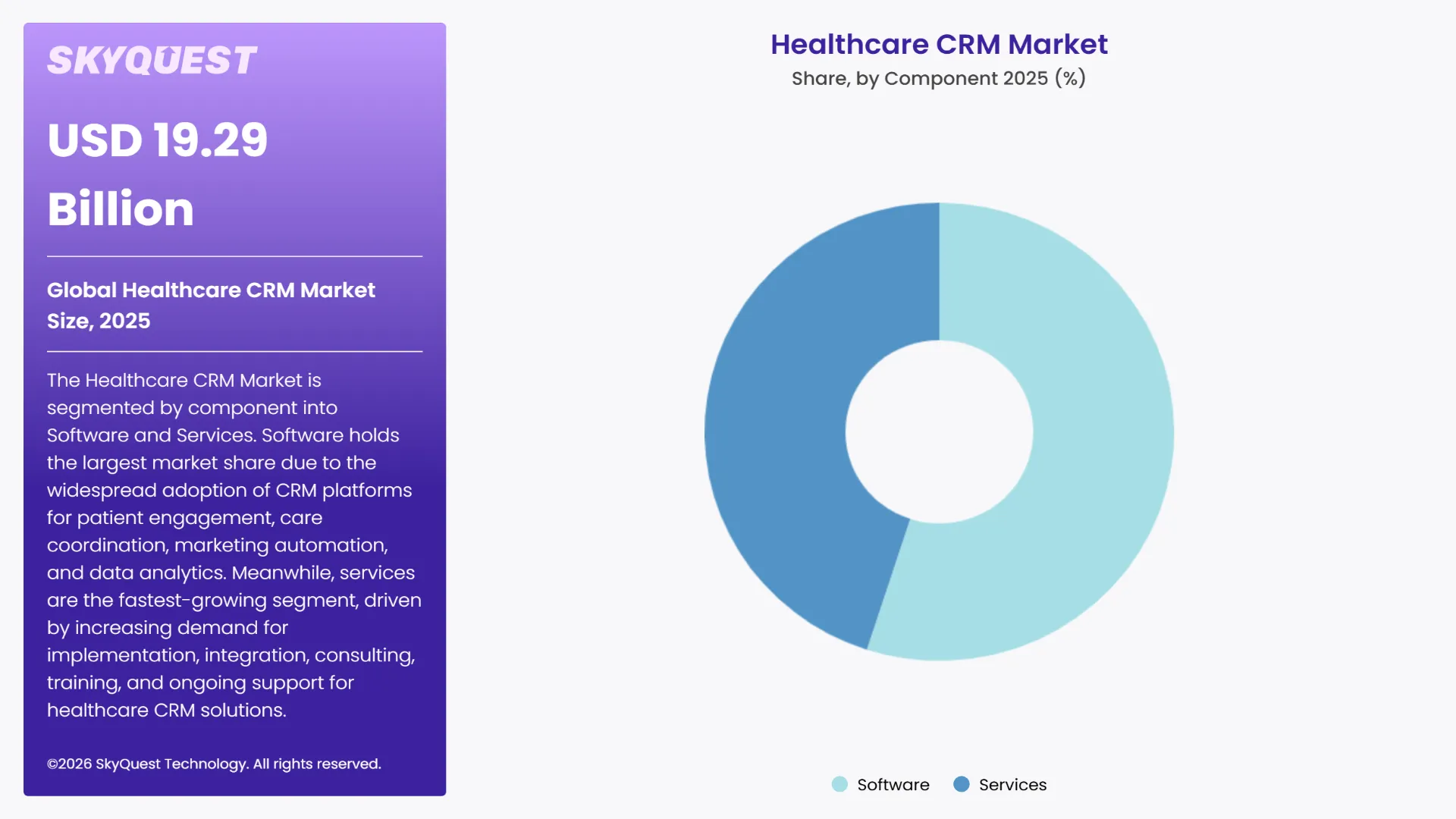
Based on component, the software segment is dominating with the largest healthcare CRM market share. The growing adoption of digital solutions for improving patient engagement, improve workflows, and enhance data-drive decision making abilities is increasing the demand for software in the healthcare CRM. Furthermore, facilities like hospitals, clinics, and pharmaceutical organizations are increasingly dependent on CRM software. This is because it can smoothen operations, automate administrative activities, and facilities real-time interaction. Moreover, the popularity of the cloud-based software solution is increasing because of its flexibility, cost-efficiency, and potential to incorporate with present healthcare IT systems. The dominance of the segment is also increasing due to the rising demand for AI-based CRM platforms with predictive analytics and automated marketing features.
The service segment is expected to witness significant demand growth during the forecast period. The demand for professional services like consulting, training, and present technical support is increasing because of the growing complexity of CRM implementation and incorporation with current system. Moreover, medical organizations are immensely dependent on managed services because it helps in making smooth system functionality, compliance with data security, and improving workflow. Furthermore, with the development of CRM platforms, the healthcare providers also need specialized training and customized services for improving the operational advantages, which is leading to the growth of the segment in the market.
Based on deployment mode, the cloud/web-based segment is dominating the healthcare CRM market. The increasing adoption of cloud technologies, digitalization of medical care, and initiatives taken by prominent companies are increasing the demand for the cloud/web-based segment in the market. The leading providers of cloud-based CRM solutions are IBM, SAP, Accenture, Cerner, Salesforce, and more.
As per the healthcare CRM market analysis, the on-premise segment is expected to be the fastest growing segment. The on-premise segment consists of server hardware, software licenses, integration abilities, and internal IT staff that can be managed within the premises of the medical facilities. The demand for on-premise segment is increasing due to its various features like increasing sales ability, streamline management, reporting & dashboards, and process automation.
However, even with its rising popularity there is an indication of decrease in the adoption of on-premise solutions because of the growing shift towards cloud-based options for improved efficiency in operations. But the on-premise CRM software is also growing steadily because it provides complete control over the systems and processes. It also helps in reducing the expenses of the systems, contributing to the growth of the market.
To get detailed segments analysis, Request a Free Sample Report
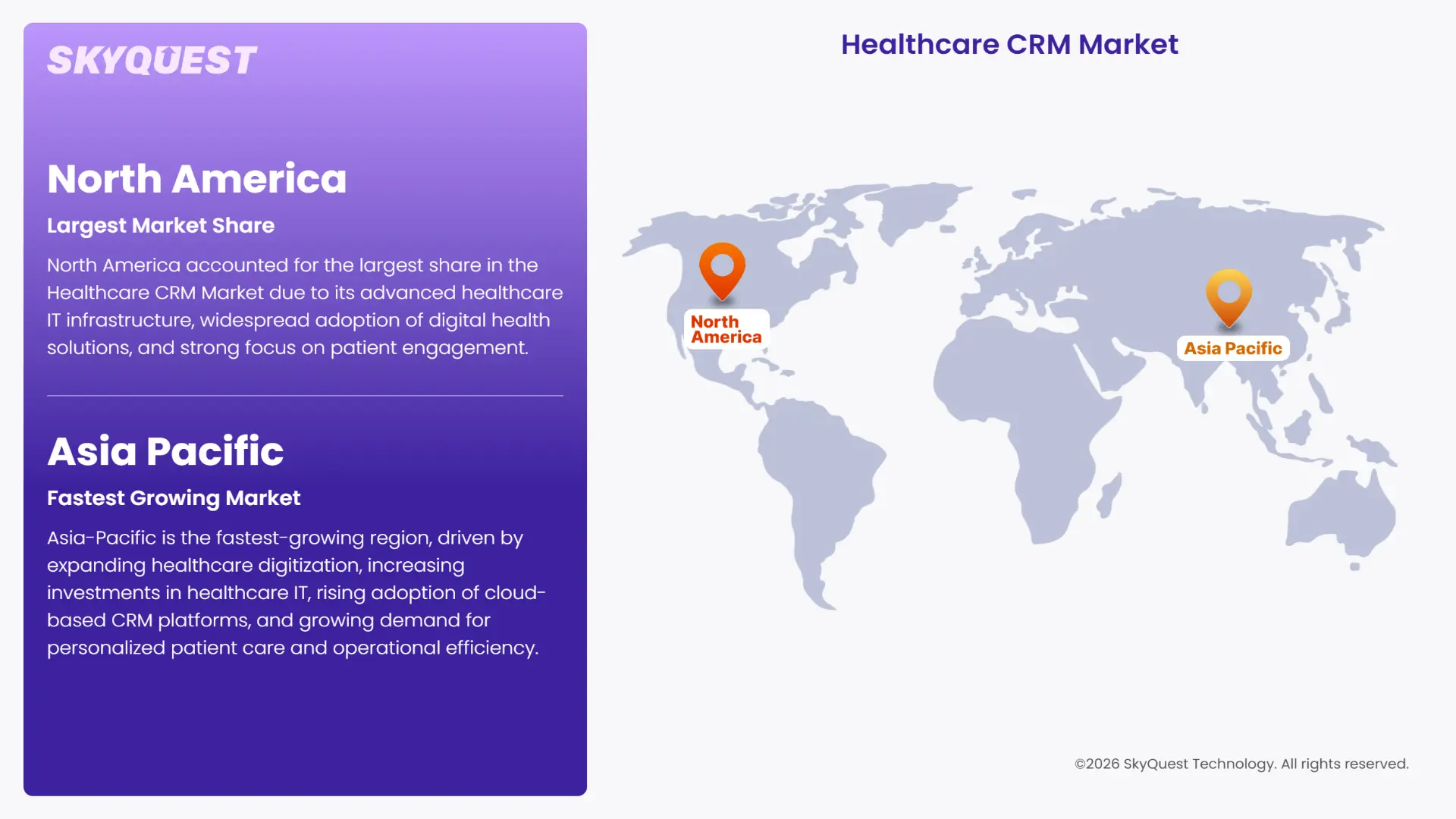
North America is dominating with the largest healthcare CRM market share. The healthcare CRM market is dominating in North America because it is a huge competitor with its massive pool of established digital companies and hospitals. The region is witnessing an increasing use of healthcare CRM to streamline the operational process in the medical sector and provide better satisfaction to the patients.
The medical sector in countries like the US and Canada is constantly trying to improve their data management process with the help of efficient CRM solutions. The hospitals are also dealing with massive amount of patient data that they must secure while maintaining the HIPPAA regulations. Therefore, the increasing use of CRM solutions in the medical sector of this region is helping them in maintaining data confidentiality.
The Asia Pacific is anticipated to witness highest growth during the healthcare CRM market forecast period. Asia-Pacific is considered as the fastest growing region in the global health care industry owing to the rising investors' interest in the industry. The market is further becoming more transitional, driving these companies to establish operations in emerging countries such as India. This rise in the number of hospitals would require installing computerized records systems and other software to simplify the processes and therefore be attributed to market growth. Yet, the developing nations invest a substantial significance in erecting their domestic healthcare infrastructure. This development is anticipated to attract numerous investors and goad the development of the nation's industry.
The healthcare CRM market in Europe is witnessing immense growth because of the implementation of stricter laws, rising focus on patient-centric treatment, and the growing requirement for efficiently controlling healthcare expenditures. The general data protection regulation of the European Union is inspiring the medical providers to incorporate advanced CRM systems for safe data management. Furthermore, countries like Germany, the UK, and France are dominating the market with strong medical systems and government programs for digitalizing healthcare services. Moreover, efficient patient management systems are important because of the increasing prevalence of chronic diseases like diabetes and cardiovascular. The CRM technologies are also assisting the medical providers in managing healthcare services in Europe by reducing administrative burdens and enhancing patient results.
In Latin America the growing demand for operational efficiency, the increasing usage of telemedicine, and government initiatives for increasing medical accessibility for boosting the healthcare CRM market. Countries like Brazil and Mexico are leading the market because of the increasing growth of their private healthcare sector. The medical centers are implementing CRM systems for improving patient interaction because of the increasing usage of smartphones. Furthermore, the CRM solutions are also necessary for efficiently managing patient schedules due to the rapid growth of medical tourism is also boosting the market growth in the region.
The medical CRM market is Middle East and Africa is growing because of the growing expenditure in healthcare, rising demand for digital health solutions, and the necessity for improving patient experiences. Government programs such as Saudi Arabia’s Vision 2023o and UAE’s is increasing the adoption of healthcare CRM in countries like UAE and Saudi Arabia. These programs are trying to improve the medical services and modernize healthcare systems. Furthermore, now CRM solutions also have the opportunity for improving patient interaction and data management because of increasing usage of telemedicine and mobile health apps.
To know more about the market opportunities by region and country, click here to
Buy The Complete Report
Increasing Adoption of Patient-Centric Method
Streamlining Operational Processes
High Expense of Implementation
Rising Concern about Security
Request Free Customization of this report to help us to meet your business objectives.
The key players in the market are introducing advanced technologies for providing improved health and safety to individuals by smoothening various processes. They are engaging in partnerships and collaborations for providing enhanced healthcare facilities to a vast range of consumers across the globe. In addition, major players are introducing platforms that allow users to schedule and launch virtual appointments that benefit in eliminating physical barriers while enhancing patient convenience and satisfaction. Apart from this, they are integrating advanced technologies, such as AI, the Internet of Things (IoT), data analytics, NLP, and ML. These technologies benefit healthcare providers for improved decision-making regarding the care of patients.
Increasing Technological Advancements
Increasing Adoption of Digital Health Technologies
SkyQuest’s ABIRAW (Advanced Business Intelligence, Research & Analysis Wing) is our Business Information Services team that Collects, Collates, Correlates, and Analyses the Data collected by means of Primary Exploratory Research backed by robust Secondary Desk research.
As per SkyQuest analysis, healthcare CRM systems have a wide range of applications, including patient relationship management, appointment scheduling, billing and insurance, marketing and outreach, and compliance management. The CRM systems help the healthcare companies to provide personalized care, decrease expense, and improve business result by centralizing patient information, smoothening interaction, and enhancing operational efficiency. Furthermore, artificial intelligence and machine learning is also assisting the CRM systems for analyzing massive amount of data, recognizing patterns, and offering valuable information, which is increasingly boosting the healthcare CRM industry growth. Moreover, incorporation with other healthcare technologies like electronic health records and telemedicine is also increasing the importance of the CRM systems, contributing to the expansion of the market.
| Report Metric | Details |
|---|---|
| Market size value in 2024 | USD 17.78 Billion |
| Market size value in 2033 | USD 37.06 Billion |
| Growth Rate | 8.5% |
| Base year | 2024 |
| Forecast period | 2026–2033 |
| Forecast Unit (Value) | USD Billion |
| Segments covered |
|
| Regions covered | North America (US, Canada), Europe (Germany, France, United Kingdom, Italy, Spain, Rest of Europe), Asia Pacific (China, India, Japan, Rest of Asia-Pacific), Latin America (Brazil, Rest of Latin America), Middle East & Africa (South Africa, GCC Countries, Rest of MEA) |
| Companies covered |
|
| Customization scope | Free report customization with purchase. Customization includes:-
|
To get a free trial access to our platform which is a one stop solution for all your data requirements for quicker decision making. This platform allows you to compare markets, competitors who are prominent in the market, and mega trends that are influencing the dynamics in the market. Also, get access to detailed SkyQuest exclusive matrix.
Table Of Content
Executive Summary
Market overview
Parent Market Analysis
Market overview
Market size
KEY MARKET INSIGHTS
COVID IMPACT
MARKET DYNAMICS & OUTLOOK
Market Size by Region
KEY COMPANY PROFILES
Methodology
For the Healthcare CRM Market, our research methodology involved a mixture of primary and secondary data sources. Key steps involved in the research process are listed below:
1. Information Procurement: This stage involved the procurement of Market data or related information via primary and secondary sources. The various secondary sources used included various company websites, annual reports, trade databases, and paid databases such as Hoover's, Bloomberg Business, Factiva, and Avention. Our team did 45 primary interactions Globally which included several stakeholders such as manufacturers, customers, key opinion leaders, etc. Overall, information procurement was one of the most extensive stages in our research process.
2. Information Analysis: This step involved triangulation of data through bottom-up and top-down approaches to estimate and validate the total size and future estimate of the Healthcare CRM Market.
3. Report Formulation: The final step entailed the placement of data points in appropriate Market spaces in an attempt to deduce viable conclusions.
4. Validation & Publishing: Validation is the most important step in the process. Validation & re-validation via an intricately designed process helped us finalize data points to be used for final calculations. The final Market estimates and forecasts were then aligned and sent to our panel of industry experts for validation of data. Once the validation was done the report was sent to our Quality Assurance team to ensure adherence to style guides, consistency & design.
Analyst Support
Customization Options
With the given market data, our dedicated team of analysts can offer you the following customization options are available for the Healthcare CRM Market:
Product Analysis: Product matrix, which offers a detailed comparison of the product portfolio of companies.
Regional Analysis: Further analysis of the Healthcare CRM Market for additional countries.
Competitive Analysis: Detailed analysis and profiling of additional Market players & comparative analysis of competitive products.
Go to Market Strategy: Find the high-growth channels to invest your marketing efforts and increase your customer base.
Innovation Mapping: Identify racial solutions and innovation, connected to deep ecosystems of innovators, start-ups, academics, and strategic partners.
Category Intelligence: Customized intelligence that is relevant to their supply Markets will enable them to make smarter sourcing decisions and improve their category management.
Public Company Transcript Analysis: To improve the investment performance by generating new alpha and making better-informed decisions.
Social Media Listening: To analyze the conversations and trends happening not just around your brand, but around your industry as a whole, and use those insights to make better Marketing decisions.
REQUEST FOR SAMPLE
 REQUEST FREE CUSTOMIZATION
Healthcare CRM Market size was valued at USD 17.78 Billion in 2024 and is poised to grow from USD 19.29 Billion in 2025 to USD 37.06 Billion by 2033, growing at a CAGR of 8.5% during the forecast period (2026–2033).
Key vendors in the Healthcare CRM Market include Salesforce, Inc., Oracle Corporation, Microsoft Corporation, SAP SE, Zoho Corporation, Pegasystems Inc., SugarCRM Inc., Creatio, NICE Ltd., and Healthgrades, Inc.. These companies provide healthcare CRM solutions for patient engagement, care coordination, marketing automation, customer relationship management, analytics, and omnichannel communication, helping healthcare organizations improve patient experiences and operational efficiency.
The key driver of the Healthcare CRM Market is the growing need for enhanced patient engagement and personalized healthcare services. Increasing adoption of digital health technologies, rising demand for efficient patient relationship management, expanding use of cloud-based CRM platforms, and the growing focus on improving care coordination and patient satisfaction are driving market growth.
The key market trend in the Healthcare CRM Market is the increasing integration of artificial intelligence (AI), cloud computing, and advanced analytics into CRM platforms. Healthcare providers are adopting AI-driven patient engagement, predictive analytics, omnichannel communication, and automation tools to deliver personalized care, improve operational efficiency, and enhance patient retention.
North America accounted for the largest share in the Healthcare CRM Market due to its advanced healthcare IT infrastructure, widespread adoption of digital health technologies, strong presence of leading CRM solution providers, and increasing focus on patient engagement. Favorable regulatory initiatives, high healthcare spending, and growing adoption of cloud-based healthcare solutions further strengthen the region's market leadership.


Want to customize this report? This report can be personalized according to your needs. Our analysts and industry experts will work directly with you to understand your requirements and provide you with customized data in a short amount of time. We offer $1000 worth of FREE customization at the time of purchase.
Feedback From Our Clients


 USA (+1) 351-333-4748

