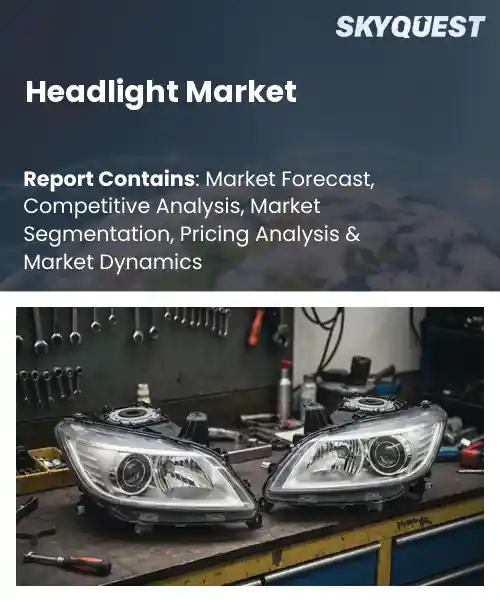
Headlight Market
Report ID: SQMIG25A2825
Report ID: SQMIG25A2825
[email protected]
USA +1 351-333-4748
Report ID:
SQMIG25A2825 |
Region:
Global |
Published Date: July, 2026
Pages:
157
|Tables:
88
|Figures:
76


Global Headlight Market size was valued at USD 8.8 Billion in 2024 and is poised to grow from USD 9.24 Billion in 2025 to USD 13.59 Billion by 2033, growing at a CAGR of 4.95% during the forecast period (2026-2033).
Headlight market worldwide is made up of all the producers and suppliers of lighting products for passenger cars, commercial vehicles, motorcycles, and future autonomous cars. Its importance is justified by safety rules, consumer demand for enhanced visibility at night time, and transition to efficient lighting systems. The history of the industry saw dominance of halogen lamps; however, the emergence of high-intensity discharge lamps in the beginning of the 2000s and LED lamps since 2015 brought about its development. As an example, a European safety directive in 2018 required adaptive headlamps, so companies like Volkswagen redesigned their cars' lighting equipment; consequently, their suppliers increased capacity of production.
The global headlight market is made up of all the producers and suppliers of lighting products for passenger cars, commercial vehicles, motorcycles, and future autonomous cars. Its importance is justified by safety rules, consumer demand for enhanced visibility at nighttime, and transition to efficient lighting systems. The history of the industry saw dominance of halogen lamps; however, the emergence of high-intensity discharge lamps in the beginning of the 2000s and LED lamps since 2015 brought about its development. As an example, a European safety directive in 2018 required adaptive headlamps, so companies like Volkswagen redesigned their cars' lighting equipment; consequently, their suppliers increased capacity of production.
How is AI Integration Influencing the Automotive Headlight Market?
The integration of AI in automotive headlights is making them intelligent, shifting from conventional light sources to smart ones which interact with the environment while driving. Through sensors, data concerning speed, weather, and road curvature will be fed into machine learning models and then beam patterns will be adjusted in real-time to improve visibility but reduce any form of glaring for other motorists. This dynamic system helps to make it possible for adaptive matrix LEDs to direct lights on areas that need it and dim any area that could create distractions. The technology has been used to develop ways in which the vehicle consumes less energy, thereby meeting the energy efficiency standards. With connected vehicles, over-the-air software updates can be done to upgrade the headlight algorithms.
Market snapshot - (2026-2033)
Global Market Size
USD 8.8 Billion
Largest Segment
Laser High Beam Module
Fastest Growth
Adaptive Laser Headlight
Growth Rate
4.95% CAGR
To get more insights on this market click here to Request a Free Sample Report
Global headlight market is segmented by illumination technology, vehicle segment application, sales distribution architecture and region. Based on illumination technology, the market is segmented into Halogen Headlights. Based on vehicle segment application, the market is segmented into Passenger Vehicles, Light Commercial Vehicles, Heavy Commercial Vehicles and Two-Wheelers Motorbikes. Based on sales distribution architecture, the market is segmented into Original Equipment Manufacturer Factory Integration and Aftermarket Customization Replacement Supply Channels. Based on region, the market is segmented into North America, Europe, Asia Pacific, Latin America and Middle East & Africa.
Passenger Vehicles dominate because they contribute to high installation volumes of headlights due to continuous model changes and the requirement for safety and styling of vehicles. Vehicle producers invest a lot of effort in the development of innovative lighting for passenger vehicles, and this is done right at the initial stages of production; hence, it results in a reliable source of demand. This stimulates investments in research and supply chains.
The growth drivers of the Two-Wheelers Motorbikes sub-segment are high growth rates due to the change in urban transport to compact and fuel-efficient transportation. Consumers and companies use slim low consumption headlamps, which results in fast product innovation cycles.
Original Equipment Manufacturer Factory Integration is at the top because this category integrates the manufacturing of headlights into vehicle assembly lines. It ensures that the parts perfectly match, and that quality control measures run simultaneously. This integration decreases lead time and also helps in coordinating the engineering of components and vehicles, thus making manufacturers agree to higher volumes early in the design process. As a result, economies of scale and reliable supply chain make this category critical for shaping the market structure of the whole ecosystem.
In contrast, Aftermarket Customization Replacement Supply Chains have become the most important growing segment as vehicle owners require customization and replacement of headlights. In addition to traditional supply chains, there are now many independent distributors and online retailers that promote innovative cycles of different design development.
To get detailed segments analysis, Request a Free Sample Report
The Asia Pacific region is the dominant player in the headlight industry in the world, owing to a combination of state-of-the-art automobile engineering, fast and bold adoption of advanced lighting technology, and a solid manufacturing environment. This region gets the benefit of huge spending on research and development activities by the original equipment manufacturers, and the supply chain focuses on high-quality optics, LEDs, and lasers-based lighting products. On the consumer side, there is a continuous push from end-users for safety and good designs of headlights, while the favorable regulation in the area encourages intelligent headlights.
Characteristics of the Headlight Market in Japan include an in-depth combination of technical competence in optics and a high standard of automobile manufacturing culture. The local manufacturers focus on advanced lighting technologies that improve the look and safety of vehicles, resulting in faster implementation of the laser headlights technology. Coordinated activities of the automakers and parts providers stimulate innovations, while a robust testing infrastructure provides for their thorough validation. Such conditions enable a reliable supply chain that delivers superior headlights solutions worldwide.
The South Korean Headlights Market operates under the influence of a fast cycle of technologies implementation and government support for the latest components of automobiles. The fact that South Korea concentrates on LED and laser headlights corresponds to the country’s strategy of concentrating on electronic convergence and intelligent automobiles. South Korean companies are successful in making the products small-sized and effective in terms of energy use, which allows using adaptive lighting in various vehicles.
The North American headlight market is expanding very quickly due to the high demands from consumers for safety, quality, and connectivity. The inclusion of adaptive lighting technology, high-performance LEDs, and infrastructure to vehicle communications makes product differentiation possible. Regulatory support for more efficient lighting technologies and mandatory safety measures force auto manufacturers to include sophisticated headlights into their products. In addition, the dynamic aftermarket and the desire of customers to customize their cars are also encouraging innovation. Cooperation between automobile manufacturers and technology leaders also facilitates the development of innovative lighting products.
The US Headlight Market will be driven by the presence of a highly competitive automobile industry that values technology and safety performance. The heavy investment made in adaptive headlight controls and laser lighting by leading manufacturers is consistent with the trend towards high-quality lighting by consumers. The active after-market industry adds to the demand for headlights through many different choices for retrofits. Collaboration between OEMs and silicon-sensor providers helps foster smart lighting eco-systems, cementing the US position as an engine for growth.
The Headlight Market in Canada is an indication of a heightened level of importance being placed on performance and durability in different weather situations. The auto manufacturers pay great attention to those solutions for vehicles that will provide better visibility even in difficult weather conditions and use such advanced technologies as LEDs and adaptive lights. The concern with safety standards makes manufacturers implement advanced lighting systems in their innovations. In addition, the increasing number of innovations in the electric car segment adds up to it.
The presence of strict safety legislation, a tradition of engineering precision, and sustainable lighting technology is what helps Europe establish itself in the headlight market. Companies benefit from the know-how related to optics and photonics by designing advanced energy-efficient lighting systems which are in line with the European standards. The emphasis on environmental considerations prompts the switch to low-energy consumption LEDs and lasers, whereas collaboration between automotive companies, universities, and technological clusters fosters innovation. Additionally, well-developed distribution networks and customers’ interest in aesthetically pleasing cars are contributing to Europe’s growing influence in headlightindustry.
German headlights market can be characterized by high standards of automotive quality and optical engineering. German car makers excel in combining laser and adaptive LEDs technologies with an emphasis on beam accuracy and power saving. The synergy between the Original Equipment Manufacturers (OEMs) and dedicated suppliers of components guarantees fast prototype development and thorough testing, which makes it possible to equip vehicles with highly advanced lights.
Market for Headlights in the United Kingdom is supported by a thriving environment where the heritage of traditional automobile manufacturing coexists with innovative digital technology. British companies focus on the production of intelligent headlights designed to interact smoothly with advanced driving assistance programs. Joint efforts of the car industry and tech start‑ups foster the development of adaptive lighting and lasers. The combination of these two aspects enhances the role of the United Kingdom in the European market for headlight systems.
France's Headlight Market is focused on the beauty aspect as well as compliance with regulations and standards and thus facilitates the development of highly efficient LED and laser light systems. The designers of French car manufacturers combine the beauty aspect with the functional one by implementing the advanced design approach. Incentives for the development of eco-friendly cars promote the development of energy-saving lights. Effective cooperation with European research organizations contributes to innovation in the field.
To know more about the market opportunities by region and country, click here to
Buy The Complete Report
Increasing Vehicle Automation Adoption
With increasing driver assistance and autonomy features, there will be a need for better lighting solutions and thus adaptive LED or laser lights which will change their beam pattern depending on specific conditions. This need pushes OEMs to innovate continuously, grow their product portfolios, and develop lighting modules, hence promoting market growth since the vehicles will increasingly need advanced headlights. Moreover, regulations encouraging improved lighting requirements push OEMs towards adopting better lighting solutions, hence accelerating market growth.
Stringent Safety Regulations Worldwide
There is a rise in the trend of making performance requirements for night-time visibility and glare reduction compulsory by global regulatory bodies, which makes it necessary for car manufacturers to fit their automobiles with headlights having high efficiency. The requirement of complying with such standards encourages development and production of headlights using LEDs and lasers due to their higher luminous efficiency and controlled light emission properties. Compliance with such standards helps manufacturers to increase their sales and makes them stand out from others because of compliance.
High Component Cost Barriers
The intricate assembly of LEDs and lasers in modern headlight fixtures includes complicated semiconductor wafers, optical elements, and thermal management techniques, which make such systems more expensive in production than ordinary halogen lamps. High costs become an obstacle to competitiveness and prevent their installation on affordable cars, causing automakers to delay the adoption process or install advanced headlights as options. This pricing policy negatively impactsmarket expansion and volume growth due to the need to combine the ability to offer distinctive features with high pricing.
Complex Integration and Reliability Issues
The incorporation of efficient lighting systems into the vehicles' electrical architecture requires careful coordination with the power management systems and sensor fusion systems along with ECU, making design complicated. Any problem with the efficiency of the illumination system may cause safety hazards and regulatory issues for the manufacturer. This would result in extended engineering efforts and extensive testing of durability before product launch, which discourages the quick introduction of efficient lighting systems and thus affects the growth of the market.
Request Free Customization of this report to help us to meet your business objectives.
Leading global headlight providers are escalating competition via strategic mergers and acquisitions, collaborations, and quick adaptation of laser and matrix LED systems. Recent mergers and acquisitions (such as an acquisition of a niche provider of adaptive lighting systems by a large OEM) and strategic collaborations (tier 1 suppliers and auto technology startups) are speeding up product differentiation and time-to-market processes. Luminova Lighting: Founded in 2020, its primary goal is to design ultra‑compact laser headlight modules for EVs. Recent achievement: received a Series B investment of $45 million and released a laser headlamp system that is ready for mass production for one of the leading EV manufacturers.
Advanced Led Integration: The automotive sector is quickly embracing LED technology for headlights due to consumer desires for greater brightness, durability, and energy savings. Automotive firms are changing their approach to car headlight design to incorporate smaller LED components, thus allowing creative design cues and adaptability of the headlight function. This trend promotes cooperation between automotive manufacturers and parts suppliers to incorporate smarter control systems for real-time beam shaping to improve road safety.
Smart Adaptive Lighting Systems: New smart headlights use sensor information, artificial intelligence techniques, and networking technologies to intelligently control the lighting pattern according to driving conditions, traffic situations, and weather changes. Such innovations enhance visibility of the driver and minimize the dazzle of oncoming vehicles and conform to safety standards and demands for advanced technology from customers. With an increased reliance on automotive platforms, the developers of headlights are increasingly developing upgradeable platforms that support over-the-air software updates.
SkyQuest’s ABIRAW (Advanced Business Intelligence, Research & Analysis Wing) is our Business Information Services team that Collects, Collates, Correlates, and Analyses the Data collected by means of Primary Exploratory Research backed by robust Secondary Desk research.
As per SkyQuest analysis, the global headlight industry is driven by the swift adoption of vehicle automation technologies, which require advanced headlamps based on LED and lasers, with another major driving factor being safety rules imposed worldwide. The high cost of headlight components is the key constraint affecting this industry. Asia Pacific leads this market owing to its advanced research and development facilities and substantial manufacturing capacity. Passenger cars are the dominant segment, as they use the maximum number of headlamps among all types of vehicles.
| Report Metric | Details |
|---|---|
| Market size value in 2024 | USD 8.8 Billion |
| Market size value in 2033 | USD 13.59 Billion |
| Growth Rate | 4.95% |
| Base year | 2024 |
| Forecast period | (2026-2033) |
| Forecast Unit (Value) | USD Billion |
| Segments covered |
|
| Regions covered | North America (US, Canada), Europe (Germany, France, United Kingdom, Italy, Spain, Rest of Europe), Asia Pacific (China, India, Japan, Rest of Asia-Pacific), Latin America (Brazil, Rest of Latin America), Middle East & Africa (South Africa, GCC Countries, Rest of MEA) |
| Companies covered |
|
| Customization scope | Free report customization with purchase. Customization includes:-
|
To get a free trial access to our platform which is a one stop solution for all your data requirements for quicker decision making. This platform allows you to compare markets, competitors who are prominent in the market, and mega trends that are influencing the dynamics in the market. Also, get access to detailed SkyQuest exclusive matrix.
Table Of Content
Executive Summary
Market overview
Parent Market Analysis
Market overview
Market size
KEY MARKET INSIGHTS
COVID IMPACT
MARKET DYNAMICS & OUTLOOK
Market Size by Region
KEY COMPANY PROFILES
Methodology
For the Headlight Market, our research methodology involved a mixture of primary and secondary data sources. Key steps involved in the research process are listed below:
1. Information Procurement: This stage involved the procurement of Market data or related information via primary and secondary sources. The various secondary sources used included various company websites, annual reports, trade databases, and paid databases such as Hoover's, Bloomberg Business, Factiva, and Avention. Our team did 45 primary interactions Globally which included several stakeholders such as manufacturers, customers, key opinion leaders, etc. Overall, information procurement was one of the most extensive stages in our research process.
2. Information Analysis: This step involved triangulation of data through bottom-up and top-down approaches to estimate and validate the total size and future estimate of the Headlight Market.
3. Report Formulation: The final step entailed the placement of data points in appropriate Market spaces in an attempt to deduce viable conclusions.
4. Validation & Publishing: Validation is the most important step in the process. Validation & re-validation via an intricately designed process helped us finalize data points to be used for final calculations. The final Market estimates and forecasts were then aligned and sent to our panel of industry experts for validation of data. Once the validation was done the report was sent to our Quality Assurance team to ensure adherence to style guides, consistency & design.
Analyst Support
Customization Options
With the given market data, our dedicated team of analysts can offer you the following customization options are available for the Headlight Market:
Product Analysis: Product matrix, which offers a detailed comparison of the product portfolio of companies.
Regional Analysis: Further analysis of the Headlight Market for additional countries.
Competitive Analysis: Detailed analysis and profiling of additional Market players & comparative analysis of competitive products.
Go to Market Strategy: Find the high-growth channels to invest your marketing efforts and increase your customer base.
Innovation Mapping: Identify racial solutions and innovation, connected to deep ecosystems of innovators, start-ups, academics, and strategic partners.
Category Intelligence: Customized intelligence that is relevant to their supply Markets will enable them to make smarter sourcing decisions and improve their category management.
Public Company Transcript Analysis: To improve the investment performance by generating new alpha and making better-informed decisions.
Social Media Listening: To analyze the conversations and trends happening not just around your brand, but around your industry as a whole, and use those insights to make better Marketing decisions.
REQUEST FOR SAMPLE
 REQUEST FREE CUSTOMIZATION
Global Headlight Market size was valued at USD 8.8 Billion in 2024 and is poised to grow from USD 9.24 Billion in 2025 to USD 13.59 Billion by 2033, growing at a CAGR of 4.95% during the forecast period (2026-2033).
Global headlight manufacturers are intensifying competition through strategic acquisitions, joint ventures, and rapid adoption of laser and matrix LED technologies. Recent M&A activity, such as a major OEM acquiring a niche adaptive lighting firm, and partnerships between tier‑1 suppliers and automotive tech startups, are accelerating product differentiation and shortening time‑to‑market for advanced illumination solutions. These moves are reshaping market dynamics and driving innovation cycles across the industry. 'Koito Manufacturing', 'Stanley Electric', 'Valeo', 'Marelli Holdings', 'Hella GmbH', 'Denso Corporation', 'Robert Bosch', 'Continental AG', 'Hyundai Mobis', 'Aisin Corporation', 'Samsung Electronics', 'Panasonic Holdings', 'Sony Group', 'Toshiba Corporation', 'Osram Licht AG', 'Signify', 'Cree LED', 'Seoul Semiconductor', 'Everlight Electronics', 'Nichion'
The shift toward higher levels of driver assistance and autonomous functions requires more sophisticated illumination solutions, prompting manufacturers to integrate adaptive LED and laser headlamps that can dynamically adjust beam patterns. This technological demand encourages continuous innovation, expands product portfolios, and drives OEM investment in advanced lighting modules, thereby reinforcing market expansion as vehicles become increasingly reliant on precise, responsive headlight systems for safety and performance. Furthermore, regulatory trends supporting higher illumination standards amplify the incentive for OEMs to adopt these solutions, further accelerating market growth.
Advanced Led Integration: The automotive industry is rapidly adopting LED technology for headlights, driven by consumer demand for brighter illumination, longer lifespan, and energy efficiency. Manufacturers are redesigning vehicle lighting architectures to accommodate compact LED modules, enabling innovative styling cues and adaptive lighting functions. This shift is fostering closer collaboration between OEMs and component suppliers, as firms seek to integrate smart control systems that adjust beam patterns in real time, enhancing safety while supporting broader vehicle electrification strategies.
Why does Asia Pacific Dominate the Global Headlight Market? |@12


Want to customize this report? This report can be personalized according to your needs. Our analysts and industry experts will work directly with you to understand your requirements and provide you with customized data in a short amount of time. We offer $1000 worth of FREE customization at the time of purchase.
Feedback From Our Clients


 USA (+1) 351-333-4748

