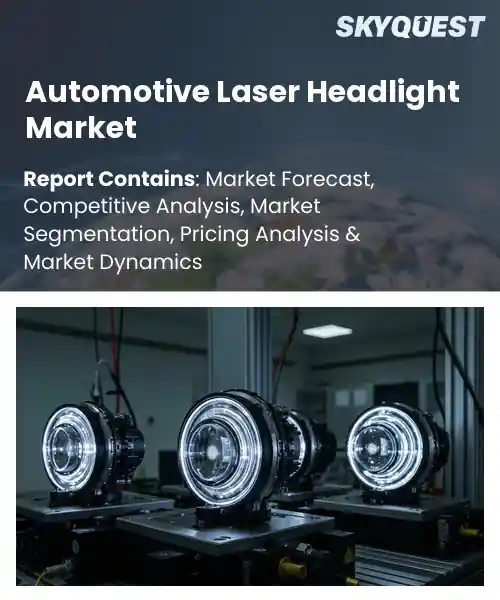
Automotive Laser Headlight Market
Report ID: SQMIG25A2744
Report ID: SQMIG25A2744
[email protected]
USA +1 351-333-4748
Report ID:
SQMIG25A2744 |
Region:
Global |
Published Date: June, 2026
Pages:
157
|Tables:
140
|Figures:
78


Global Automotive Laser Headlight Market size was valued at USD 1.52 Billion in 2024 and is poised to grow from USD 1.73 Billion in 2025 to USD 4.85 Billion by 2033, growing at a CAGR of 13.82% during the forecast period (2026-2033).
The main cause of the automotive laser headlight market trends expansion is the need for safety, specifically, advanced driver assistance systems' (ADAS) improved nighttime visibility, which points towards a trend towards autonomy in driving. Compact, high-output laser diodes paired with a phosphor convertor make up this subsector of lasers; they produce brighter and longer-range light than traditional LED-based car lights while requiring less space (appealing to both luxury and performance-oriented vehicles). Improved and prolonged illumination through the use of automotive laser headlights enhances reaction time, reducing the risk of a collision, luxury auto manufacturers make use of advanced lighting as a point of differentiation between them and other manufacturers.
Automotive laser headlight market growth has matured, and decreased price points and control systems have allowed increased commercialisation of this technology since the early 2000s, starting with BMW's i8, continuing with several suppliers' investments, and concluding with a consequent fall in price points. Cost-performance convergence caused by the scale of suppliers and technological synergy is the single most significant driver of global automotive laser headlight growth. The growth pathways provided by greater number of units being manufactured facilitates enhancements to the manufacturing process that will lead to improvements to the manufacturer's margin.
The continuing reduction in the cost of lasers vs LED-like light compared to traditional incandescent-type lights signifies that, while the component cost of laser-equipped automobile light assemblies will continue to fall, the performance characteristics of the overall automobile will continue to improve (extending the range of ADAS sensors will result in fewer accidents involving pedestrians.) This capability will positively impact electric vehicles because of the increased distance the vehicle will be able to achieve on a full battery as a result of less energy being used when usingAS a result of the use of lasers for light sources while the use of adaptive lighting on mid-tier automobile models creates a point of differentiation from their competition. Harmonized regulations and aftermarket adaptation will further stimulate interest in automotive laser headlights.
How is AI Improving Adaptive Performance in the Automotive Laser Headlight Market?
The advancement of automotive laser headlight market share has benefited from the use of artificial intelligence (AI). This technology has improved the ability to recognize what is happening around the vehicle in real time and offers precise control of the laser's beam. This is accomplished by using multiple sensors including cameras and LiDAR, applying machine learning to determine the type of user and condition of the road surface, and using control algorithms to create an adaptive laser beam pattern that avoids creating glare while maximizing visibility for the user.
The state of development now shows that suppliers and OEMs are embedding AI capabilities into the headlamp module, enabling the headlamp system to proactively respond to curves in the road, each other, and the complexity of the urban scene. This represents an evolution in how headlamps fit within the vehicle sensing system and offers OEMs a way to provide their customers with safer and more comfortable night driving experiences.
On May 2026, ams OSRAM announced a joint development agreement to develop an entry into the AI photonics market and demonstrate how AI-driven control and advanced laser modules can enable adaptive shape beams that integrate with the vehicle's sensors and enable quicker scaling to the production of laser headlight systems.
Market snapshot - (2026-2033)
Global Market Size
USD 1.52 Billion
Largest Segment
Laser High Beam Module
Fastest Growth
Adaptive Laser Headlight
Growth Rate
13.82% CAGR
To get more insights on this market click here to Request a Free Sample Report
Global automotive laser headlight market is segmented by type, material, vehicle type, sales channel, technology and region. Based on type, the market is segmented into laser high beam module and adaptive laser headlight. Based on material, the market is segmented into laser diode-based and LED + laser hybrid. Based on vehicle type, the market is segmented into luxury cars, sports cars and premium SUVs. Based on sales channel, the market is segmented into OEM and aftermarket. Based on technology, the market is segmented into fixed laser headlight and dynamic adaptive (matrix). Based on region, the market is segmented into North America, Europe, Asia Pacific, Latin America and Middle East & Africa.
The reason that the dynamic adaptive (matrix) segment is the leader in the automotive laser headlight market is due to its fine-grained beam shaping and real-time zoning capabilities that meet the core safety and visibility requirements of the automotive laser headlight marketplace. The continuous integration of sensors and controls allow for glare-free use of high beams while maintaining comfort for the surrounding driver, which is leading to increased preference by OEMs to include premium lighting packages. In addition to the capabilities for reducing hit/miss events, this technology simplifies compliance, and enables OEMs to provide unique features on vehicles that create more design investment on behalf of the OEMs and consolidate suppliers around an adaptive optical and software ecosystem.
The fixed laser headlight segment is rapidly becoming the fastest developing segment of the automotive laser headlight market because of its simpler optical designs, lower calibration complexity, and easier integration into existing automobile platforms. This predictability is driving shorter development cycles for price-sensitive trims, encourages retrofitting, and creates an immediate demand from both manufacturers and the aftermarket for laser performance without requiring complex control architectures.
The predominant market segment is the laser-diode-based segment, which provides a compact, energy-efficient approach to light sources and is a matured technology that fits well in terms of vehicle package and thermal requirements. OEMs will be able to reduce the risks associated with integrating laser diode solutions into their platforms due to well-established supplier ecosystems and validated production processes, which will support the broader use of laser diodes within the high-end vehicle segment. The optical design of the laser diode is straightforward and predictable lifecycle will help to build confidence among suppliers and will help speed up the introduction of laser diodes into different platforms and will help accelerate the focus on procurement and R&D for diode development and reliability engineering.
However, the most rapidly growing segment of the automotive lighting market is the hybrid segment of LED and laser technology where automotive light manufacturers continue to utilize the exceptional distance of laser light and combine it with the exceptional flexibility of LED to aid in cost-effective styling and thermal management of vehicle lighting. Additionally, the hybridization of these technologies provides opportunities for manufacturers to tier different levels of performance across automotive lines, creates incentives for joint product development between lighting manufacturers and increases opportunities for retrofitting vehicles and for aftermarket services, therefore enhancing the diffusion of technology and providing new revenue opportunities to automotive lighting manufacturers.
To get detailed segments analysis, Request a Free Sample Report
As the leader in the global automotive laser headlight market, Asia Pacific is home to the combined effects of large-scale manufacturing, technological superiority, and strong integrated supply chains that allow for fast commercialization of premium automotive lighting products. Major automotive manufacturing hubs have access to world-class engineering design resources and a broad array of tier 1 suppliers who have the capabilities to design and manufacture the required optics and electronics. The cooperation between OEMs and component suppliers allows for early entry into the marketplace for premium lighting technologies via cooperative investment in R&D and prototype development, thus significantly reduces the time required to develop new products for production. The consumer desire for improved safety and aesthetics, along with efficient supply chain clusters, and large numbers of local semiconductor manufacturers and optics specialists, help to further establish and support the strength of the region and allow for continued dominance in global automotive lighting development. Finally, the region also benefits from coordinated efforts between private and public agencies to support advanced manufacturing, access to a wide variety of testing facilities and validation services, and a highly skilled workforce that allow for the effective and economical iterative refinement and scale-up of new laboratory inventions into production-scale automotive lighting systems.
Automotive laser headlight market outlook in Japan is driven by deep engineering expertise among OEMs and suppliers, strong integration of advanced lighting into premium and mainstream models, and collaborative ecosystems that accelerate prototype to production cycles. Focus on quality, rigorous testing, and long term supplier relationships supports high adoption of complex lighting modules. Continuous investment in miniaturization and optical innovation reinforces Japan position as a technological leader in automotive illumination markets.
Automotive laser headlight market forecast in South Korea benefits from advanced semiconductor capability, strong OEM innovation, and supplier clusters that support development and scaling. Coordination between lighting specialists and vehicle electronics teams enables integration with driver assistance and infotainment systems. Emphasis on compact form factors, cost efficient manufacturing, and export oriented platforms positions South Korea as a focused innovation and production hub for advanced automotive lighting and aftermarket adoption broadens reach.
There is a boon in Europe’s automotive laser headlight market, led by regulatory measures regarding active safety, a robust premium market that emphasizes advanced lighting systems, and an extensive network of engineers and suppliers and development centers throughout the region. In order to adhere to strict visibility standards and safety requirements, many manufacturers are now adding adaptive, high-performance illumination capabilities to grow the importance of driver assistance systems. Germany has extensive industrial capacity and thorough validation systems to increase the support of cross-border partnerships throughout Europe, enabling quicker commercialization through investments in optics and semiconductors, increased access to aftermarket and retrofit offerings. Overall, the combined effort across all of these capabilities will create an environment of technical excellence, aesthetic differentiation and regulatory compatibility to further speed the adoption of laser based lighting in Europe’s automotive industry. Furthermore, many of these synergies will help OEM fitment strategies as well as niche market applications, making Europe an industry leader in turning innovation into unique vehicle lighting solutions.
Automotive laser headlight market penetration in Germany benefits from a deep industrial ecosystem of automotive engineering, renowned OEM leadership, and specialized tier supplier networks that support complex lighting development. High emphasis on rigorous testing, functional safety alignment, and integration with driver assistance architecture drives early adoption of sophisticated illumination systems. Close collaboration between manufacturers, engineering institutes, and lighting specialists sustains Germany role as the regional anchor for advanced automotive lighting innovation and lighting innovation.
Automotive laser headlight market regional outlook in United Kingdom is driven by design oriented manufacturers, technology startups, and lighting specialists that bring innovative applications to market. Strong focus on integration with driver assistance and adaptive lighting, combined with premium vehicle differentiation, supports rapid uptake. Vibrant testing facilities, collaborative research networks, and a growing aftermarket culture enable swift commercialization, positioning United Kingdom as a fast evolving hub for sophisticated automotive illumination solutions globally.
Automotive laser headlight market analysis in France is characterized by design led approaches, emphasis on lighting as a brand differentiator, and growing collaboration between automakers and specialist suppliers. Focus on stylistic innovation, compact module design, and optical refinement supports increasing integration of advanced lighting across model ranges. Research centers and engineering teams contribute to prototype validation and aesthetic tuning, positioning France as an emerging center for creative, technically sophisticated automotive illumination.
North America is becoming a strong player in the automotive market by concentrating R&D activity in this region, creating strategic partnerships between OEMs and advanced optics and semiconductor companies, and developing an extensive testing and validation ecosystem to accelerate product commercialization. Both OEMs and Tier suppliers are focusing on integrating laser-based light sources with driver assistance and autonomous driving systems while aftermarket distributors and fleet managers use their products to provide real-world testing for these solutions. The strengthening of cross-border industrial relationships through targeted manufacturing investments leads to increased supply chain resiliency through scale and efficiency. The combination of innovation clusters, pilot programs, and collaborative work around standards creates an atmosphere conducive to creating technically sound and commercially viable lighting products across all vehicle segments. Manufacturing investments in automation and workforce training targeted toward the region, combined with region-specific testing to meet the demands of different climates, provide the opportunity to develop durable, efficient laser modules that will meet OEM specifications while being sustainable and suitable for mobility platforms.
Automotive laser headlight industry in United States is driven by research hubs, strong collaboration between vehicle manufacturers and technology firms, and a robust testing infrastructure that supports prototype validation under field conditions. Emphasis on integration with advanced driver assistance systems, electrified platforms, and fleet applications accelerates commercial trials. Venture backed startups and Tier suppliers complement traditional industrial strengths, advancing scalable and customizable lighting solutions tailored to regional market requirements effectively.
Automotive laser headlight market regional forecast in Canada benefits from skilled engineering talent, specialist optical suppliers, and close industrial ties with neighboring automotive hubs that support component design and testing. Focus on validation in demanding environmental conditions leads to durable, climate resilient solutions. Industry and research collaboration accelerates prototype refinement, while niche manufacturing and export strategies position Canada as a development and low volume production partner in North American lighting supply ecosystem
To know more about the market opportunities by region and country, click here to
Buy The Complete Report
Rising Adoption Of Laser Headlights
Energy Efficiency With Reduced Weight
High Manufacturing Component Expenses
Regulatory Safety Certification Hurdles
Request Free Customization of this report to help us to meet your business objectives.
Competitive landscape in the global automotive laser headlight market is driven by OEM demand for differentiation and suppliers’ consolidation; incumbents pursue M&A and strategic investments while OEMs form R&D partnerships to secure differentiated modules. Examples include Faurecia’s acquisition of HELLA to scale lighting capabilities and Koito’s strategic investment in BrightWay Vision, plus OEM-supplier R&D consortia such as Audi with Bosch and OSRAM for matrix laser projects.
Top Player’s Company Profile
Recent Developments
SkyQuest’s ABIRAW (Advanced Business Intelligence, Research & Analysis Wing) is our Business Information Services team that Collects, Collates, Correlates, and Analyses the Data collected by means of Primary Exploratory Research backed by robust Secondary Desk research. As per SkyQuest analysis, the global automotive laser headlight market is gaining momentum primarily because safety-driven demand for superior night-time visibility and ADAS support is pushing OEMs to adopt laser modules. A secondary driver is improved energy efficiency and reduced weight, which benefits electric vehicle range and thermal packaging. However, high manufacturing and component expenses remain a key restraint, limiting fitment to premium models and slowing broader adoption. Asia Pacific currently dominates due to manufacturing scale, integrated supply networks, and strong OEM-supplier collaboration. Dynamic adaptive matrix headlights lead the market by offering fine-grained, glare-free beam shaping that aligns with modern sensor-driven vehicle architectures.
| Report Metric | Details |
|---|---|
| Market size value in 2024 | USD 1.52 Billion |
| Market size value in 2033 | USD 4.85 Billion |
| Growth Rate | 13.82% |
| Base year | 2024 |
| Forecast period | (2026-2033) |
| Forecast Unit (Value) | USD Billion |
| Segments covered |
|
| Regions covered | North America (US, Canada), Europe (Germany, France, United Kingdom, Italy, Spain, Rest of Europe), Asia Pacific (China, India, Japan, Rest of Asia-Pacific), Latin America (Brazil, Rest of Latin America), Middle East & Africa (South Africa, GCC Countries, Rest of MEA) |
| Companies covered |
|
| Customization scope | Free report customization with purchase. Customization includes:-
|
To get a free trial access to our platform which is a one stop solution for all your data requirements for quicker decision making. This platform allows you to compare markets, competitors who are prominent in the market, and mega trends that are influencing the dynamics in the market. Also, get access to detailed SkyQuest exclusive matrix.
Table Of Content
Executive Summary
Market overview
Parent Market Analysis
Market overview
Market size
KEY MARKET INSIGHTS
COVID IMPACT
MARKET DYNAMICS & OUTLOOK
Market Size by Region
KEY COMPANY PROFILES
Methodology
For the Automotive Laser Headlight Market, our research methodology involved a mixture of primary and secondary data sources. Key steps involved in the research process are listed below:
1. Information Procurement: This stage involved the procurement of Market data or related information via primary and secondary sources. The various secondary sources used included various company websites, annual reports, trade databases, and paid databases such as Hoover's, Bloomberg Business, Factiva, and Avention. Our team did 45 primary interactions Globally which included several stakeholders such as manufacturers, customers, key opinion leaders, etc. Overall, information procurement was one of the most extensive stages in our research process.
2. Information Analysis: This step involved triangulation of data through bottom-up and top-down approaches to estimate and validate the total size and future estimate of the Automotive Laser Headlight Market.
3. Report Formulation: The final step entailed the placement of data points in appropriate Market spaces in an attempt to deduce viable conclusions.
4. Validation & Publishing: Validation is the most important step in the process. Validation & re-validation via an intricately designed process helped us finalize data points to be used for final calculations. The final Market estimates and forecasts were then aligned and sent to our panel of industry experts for validation of data. Once the validation was done the report was sent to our Quality Assurance team to ensure adherence to style guides, consistency & design.
Analyst Support
Customization Options
With the given market data, our dedicated team of analysts can offer you the following customization options are available for the Automotive Laser Headlight Market:
Product Analysis: Product matrix, which offers a detailed comparison of the product portfolio of companies.
Regional Analysis: Further analysis of the Automotive Laser Headlight Market for additional countries.
Competitive Analysis: Detailed analysis and profiling of additional Market players & comparative analysis of competitive products.
Go to Market Strategy: Find the high-growth channels to invest your marketing efforts and increase your customer base.
Innovation Mapping: Identify racial solutions and innovation, connected to deep ecosystems of innovators, start-ups, academics, and strategic partners.
Category Intelligence: Customized intelligence that is relevant to their supply Markets will enable them to make smarter sourcing decisions and improve their category management.
Public Company Transcript Analysis: To improve the investment performance by generating new alpha and making better-informed decisions.
Social Media Listening: To analyze the conversations and trends happening not just around your brand, but around your industry as a whole, and use those insights to make better Marketing decisions.
REQUEST FOR SAMPLE
 REQUEST FREE CUSTOMIZATION
Global Automotive Laser Headlight Market size was valued at USD 1.52 Billion in 2024 and is poised to grow from USD 1.73 Billion in 2025 to USD 4.85 Billion by 2033, growing at a CAGR of 13.82% during the forecast period (2026-2033).
Competitive landscape in the global automotive laser headlight market is driven by OEM demand for differentiation and suppliers’ consolidation; incumbents pursue M&A and strategic investments while OEMs form R&D partnerships to secure differentiated modules. Examples include Faurecia’s acquisition of HELLA to scale lighting capabilities and Koito’s strategic investment in BrightWay Vision, plus OEM-supplier R&D consortia such as Audi with Bosch and OSRAM for matrix laser projects. 'OSRAM GmbH', 'Nichia Corporation', 'Hella GmbH', 'Valeo SA', 'Koito Manufacturing', 'Stanley Electric', 'Ichikoh Industries', 'Gentex Corporation', 'Magneti Marelli (KKR)', 'AL-KO (BMW supplier)', 'Marelli Holdings', 'Automotive Lighting (Marelli)', 'ZKW Group (LG Electronics)', 'Grupo Antolin', 'Novatel Wireless', 'Lumileds (Go-Private)', 'Seoul Semiconductor', 'Cree Lighting', 'Epistar Corporation', 'Dominant Opto Technologies'
Laser headlights deliver superior illumination and precise beam control, prompting automakers to incorporate them into new vehicle designs for enhanced safety, visibility, and distinctive styling. This capability supports OEM differentiation and aligns with consumer expectations for premium lighting performance, encouraging investment in production and integration processes. As lighting becomes a key feature in vehicle perception and advanced driver assistance systems, manufacturers prioritize laser solutions to improve nighttime detection and driver confidence, thereby expanding specification rates and stimulating supplier innovation and component adoption across model lineups.
Adaptive Lighting Integration: Automotive manufacturers and suppliers are increasingly integrating laser headlights with sensor suites and adaptive control systems to deliver context-aware illumination that enhances visibility without creating glare. This trend emphasizes software-driven beam shaping, dynamic range adjustment, and seamless communication with driver-assistance systems to optimize lighting for traffic, weather, and roadway conditions. Greater focus on system-level design and calibration drives collaborations across optics, electronics, and software teams, positioning laser headlights as integral components of holistic vehicle safety and user-experience strategies.
Why does Asia Pacific Dominate the Global Automotive Laser Headlight Market? |@12


Want to customize this report? This report can be personalized according to your needs. Our analysts and industry experts will work directly with you to understand your requirements and provide you with customized data in a short amount of time. We offer $1000 worth of FREE customization at the time of purchase.
Feedback From Our Clients


 USA (+1) 351-333-4748

