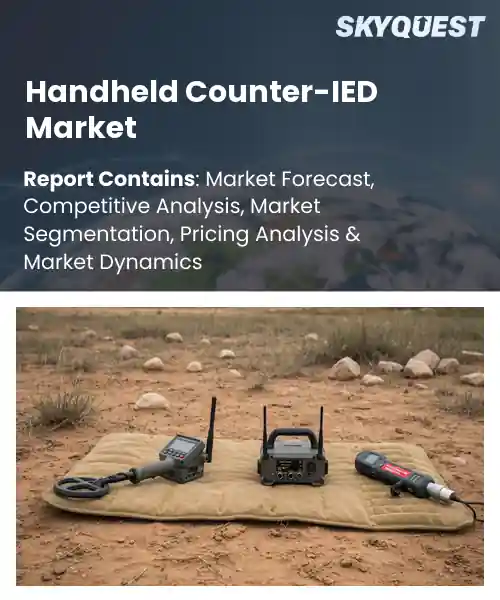
Handheld Counter-IED Market
Report ID: SQMIG45K2295
Report ID: SQMIG45K2295
[email protected]
USA +1 351-333-4748
Report ID:
SQMIG45K2295 |
Region:
Global |
Published Date: June, 2026
Pages:
157
|Tables:
179
|Figures:
79


Global Handheld Counter-Ied Market size was valued at USD 1.34 Billion in 2024 and is poised to grow from USD 1.45 Billion in 2025 to USD 2.66 Billion by 2033, growing at a CAGR of 7.9% during the forecast period (2026-2033).
Handheld systems detecting, disrupting or neutralising explosive devices are an important resource for Military and Security agencies in their fight against explosives. As the incidence of asymmetric warfare has increased, with non-state actors using low-cost IEDs to inflict casualties and create instability in regions, the need for these types of portable devices has been necessitated. The introduction of handheld jammers, metal detectors and chemical sniffers in the warzones of Afghanistan and Iraq in the early 2000's contributed to rapid growth and development of handheld counter IED devices, leading manufactures to develop miniaturized sensors and real-time analytics.
The introduction of artificial intelligence algorithms and cloud connectivity has evolved the use of handheld counter IED systems into networked threat assessment tools, with applications extending to urban law enforcement and global critical infrastructure protection, moving beyond the combat operating area. A major contributor to the growth of the handheld counter IED market is the increased demand for integrated situational awareness solutions that provide embedded detection hardware in command and control solutions.
The alerts provided by handheld detection sensors allow commanding officers to reroute convoys, isolate blast zones, and deploy jamming teams all of which have resulted in reduced casualties and mission delays. This change has resulted in the National NATO procurement strategies where the United States Army is integrating the use of handheld IED detection tools into their NLOS-CBRN systems, linked to satellite data. As urban terrorism rises, civilian agencies like the London Metropolitan Police adopt these devices for crowd‑screening events, creating a market that stimulates R&D investment and drives price reductions through scale.
How is AI Enhancing Detection Capabilities in the Handheld Counter‑IED Market?
Hand-held counters - IED detection has been enhanced with the help of AI. As a result, many modern multi-functional devices integrate multiple sensor types to combine data from several sources (metal detector coils, chemical sniffers, and visual scanners, etc.) into a signature that is sent to a neural network where it can reliably identify a benign object or an explosive component based on its characteristics. The neural networks are trained continuously from the data generated in the field so that they may continually improve their pattern recognition abilities and reduce the number of false alarms generated. The real-time analysis capability allows the operator to receive highly actionable alerts in seconds, providing for faster, more informed decisions by the operator and enabling safer route clearance. Additionally, by processing on-device, instead of relying on remote servers, it permits for the use of much lighter and more battery-efficient hardware.
As conditions change in response to new threats, the use of AI-enabled adaptability will allow hand-held devices for countering IEDs to remain relevant and drive their adoption by military and law enforcement organizations. An AI-enabled hand-held detector developed by Raytheon has been added to the market in April 2024, which streamlines the process of identifying potential threats; therefore, increasing the efficiency of operations; consequently increasing market traction and providing for validation of the technology.
Market snapshot - (2026-2033)
Global Market Size
USD 1.34 Billion
Largest Segment
Handheld Multi-Sensor Detection Systems
Fastest Growth
Handheld Multi-Sensor Detection Systems
Growth Rate
7.9% CAGR
To get more insights on this market click here to Request a Free Sample Report
Global handheld counter-IED market is segmented by product type, technology, deployment environment, end user, platform type, distribution channel and region. Based on product type, the market is segmented into Handheld Explosive Detectors, Handheld Ground-Penetrating Detection Devices, Handheld Electronic Countermeasure (ECM) Devices, Handheld Multi-Sensor Detection Systems and Others. Based on technology, the market is segmented into Trace Explosive Detection, Ground-Penetrating Radar (GPR), Electromagnetic Detection, Chemical Vapor Detection, Multi-Sensor Fusion and Others. Based on deployment environment, the market is segmented into Military Operations, Border Security, Homeland Security, Critical Infrastructure Protection and Others. Based on end user, the market is segmented into Defense Forces, Law Enforcement Agencies, Border Security Agencies, Special Operations Units and Others. Based on platform type, the market is segmented into Portable Handheld Units and Backpack-Mounted Systems. Based on distribution channel, the market is segmented into Direct Government Procurement, Defense Contractors & Integrators and Others. Based on region, the market is segmented into North America, Europe, Asia Pacific, Latin America and Middle East & Africa.
The handheld explosive detectors category is leading the segment because they can identify chemical vapours from many types of explosives immediately, allowing an operator to detect explosives before there is visual confirmation. Handheld devices have a long record of reliability and can be easily integrated into existing weapon platforms with little additional training required on the operator's part. Their ability to work in different environments and the existence of a mature supply chain for this technology support continued market success.
As per handheld counter-IED market analysis, handheld ground penetrating detection devices are the fastest growing category because of advancements in radar miniaturisation that allow operators to locate buried threats without the need to excavate (dig up soil), providing operators with many new use cases at borders and for protecting critical infrastructure. These capabilities have raised the demand for covert detection and will result in increased procurement of these products and the continued development of these products.
The multi-sensor fusion is the largest market because it combines chemical, electromagnetic and radar data into one interface which allows all possible threat information to be obtained, whereas other single technology products don't allow for that level of threat identification. This comprehensive approach also reduces false alarms, provides greater situational awareness and reduces operator workload; therefore it appeals to the complexity of missions that have multiple threats. The overall combination of different detection approaches contributes greatly to many suppliers investing heavily in this technology and the many uses of these systems by defense/security users.
As per handheld counter-IED market forecast, the ground penetrating radar segment is growing at the fastest rate because of recent innovations in antenna design and signal processing which allow deeper and higher resolution imaging with handheld systems. This has created many new possibilities for use in urban and underground circumstances driving rapid growth by those users looking for non-invasive detection and contributing to the overall expansion of this market.
To get detailed segments analysis, Request a Free Sample Report
Due to the size of the defense production base, strong research and development networks, and government technology collaboration, North America continues to be a leader. The U.S. has made significant investments in advanced sensing and autonomous technologies; while Canada uses integrated security and cross border programming to provide technical capability. Swift deployment of new handheld counter-IED solutions can occur because of the combination of good procurement processes, quality control, and rapid field test programs. The success of North America in the global market for counter-IED technology also is attributable to the region's exceptional pool of specialized workers and established partnerships with allied militaries.
The U.S. market is primarily fueled by federal funding toward counter-terrorism technologies, combined with a robust defense contracting industry. Close collaboration among the U.S. military, law enforcement, and academia allows for the expedient prototyping and field testing of new designs. Additionally, effective interoperability and integration of handheld appliances into existing situational awareness systems will ensure that these devices can meet the demanding operational requirements of diverse mission types, and be rapidly scaled for use within various mission profiles.
The Handheld Counter-IED market penetration in Canada has benefitted from an integrated national security strategy with an emphasis on cooperation between Canada and its neighbouring countries. Indigenous companies work with government agencies to customise their equipment for both urban and rural locations. The emphasis on modular design and ease of use meets the Canadian Government's goal of supplying first responders and peacekeepers with reliable, easy to use equipment, which has further developed Canada's expertise in the field of counter-IED technologies.
Rapid growth in Europe is being driven by the combination of advanced engineering capabilities within the region with the availability of supportive public-private partnerships and a focus on improving the safety of citizens within both defence and civil sectors. Strong regulatory frameworks are in place to promote the rigorous testing and certification of products and programs across the European Union to enhance knowledge-sharing and the allocation of funds for the development of innovative projects. The focus on integrating handheld Counter-IED devices with broader digital security ecosystems will improve operational efficiencies. In addition, there has been a significant increase in demand for handheld Counter-IED devices from Border Agencies and for the protection of large events, which has resulted in the ongoing improvement of sensor technologies and user ergonomics making Europe an emerging global centre for the development of Next Generation Counter-IED Solutions.
Handheld Counter-IED Market endeavors in Germany leverage the nation’s precision engineering heritage and strong defense research institutions. Close cooperation between federal ministries, industrial consortiums, and academic labs accelerates the translation of cutting‑edge sensor technologies into field‑ready devices. Emphasis on standardization and integration with existing NATO communication networks ensures that German solutions meet stringent alliance requirements, reinforcing the country’s role as a dominant force in European counter‑IED innovation.
Handheld Counter-IED Market progress in the United Kingdom is characterized by rapid adoption driven by proactive security policies and active involvement of home‑office agencies. The UK’s vibrant start‑up ecosystem, coupled with established defense firms, fosters agile development cycles and swift field trials. Prioritization of interoperability with allied intelligence platforms and a focus on portable, user‑centric designs propel the United Kingdom as the fastest‑growing market within Europe.
Handheld Counter-IED Market activity in France is emerging through strategic investments in dual‑use technologies that serve both military and civil protection needs. Collaborative initiatives linking national research agencies with boutique manufacturers enable the exploration of novel detection materials and compact form factors. France’s commitment to enhancing urban safety and supporting multinational peacekeeping missions drives the pursuit of adaptable handheld solutions, marking the country as an emerging contributor to Europe’s counter‑IED landscape.
Asia Pacific is strengthening its position by capitalizing on rapid technological adoption, strong manufacturing capabilities, and growing security concerns across diverse environments. Nations such as Japan and South Korea invest heavily in miniaturized sensor platforms and artificial‑intelligence‑enhanced detection algorithms, fostering a climate of continuous innovation. Robust supply chains and close ties between defense ministries and leading electronics firms enable swift scaling of handheld counter‑IED devices. The region’s emphasis on integrating these tools with advanced communication networks and unmanned systems further consolidates its emerging role as a significant contributor to the global market.
Handheld Counter-IED Market initiatives in Japan benefit from a tradition of precision electronics and a proactive approach to public safety. Collaboration between government security agencies, university research centers, and leading electronics manufacturers drives the development of highly sensitive, compact detection devices. Emphasis on seamless integration with national emergency response networks and disaster‑relief operations ensures that Japanese handheld solutions are tailored for both urban and remote contexts, reinforcing the country’s growing expertise in counter‑IED technology.
Handheld Counter-IED Market growth in South Korea is propelled by a dynamic defense industry and strong focus on smart sensor integration. Partnerships between military research institutes and cutting‑edge semiconductor firms accelerate the creation of lightweight, AI‑enabled handheld devices. The South Korean emphasis on rapid deployment for both military and civilian security scenarios, combined with rigorous testing protocols, positions the nation as a key player in advancing handheld counter‑IED capabilities throughout the Asia Pacific region.
To know more about the market opportunities by region and country, click here to
Buy The Complete Report
Increasing Threat Landscape Drives Adoption
Advancements In Sensor Technology Enhance Effectiveness
High Procurement Costs Limit Adoption
Regulatory Hurdles Slow Market Entry
Request Free Customization of this report to help us to meet your business objectives.
The handheld counter‑IED market is shaped by intense rivalry among established defense firms such as L3Harris Technologies, Chemring Group, Smiths Detection, FLIR Systems and Raytheon, each accelerating AI‑driven sensor integration, forging defense‑agency partnerships and expanding product portfolios to meet rising security concerns and procurement demands. Competitive pressure drives rapid technology upgrades and collaborative development programs across the sector.
SkyQuest’s ABIRAW (Advanced Business Intelligence, Research & Analysis Wing) is our Business Information Services team that Collects, Collates, Correlates, and Analyses the Data collected by means of Primary Exploratory Research backed by robust Secondary Desk research.
As per SkyQuest analysis, the global handheld counter‑IED market is propelled primarily by the rising threat of asymmetric warfare and the proliferation of improvised explosive devices, which pushes militaries and security agencies to adopt portable detection tools, while advances in miniaturised sensors and AI‑driven multi‑modal fusion form a second strong catalyst that improves accuracy and reduces false alarms. High procurement costs act as the chief restraint, limiting uptake among budget‑constrained forces. North America remains the dominating region due to its mature defence industrial base and strong government funding, and within the market the handheld explosive detectors segment leads due to its proven reliability and ease of integration.
| Report Metric | Details |
|---|---|
| Market size value in 2024 | USD 1.34 Billion |
| Market size value in 2033 | USD 2.66 Billion |
| Growth Rate | 7.9% |
| Base year | 2024 |
| Forecast period | (2026-2033) |
| Forecast Unit (Value) | USD Billion |
| Segments covered |
|
| Regions covered | North America (US, Canada), Europe (Germany, France, United Kingdom, Italy, Spain, Rest of Europe), Asia Pacific (China, India, Japan, Rest of Asia-Pacific), Latin America (Brazil, Rest of Latin America), Middle East & Africa (South Africa, GCC Countries, Rest of MEA) |
| Companies covered |
|
| Customization scope | Free report customization with purchase. Customization includes:-
|
To get a free trial access to our platform which is a one stop solution for all your data requirements for quicker decision making. This platform allows you to compare markets, competitors who are prominent in the market, and mega trends that are influencing the dynamics in the market. Also, get access to detailed SkyQuest exclusive matrix.
Table Of Content
Executive Summary
Market overview
Parent Market Analysis
Market overview
Market size
KEY MARKET INSIGHTS
COVID IMPACT
MARKET DYNAMICS & OUTLOOK
Market Size by Region
KEY COMPANY PROFILES
Methodology
For the Handheld Counter-IED Market, our research methodology involved a mixture of primary and secondary data sources. Key steps involved in the research process are listed below:
1. Information Procurement: This stage involved the procurement of Market data or related information via primary and secondary sources. The various secondary sources used included various company websites, annual reports, trade databases, and paid databases such as Hoover's, Bloomberg Business, Factiva, and Avention. Our team did 45 primary interactions Globally which included several stakeholders such as manufacturers, customers, key opinion leaders, etc. Overall, information procurement was one of the most extensive stages in our research process.
2. Information Analysis: This step involved triangulation of data through bottom-up and top-down approaches to estimate and validate the total size and future estimate of the Handheld Counter-IED Market.
3. Report Formulation: The final step entailed the placement of data points in appropriate Market spaces in an attempt to deduce viable conclusions.
4. Validation & Publishing: Validation is the most important step in the process. Validation & re-validation via an intricately designed process helped us finalize data points to be used for final calculations. The final Market estimates and forecasts were then aligned and sent to our panel of industry experts for validation of data. Once the validation was done the report was sent to our Quality Assurance team to ensure adherence to style guides, consistency & design.
Analyst Support
Customization Options
With the given market data, our dedicated team of analysts can offer you the following customization options are available for the Handheld Counter-IED Market:
Product Analysis: Product matrix, which offers a detailed comparison of the product portfolio of companies.
Regional Analysis: Further analysis of the Handheld Counter-IED Market for additional countries.
Competitive Analysis: Detailed analysis and profiling of additional Market players & comparative analysis of competitive products.
Go to Market Strategy: Find the high-growth channels to invest your marketing efforts and increase your customer base.
Innovation Mapping: Identify racial solutions and innovation, connected to deep ecosystems of innovators, start-ups, academics, and strategic partners.
Category Intelligence: Customized intelligence that is relevant to their supply Markets will enable them to make smarter sourcing decisions and improve their category management.
Public Company Transcript Analysis: To improve the investment performance by generating new alpha and making better-informed decisions.
Social Media Listening: To analyze the conversations and trends happening not just around your brand, but around your industry as a whole, and use those insights to make better Marketing decisions.
REQUEST FOR SAMPLE
 REQUEST FREE CUSTOMIZATION
Global Handheld Counter-Ied Market size was valued at USD 1.34 Billion in 2024 and is poised to grow from USD 1.45 Billion in 2025 to USD 2.66 Billion by 2033, growing at a CAGR of 7.9% during the forecast period (2026-2033).
The handheld counter‑IED market is shaped by intense rivalry among established defense firms such as L3Harris Technologies, Chemring Group, Smiths Detection, FLIR Systems and Raytheon, each accelerating AI‑driven sensor integration, forging defense‑agency partnerships and expanding product portfolios to meet rising security concerns and procurement demands. Competitive pressure drives rapid technology upgrades and collaborative development programs across the sector. 'L3Harris Technologies', 'RTX Corporation', 'Leidos Holdings', 'Smiths Detection', 'OSI Systems', 'Teledyne FLIR Defense', 'Chemring Group', 'ECA Group', 'Exail Technologies', 'Cobham plc', 'QinetiQ Group', 'Thales Group', 'Safran Electronics & Defense', 'Kromek Group plc', 'Mirion Technologies', 'Nuctech Company Limited', 'Westminster Group plc', 'CEIA S.p.A.', 'Viken Detection', 'Rapiscan Systems'
The rise in asymmetric warfare and the proliferation of improvised explosive devices create a pressing demand for portable detection solutions, prompting armed forces and security agencies to prioritize handheld counter‑IED technologies. These devices enable rapid threat assessment in diverse operational environments, supporting mission continuity and personnel safety, which in turn encourages procurement programs and sustained investment, reinforcing market expansion through heightened awareness of the technology’s tactical value. The capability to operate autonomously without extensive support infrastructure further strengthens its appeal across both conventional and irregular combat scenarios, fostering broader adoption.
Integrated Sensor Fusion: Growing adoption of multi‑modal detection systems combines electromagnetic, acoustic, and chemical sensors within handheld units, enabling operators to identify a broader spectrum of improvised explosive devices with greater confidence. The convergence of advanced algorithms and edge‑computing processors allows real‑time data correlation, reducing false alarms and accelerating decision cycles. This capability is driving demand among security forces seeking versatile tools that adapt to evolving threat profiles across urban, maritime, and remote environments and support joint interdiction missions globally.
Why does North America Dominate the Global Handheld Counter-IED Market? |@12


Want to customize this report? This report can be personalized according to your needs. Our analysts and industry experts will work directly with you to understand your requirements and provide you with customized data in a short amount of time. We offer $1000 worth of FREE customization at the time of purchase.
Feedback From Our Clients


 USA (+1) 351-333-4748

