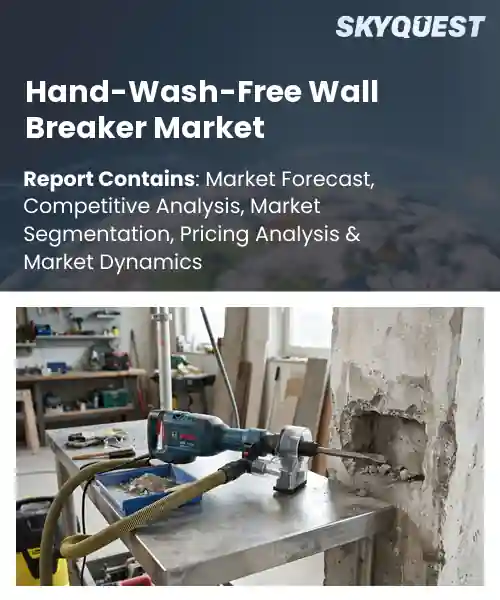
Hand-Wash-Free Wall Breaker Market
Report ID: SQMIG25H2215
Report ID: SQMIG25H2215
[email protected]
USA +1 351-333-4748
Report ID:
SQMIG25H2215 |
Region:
Global |
Published Date: November, 2026
Pages:
157
|Tables:
93
|Figures:
76


Global Hand-Wash-Free Wall Breaker Market size was valued at USD 480.0 Million in 2024 and is poised to grow from USD 514.56 Million in 2025 to USD 897.42 Million by 2033, growing at a CAGR of 7.2% during the forecast period (2026-2033).
The hand‑wash‑free wall‑breaker market is defined by tools that fracture masonry without requiring manual cleaning of the cutting surface, a feature that reduces downtime and contamination in construction sites. Its primary driver is the rising demand for rapid, hygienic renovation in hospitals and food‑processing plants, where traditional wall‑breaking generates dust that compromises sterile environments. Historically, the sector evolved from abrasive hammer drills to integrated water‑spray systems introduced in 2015, which simultaneously cool the blade and capture particulate matter. Early adopters such as a Tokyo hospital chain reported a 30 % reduction in project turnaround time, illustrating the technology’s relevance for builders. Another decisive factor driving the hand‑wash‑free wall‑breaker market is the alignment of sustainability regulations with automation, which together generate efficiencies and compliance benefits. Tightened silica‑dust limits force manufacturers to incorporate sensor‑controlled water‑spray systems that modulate flow in real time, eliminating manual adjustments. This capability appeals to developers seeking lower impact scores and easier access to financing. For instance, a German retrofit contractor integrated a wireless telemetry unit with a water‑based breaker, reducing water consumption by 40 % and accelerating wall removal by 25 %. The cause‑effect link between stricter standards and smarter equipment therefore expands opportunities and draws investment into demolition tools.
How is AI-driven automation reshaping the hand‑wash‑free wall breaker market?
AI-driven automation is redefining the hand‑wash‑free wall breaker market by embedding sensors, computer vision and adaptive control into demolition equipment. These technologies enable machines to detect surface conditions, adjust impact force and coordinate multiple tools without human intervention. The result is faster cycle times, reduced labor exposure and consistent break quality across varied construction sites. Operators now monitor progress through intuitive dashboards that aggregate real‑time data, allowing predictive maintenance and resource planning. By eliminating the need for manual cleaning and preparation, firms can keep projects on schedule while adhering to stricter safety and hygiene standards that are increasingly demanded by clients and regulators. This convergence of robotics and AI is turning what was once a labor‑intensive task into a streamlined, data‑rich process.EcoBreak Innovations June 2024, introduced an AI‑controlled wall breaker that autonomously calibrates impact based on material density, cutting setup time dramatically and boosting overall project efficiency.
Market snapshot - (2026-2033)
Global Market Size
USD 480.0 Million
Largest Segment
Hydraulic Wall Breakers
Fastest Growth
Electric Wall Breakers
Growth Rate
7.2% CAGR
To get more insights on this market click here to Request a Free Sample Report
Global hand-wash-free wall breaker market is segmented by product type, application, end user and region. Based on product type, the market is segmented into Manual Wall Breakers, Hydraulic Wall Breakers, Pneumatic Wall Breakers and Electric Wall Breakers. Based on application, the market is segmented into Building Demolition, Concrete Breaking, Masonry Removal and Renovation & Remodeling. Based on end user, the market is segmented into Construction Contractors, Demolition Contractors, Infrastructure Maintenance Providers and Industrial Users. Based on region, the market is segmented into North America, Europe, Asia Pacific, Latin America and Middle East & Africa.
Manual Wall Breakers segment dominates because operators value the immediate portability and low maintenance of hand wash free designs, allowing workers to quickly reposition tools without external power sources. The simplicity of mechanical operation bypasses the need for fuel or compressed air, aligning with on site safety protocols that restrict hazardous emissions. Consequently, contractors prioritize these units for small scale demolition tasks, preserving productivity while adhering to stringent hygiene standards.
Meanwhile, Hydraulic Wall Breakers segment emerges as the fastest growing area because advances in compact hydraulic pumps deliver higher impact forces while preserving the hand wash free requirement. Sealed fluid circuits reduce contamination risk, attracting large demolition projects that need power and cleanliness, thereby expanding market scope and spurring technology adoption.
Renovation & Remodeling segment dominates because managers prioritize tools that maintain site cleanliness while enabling material removal. Hand wash free wall breakers eliminate dust suppression, reducing cleanup time and preserving finishes. Their lightweight nature allows easy maneuvering in confined spaces typical of remodels, and the absence of fuel or air connections simplifies logistics. These benefits align with expectations for minimal disruption, making the segment the preferred choice for renovation work.
Conversely, Concrete Breaking segment is witnessing the strongest growth momentum because new hand wash free breakers equipped with high impact heads deliver efficient fracture of reinforced concrete without water based cooling. This capability meets rising demand for rapid low mess demolition in scale infrastructure projects, propelling adoption and encouraging investment in specialized tooling.
To get detailed segments analysis, Request a Free Sample Report
North America leads the global Hand-Wash-Free Wall Breaker market because of its integrated ecosystem of advanced manufacturing, strong environmental regulations, and high consumer awareness of sustainability. Leading firms invest heavily in research that aligns with rigorous safety standards and building efficiency goals. The region benefits from extensive commercial‑real‑estate portfolios that prioritize low‑water cleaning solutions, and from a distribution network that ensures rapid product rollout across urban and suburban markets. Moreover, corporate procurement policies often favor eco‑friendly technologies, reinforcing demand. Collaborative partnerships between academia, technology providers, and construction companies further accelerate product innovation, while the cultural emphasis on cleanliness and hygiene supports widespread acceptance across residential and industrial sectors.
Hand-Wash-Free Wall Breaker Market in United States benefits from a mature construction sector that prioritizes innovative cleaning solutions, extensive commercial retrofit projects, and a strong emphasis on occupational safety. Leading manufacturers collaborate with large‑scale property managers, driving early adoption of water‑free technologies. The regulatory climate encourages reduced water usage, while consumer awareness of environmental impact further reinforces demand across residential and commercial applications. This environment also fuels continuous product refinement and localized support services.
Hand-Wash-Free Wall Breaker Market in Canada thrives on a progressive building‑code framework that encourages water‑conserving practices, combined with a strong focus on green certifications for new constructions. Provincial initiatives support adoption in both public infrastructure and private developments, while a collaborative ecosystem of research institutions and manufacturers accelerates technology refinement. The market benefits from consumer preference for sustainable cleaning and from robust supply chains that ensure reliable product availability.
Europe’s Hand-Wash-Free Wall Breaker market is expanding rapidly due to a confluence of stringent environmental directives, strong emphasis on building energy performance, and a mature construction landscape that values innovation. Policy frameworks encourage reduction of water consumption, prompting developers and facilities managers to adopt water‑free cleaning technologies. The region’s deep engineering expertise and robust supply chains facilitate swift integration of advanced wall‑breaker solutions. Growing consumer demand for greener living spaces, coupled with corporate sustainability commitments, fuels market momentum. Collaborative research initiatives across leading universities and industry players further enhance product efficacy, positioning Europe as a hub for sophisticated, environmentally responsible cleaning solutions.
Hand-Wash-Free Wall Breaker Market in Germany is anchored by rigorous sustainability standards and a strong tradition of engineering excellence. Manufacturers collaborate closely with building‑material suppliers to embed water‑free technologies into new construction projects and retrofits. Policy incentives encourage adoption across commercial facilities and residential complexes, while industry associations promote best practices for maintenance and hygiene. The market benefits from a skilled labor pool that ensures precise installation and effective performance of wall‑breaker systems.
Hand-Wash-Free Wall Breaker Market in United Kingdom experiences rapid uptake driven by aggressive sustainability agendas and progressive building‑regulation reforms. Developers of high‑rise and mixed‑use projects prioritize water‑free cleaning solutions to meet performance targets, while facilities managers seek low‑maintenance options for legacy structures. Industry collaborations focus on integrating smart sensors that optimize usage, enhancing operational efficiency. Growing consumer demand for environmentally conscious living spaces further accelerates market traction across commercial and residential sectors.
Hand-Wash-Free Wall Breaker Market in France is emerging as policymakers promote water conservation across renovation initiatives and new builds. Early adopters include eco‑focused property developers and public institutions seeking to lower operational costs. Collaborative projects between technology firms and architectural schools foster customized solutions suited to historic building fabrics. Consumer awareness of sustainable cleaning contributes to a gradual increase in demand, positioning France as a growing niche within the broader European landscape.
Asia Pacific is strengthening its role in the Hand-Wash-Free Wall Breaker market through accelerated adoption of smart building concepts and heightened focus on resource efficiency. Emerging urban centers are investing in modern construction methods that incorporate water‑saving technologies, while governmental programs promote reduced water usage across public and private sectors. The presence of technically skilled workforces and forward‑looking manufacturers enables rapid customization of solutions to meet diverse market needs. Growing awareness of environmental impact among consumers and corporations alike drives preference for sustainable cleaning options. The region’s dynamic trade networks and increasing collaboration between technology firms and construction companies reinforce its advancing position in the global landscape.
Hand-Wash-Free Wall Breaker Market in Japan advances through integration with construction practices and a cultural emphasis on cleanliness. Manufacturers leverage precision engineering capabilities to produce compact, efficient systems suited for dense urban environments. Government initiatives encourage water‑saving technologies in both new construction and seismic retrofits, while corporate sustainability programs drive adoption across office complexes. Collaboration between robotics firms and cleaning solution providers further enhances product performance, reinforcing Japan’s role as an innovative market leader.
Hand-Wash-Free Wall Breaker Market in South Korea is propelled by rapid urban development and a governmental focus on resource efficiency. Local manufacturers combine high‑density material science with smart control interfaces to meet the demands of compact living spaces. Partnerships with major construction conglomerates enable early integration of water‑free cleaning solutions in high‑rise projects. Growing corporate environmental commitments and heightened public awareness of water stewardship further boost market acceptance across commercial and residential applications.
To know more about the market opportunities by region and country, click here to
Buy The Complete Report
Increasing Consumer Hygiene Awareness
Regulatory Support for Water Conservation
High Initial Installation Costs
Limited Consumer Awareness of Technology
Request Free Customization of this report to help us to meet your business objectives.
Top Player’s Company Profile
Recent Developments
SkyQuest’s ABIRAW (Advanced Business Intelligence, Research & Analysis Wing) is our Business Information Services team that Collects, Collates, Correlates, and Analyses the Data collected by means of Primary Exploratory Research backed by robust Secondary Desk research. As per SkyQuest analysis, the market is being propelled primarily by rising hygiene awareness that pushes contractors toward hand‑wash‑free wall breakers for faster, cleaner demolition, while a second strong driver is regulatory pressure for water‑conservation and dust‑control, which fuels investment in sensor‑enabled, low‑impact equipment. The main restraint remains the high upfront installation cost, which deters price‑sensitive buyers despite long‑term savings. North America dominates the landscape, thanks to its robust manufacturing base, strict environmental standards and widespread adoption of smart building practices. Within the sector, manual wall breakers lead the segment mix because their portability and low maintenance meet the demand for quick, low‑emission tools on small‑scale projects.
| Report Metric | Details |
|---|---|
| Market size value in 2024 | USD 480.0 Million |
| Market size value in 2033 | USD 897.42 Million |
| Growth Rate | 7.2% |
| Base year | 2024 |
| Forecast period | (2026-2033) |
| Forecast Unit (Value) | USD Million |
| Segments covered |
|
| Regions covered | North America (US, Canada), Europe (Germany, France, United Kingdom, Italy, Spain, Rest of Europe), Asia Pacific (China, India, Japan, Rest of Asia-Pacific), Latin America (Brazil, Rest of Latin America), Middle East & Africa (South Africa, GCC Countries, Rest of MEA) |
| Companies covered |
|
| Customization scope | Free report customization with purchase. Customization includes:-
|
To get a free trial access to our platform which is a one stop solution for all your data requirements for quicker decision making. This platform allows you to compare markets, competitors who are prominent in the market, and mega trends that are influencing the dynamics in the market. Also, get access to detailed SkyQuest exclusive matrix.
Table Of Content
Executive Summary
Market overview
Parent Market Analysis
Market overview
Market size
KEY MARKET INSIGHTS
COVID IMPACT
MARKET DYNAMICS & OUTLOOK
Market Size by Region
KEY COMPANY PROFILES
Methodology
For the Hand-Wash-Free Wall Breaker Market, our research methodology involved a mixture of primary and secondary data sources. Key steps involved in the research process are listed below:
1. Information Procurement: This stage involved the procurement of Market data or related information via primary and secondary sources. The various secondary sources used included various company websites, annual reports, trade databases, and paid databases such as Hoover's, Bloomberg Business, Factiva, and Avention. Our team did 45 primary interactions Globally which included several stakeholders such as manufacturers, customers, key opinion leaders, etc. Overall, information procurement was one of the most extensive stages in our research process.
2. Information Analysis: This step involved triangulation of data through bottom-up and top-down approaches to estimate and validate the total size and future estimate of the Hand-Wash-Free Wall Breaker Market.
3. Report Formulation: The final step entailed the placement of data points in appropriate Market spaces in an attempt to deduce viable conclusions.
4. Validation & Publishing: Validation is the most important step in the process. Validation & re-validation via an intricately designed process helped us finalize data points to be used for final calculations. The final Market estimates and forecasts were then aligned and sent to our panel of industry experts for validation of data. Once the validation was done the report was sent to our Quality Assurance team to ensure adherence to style guides, consistency & design.
Analyst Support
Customization Options
With the given market data, our dedicated team of analysts can offer you the following customization options are available for the Hand-Wash-Free Wall Breaker Market:
Product Analysis: Product matrix, which offers a detailed comparison of the product portfolio of companies.
Regional Analysis: Further analysis of the Hand-Wash-Free Wall Breaker Market for additional countries.
Competitive Analysis: Detailed analysis and profiling of additional Market players & comparative analysis of competitive products.
Go to Market Strategy: Find the high-growth channels to invest your marketing efforts and increase your customer base.
Innovation Mapping: Identify racial solutions and innovation, connected to deep ecosystems of innovators, start-ups, academics, and strategic partners.
Category Intelligence: Customized intelligence that is relevant to their supply Markets will enable them to make smarter sourcing decisions and improve their category management.
Public Company Transcript Analysis: To improve the investment performance by generating new alpha and making better-informed decisions.
Social Media Listening: To analyze the conversations and trends happening not just around your brand, but around your industry as a whole, and use those insights to make better Marketing decisions.
REQUEST FOR SAMPLE
 REQUEST FREE CUSTOMIZATION


Want to customize this report? This report can be personalized according to your needs. Our analysts and industry experts will work directly with you to understand your requirements and provide you with customized data in a short amount of time. We offer $1000 worth of FREE customization at the time of purchase.
Feedback From Our Clients


 USA (+1) 351-333-4748

