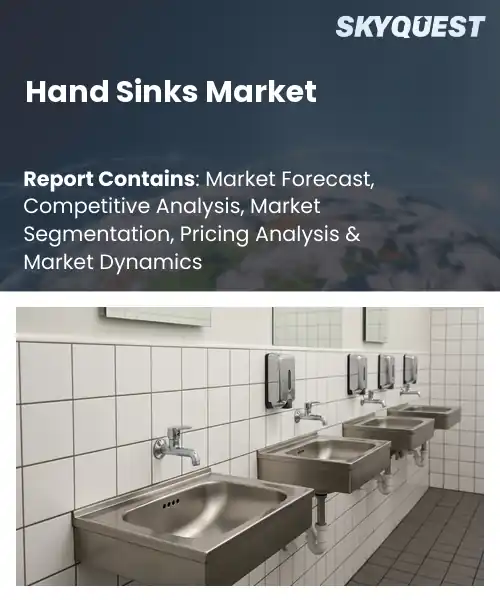
Hand Sinks Market
Report ID: SQMIG25G2037
Report ID: SQMIG25G2037
[email protected]
USA +1 351-333-4748
Report ID:
SQMIG25G2037 |
Region:
Global |
Published Date: June, 2026
Pages:
157
|Tables:
116
|Figures:
77


Global Hand Sinks Market size was valued at USD 68.5 Billion in 2024 and is poised to grow from USD 79.04 Billion in 2025 to USD 248.43 Billion by 2033, growing at a CAGR of 15.39% during the forecast period (2026-2033).
Growing awareness of cleanliness and stringent infection control rules are the leading factor responsible for the growth of the hand sinks market. This includes producers, suppliers, and installers of hand washing products tailored to regulations and durability, and is relevant because sinks play an important role in the prevention of infections and protection of public health. In terms of its history, the hand sinks industry has seen development from basic basin or pedestal versions through stainless steel wall-mounted installations for kitchen and clinic environments to sensor-operated systems being used in hospital and airport contexts.
The adoption of touchless technologies is one of the major factors influencing growth in the market due to the impact of these technologies in minimizing risks of cross-contamination and satisfying procurement needs of organizations, leading to an increase in price and profit margins. Handwashing sinks made of stainless steel and equipped with sensors used by hospitals and fast-food restaurants registered reduced HAIs and higher compliance rates during audit inspections, which resulted in the installation of this technology in existing institutions and the specification of these features in new construction projects. This created demand for IoT-facilitated faucets that track water consumption and offer sensor maintenance services, among other opportunities.
How is IoT Improving Hygiene Monitoring in the Hand Sinks Market?
IoT is changing the face of hygiene tracking in hand sinks by providing an interconnected system of sensors within the faucet, soap dispenser and water supply lines, allowing facilities to monitor performance and identify potential issues. The important features include sensing usage, alerting low supply or unusual water flow, remote software updates and cloud-based analytics converting the data into actionable insights. Currently, there are many uses of IoT in sinks in the hand sink market for sectors such as hospitals, food establishments, and high traffic locations where compliance and timely intervention are crucial. Such use cases may include faucets that automatically sense usage and send information to dashboards, soap dispensers which send alerts to employees in case of malfunctioning, and water quality sensors that schedule preventative maintenance. Sloan January 2026 extended its portfolio of products in its SC Argus Pro platform by adding new faucets and fixtures for more effective monitoring and maintenance.
Market snapshot - (2026-2033)
Global Market Size
USD 68.5 Billion
Largest Segment
Wall-Mounted Sinks
Fastest Growth
Portable Sinks
Growth Rate
15.39% CAGR
To get more insights on this market click here to Request a Free Sample Report
Global hand sinks market is segmented by product type, material type, end use, distribution channel and region. Based on product type, the market is segmented into Wall-Mounted Sinks, Freestanding Sinks and Portable Sinks. Based on material type, the market is segmented into Stainless Steel, Ceramic and Plastic. Based on end use, the market is segmented into Residential and Commercial. Based on the distribution channel, the market is segmented into Online Sales, Retail Stores and Wholesale. Based on the region, the market is segmented into North America, Europe, Asia Pacific, Latin America and Middle East & Africa.
Segment Wall Mounted Sinks prevails due to its permanent fixture, saving floor space as well as allowing cleaning procedures to minimize contamination sources. Its elevation makes it easier for staff members to clean it as well as minimizing chances of splash on the floor which improves results from such cleaning processes. The effective installation and robustness of the product also minimize incidences of maintenance while encouraging users to adopt wall-mounted sinks in order to maintain better hygiene results.
The fastest-growing segments currently are portable sinks which have seen tremendous growth as they meet a rising demand for flexible hand-washing facilities in different scenarios. This segment benefits from its easy installation process as well as ease of carrying out maintenance services which opens up more channels for sale.
The Stainless-Steel category rules since the robustness, ability to withstand corrosive substances, and impermeability characteristics make them well suited to meet hygiene requirements and minimize maintenance costs. Due to this factor, stainless sinks can endure repeated sanitation cycles without breaking down or suffering damages, thus enhancing operation and reducing the complexity associated with the process. It becomes easier for consumers who purchase stainless sinks to achieve consistent results and ease maintenance processes.
On the other hand, Plastic sinks present themselves as the category showing the greatest growth potential due to low manufacturing costs and portability. There have been significant improvements in plastic durability and the addition of antimicrobial properties, which have led to higher demand, facilitated by easy logistics and greater availability through the internet. The category presents immense opportunities to diversify products and tap into more applications.
To get detailed segments analysis, Request a Free Sample Report
The dominance of North America can be attributed to a proven synergy of strict hygiene regulations, high demand from institutions in both healthcare and catering sectors, and efficient infrastructure for production and distribution of highly evolved fixtures. Consumers have a preference for fixtures that are accredited, hands-free, and meet accessibility guidelines, encouraging innovation and manufacturing on a larger scale. Market leadership is also assured through a highly developed system of after-market services, partnerships with facility management companies, and purchase policies favoring dependable and low-maintenance fixtures. Retrofit activity in the commercial sector and collaborative relationships among manufacturers, specifiers, and purchasing companies also help solidify the region’s position as a key market for high-end hand wash stations and systems.
The market for Hand Sinks in the USA is an example of a developed ecosystem where strict hygiene standards, widespread purchasing activities in institutions, and competition among manufacturers exist. The key factors contributing to demand for hand sinks include healthcare, catering, and renovation activities, along with high demands for touch-free and accessible models. Some important distribution channels for hand sinks are specialized distributors and facility management firms.
Key Features of Hand Sinks Market in Canada include an emphasis on public health initiatives, regional purchasing behavior, and a combination of domestic production and imported products. The end users appreciate hygiene-focused features, water saving technologies, and modular designs to meet varied facility needs. Adoption of hand sinks is encouraged by distributors and other service providers who stress code compliance, product longevity, and easy installation in healthcare, education, and food service facilities needing regular maintenance.
The expansion in Europe is catalyzed by the coming together of factors such as stringent public hygiene standards, a thriving hospitality industry along with food processing units, and an increased focus on the environmental impact of buildings as well as water savings. There will always be a need to procure institutional equipment in addition to the requirement to retrofit old facilities, which drives the demand for certified fixtures that not only perform their functional purposes but are aesthetically pleasing as well. Innovations will be fueled by the competitive production environment, along with supply chains that enable customized products, while distributors and specifiers play an important role in promoting them through installation and maintenance services.
Precision manufacturing, strict hygiene, high construction standards, and water-saving technology are key strengths of Hand Sinks Market in Germany. Purchasing hospitals, food production companies, and manufacturing plants emphasizes the use of durable fixtures with certifications that are part of existing sanitation systems. Innovation is driven by established local manufacturers and specialists in distributors due to their ability to meet highly regulated requirements.
UK Hand Sink Market features the increasing popularity of design-oriented fixtures that are innovative due to growing hygiene standards in both hospitality and healthcare segments. Facility modernizations lead to an increased installation of sensor-controlled products, which are more economical when it comes to water usage, thanks to flexible distribution and specialist installation services. Specifiers prioritize products for their good looks, ease of use, and compatibility with overall hygiene systems.
Market for Hand Sinks in France is developing via a combination of factors including high demand in the hospitality sector, increasing focus on sustainability in fixtures sourcing, and design-based purchasing by businesses. There is a need for small-sized and flexible hand sinks that are designed in accordance with aesthetic criteria but which also comply with hygiene standards. Local manufacturers and creative vendors are widening their distribution networks and producing maintenance products that conserve water.
Asia Pacific is gaining ground due to the upgrading in the medical care systems, food service industry, and commercial sectors along with increased use of innovative hygiene systems. The driving force behind this comes from both the local production of products, as well as collaboration with international companies and adaptation of the products according to the space constraints prevalent locally. Focus on touchless, water-efficient, and intelligent products matches the local demand for integrated and maintainable fixtures. Increased distribution channels, professional facility management, and specific retrofit projects ensure greater reachability in the region. This results in a demand transition from regular fixtures to technology-infused hand sinks.
The Hand Sinks Market in Japan consists of products that have been engineered to a high degree of accuracy and made of good quality material. There is preference for sinks that are small and elegant, having features such as sensor operation and automatic functions for efficient cleaning. In terms of local brands, durability, minimal upkeep, and conservation of water resources are prioritized, while specialist installers offer retrofit services in densely populated areas.
Hand Sink Market in South Korea is driven by innovations that use intelligent and space-saving fixtures integrating sophisticated electronics technology with elegant designs. The manufacturers take advantage of their sensors' know-how and precise engineering to come up with touch-free and water saving sink products ideal for small spaces in both commercial and residential buildings. Distribution is done online and installation networks.
To know more about the market opportunities by region and country, click here to
Buy The Complete Report
Rising Hygiene Awareness
An increase in focus on hygiene by the general population and institutions results in higher demand for hand sinks since such institutions ensure that there are hand sinks available to ensure that they are not at risk of diseases and that they maintain their safety. In procurement, sinks that are robust enough to withstand frequent usage and have features that make maintenance easier are selected, leading to the specification of newer models.
Technological Advancements in Design
Incorporation of touchless systems, sensor controls, and water conservation systems can be made easier through the promotion of such products since they make life more convenient for users, conserve water, and make maintenance easier. As a result, facility owners will want to install better hand-washing systems to improve their facilities. Product developers will then develop a line of products that can be used in future projects based on the changing specifications. The need for cost savings and better performance is what makes organizations install better hand-washing systems.
High Installation and Maintenance Costs
The high initial costs for plumbing, construction work, and qualified labor may prevent establishments and smaller enterprises from setting up new hand washing stations or upgrading existing systems, thus limiting the demand. With restricted budgets, managers focus on fundamental necessities and postpone the improvement process, preferring more affordable options that do not involve any permanent installation. This creates obstacles in retrofit applications and lowers the level of market penetration in budget-conscious sectors, hindering the growth potential of the industry even though there are clear hygienic advantages.
Inadequate Water and Sewage Infrastructure
Due to unreliable availability of water as well as problems with wastewater, stakeholders may be reluctant to put up fixed hand sinks that rely on steady water flow and drainage capabilities. Fears regarding upkeep costs and constant power failures, along with issues related to unhygienic conditions resulting from poor sewage disposal, prompt planners to opt for portable hand sinks or those that are not plumbing-dependent. Such reluctance adversely impacts marketing efforts in areas with these challenges, directing the efforts of manufacturers towards less complex hand sinks.
Request Free Customization of this report to help us to meet your business objectives.
The Hand Sinks Market has been described as having moderate competition because there are already existing companies that compete in terms of the quality, durability, hygiene conformity, and customization of their products. Innovation, touch-free technology, and water efficiency have become essential factors for success.
Touchless Fixture Adoption: There is increasing demand for hand sinks that allow hands-free operations, as operators value infection control, increased confidence, and efficiency. In their marketing, companies emphasize sensors' durability and functionality, along with antimicrobial properties of components. Such products attract attention of facility managers who wish to reduce risks of cross contamination and simplify sanitization procedures, while adhering to hygiene requirements. Differentiation is based on ease of retrofits, longevity of products, and usability, making it possible to replace conventional systems with more efficient options.
Smart Building Integration: The use of hand sinks as an element of automated buildings continues to grow, which allows for remote supervision, prevention maintenance, and the ability to monitor water consumption. Interoperability of vendors who manufacture these products continues to increase, making it possible for hand sinks to communicate their state, identify abnormalities, and synchronize operations with HVAC and sanitization cycles. This leads to transparency in operations, prevention of equipment failure via predictive maintenance, and easier regulatory compliance. Cooperation between plumbing companies and system integrators also grows, allowing for plug-and-play installations.
SkyQuest’s ABIRAW (Advanced Business Intelligence, Research & Analysis Wing) is our Business Information Services team that Collects, Collates, Correlates, and Analyses the Data collected by means of Primary Exploratory Research backed by robust Secondary Desk research.
As per SkyQuest analysis, the major factor driving the global hand sink market is increased hygiene consciousness and stricter infection control guidelines, whereas high costs of installation and maintenance serve as a constraint. North America dominates this market because of its strict guidelines and well-established procurement process, and wall-mounted sinks dominate this market owing to their ability to conserve space and ease cleaning. Another factor driving the global hand sink market is quick adoption of touchless hand sinks and smart hand sinks owing to their role in limiting cross-contamination and providing remote hygiene monitoring capabilities.
| Report Metric | Details |
|---|---|
| Market size value in 2024 | USD 68.5 Billion |
| Market size value in 2033 | USD 248.43 Billion |
| Growth Rate | 15.39% |
| Base year | 2024 |
| Forecast period | (2026-2033) |
| Forecast Unit (Value) | USD Billion |
| Segments covered |
|
| Regions covered | North America (US, Canada), Europe (Germany, France, United Kingdom, Italy, Spain, Rest of Europe), Asia Pacific (China, India, Japan, Rest of Asia-Pacific), Latin America (Brazil, Rest of Latin America), Middle East & Africa (South Africa, GCC Countries, Rest of MEA) |
| Companies covered |
|
| Customization scope | Free report customization with purchase. Customization includes:-
|
To get a free trial access to our platform which is a one stop solution for all your data requirements for quicker decision making. This platform allows you to compare markets, competitors who are prominent in the market, and mega trends that are influencing the dynamics in the market. Also, get access to detailed SkyQuest exclusive matrix.
Table Of Content
Executive Summary
Market overview
Parent Market Analysis
Market overview
Market size
KEY MARKET INSIGHTS
COVID IMPACT
MARKET DYNAMICS & OUTLOOK
Market Size by Region
KEY COMPANY PROFILES
Methodology
For the Hand Sinks Market, our research methodology involved a mixture of primary and secondary data sources. Key steps involved in the research process are listed below:
1. Information Procurement: This stage involved the procurement of Market data or related information via primary and secondary sources. The various secondary sources used included various company websites, annual reports, trade databases, and paid databases such as Hoover's, Bloomberg Business, Factiva, and Avention. Our team did 45 primary interactions Globally which included several stakeholders such as manufacturers, customers, key opinion leaders, etc. Overall, information procurement was one of the most extensive stages in our research process.
2. Information Analysis: This step involved triangulation of data through bottom-up and top-down approaches to estimate and validate the total size and future estimate of the Hand Sinks Market.
3. Report Formulation: The final step entailed the placement of data points in appropriate Market spaces in an attempt to deduce viable conclusions.
4. Validation & Publishing: Validation is the most important step in the process. Validation & re-validation via an intricately designed process helped us finalize data points to be used for final calculations. The final Market estimates and forecasts were then aligned and sent to our panel of industry experts for validation of data. Once the validation was done the report was sent to our Quality Assurance team to ensure adherence to style guides, consistency & design.
Analyst Support
Customization Options
With the given market data, our dedicated team of analysts can offer you the following customization options are available for the Hand Sinks Market:
Product Analysis: Product matrix, which offers a detailed comparison of the product portfolio of companies.
Regional Analysis: Further analysis of the Hand Sinks Market for additional countries.
Competitive Analysis: Detailed analysis and profiling of additional Market players & comparative analysis of competitive products.
Go to Market Strategy: Find the high-growth channels to invest your marketing efforts and increase your customer base.
Innovation Mapping: Identify racial solutions and innovation, connected to deep ecosystems of innovators, start-ups, academics, and strategic partners.
Category Intelligence: Customized intelligence that is relevant to their supply Markets will enable them to make smarter sourcing decisions and improve their category management.
Public Company Transcript Analysis: To improve the investment performance by generating new alpha and making better-informed decisions.
Social Media Listening: To analyze the conversations and trends happening not just around your brand, but around your industry as a whole, and use those insights to make better Marketing decisions.
REQUEST FOR SAMPLE
 REQUEST FREE CUSTOMIZATION
Global Hand Sinks Market size was valued at USD 68.5 Billion in 2024 and is poised to grow from USD 79.04 Billion in 2025 to USD 248.43 Billion by 2033, growing at a CAGR of 15.39% during the forecast period (2026-2033).
I can verify Throne Labs (est. 2020) as a relevant startup, but I cannot reliably find a second verified startup in the global hand sinks market founded in or after 2019. Do you want me to proceed by allowing one company founded before 2019, include a startup in adjacent sanitation technology founded after 2019, or continue with Throne Labs plus a non-startup innovator such as WOTA? Reply with 1, 2, or 3. 'Elkay Manufacturing Company', 'Franke Group', 'Mustee', 'NEMCO Food Equipment', 'Winco', 'Advance Tabco', 'Kohler Co.', 'T&S Brass and Bronze Works', 'Gaylord Industries', 'Crown Verity', 'Enviroware', 'Basys', 'Albiral', 'Blakeslee', 'Zurn Industries', 'Callington', 'Sunkist Growers', 'Hoshizaki America, Inc.', 'Cambro Manufacturing Company', 'Krowne Metal Corporation'
Improved public and institutional emphasis on hygiene has translated into stronger demand for hand sinks because facilities prioritize reliable handwashing infrastructure to prevent illness and maintain perceived safety. Procurement decisions favor dedicated, durable sinks that support frequent use and integrated features that simplify cleaning and maintenance, prompting facility managers and designers to specify modern sink solutions. This preference drives manufacturers to expand offerings tailored to healthcare, foodservice, and public buildings, strengthening market growth through sustained replacement cycles and specification-led purchases.
Touchless Fixture Adoption: Demand for hands free hand sinks continues to grow as operators prioritize infection control, occupant confidence, and operational efficiency. Manufacturers are emphasizing sensor reliability, low maintenance mechanisms, and antimicrobial surfaces to meet healthcare and foodservice expectations. Adoption is driven by facility managers seeking reduced cross contamination risk and simplified cleaning protocols while aligning with hygiene standards. Product differentiation emphasizes retrofit compatibility, lifecycle support, and user experience, enabling replacement of traditional units and stimulating aftermarket services, integration with facility maintenance programs.
Why does North America Dominate the Global Hand Sinks Market? |@12


Want to customize this report? This report can be personalized according to your needs. Our analysts and industry experts will work directly with you to understand your requirements and provide you with customized data in a short amount of time. We offer $1000 worth of FREE customization at the time of purchase.
Feedback From Our Clients


 USA (+1) 351-333-4748

