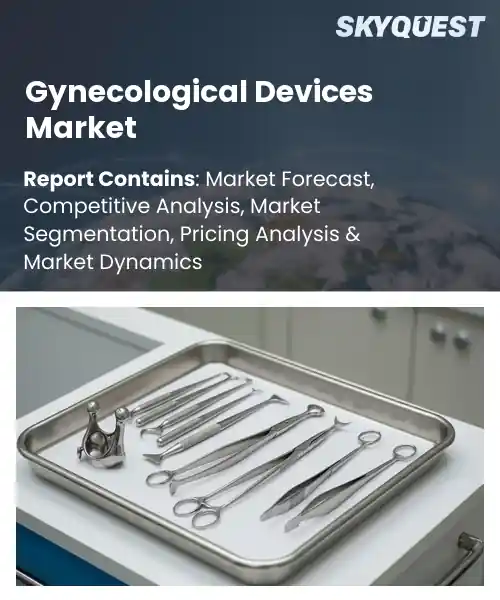
Gynecological Devices Market
Report ID: SQMIG35A3790
Report ID: SQMIG35A3790
[email protected]
USA +1 351-333-4748
Report ID:
SQMIG35A3790 |
Region:
Global |
Published Date: June, 2026
Pages:
157
|Tables:
121
|Figures:
77


Global Gynecological Devices Market size was valued at USD 10.1 Billion in 2024 and is poised to grow from USD 10.97 Billion in 2025 to USD 21.29 Billion by 2033, growing at a CAGR of 8.64% during the forecast period (2026-2033).
Demographic change as the key driver for the gynecological devices market growth, as aging populations, growing health awareness and increased reproductive choices increase demand for diagnostics, therapeutics and invasive interventions. The market includes instruments and implants for the diagnosis, treatment and monitoring of gynecologic conditions like fibroids, endometriosis, pelvic organ prolapse and infertility. It matters because women’s health outcomes affect workforce participation and healthcare spending. The sector, historically, moved from basic specula and forceps, to laparoscopic tools, intrauterine devices and image-guided ablation, as exemplified by the move from open hysterectomy to hysteroscopic and robotic procedures.
Moreover, rapid technological innovation is a key factor enhancing the global gynecological devices market penetration, building on that technological shift. Advances in imaging, robotics and single-use instrumentation reduce procedure time, lower infection risk, and expand outpatient care. Consequently, hospitals are now employing hysteroscopic morcellators and robot-assisted platforms for myomectomy and hysterectomy. This results in shorter stays and lower total costs, creating a positive reimbursement cycle and wider clinician adoption. This cascade opens avenues in emerging markets where lower-cost single-use devices and telehealth-enabled diagnostics can increase access, while AI-powered imaging and remote monitoring enable earlier intervention and enhance patient outcomes across health systems.
Increase in diagnostic accuracy with the use of advanced image analysis, clinical decision support and workflow automation in the gynecological devices market. Core elements include automatic detection of subtle tissue changes, standardized image acquisition and integration with pathology and molecular results. The present situation shows an increasing adoption in pelvic ultrasound, colposcopy and cytology where AI reduces the operator variability and highlights suspicious findings earlier. These improvements lead to more consistent interpretations and faster triage by clinicians to support better screening and preoperative planning. In the real world, this includes AI-powered ultrasound guidance, digital colposcopy, and tools for cytology scoring.
Market snapshot - (2026-2033)
Global Market Size
USD 10.1 Billion
Largest Segment
Contraceptive Devices
Fastest Growth
Endometrial Ablation Devices
Growth Rate
8.64% CAGR
To get more insights on this market click here to Request a Free Sample Report
The global gynecological devices market is segmented by product type, application area, end-user, distribution channel and region. Based on product type, the market is segmented into Gynecological Endoscopy Devices, Endometrial Ablation Devices, Contraceptive Devices, Fluid Management Systems and Diagnostic Imaging Systems. Based on application area, the market is segmented into Laparoscopy Procedures, Hysteroscopy Procedures, Endometrial Ablation Workflows, Dilation & Curettage and Others. Based on end-user, the market is segmented into Hospitals & Clinics, Gynecology Centers, Ambulatory Surgical Centers and Fertility Centers. Based on distribution channel, the market is segmented into Direct and Indirect. Based on region, the market is segmented into North America, Europe, Asia Pacific, Latin America and Middle East & Africa.
As per the gynecological devices market analysis, the Gynecological Endoscopy Devices segment held the largest share in the market. These devices allow minimally invasive diagnosis and therapy in a wide range of gynecological procedures, allowing surgeons to substitute open surgery with endoscopic approaches. The continuous improvements in optics, instrumentation and ergonomics are leading to increased procedural safety and efficiency, which translates into strong preference and acquisition by hospitals. Integrated platforms and training ecosystems that support installed base growth and incremental disposable sales drive stickiness with clinicians.
However, the Endometrial Ablation Devices segment is emerging as the fastest growing segment as outpatient friendly designs and simplified procedures drive clinician adoption for the treatment of abnormal uterine bleeding. New care avenues and reimbursement interest are being created by innovation in device delivery and growing demand for fast recovery therapies, paving the way for future product launches and market entry opportunities.
According to the gynecological devices market forecast, the hysteroscopy procedures segment dominates as hysteroscopy is the diagnostic and therapeutic backbone for intracavitary gynecological care, which encourages consistent demand for visualization tools, fluid management systems and operative instruments. Its central role in the evaluation of abnormal bleeding, polyps and intrauterine pathology leads to cross platform purchases and preference for integrated solution providers. Clinicians are very dependent on workflows, which are standardized and lead to the reuse of consumables and institutions investing in a compatible device ecosystem.
Endometrial Ablation Workflows, however, are the fastest growing area as clinicians are favouring less invasive treatments for menorrhagia and technologies are allowing for clinic based procedures. Device simplification, portable delivery platforms, and clearer guideline support accelerate adoption in ambulatory settings, opening new pathways for device manufacturers to capture procedural volume and drive adjunctive service models.
To get detailed segments analysis, Request a Free Sample Report
As per the gynecological devices market regional forecast, North America is the leading player in the market, owing to the synergistic combination of advanced clinical infrastructure, a large pool of specialized healthcare providers, and an innovative culture prevalent in the medical technology industry. Established regulatory and reimbursement frameworks reduce uncertainty for developers and enable rapid clinical adoption. The concentration of leading manufacturers, collaboration between academic medical centers and industry, and extensive clinician training programs promote continuous product refinement and diffusion. The scaling of new technologies is supported by access to venture capital and established distribution and service networks. Strong post market surveillance and active professional societies that generate clinical guidance accelerate clinician confidence and procurement. The increased integration of digital health and telemedicine into gynecological care pathways offers use cases for device-enabled diagnostics and monitoring.
Gynecological Devices Market in the United States
The Gynecological Devices sector in the United States is characterized by strong innovation ecosystem, concentration of leading manufacturers and extensive clinical expertise. Acceptance of advanced devices is driven by receptive clinical communities and clear regulatory pathways, and integrated health systems ease procurement and training. Collaborations between academic centers, industry and patient advocacy groups speed the pace of product development and market entry, strengthening the U.S. as a hub for advanced gynecological technologies and continuous innovation.
Gynecological Devices Market in Canada
The Canadian gynecological devices industry is supported by a well-integrated healthcare delivery system, extensive public sector participation and targeted clinical networks that support device assessment and acceptance. The focus on equitable access and training of clinicians encourages slow and steady adoption of minimally invasive and diagnostic technologies. Partnerships between provincial health authorities and research institutions, and international manufacturers support local adoption pathways and incremental innovation to deliver on regional care delivery priorities and evidence generation capacity.
Strong national healthcare systems, proactive clinical communities and increasing focus on women oriented health initiatives are driving rapid expansion of Europe gynecological devices market. Regulatory harmonization across markets and structured health technology assessment processes help clarify value propositions for new devices and reimbursement decision making in key markets support adoption of clinically proven innovations. A rich ecosystem of specialized manufacturers and research institutions fosters product development and real world evaluation. Moreover, collaboration across borders between hospitals, academic centres and industry, along with increasing patient awareness and dedicated training programs, are accelerating the diffusion of minimally invasive, image guided and diagnostic solutions, further strengthening Europe's position as a major and evolving market for gynecological technologies. Policy initiatives and national screening programmes establish pathways for technology integration and investments in digital health allow for device connectivity and remote care. Networks of clinical opinion leaders and professional societies drive evidence generation and adoption of guidelines across markets.
Gynecological Devices Market in Germany
Germany's Gynecological Devices market is helped by a well-developed medical technology ecosystem, substantial hospital infrastructure and a robust culture of clinical research and training. The product is honed with domestic manufacturers and specialized clinical centers for real world evaluation. Reimbursement pathways and centralized procurement mechanisms facilitate adoption of advanced surgical and diagnostic devices. Adoption of minimally invasive and image guided solutions across care pathways and professional development is underpinned by strong clinician engagement.
Gynecological Devices Market in the UK
The United Kingdom Gynecological Devices Market is driven by a vibrant mix of private and public healthcare initiatives, robust clinical research networks and emphasis on minimally invasive technologies. Active clinician engagement and regulatory modernization speed adoption. It is the investment in training and cross sector collaboration between hospitals, academic centers and international manufacturers that enables the rapid evaluation and deployment of products that is driving a shift towards innovative diagnostic and therapeutic approaches in gynecological care and outcomes.
Gynecological Devices Market in France
The France’s Gynecological Devices Market is evolving through a blend of focused public health priorities, growing clinical expertise and a conducive innovation environment. Regional centers of excellence and specialized hospitals are piloting new diagnostic and surgical approaches, while domestic startups are collaborating with multinational companies to develop products. The emphasis on integrated care pathways and physician education encourages a prudent adoption of high-end devices, positioning France as a strategic market for customized gynecological solutions.
Asia Pacific is strengthening its standing in the gynecological devices market through a combination of rising healthcare investment, maturing regulatory frameworks and growing clinical capacity. Increasing expertise of regional medical device firms and increasing localization of manufacturing reduces barriers to market entry and enables cost competitive technology development. Collaboration between hospitals, research centres and technology companies accelerates the clinical validation of new approaches. The uptake of digital health and the focus on improving access to women’s health services create new pathways for device enabled diagnostics and remote care models. Strategic emphasis on training, quality standards and export oriented innovation makes the region a more powerful source of incremental and disruptive gynecological technologies. Government led initiatives and public private partnerships are providing increasing support for device innovation and clinical research across markets. Cooperation with multinational corporations and efforts to align regulatory standards with international benchmarks increase international competitiveness and export potential.
Gynecological Devices Market in Japan
The Japan Gynecological Devices Market is driven by a robust emphasis on precision engineering, advanced clinical practices and a strong research infrastructure. The high standards for device quality and the rigour of clinical evaluation favour the adoption of technically sophisticated diagnostic and therapeutic tools. Iterative innovation is facilitated by collaborative efforts among domestic manufacturers, academic centers, and international partners. Training clinicians and validating pathways within hospitals ensures that new technologies are incorporated into existing care pathways.
Gynecological Devices Market in South Korea
Fast-paced technology adoption, strong manufacturing capabilities and vibrant industry-clinician collaboration are driving South Korea’s Gynecological Devices market. Innovation clusters enable the development of miniaturised, image guided and digitally enabled devices. Smart investment in medical device startups and agile regulatory engagement fast-track local commercialization. Close linkages between hospitals, research institutes and technology companies allow for practical validation and scaling of solutions tailored to domestic and global markets.
To know more about the market opportunities by region and country, click here to
Buy The Complete Report
Advancements In Minimally Invasive Technologies
Increasing Investment In Research and Development
Complex Regulatory Approval and Compliance
Limited Reimbursement and Cost Constraints
Request Free Customization of this report to help us to meet your business objectives.
Major medtech firms are using M&A, targeted partnerships and in-house technology development to close gaps in urogynecology and minimally invasive solutions, leading to rapid consolidation and product differentiation in the competitive landscape. Boston Scientific's acquisition of Axonics, Organon's purchase of Alydia and Caldera Medical's buy of UVision360 are examples of consolidation, while incumbents and startups are pursuing at home and catheter free diagnostics to differentiate clinically and commercially.
Top Player’s Company Profile
Recent Developments in the Gynecological Devices Market
SkyQuest’s ABIRAW (Advanced Business Intelligence, Research & Analysis Wing) is our Business Information Services team that Collects, Collates, Correlates, and Analyses the Data collected by means of Primary Exploratory Research backed by robust Secondary Desk research.
As per SkyQuest analysis, the global gynecological devices market is primarily driven by demographic change increasing the demand for diagnostics and interventions. A second key driver is rapid technological innovation in imaging, robotics and single-use instruments that enable more outpatient care. A major constraint is the complicated and divergent processes of regulatory approvals that hinder product launches and increase expenses. North America is the dominating region due to the presence of advanced clinical infrastructure and strong industry-academic ties. Gynecological endoscopy devices are the dominating segment as they allow minimally invasive diagnosis and therapy across broad care pathways. Overall the market has a lot of innovation but also regulatory and reimbursement challenges.
| Report Metric | Details |
|---|---|
| Market size value in 2024 | USD 10.1 Billion |
| Market size value in 2033 | USD 21.29 Billion |
| Growth Rate | 8.64% |
| Base year | 2024 |
| Forecast period | (2026-2033) |
| Forecast Unit (Value) | USD Billion |
| Segments covered |
|
| Regions covered | North America (US, Canada), Europe (Germany, France, United Kingdom, Italy, Spain, Rest of Europe), Asia Pacific (China, India, Japan, Rest of Asia-Pacific), Latin America (Brazil, Rest of Latin America), Middle East & Africa (South Africa, GCC Countries, Rest of MEA) |
| Companies covered |
|
| Customization scope | Free report customization with purchase. Customization includes:-
|
To get a free trial access to our platform which is a one stop solution for all your data requirements for quicker decision making. This platform allows you to compare markets, competitors who are prominent in the market, and mega trends that are influencing the dynamics in the market. Also, get access to detailed SkyQuest exclusive matrix.
Table Of Content
Executive Summary
Market overview
Parent Market Analysis
Market overview
Market size
KEY MARKET INSIGHTS
COVID IMPACT
MARKET DYNAMICS & OUTLOOK
Market Size by Region
KEY COMPANY PROFILES
Methodology
For the Gynecological Devices Market, our research methodology involved a mixture of primary and secondary data sources. Key steps involved in the research process are listed below:
1. Information Procurement: This stage involved the procurement of Market data or related information via primary and secondary sources. The various secondary sources used included various company websites, annual reports, trade databases, and paid databases such as Hoover's, Bloomberg Business, Factiva, and Avention. Our team did 45 primary interactions Globally which included several stakeholders such as manufacturers, customers, key opinion leaders, etc. Overall, information procurement was one of the most extensive stages in our research process.
2. Information Analysis: This step involved triangulation of data through bottom-up and top-down approaches to estimate and validate the total size and future estimate of the Gynecological Devices Market.
3. Report Formulation: The final step entailed the placement of data points in appropriate Market spaces in an attempt to deduce viable conclusions.
4. Validation & Publishing: Validation is the most important step in the process. Validation & re-validation via an intricately designed process helped us finalize data points to be used for final calculations. The final Market estimates and forecasts were then aligned and sent to our panel of industry experts for validation of data. Once the validation was done the report was sent to our Quality Assurance team to ensure adherence to style guides, consistency & design.
Analyst Support
Customization Options
With the given market data, our dedicated team of analysts can offer you the following customization options are available for the Gynecological Devices Market:
Product Analysis: Product matrix, which offers a detailed comparison of the product portfolio of companies.
Regional Analysis: Further analysis of the Gynecological Devices Market for additional countries.
Competitive Analysis: Detailed analysis and profiling of additional Market players & comparative analysis of competitive products.
Go to Market Strategy: Find the high-growth channels to invest your marketing efforts and increase your customer base.
Innovation Mapping: Identify racial solutions and innovation, connected to deep ecosystems of innovators, start-ups, academics, and strategic partners.
Category Intelligence: Customized intelligence that is relevant to their supply Markets will enable them to make smarter sourcing decisions and improve their category management.
Public Company Transcript Analysis: To improve the investment performance by generating new alpha and making better-informed decisions.
Social Media Listening: To analyze the conversations and trends happening not just around your brand, but around your industry as a whole, and use those insights to make better Marketing decisions.
REQUEST FOR SAMPLE
 REQUEST FREE CUSTOMIZATION
Global Gynecological Devices Market size was valued at USD 10.1 Billion in 2024 and is poised to grow from USD 10.97 Billion in 2025 to USD 21.29 Billion by 2033, growing at a CAGR of 8.64% during the forecast period (2026-2033).
Competitive landscape shows rapid consolidation and product differentiation as major medtech firms use M&A, targeted partnerships, and in house technology development to close gaps in urogynecology and minimally invasive solutions; recent deals such as Boston Scientific’s acquisition of Axonics, Organon’s purchase of Alydia, and Caldera Medical’s buy of UVision360 illustrate consolidation, while incumbents and startups pursue at home and catheter free diagnostics to differentiate clinically and commercially. 'Boston Scientific Corporation', 'CooperSurgical', 'Hologic', 'Medtronic', 'Stryker Corporation', 'Johnson & Johnson', 'Richard Wolf GmbH', 'Karl Storz SE', 'Olympus Corporation', 'Cook Medical', 'Berchtold Corporation', 'Gynex Corporation', 'Wallach Surgical Devices', 'Utah Medical Products', 'Pelican Feminine Healthcare', 'Sklar Surgical Instruments', 'Medline Industries', 'Cardinal Health', 'Merit Medical Systems', 'Thermage'
Improvements in device design, imaging integration, and instrument precision have expanded the applicability of minimally invasive gynecological procedures, enabling clinicians to perform complex interventions with reduced trauma and faster recovery. These technological refinements increase clinician confidence and broaden indications for device use, thereby encouraging adoption in hospital and ambulatory settings. As result, demand for advanced surgical instruments, energy-based devices, and visualization systems grows, supporting market expansion by reinforcing clinical value, improving patient outcomes, and creating stronger procurement incentives among healthcare providers.
Telehealth And Remote Monitoring: Adoption of virtual care platforms and connected gynecological devices is reshaping patient engagement and continuity of care. Manufacturers are prioritizing interoperability, secure data exchange, and easy at home use to enable remote consultations, post procedure follow up, and chronic condition management. Healthcare providers and device makers are collaborating to integrate device data into clinical workflows, improve adherence, and support decentralized care models. This trend is driving design emphasis on usability, connectivity, and service models that extend device value beyond clinic.
Why does North America Dominate the Global Gynecological Devices Market? |@12


Want to customize this report? This report can be personalized according to your needs. Our analysts and industry experts will work directly with you to understand your requirements and provide you with customized data in a short amount of time. We offer $1000 worth of FREE customization at the time of purchase.
Feedback From Our Clients


 USA (+1) 351-333-4748

