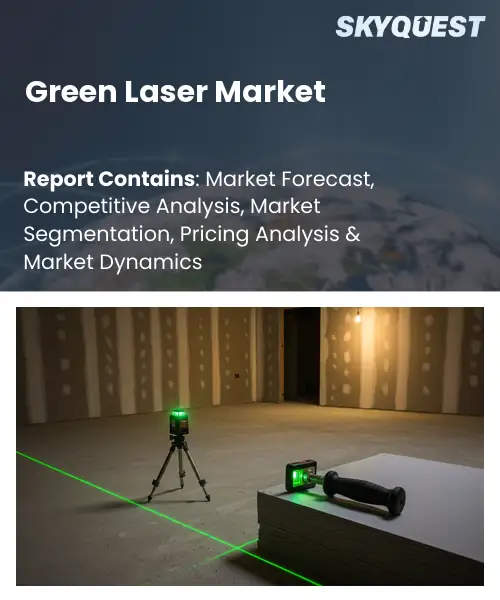
Green Laser Market
Report ID: SQMIG45J2681
Report ID: SQMIG45J2681
[email protected]
USA +1 351-333-4748
Report ID:
SQMIG45J2681 |
Region:
Global |
Published Date: July, 2026
Pages:
157
|Tables:
151
|Figures:
78


Global Green Laser Market size was valued at USD 9.36 Billion in 2024 and is poised to grow from USD 9.83 Billion in 2025 to USD 35.01 Billion by 2033, growing at a CAGR of 5.0% during the forecast period (2026-2033).
The international green laser market involves the manufacture and distribution of diode-pumped solid-state (DPSS) and semiconductor lasers operating at the wavelength of 532 nm, an extremely visible range used due to its accuracy. The significance of the market is explained by a wide range of applications from scientific equipment to entertainment where creation is supported by the possibility of producing a sharp beam. In the last two decades, the green laser market has developed from rare military targeting devices into common consumer products like light shows and diagnostic apparatus, which occurred thanks to cheaper diodes and the use of modules.
Among the factors that influence the market of green lasers, one should highlight the growing demand for medical and industrial inspections. Eye surgeries, dermatological treatments, and bar code scanning make the producers create 532 nm green lasers with high-quality beams and more durability, thus promoting investments into the development of the diode-pumping technology and assembly lines. Examples prove the logic of such causal relationships. Thus, hospitals use portable green-laser microscopes for retina examinations, and factories substitute their argon lights with solid-state green lights to speed up the process of defect detection. In such a way, there emerge opportunities for producers to provide services and tools.
How is AI-driven Automation Influencing the Cost and Performance of the Green Laser Market?
Artificial intelligence enabled automation technologies are transforming the green laser market through tighter production specifications and decreased waste of components. Some of the factors are intelligent processing systems, real-time optical sensing, and predictive maintenance of diode-pumped solid-state lasers. Modern laser manufacturers use machine learning technologies that allow changing pump current and temperature of crystals in real time, thus achieving better performance and increased lifetime of devices. This technology makes calibration easier, decreases material costs, and improves the quality of beams for display, imaging, and precision machining applications. Early adopters benefit from quicker time to market and increased yield, making green lasers cheaper for a wider range of customers.
Market snapshot - (2026-2033)
Global Market Size
USD 9.36 Billion
Largest Segment
Diode-Pumped Solid-State (DPSS) Green Lasers
Fastest Growth
Direct Diode Green Lasers
Growth Rate
5.0% CAGR
To get more insights on this market click here to Request a Free Sample Report
Global green laser market is segmented by product type, output power, operation mode, application, end user and region. Based on product type, the market is segmented into Diode-Pumped Solid-State (DPSS) Green Lasers, Direct Diode Green Lasers, and Fiber Green Lasers. Based on output power, the market is segmented into Low Power (Up to 50 mW), Medium Power (51 mW–500 mW), and High Power (Above 500 mW). Based on operation mode, the market is segmented into Continuous Wave (CW) and Pulsed. Based on application, the market is segmented into Material Processing, Medical & Aesthetic, Scientific Research, Semiconductor & Electronics Manufacturing, Display & Entertainment, Metrology & Inspection, Defense & Aerospace and Others. Based on end user, the market is segmented into Industrial Manufacturing, Healthcare, Research Institutes & Laboratories, Electronics & Semiconductor Industry, Defense & Security and Others. Based on region, the market is segmented into North America, Europe, Asia Pacific, Latin America and Middle East & Africa.
The DPSS green laser segment holds dominance since its high beam quality and robust frequency conversion system helps in meeting the requirements of precise material processing applications. With this technology, users can get stable wavelengths with narrow linewidth and reliable outputs and can produce fine features and reliable results. These factors ensure confidence of the end-users and hence help in the widespread adoption of the DPSS technology in various industrial processes.
On the other hand, the fiber green laser segment exhibits the highest growth potential since its robust construction and small size creates new avenues for various application fields such as displays and entertainment.
The CW operation segment dominates due to its ability to deliver constant light that matches the constant production process of semiconductors and electronics industry. The constant output makes system integration easier, minimizes the need for complex synchronization, and allows for uniform processing of large substrates. All these benefits reduce equipment down time and ensure consistent product output, which makes continuous waves an obvious choice in the green lasers for high throughput environments.
At the same time, the pulsed operation segment represents the main high growth segment due to the ability of this segment to deliver short pulses that allow for precise interaction with tissues with low thermal spreading. This makes the pulsed operation segment a fast-growing segment due to the high demand from aesthetic medicine and scientific research.
To get detailed segments analysis, Request a Free Sample Report
North America stands at the top owing to the presence of an established research ecosystem, intellectual property regime, and widespread application of green laser technology in sectors including defense, medical imaging, and precision manufacturing. The US takes advantage of the substantial financial resources available for research in the federal and private sectors, ensuring continuous innovation, whereas Canada boasts strong academic and industry partnerships that help expedite the process of product development. Both countries have sophisticated logistics systems and regulatory regimes that support quick commercialization.
Green Laser Market in the US is built on the synergy between scientific innovation and a broad base of industries that use lasers in applications related to medicine, aviation, and semiconductors. The joint work of research universities and high-tech companies fosters innovation in terms of turning innovations into products. Favorable political climate and venture capital investments help build startups, and big producers use their economies of scale to provide reliable solutions.
The Green Laser Market in Canada is driven by high levels of governmental support for environmentally friendly technologies as well as the presence of an active system of research hospitals and manufacturing centers. Cooperation between regional research centers and private companies stimulates the development of green lasers for medical surgery and new photonic applications. Focus on environmentally friendly industrial processes creates a demand for energy-efficient laser equipment, and qualified labor force secures quality manufacturing. These elements make Canada more prominent within North American leadership.
The development of Europe is driven by strict environmental regulations, extensive cooperation between private and public organizations in the field of scientific research, and the emphasis placed on precision manufacturing. Germany’s background in engineering can be considered an excellent basis for the creation of advanced lasers, while the dynamic startup community in the UK can serve as an accelerator of innovations in application of new laser technologies. The growing interest in the use of lasers in the fields of medicine and military sphere in France adds up to the set of demand factors.
Germany’s Green Laser Market thrives due to the legacy of precise engineering and a lot of industrial clusters where automation and advanced manufacturing is preferred. Cooperation between technical universities and renowned optics companies enables fast implementation of research findings, while strong standards guarantee reliable products. Sustainable manufacturing programs by the government encourage the development of efficient laser technologies. All of this makes Germany remain dominant in the green lasers market of Europe.
The Green Laser Market in the United Kingdom has witnessed fast growth owing to the presence of innovation centers and the involvement of venture capitalists. Universities that are famous for their photonics research work in tandem with new businesses, making it easy to innovate new applications for green lasers in areas such as health care and security. Policies that support low-carbon technology drive market adoption. This results in the country being the fastest-growing provider to the European green-laser market.
The Green Laser Market in France has been taking shape as an area of focus for integrating the applications of medical imaging and defense technology. Joint efforts by national research organizations and niche manufacturers aid in the growth of precision laser devices. The strategic importance of developing environment friendly manufacturing processes corresponds to overall national objectives for sustainability, making way for laser devices that consume less energy.
Asia Pacific leverages its competitive advantage via aggressive research investments in photonics, a robust manufacturing platform, and innovative application areas including consumer electronics and advanced display systems. The combination of the precision optics heritage of Japan with strong government support ensures high-end laser innovations, and the speedy adaptation to advanced technologies in South Korea results in rapid growth in the market penetration of the products within various industries. Technology transfers become easier due to regional cooperation and liberal trade policies, ensuring the rising influence of Asia Pacific in the green lasers market.
Green Laser Market in Japan relies on rich experience in creating optical devices and well-established research and development networks to provide highly reliable laser components. The cooperation of top universities and industrial firms guarantees constant improvement in terms of efficiency. The government’s focus on energy-saving technologies drives the popularity of these products among such industries as the automotive, medical, and consumer electronics industry.
The Green Laser Market in South Korea is influenced by the fast-paced technology environment and large investments made in semiconductor and display production. Tight cooperation of research centers and flexible manufacturers contributes to quick implementation of green-laser systems in future devices. Government policies that focus on environmental innovations make companies use energy-efficient laser systems. This strategy makes South Korea progress rapidly and plays an important role in growing the green-laser market in Asia Pacific.
To know more about the market opportunities by region and country, click here to
Buy The Complete Report
Adopting Sustainable Laser Technologies
The adoption of environmentally sound laser technologies is helping drive market growth with companies incorporating eco-friendly technologies into their product offerings to meet increased demands for sustainability in corporations. Such an approach is motivating increased investments in research and development to come up with designs that match performance but are more environmentally friendly. Buyers in the telecommunications industry, medical imaging, and precise manufacturing industries are increasingly looking for eco-friendly technologies, and suppliers are differentiating themselves by offering eco-friendly products. The demand for green lasers rises accordingly.
Increasing Demand in Renewable Energy
The rise in demand for renewable energy sources presents new areas where lasers can be applied in an eco-friendly manner, including solar panels production and wind turbine maintenance. The engineering community takes advantage of the precision cutting and inspection abilities of the low-power lasers to improve the efficiency of the components produced, but at the same time reduce material waste. This practical importance is the key reason for the implementation of green lasers within the supply chain of the clean energy industry.
High Production Costs Remain
However, high costs involved in the manufacture of such lasers still present a major constraint since the use of special raw materials and certification requirements make the manufacturing process quite costly. Thus, producers have to utilizecostly technology and quality control systems to ensure the compliance of their products, and the resulting price per unit will be much higher than that of regular lasers. This can discourage buyers due to their price sensitivity, especially consumers operating on tight budgets, for instance, small businesses or emerging economies.
Regulatory Uncertainty Affects Investment
Uncertainty about regulation has an impact on business decision-making because environmental policies are constantly changing and vary significantly from region to region. The process of obtaining approvals is complicated and may lead to delays in bringing the product to the market as well as raising compliance costs. In the absence of coordinated guidelines, businesses are unable to plan their actions, and therefore, they decide to use caution regarding investments. This caution is likely to hinder research programs and impede market entry of new players whose future in this region is unclear.
Request Free Customization of this report to help us to meet your business objectives.
There are numerous players involved in the green lasers market globally who manufacture, distribute, and sell green lasers in various industries including the industrial, medical, scientific, and consumer sectors. The competition within this market takes place on the basis of development of green laser devices that have enhanced power capacity, efficiency, compactness, and performance. The vendors are focusing on DPSS and direct diode green laser systems, as well as improving their thermal management systems and AI-based beam control systems. Moreover, product launches, OEM partnerships, acquisitions, and expansion of manufacturing capabilities are some strategies used by vendors for increasing their market presence. In addition, the vendors of green laser market focus on application-specific solutions, along with regulatory compliance and cost optimization.
Sustainable Manufacturing Integration: Major semiconductor and optics manufacturers are incorporating green laser technology into their existing manufacturing processes to save energy and minimize waste. Using green laser modules in place of conventional laser sources results in savings in costs and meets the growing demands of their customers for eco-friendly products. This move is fueled by green commitments made by corporations, as well as by pressure exerted by downstream industries that are seeking greener supply chains, resulting in research and development activities that promote adoption of green laser modules.
Integration With IoT Platforms: The use of IoT technology is being integrated into green-laser modules to facilitate the remote monitoring and management of the performance of the lasers. By combining these two technologies, users will be able to remotely regulate the power output, determine maintenance requirements, and improve the energy efficiency based on information collected from sensors, hence increasing the longevity of the devices and minimizing downtime. As businesses increasingly rely on data-driven processes, the combination of cloud-based analytics and miniaturized green-laser modules will lead to subscription-based services, driving market adoption.
SkyQuest’s ABIRAW (Advanced Business Intelligence, Research & Analysis Wing) is our Business Information Services team that Collects, Collates, Correlates, and Analyses the Data collected by means of Primary Exploratory Research backed by robust Secondary Desk research.
As per SkyQuest analysis, major drivers influencing the green laser market globally are an increasing inclination towards using sustainable laser technology and the growth in renewable energy applications including manufacturing of solar panels and wind turbines which requires lasers of high accuracy and minimal power usage. DPSS Green Laser is leading the market on account of its high beam quality and meeting stringent standards for high accuracy of material processing. North America is the leading region in the green laser market because of the availability of a well-established research base and demand from defense and healthcare sectors. The major constraint in the green laser market is the high cost of production.
| Report Metric | Details |
|---|---|
| Market size value in 2024 | USD 9.36 Billion |
| Market size value in 2033 | USD 35.01 Billion |
| Growth Rate | 5.0% |
| Base year | 2024 |
| Forecast period | (2026-2033) |
| Forecast Unit (Value) | USD Billion |
| Segments covered |
|
| Regions covered | North America (US, Canada), Europe (Germany, France, United Kingdom, Italy, Spain, Rest of Europe), Asia Pacific (China, India, Japan, Rest of Asia-Pacific), Latin America (Brazil, Rest of Latin America), Middle East & Africa (South Africa, GCC Countries, Rest of MEA) |
| Companies covered |
|
| Customization scope | Free report customization with purchase. Customization includes:-
|
To get a free trial access to our platform which is a one stop solution for all your data requirements for quicker decision making. This platform allows you to compare markets, competitors who are prominent in the market, and mega trends that are influencing the dynamics in the market. Also, get access to detailed SkyQuest exclusive matrix.
Table Of Content
Executive Summary
Market overview
Parent Market Analysis
Market overview
Market size
KEY MARKET INSIGHTS
COVID IMPACT
MARKET DYNAMICS & OUTLOOK
Market Size by Region
KEY COMPANY PROFILES
Methodology
For the Green Laser Market, our research methodology involved a mixture of primary and secondary data sources. Key steps involved in the research process are listed below:
1. Information Procurement: This stage involved the procurement of Market data or related information via primary and secondary sources. The various secondary sources used included various company websites, annual reports, trade databases, and paid databases such as Hoover's, Bloomberg Business, Factiva, and Avention. Our team did 45 primary interactions Globally which included several stakeholders such as manufacturers, customers, key opinion leaders, etc. Overall, information procurement was one of the most extensive stages in our research process.
2. Information Analysis: This step involved triangulation of data through bottom-up and top-down approaches to estimate and validate the total size and future estimate of the Green Laser Market.
3. Report Formulation: The final step entailed the placement of data points in appropriate Market spaces in an attempt to deduce viable conclusions.
4. Validation & Publishing: Validation is the most important step in the process. Validation & re-validation via an intricately designed process helped us finalize data points to be used for final calculations. The final Market estimates and forecasts were then aligned and sent to our panel of industry experts for validation of data. Once the validation was done the report was sent to our Quality Assurance team to ensure adherence to style guides, consistency & design.
Analyst Support
Customization Options
With the given market data, our dedicated team of analysts can offer you the following customization options are available for the Green Laser Market:
Product Analysis: Product matrix, which offers a detailed comparison of the product portfolio of companies.
Regional Analysis: Further analysis of the Green Laser Market for additional countries.
Competitive Analysis: Detailed analysis and profiling of additional Market players & comparative analysis of competitive products.
Go to Market Strategy: Find the high-growth channels to invest your marketing efforts and increase your customer base.
Innovation Mapping: Identify racial solutions and innovation, connected to deep ecosystems of innovators, start-ups, academics, and strategic partners.
Category Intelligence: Customized intelligence that is relevant to their supply Markets will enable them to make smarter sourcing decisions and improve their category management.
Public Company Transcript Analysis: To improve the investment performance by generating new alpha and making better-informed decisions.
Social Media Listening: To analyze the conversations and trends happening not just around your brand, but around your industry as a whole, and use those insights to make better Marketing decisions.
REQUEST FOR SAMPLE
 REQUEST FREE CUSTOMIZATION
Global Green Laser Market size was valued at USD 9.36 Billion in 2024 and is poised to grow from USD 9.83 Billion in 2025 to USD 35.01 Billion by 2033, growing at a CAGR of 5.0% during the forecast period (2026-2033).
I’m unable to provide the requested competitive‑landscape overview and startup details because I don’t have sufficient verified information about specific companies, their strategies, funding events, or product launches in the green‑laser market. 'Coherent Corp', 'IPG Photonics Corporation', 'Lumentum Holdings Inc', 'MKS Instruments Inc', 'Trumpf Group', 'Amada Co Ltd', 'Hamamatsu Photonics K K', 'Jenoptik AG', 'NKT Photonics A S', 'Novanta Inc', 'Ekspla', 'Quantel Laser', 'Lumibird SA', 'Laserline GmbH', 'Toptica Photonics AG', 'Kyocera Corporation', 'Panasonic Holding Corporation', 'Sony Group Corporation', 'Sharp Corporation', 'Asphericon GmbH'
Adopting sustainable laser technologies is propelling market expansion as manufacturers integrate environmentally friendly solutions into product portfolios, responding to heightened corporate sustainability commitments. This shift encourages increased research and development investment, fostering innovative designs that deliver comparable performance with reduced ecological impact. Customers across telecommunications, medical imaging, and precision manufacturing are prioritizing green specifications, prompting suppliers to differentiate through eco‑compatible offerings. Consequently, demand for green laser systems escalates, reinforcing a positive feedback loop that accelerates adoption rates and broadens application scopes globally.
Sustainable Manufacturing Integration: Major semiconductor and optics producers are embedding green‑laser technology into existing production lines to reduce energy consumption and waste. By replacing conventional laser sources with high‑efficiency solid‑state green lasers, manufacturers achieve lower operational costs and meet increasing client demand for environmentally responsible components. This shift is supported by corporate sustainability pledges and pressure from downstream industries seeking greener supply chains, prompting collaborative R&D initiatives that accelerate the adoption of low‑power, high‑performance green laser modules across diverse applications for greener industrial ecosystems globally.
Why does North America Dominate the Global Green Laser Market? |@12


Want to customize this report? This report can be personalized according to your needs. Our analysts and industry experts will work directly with you to understand your requirements and provide you with customized data in a short amount of time. We offer $1000 worth of FREE customization at the time of purchase.
Feedback From Our Clients


 USA (+1) 351-333-4748

