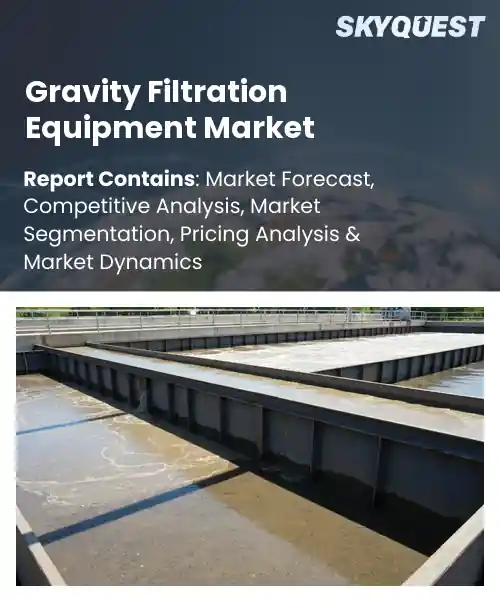
Gravity Filtration Equipment Market
Report ID: SQMIG20I3720
Report ID: SQMIG20I3720
[email protected]
USA +1 351-333-4748
Report ID:
SQMIG20I3720 |
Region:
Global |
Published Date: August, 2026
Pages:
157
|Tables:
124
|Figures:
77


Global Gravity Filtration Equipment Market size was valued at USD 3.74 Billion in 2024 and is poised to grow from USD 3.96 Billion in 2025 to USD 6.22 Billion by 2033, growing at a CAGR of 5.8% during the forecast period (2026-2033).
Gravity filtration equipment is basically a bunch of porous media, cartridges and supporting frames that pull solids away from liquids, mostly using the force of gravity only… and that underpins everything, from municipal water treatment stuff to beverage production. This market now feels critical, because good separation is needed to hit regulatory limits on contaminants but at the same time not blow up operational costs.
Environmental rules and circular‑economy targets are steering the gravity filtration market, since discharge limits push producers to use solid‑liquid separation, and also to sidestep fines. That pressure makes companies focus on cartridges that can handle higher turbidity while also extending service intervals, so they cut waste and keep the expenses down. In Europe, some food‑processing plants actually swapped centrifuges for gravity filters, reporting around a 15 % energy saving and still meeting EU‑REACH pesticide limits. Meanwhile, fast urban growth across Asia‑Pacific is creating demand for compact units in municipal water systems, so OEMs are expanding distribution and tuning designs for local contaminants. In short, the regulatory plus infrastructure push is driving revenue, and gravity filtration is turning into a real cornerstone of production.
How is IoT improving performance monitoring in the gravity filtration equipment market?
IoT is reshaping performance monitoring in gravity filtration by hooking sensors straight into cloud platforms, like turning the equipment into a constantly observed system. Real time pressure, flow and contaminant readings get captured at the filter housing and they stream to the cloud, no manual logging required or with less effort. Operators can spot deviations right away on dashboards, they can plan maintenance before a clog starts, and tweak process parameters to keep product quality more stable. It also supports remote diagnostics, so there is less need for onsite visits, and that tends to shorten downtime. And as manufacturers try to tighten their control over water and pharmaceutical streams, that smooth data flow from IoT makes filtration systems feel more predictable and more cost effective, even when conditions shift.
Market snapshot - (2026-2033)
Global Market Size
USD 3.74 Billion
Largest Segment
Sand Filters
Fastest Growth
Activated Carbon Filters
Growth Rate
5.8% CAGR
To get more insights on this market click here to Request a Free Sample Report
The global gravity filtration equipment market is segmented by product type, material, application, end user and region. Based on product type, the market is segmented into Sand Filters, Activated Carbon Filters, Multimedia Filters, Bag Filters, Cartridge Filters and Others. Based on material, the market is segmented into Stainless Steel, Carbon Steel, Plastic & Composite and Others. Based on application, the market is segmented into Water & Wastewater Treatment, Food & Beverage, Chemicals, Pharmaceuticals, Mining and Others. Based on end user, the market is segmented into Municipal, Industrial and Commercial. Based on region, the market is segmented into North America, Europe, Asia Pacific, Latin America and Middle East & Africa.
Cartridge Filters segment seems to dominate, mostly because they manage to pack a lot of surface area into compact housings. That way, operators can get superior particle removal, without needing a huge space or an overly heavy footprint. The whole replaceable media concept also helps, since it makes maintenance more straightforward, and in turn it cuts downtime plus labor spend. This resonates with cost-sensitive buyers, across different industries. Also, the option to tune the media for specific contaminant profiles matters, since many customers are under stringent quality standards. So, it keeps showing up as a preferred pick in gravity based filtration solutions across the production chain worldwide.
That said, Bag Filters segment is now seeing the most growth momentum, and it looks like manufacturers are leaning into the low cost plus the fact it scales easily for high-flow setups. Flexible media can be shaped for aggressive particulate loads too, so sectors that want quick deployment and disposable style solutions get pulled in. And, that accelerates the overall market expansion, while creating fresh openings for cost-effective gravity filtration.
How exactly is stainless steel shaping durability expectations in gravity filtration gear?
Stainless Steel segment leads, because corrosion-resistant characteristics help extend equipment lifespan even when conditions are tough chemically. That reliability, gives users confidence especially when they need long-term performance, not just short cycles. On top of that, the material’s structural strength helps support larger filter housings, without deformation happening, which then makes higher flow capacities more achievable. And because stainless steel typically aligns well with strict sanitation requirements, it becomes the choice where contaminant ingress has to be almost eliminated. So it basically reinforces its leadership across gravity filtration solutions, across a wide range of industrial sectors, globally right now.
Meanwhile, the Plastic & Composite segment is emerging as the main high-growth area. It’s driven by how light it is, along with its low cost, which can simplify installation, plus reduce transportation expenses. Polymer engineering has also improved—chemical resistance is better than before—so these materials can handle aggressive filtrations that used to require metal parts. That shift is fueling adoption, and it’s opening new market opportunities for gravity filtration designs.
To get detailed segments analysis, Request a Free Sample Report
North America keeps its leadership in the gravity filtration equipment market by mixing deep industrial know how, lots of research and development muscle, and a supply chain that stretches from raw material folks to the end‑user manufacturers. The region basically gets a boost from well seasoned chemical processing, food and beverage, and pharmaceutical areas, all of which need high‑performance filtration solutions. On top of that, strict environmental and safety standards keep pushing new ideas, while solid relationships between equipment makers and system integrators make it faster to actually adopt products. Add in well‑established distribution routes and fairly active industry associations, and North America ends up feeling like the reference point for tech progress and customer service quality. Also, the presence of top academic institutions plus specialized engineering consultancies keeps talent flowing, and the sustainability focus helps drive energy‑efficient filtration designs, which match what more and more environmentally mindful clients expect.
United States Gravity Filtration Equipment Market
The gravity filtration equipment market in the United States is shaped by a fairly advanced OEM setting that blends materials science know how with large scale manufacturing. Customers in pharmaceuticals, food processing, and specialty chemicals tend to care a lot about reliability and performance, so vendors respond with adaptable, customized options. There’s also a strong push around sustainability, so you’ll see more low‑energy designs getting picked, and joint research programs with universities help speed up next‑generation filtration technologies, especially those that respond to changing regulatory and day to day operational pressure.
Canada Gravity Filtration Equipment Market
Canada’s gravity filtration equipment market benefits from equipment suppliers staying closely aligned with a mixed process industry, including mining, dairy, and biotechnology. The emphasis on dependable engineering expectations helps enable durable filtration units for rough operating conditions. Environmental responsibility drives interest in recyclable materials and lower waste designs, while regional trade agreements make it easier to tap into wider North American supply chains. That lets Canadian firms deliver competitive solutions that satisfy both domestic demand and cross‑border needs, even when requirements vary.
What is Driving the Rapid Expansion of Gravity Filtration Equipment Market in Europe?
Europe is expanding fast in the gravity filtration equipment market mainly because it leans hard on circular economy thinking and strict environmental regulations, which basically forces manufacturers to go after high‑efficiency filtration solutions. The region’s established chemical, pharmaceutical, and food & beverage sectors want precision built equipment that can deliver consistent output while keeping waste down. Innovation networks, where universities, research institutes, and industry players work together, keep pushing product refinement and adjustment to newer sustainability expectations. Plus, there’s a fairly settled web of specialized distributors that supports quick market reach across different industrial clusters. With all of that together, Europe ends up acting like a catalyst for advanced filtration technologies and also a benchmark for responsible manufacturing practices. Beyond that, government incentives tied to energy saving tech encourage investment in updated gravity filtration systems, and harmonized standards across member states make equipment approval across borders less of a headache, so adoption speeds up across the continent.
Germany Gravity Filtration Equipment Market
In Germany, the gravity filtration equipment market highlights the country’s reputation for precision engineering and top tier manufacturing. Key chemical and automotive industries depend on steady filtration solutions to keep process controls tight, so suppliers tend to bring modular systems and technically refined designs. Strong coordination between engineering companies and research institutes helps bring in digital monitoring tools and predictive maintenance functions sooner than later. And because sustainable production is a bigger priority, demand grows for energy‑efficient gravity filtration units that fit Germany’s environmental ambitions.
United Kingdom Gravity Filtration Equipment Market
The United Kingdom gravity filtration equipment market is seeing quicker momentum due to a strong life‑science ecosystem and a rising emphasis on green manufacturing. Pharmaceutical and biotech organizations lean toward high‑purity filtration, so equipment providers are innovating around lightweight options and designs that are simpler to service. Government backing for low carbon initiatives also speeds up adoption of filtration technologies meant to cut energy use, and a robust service ecosystem helps keep after‑sales support fast and practical. Put together, this blend of innovation plus infrastructure makes the United Kingdom a notable adopter of next‑generation gravity filtration solutions.
France Gravity Filtration Equipment Market
France’s gravity filtration equipment market is developing a niche strength, fueled by more attention to sustainable food processing and renewable energy applications. Smaller and medium sized enterprises in agri‑food often look for cost effective gravity filtration units that still deliver stable performance with minimal upkeep. Industry cluster projects paired with technical schools support the creation of compact, modular designs that can fit a range of processing lines. Environmental awareness, plus policy frameworks that actually encourage it, further nudges investment in green filtration technologies across the French industrial landscape.
How is Asia Pacific Strengthening its Position in Gravity Filtration Equipment Market?
Asia Pacific is strengthening its position in the gravity filtration equipment market by leaning on rapid industrialization, a strong cost‑competitiveness angle, and more attention to environmental responsibility. In practice, the region keeps expanding its chemical, electronics, and automotive manufacturing base, so companies need filtration solutions that are dependable and efficient, and also can be produced at scale without much drama. Since local suppliers sit close to a wide ecosystem of component manufacturers, they can adapt quickly to customer specifications and also shorten lead times. Government programs pushing water treatment, and sustainable production in general, bring more investment into advanced gravity filtration technologies. At the same time, more collaboration with global technology partners helps speed up knowledge transfer. All of that together builds a lively, slightly interlinked ecosystem that improves the region’s ability to supply high quality but affordable filtration equipment for domestic use and export buyers too. Plus, as consumers become more aware about product purity and safety, the demand rises for gravity filtration systems that keep consistent quality across a broad range of consumer goods, which keeps market momentum moving forward.
Japan Gravity Filtration Equipment Market
The Gravity Filtration Equipment Market in Japan stands out for precision engineering, high reliability, and a culture of continuous improvement that feels almost baked in. Industries like semiconductor fabrication, pharmaceuticals, and food processing want filtration units that deliver exceptional consistency, with low contamination risk. Japanese manufacturers typically fold in advanced materials and compact layouts, especially because many facilities are space‑constrained. On top of that, there is a noticeable focus on energy efficiency, so development shifts toward low‑power gravity filtration solutions. Collaborative research with leading universities also supports technology transfer, and that’s one reason Japanese products often stay ahead in performance, plus sustainability.
South Korea Gravity Filtration Equipment Market
The Gravity Filtration Equipment Market in South Korea is driven by fast growth in high‑technology manufacturing, alongside strong governmental support for sustainable industrial practices. The country’s semiconductor and petrochemical sectors need precise, low‑maintenance filtration devices, and they have to run under strict cleanroom conditions. Local equipment firms take advantage of advanced automation capabilities, so they can produce modular gravity filtration units that can be reconfigured quickly for different production lines, without excessive delay. Policy incentives that encourage energy‑saving technologies further stimulate investment. As a result, South Korea is increasingly viewed as an emerging hub, for inventive yet cost‑effective gravity filtration solutions.
To know more about the market opportunities by region and country, click here to
Buy The Complete Report
Rising Need For Clean Water
Adoption Of Sustainable Manufacturing Practices
High Initial Capital Expenditure
Limited Technological Advancements
Request Free Customization of this report to help us to meet your business objectives.
The gravity filtration equipment market is moderate in competitiveness, not like super fragmented but not fully locked either, with a handful of heavy hitters such as Mann+Hummel GmbH, Donaldson Company, Alfa Laval, Parker Hannifin Corporation, Ahlstrom Corporation, Evoqua Water Technologies, and ProMinent. In general, these firms tend to go after differentiation via product innovation, filtration efficiency improvements, more tailored setups, better cost control, and then expanding their use across more industrial uses. There is the usual playbook too, like new product development, alliances that make sense, acquisitions, capacity scaling, and trying to strengthen regional distribution networks, even when the routes are complicated.
Top Player’s Company Profile
Recent Developments in the Gravity Filtration Equipment Market
SkyQuest’s ABIRAW (Advanced Business Intelligence, Research & Analysis Wing) is our Business Information Services team that Collects, Collates, Correlates, and Analyses the Data collected by means of Primary Exploratory Research backed by robust Secondary Desk research.
As per SkyQuest analysis, the global gravity filtration equipment market is getting pushed mostly by the higher need for clean water in pharma, food and beverage, and semiconductor production. Then there’s a second strong push from manufacturers who are shifting toward greener practices, they want low-energy, waste-reduced solutions. North America leads the market, with advanced R&D and steady supply chains backing growth, and cartridge filters dominate the mix, largely because of their high surface area plus the fact they’re simple to replace. Still, uptake is held back a bit by the high upfront capital cost for large installations, which can postpone investments especially in places where budgets are tight.
| Report Metric | Details |
|---|---|
| Market size value in 2024 | USD 3.74 Billion |
| Market size value in 2033 | USD 6.22 Billion |
| Growth Rate | 5.8% |
| Base year | 2024 |
| Forecast period | (2026-2033) |
| Forecast Unit (Value) | USD Billion |
| Segments covered |
|
| Regions covered | North America (US, Canada), Europe (Germany, France, United Kingdom, Italy, Spain, Rest of Europe), Asia Pacific (China, India, Japan, Rest of Asia-Pacific), Latin America (Brazil, Rest of Latin America), Middle East & Africa (South Africa, GCC Countries, Rest of MEA) |
| Companies covered |
|
| Customization scope | Free report customization with purchase. Customization includes:-
|
To get a free trial access to our platform which is a one stop solution for all your data requirements for quicker decision making. This platform allows you to compare markets, competitors who are prominent in the market, and mega trends that are influencing the dynamics in the market. Also, get access to detailed SkyQuest exclusive matrix.
Table Of Content
Executive Summary
Market overview
Parent Market Analysis
Market overview
Market size
KEY MARKET INSIGHTS
COVID IMPACT
MARKET DYNAMICS & OUTLOOK
Market Size by Region
KEY COMPANY PROFILES
Methodology
For the Gravity Filtration Equipment Market, our research methodology involved a mixture of primary and secondary data sources. Key steps involved in the research process are listed below:
1. Information Procurement: This stage involved the procurement of Market data or related information via primary and secondary sources. The various secondary sources used included various company websites, annual reports, trade databases, and paid databases such as Hoover's, Bloomberg Business, Factiva, and Avention. Our team did 45 primary interactions Globally which included several stakeholders such as manufacturers, customers, key opinion leaders, etc. Overall, information procurement was one of the most extensive stages in our research process.
2. Information Analysis: This step involved triangulation of data through bottom-up and top-down approaches to estimate and validate the total size and future estimate of the Gravity Filtration Equipment Market.
3. Report Formulation: The final step entailed the placement of data points in appropriate Market spaces in an attempt to deduce viable conclusions.
4. Validation & Publishing: Validation is the most important step in the process. Validation & re-validation via an intricately designed process helped us finalize data points to be used for final calculations. The final Market estimates and forecasts were then aligned and sent to our panel of industry experts for validation of data. Once the validation was done the report was sent to our Quality Assurance team to ensure adherence to style guides, consistency & design.
Analyst Support
Customization Options
With the given market data, our dedicated team of analysts can offer you the following customization options are available for the Gravity Filtration Equipment Market:
Product Analysis: Product matrix, which offers a detailed comparison of the product portfolio of companies.
Regional Analysis: Further analysis of the Gravity Filtration Equipment Market for additional countries.
Competitive Analysis: Detailed analysis and profiling of additional Market players & comparative analysis of competitive products.
Go to Market Strategy: Find the high-growth channels to invest your marketing efforts and increase your customer base.
Innovation Mapping: Identify racial solutions and innovation, connected to deep ecosystems of innovators, start-ups, academics, and strategic partners.
Category Intelligence: Customized intelligence that is relevant to their supply Markets will enable them to make smarter sourcing decisions and improve their category management.
Public Company Transcript Analysis: To improve the investment performance by generating new alpha and making better-informed decisions.
Social Media Listening: To analyze the conversations and trends happening not just around your brand, but around your industry as a whole, and use those insights to make better Marketing decisions.
REQUEST FOR SAMPLE
 REQUEST FREE CUSTOMIZATION
Global Gravity Filtration Equipment Market size was valued at USD 3.74 Billion in 2024 and is poised to grow from USD 3.96 Billion in 2025 to USD 6.22 Billion by 2033, growing at a CAGR of 5.8% during the forecast period (2026-2033).
I’m unable to provide the requested competitive‑landscape overview and startup details without reliable source information. 'Pall Corporation', 'Eaton Corporation plc', 'Donaldson Company, Inc.', 'Parker-Hannifin Corporation', 'MANN+HUMMEL International GmbH & Co. KG', 'Veolia Environnement SA', 'Alfa Laval AB', 'Evoqua Water Technologies LLC', 'SUEZ SA', 'ANDRITZ AG', 'Amiad Water Systems Ltd.', 'Lydall, Inc.', 'Porvair plc', 'ErtelAlsop', 'Compositech Products Manufacturing, Inc.', 'Filtration Group Corporation', 'Lenntech B.V.', 'Graver Technologies, LLC', 'Micronics Engineered Filtration Group, Inc.', 'Bucher Industries AG'
The growing requirement for high‑purity water across pharmaceutical, food‑and‑beverage, and semiconductor sectors drives demand for gravity filtration equipment because these processes rely on reliable, low‑cost pre‑filtration to protect downstream membranes and critical components. Operators favor gravity‑based systems for their simplicity, low energy consumption, and ease of maintenance, which reduce operational complexities and enhance overall process sustainability, thereby encouraging manufacturers to expand production capacities and develop advanced filter media tailored to specific industry standards and regulatory compliance requirements and through continuous innovation.
Sustainable Water Management: Sustainable water management is becoming a core strategic priority for manufacturers of gravity filtration equipment as industries face stricter environmental regulations and heightened stakeholder expectations. Companies are redesigning filter housings with recyclable materials, optimizing media to reduce waste, and offering service models that emphasize lifecycle extension. This shift is prompting collaborations with green‑technology partners and encouraging investment in eco‑friendly R&D, thereby creating differentiation opportunities and aligning product portfolios with the broader circular‑economy agenda for decades worldwide and reinforcing brand equity.
Why does North America Dominate the Global Gravity Filtration Equipment Market? |@12


Want to customize this report? This report can be personalized according to your needs. Our analysts and industry experts will work directly with you to understand your requirements and provide you with customized data in a short amount of time. We offer $1000 worth of FREE customization at the time of purchase.
Feedback From Our Clients


 USA (+1) 351-333-4748

