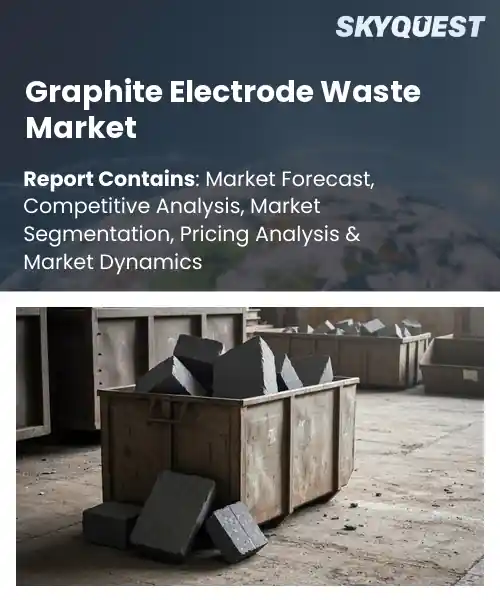
Graphite Electrode Waste Market
Report ID: SQMIG15M2026
Report ID: SQMIG15M2026
[email protected]
USA +1 351-333-4748
Report ID:
SQMIG15M2026 |
Region:
Global |
Published Date: July, 2026
Pages:
157
|Tables:
118
|Figures:
77


Global Graphite Electrode Waste Market size was valued at USD 186.8 Million in 2024 and is poised to grow from USD 197.63 Million in 2025 to USD 310.28 Million by 2033, growing at a CAGR of 5.8% during the forecast period (2026-2033).
The global graphite electrode waste market includes collection, recycling, and resale of spent carbon electrodes used primarily in electric‑arc furnace steelmaking. Its importance lies in the carbon content that can be reclaimed to lower raw material expenses and curb greenhouse‑gas emissions. In early years the market remained fragmented, with numerous small‑scale scrap dealers handling end‑of‑life parts. Over the past decade rising steel output in China and tighter environmental rules have driven the emergence of recycling hubs; the Xinjiang Carbon Recovery Facility now processes millions of kilograms each year. This shift demonstrates how policy pressures and industrial demand reshape the sector.Accelerating demand for steel production constitutes the principal catalyst for expansion of the graphite electrode waste market, because recycling supplies a ready source of carbon that can replace virgin coke in furnace charging. When steelmakers adopt electric‑arc processes to meet decarbonisation targets, they generate larger volumes of spent electrodes, prompting waste‑to‑value chains to scale up. Companies such as Osram GmbH have partnered with China‑based recyclers to convert recovered graphite into battery‑grade anodes, illustrating how downstream industries benefit from the feedstock. This loop creates revenue streams, reduces disposal costs, and strengthens supply security, thereby amplifying investment appeal across the value chain.
How is AI driving waste‑to‑value solutions in the graphite electrode market?
AI is reshaping waste‑to‑value pathways in the graphite electrode sector by turning scrap into a strategic resource. Machine‑learning models analyze production by‑products, identifying material composition and predicting optimal recycling routes. Real‑time sensor data feed algorithms that adjust furnace temperatures and grinding parameters, reducing energy loss while maximizing recovered carbon. Digital twins simulate the entire lifecycle of electrodes, allowing manufacturers to test waste‑reduction strategies without physical trials. These tools also streamline inventory management, ensuring that reclaimed graphite re‑enters the supply chain efficiently. By coupling predictive analytics with automated sorting, AI creates a closed‑loop system that cuts costs, lowers emissions, and enhances product consistency, making waste a value‑adding asset.HEG & Graphite India, July 2024, launched an AI‑driven platform that automatically classifies and processes scrap graphite electrodes, boosting material recovery and supporting market growth through heightened efficiency.
Market snapshot - (2026-2033)
Global Market Size
USD 186.8 Million
Largest Segment
Electrode Scrap
Fastest Growth
Graphite Dust
Growth Rate
5.8% CAGR
To get more insights on this market click here to Request a Free Sample Report
Global graphite electrode waste market is segmented by waste type, recycling process, application, end user and region. Based on waste type, the market is segmented into Electrode Scrap, Graphite Dust and Machining Waste. Based on recycling process, the market is segmented into Mechanical Recycling, Chemical Processing and Thermal Processing. Based on application, the market is segmented into Refractory Materials, Battery Materials, Metallurgy and Carbon Products. Based on end user, the market is segmented into Steel Industry, Battery Manufacturers and Recycling Companies. Based on region, the market is segmented into North America, Europe, Asia Pacific, Latin America and Middle East & Africa.
Mechanical Recycling segment dominates because it directly transforms bulk electrode scrap into reusable carbon feedstock with minimal material loss, aligning with cost sensitive steel producers seeking circular solutions. Its simple equipment footprint and established process control enable rapid integration into existing furnace lines, reducing operational disruption. Moreover, the ability to recover high purity graphite without intensive chemical handling meets environmental compliance expectations, cementing its leadership in the graphite electrode waste market.
However, Chemical Processing segment emerges as the most rapidly expanding area, driven by rising demand for high purity graphene precursors and advanced battery grade carbon. Innovative solvent based leaching and purification techniques unlock value from previously unusable dust, attracting investment from battery manufacturers and research labs, thereby accelerating market diversification and future growth prospects.
Electrode Scrap segment dominates because it represents the largest volume of waste generated from continuous casting and arc furnace operations, providing a readily available feedstock for recycling loops. Its high carbon density and predictable composition simplify handling and downstream processing, making it economically attractive for steel recyclers. Additionally, existing collection infrastructure and long standing industry familiarity reinforce its preeminence within the graphite electrode waste market and support sustainable production pathways.
Meanwhile, Graphite Dust segment is witnessing the strongest growth momentum as emerging battery chemistries demand ultra fine carbon additives for performance. Improved sieving and pneumatic capture enable efficient recovery, converting a previously neglected by product into a valuable material for energy storage manufacturers. This shift creates new revenue streams and expands the market’s application base.
To get detailed segments analysis, Request a Free Sample Report
The Asia Pacific region leverages a deep integration of electric arc furnace operations with advanced recycling infrastructure, creating a virtuous cycle that continually feeds high‑quality graphite electrode waste back into the supply chain. Strong governmental emphasis on circular economy principles encourages investment in low‑emission technologies, while established industrial clusters foster collaboration among steel producers, waste processors, and equipment manufacturers. Technical expertise in electrode design and a long history of metallurgical innovation further enhance the ability to extract value from spent materials. Together, these factors generate a robust ecosystem that supports efficient waste collection, sophisticated re‑processing, and rapid adoption of recycled graphite products, establishing Asia Pacific as the pre‑eminent hub for graphite electrode waste management.
Graphite Electrode Waste Market in Japan benefits from a legacy of precision engineering and a strong commitment to resource efficiency. National policies promote closed‑loop recycling, encouraging steel manufacturers to partner with specialist recyclers. A culture of continuous improvement drives adoption of cutting‑edge separation and purification techniques, ensuring high recovery rates. Collaborative research initiatives between universities and industry further enhance process reliability, positioning Japan as a benchmark for sustainable electrode waste handling.
Graphite Electrode Waste Market in South Korea is propelled by a strategic focus on heavy industry modernization and environmental stewardship. Government incentives support the development of advanced re‑processing facilities that integrate seamlessly with existing steel production sites. Strong supply chain coordination enables rapid mobilization of waste streams, while a skilled workforce applies sophisticated thermal and mechanical treatment methods. This combination of policy support and technical capability sustains South Korea’s leadership within the regional market.
Europe’s expansion is driven by stringent environmental regulations that compel steel producers to adopt sustainable waste management practices, coupled with a growing corporate emphasis on carbon neutrality. The region boasts a dense network of specialized recyclers equipped with state‑of‑the‑art purification technologies, facilitating high‑value recovery of graphite. Collaborative frameworks between industry associations, research institutions, and policy makers foster innovation in circular economy models, encouraging cross‑border waste exchange and harmonized standards. These dynamics, reinforced by strong demand for recycled graphite in emerging clean‑energy applications, create a fertile environment for fast‑paced market growth across the continent.
Graphite Electrode Waste Market in Germany is anchored by a mature industrial base and a rigorous regulatory landscape that mandates high recovery rates. Leading steel producers partner with technologically sophisticated recyclers who employ precision grinding and thermal treatment to maximize material quality. Research collaborations focus on enhancing impurity removal, ensuring that recycled graphite meets demanding performance criteria. This systematic approach solidifies Germany’s position as the dominant European market.
Graphite Electrode Waste Market in United Kingdom experiences accelerated growth through proactive policy incentives and a vibrant ecosystem of innovators. Investment in modular recycling plants enables rapid scaling, while close ties between academia and industry drive improvements in waste valorization techniques. Market participants emphasize low‑carbon processes, aligning with national climate objectives and attracting forward‑looking steel manufacturers eager to integrate recycled graphite into their production cycles.
Graphite Electrode Waste Market in France is emerging as a dynamic segment supported by progressive environmental legislation and a growing network of niche recyclers. Pilot projects explore novel electro‑chemical purification methods that promise to enhance the quality of reclaimed graphite. Collaborative platforms bring together stakeholders from the steel sector, research labs, and governmental bodies to share best practices, fostering a supportive environment for market development.
North America reinforces its role through a combination of strategic investments in advanced recycling facilities and a strong emphasis on sustainability within the steel industry. Leading manufacturers are integrating waste recovery into their operational blueprints, supported by policy frameworks that reward circular practices. Technological innovation focuses on improving thermal cracking and chemical leaching processes, yielding higher purity recycled graphite. Partnerships between energy companies, equipment suppliers, and research institutes accelerate knowledge transfer and scale‑up of best‑in‑class solutions. This collaborative and technology‑driven approach positions the region as a burgeoning hub for graphite electrode waste transformation.
Graphite Electrode Waste Market in United States benefits from extensive industrial capacity and a proactive stance on waste-to-resource initiatives. Major steel producers collaborate with dedicated recycling firms to capture waste streams directly from furnace sites, enabling efficient material handling. Ongoing research emphasizes process optimization and emissions reduction, aligning economic incentives with environmental goals. The resulting ecosystem supports robust growth and positions the United States as a key driver of market evolution.
Graphite Electrode Waste Market in Canada leverages its strong environmental standards and access to abundant energy resources to develop eco‑efficient recycling solutions. Collaborative ventures between mining sectors and steel manufacturers foster the creation of integrated waste processing hubs. Emphasis on low‑impact thermal treatments and innovative purification techniques ensures that recycled graphite meets high performance expectations. This commitment to sustainable practices underpins Canada’s emerging influence within the regional market.
To know more about the market opportunities by region and country, click here to
Buy The Complete Report
Increasing Battery Recycling Initiatives
Stringent Environmental Regulations Driving Adoption
High Cost of Recycling Processes
Limited Infrastructure for Waste Collection
Request Free Customization of this report to help us to meet your business objectives.
The competitive landscape is shaped by established manufacturers such as SHOWA DENKO KK and GrafTech International expanding recycling capabilities while new entrants like Sunrise Enterprises and MORKIN launch advanced technologies that cut processing energy and improve graphite recovery, intensifying pressure on traditional players to secure cost‑advantage through innovation, strategic partnerships, and selective acquisitions.
Top Player’s Company Profile
Recent Developments
SkyQuest’s ABIRAW (Advanced Business Intelligence, Research & Analysis Wing) is our Business Information Services team that Collects, Collates, Correlates, and Analyses the Data collected by means of Primary Exploratory Research backed by robust Secondary Desk research. As per SkyQuest analysis, the market is propelled primarily by the surge in steel production which creates a steady stream of spent electrodes for recycling, while the growing push for battery‑recycling initiatives adds a second boost by supplying additional graphite feedstock. The main restraint remains the high cost of recycling processes which can outweigh the price advantage of reclaimed material. Asia Pacific dominates the landscape thanks to its integrated electric‑arc furnace base and advanced recycling infrastructure, and mechanical recycling leads the segment mix by delivering high recovery rates with minimal material loss. These dynamics together shape the market’s growth trajectory overall
| Report Metric | Details |
|---|---|
| Market size value in 2024 | USD 186.8 Million |
| Market size value in 2033 | USD 310.28 Million |
| Growth Rate | 5.8% |
| Base year | 2024 |
| Forecast period | (2026-2033) |
| Forecast Unit (Value) | USD Million |
| Segments covered |
|
| Regions covered | North America (US, Canada), Europe (Germany, France, United Kingdom, Italy, Spain, Rest of Europe), Asia Pacific (China, India, Japan, Rest of Asia-Pacific), Latin America (Brazil, Rest of Latin America), Middle East & Africa (South Africa, GCC Countries, Rest of MEA) |
| Companies covered |
|
| Customization scope | Free report customization with purchase. Customization includes:-
|
To get a free trial access to our platform which is a one stop solution for all your data requirements for quicker decision making. This platform allows you to compare markets, competitors who are prominent in the market, and mega trends that are influencing the dynamics in the market. Also, get access to detailed SkyQuest exclusive matrix.
Table Of Content
Executive Summary
Market overview
Parent Market Analysis
Market overview
Market size
KEY MARKET INSIGHTS
COVID IMPACT
MARKET DYNAMICS & OUTLOOK
Market Size by Region
KEY COMPANY PROFILES
Methodology
For the Graphite Electrode Waste Market, our research methodology involved a mixture of primary and secondary data sources. Key steps involved in the research process are listed below:
1. Information Procurement: This stage involved the procurement of Market data or related information via primary and secondary sources. The various secondary sources used included various company websites, annual reports, trade databases, and paid databases such as Hoover's, Bloomberg Business, Factiva, and Avention. Our team did 45 primary interactions Globally which included several stakeholders such as manufacturers, customers, key opinion leaders, etc. Overall, information procurement was one of the most extensive stages in our research process.
2. Information Analysis: This step involved triangulation of data through bottom-up and top-down approaches to estimate and validate the total size and future estimate of the Graphite Electrode Waste Market.
3. Report Formulation: The final step entailed the placement of data points in appropriate Market spaces in an attempt to deduce viable conclusions.
4. Validation & Publishing: Validation is the most important step in the process. Validation & re-validation via an intricately designed process helped us finalize data points to be used for final calculations. The final Market estimates and forecasts were then aligned and sent to our panel of industry experts for validation of data. Once the validation was done the report was sent to our Quality Assurance team to ensure adherence to style guides, consistency & design.
Analyst Support
Customization Options
With the given market data, our dedicated team of analysts can offer you the following customization options are available for the Graphite Electrode Waste Market:
Product Analysis: Product matrix, which offers a detailed comparison of the product portfolio of companies.
Regional Analysis: Further analysis of the Graphite Electrode Waste Market for additional countries.
Competitive Analysis: Detailed analysis and profiling of additional Market players & comparative analysis of competitive products.
Go to Market Strategy: Find the high-growth channels to invest your marketing efforts and increase your customer base.
Innovation Mapping: Identify racial solutions and innovation, connected to deep ecosystems of innovators, start-ups, academics, and strategic partners.
Category Intelligence: Customized intelligence that is relevant to their supply Markets will enable them to make smarter sourcing decisions and improve their category management.
Public Company Transcript Analysis: To improve the investment performance by generating new alpha and making better-informed decisions.
Social Media Listening: To analyze the conversations and trends happening not just around your brand, but around your industry as a whole, and use those insights to make better Marketing decisions.
REQUEST FOR SAMPLE
 REQUEST FREE CUSTOMIZATION


Want to customize this report? This report can be personalized according to your needs. Our analysts and industry experts will work directly with you to understand your requirements and provide you with customized data in a short amount of time. We offer $1000 worth of FREE customization at the time of purchase.
Feedback From Our Clients


 USA (+1) 351-333-4748

