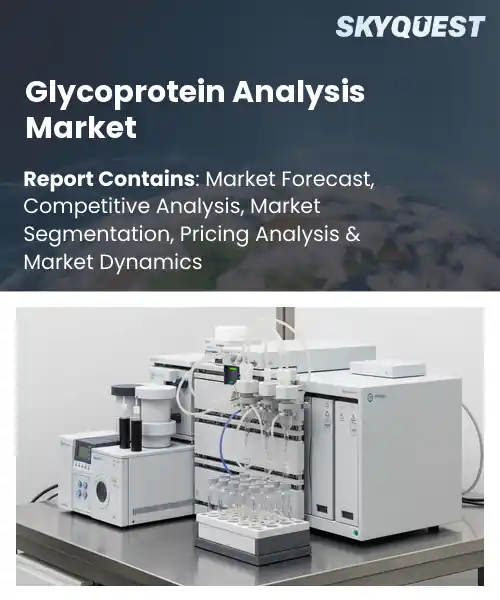
Glycoprotein Analysis Market
Report ID: SQMIG35J2651
Report ID: SQMIG35J2651
[email protected]
USA +1 351-333-4748
Report ID:
SQMIG35J2651 |
Region:
Global |
Published Date: July, 2026
Pages:
157
|Tables:
147
|Figures:
78


Global Glycoprotein Analysis Market size was valued at USD 528.6 Million in 2024 and is poised to grow from USD 587.8 Million in 2025 to USD 1374.26 Million by 2033, growing at a CAGR of 11.2% during the forecast period (2026-2033).
The global glycoprotein analysis market revolves around technologies that identify and quantify carbohydrate modifications on proteins, a critical step for ensuring the safety and efficacy of biopharmaceuticals. Its primary driver is the explosive growth of therapeutic monoclonal antibodies and recombinant vaccines, which require precise glycosylation profiling to meet regulatory standards. Historically, the sector relied on low‑resolution electrophoresis and lectin blotting, but the past decade has seen a shift toward high‑resolution liquid chromatography‑mass spectrometry and capillary electrophoresis platforms. For instance, Pfizer’s COVID‑19 mRNA vaccine development accelerated adoption of rapid glycan mapping, illustrating how market demand has evolved alongside innovative drug pipelines. Building on that momentum, the second key factor shaping the glycoprotein analysis market is the tightening of regulatory expectations for biosimilarity and personalized medicine, which compel manufacturers to invest in more sophisticated analytical suites. As agencies such as the FDA and EMA require detailed glycan heterogeneity data, companies are turning to automated sample‑prep robots and AI‑driven data interpretation tools to reduce turnaround time and cost. This investment cascade creates opportunities for instrument vendors, exemplified by Thermo Fisher’s recent launch of a high‑throughput MS system that shortens analysis from days to hours, thereby accelerating clinical trial timelines and expanding market size.
How is AI-driven automation reshaping the global glycoprotein analysis market?
AI‑driven automation is turning glycoprotein analysis into a faster, more reliable process. Machine learning models now interpret mass‑spectrometry data, reducing the need for manual peak assignment and lowering the risk of human error. Integrated robotic sample handlers prepare and load dozens of specimens per run, freeing scientists to focus on experimental design. Cloud‑based pipelines share processed results instantly across research sites, speeding collaboration and enabling real‑time quality checks. These advances are expanding the reach of glycoprotein studies beyond large biopharma labs to academic and diagnostic groups, making the technology more accessible and supporting the growing demand for detailed protein characterization. The overall workflow is becoming more scalable, cost‑effective and reproducible, which is reshaping the market landscape.In March 2024 a leading analytics firm introduced an AI‑enabled platform that streamlines glycoprotein profiling, cutting hands‑on time and improving data consistency, thereby accelerating research pipelines and supporting market growth.
Market snapshot - (2026-2033)
Global Market Size
USD 528.6 Million
Largest Segment
Instruments
Fastest Growth
Software
Growth Rate
11.2% CAGR
To get more insights on this market click here to Request a Free Sample Report
Global glycoprotein analysis market is segmented by product type, technology, application, end user, workflow and region. Based on product type, the market is segmented into Instruments, Reagents & Kits, Software and Services. Based on technology, the market is segmented into Mass Spectrometry, Chromatography, Electrophoresis and Lectin-Based Analysis. Based on application, the market is segmented into Biomarker Discovery, Biopharmaceutical Development, Clinical Research and Proteomics Research. Based on end user, the market is segmented into Pharmaceutical & Biotechnology Companies, Academic & Research Institutes and Contract Research Organizations. Based on workflow, the market is segmented into Glycoprotein Identification, Glycosylation Profiling and Quantitative Analysis. Based on region, the market is segmented into North America, Europe, Asia Pacific, Latin America and Middle East & Africa.
Instruments segment dominates because it delivers the sensitivity and resolution required to characterize complex glycan structures, enabling researchers to generate high‑confidence data across discovery and development workflows. Robust hardware platforms empower integration with advanced separation methods, while continuous innovations in detector design and automation reduce turnaround times. These capabilities meet the escalating demand for precise glycoprotein profiling, reinforcing instrument preference among users in pharmaceutical and biotech environments, and accelerating product pipelines.
However, Reagents & Kits segment emerges as the fastest growing because the rise of multiplexed assays and label‑free approaches fuels demand for ready‑to‑use glycan‑specific reagents. Manufacturers are expanding libraries of lectins, antibodies, and stable isotope‑labeled standards, simplifying method development. This acceleration broadens accessibility for laboratories, propelling market expansion and opening avenues for glycoprotein studies.
Mass Spectrometry technology dominates because it provides unparalleled structural elucidation of glycan linkages and site-specific occupancy, essential for detailed glycoprotein characterization. The capability to couple with liquid chromatography and employ high‑resolution fragmentation delivers comprehensive data across discovery and regulatory workflows. Continuous advancements in sensitivity and software integration satisfy the increasing need for precise, reproducible analyses in both academic and industrial settings, accelerating therapeutic development pipelines and supporting biomarker validation efforts globally.
Meanwhile, Lectin-Based Analysis emerges as the fastest growing because it offers a targeted approach for profiling specific glycan motifs without requiring extensive instrumentation. Innovations in lectin engineering and microarray formats enable multiplexed detection and rapid screening of glycosylation patterns. This accessibility drives adoption across labs, fueling market momentum and expanding opportunities for rapid glycoprotein assessments.
To get detailed segments analysis, Request a Free Sample Report
North America enjoys a uniquely synergistic ecosystem where world‑class research institutions intersect with a mature pharmaceutical landscape and a deep reservoir of venture capital dedicated to biologics innovation. The region benefits from early adoption of cutting‑edge analytical technologies, a regulatory environment that encourages accelerated pathways for complex biologics, and a dense network of specialized service providers. Robust collaborations between academia, industry, and government accelerate method development, while a highly skilled workforce sustains continuous improvement in assay precision and throughput. These complementary strengths create a self‑reinforcing cycle that keeps North America at the forefront of glycoprotein analysis capabilities and market influence.
Glycoprotein Analysis Market in the United States is driven by a concentration of leading biopharmaceutical companies that demand sophisticated characterization tools for therapeutic development. Advanced research universities and a dynamic startup scene provide a pipeline of innovative methodologies, while a regulatory framework that embraces scientific rigor supports rapid implementation of new analytical platforms. Strong partnerships between instrument manufacturers and end‑users further enhance technology adoption and sustain a high level of expertise across the supply chain.
Glycoprotein Analysis Market in Canada benefits from a collaborative research environment that links federal funding agencies with biotech clusters focused on protein therapeutics. The presence of specialized laboratories and a growing number of contract research organizations create a supportive infrastructure for method development and validation. Emphasis on regulatory compliance and a skilled scientific workforce ensures that Canadian firms remain competitive in delivering high‑quality glycosylation data for both domestic and international partners.
Europe’s expansion is propelled by strong governmental support for biotech innovation, harmonized regulatory standards that facilitate cross‑border collaboration, and a dense network of academic and industry research centers. The region’s commitment to precision medicine encourages detailed protein characterization, while collaborative consortia accelerate knowledge sharing and method standardization. Leading instrument suppliers have established extensive service networks, enabling rapid deployment of advanced platforms. Moreover, emerging biotech hubs in the United Kingdom and France complement Germany’s established manufacturing strength, collectively fostering a vibrant market ecosystem.
Glycoprotein Analysis Market in Germany is anchored by a robust pharmaceutical manufacturing base that requires meticulous glycosylation profiling for product consistency. Highly regarded research institutes contribute cutting‑edge expertise, while strong engineering capabilities support the integration of sophisticated analytical instrumentation. Collaborative frameworks between industry and academia promote continuous method refinement, ensuring that German firms maintain rigorous quality standards and remain at the forefront of analytical innovation.
Glycoprotein Analysis Market in the United Kingdom is experiencing swift growth due to a surge in biotech startups focused on antibody therapeutics and a supportive policy environment that incentivizes high‑value research. Leading universities provide a pipeline of talent and pioneering analytical techniques, while close ties with global pharmaceutical partners drive rapid adoption of novel glycan profiling technologies. The emphasis on translational research accelerates the movement of analytical advancements from lab to market.
Glycoprotein Analysis Market in France is emerging as a dynamic segment supported by increasing investment in life‑science clusters and a strong tradition of academic excellence in protein chemistry. Collaborative initiatives between research institutions and biotech firms foster the development of innovative analytical approaches. The French regulatory landscape encourages thorough characterization of biologics, prompting adoption of advanced glycoprotein analysis solutions to meet stringent quality expectations.
Asia Pacific is enhancing its role through concerted government initiatives that prioritize biotech development, substantial investments in research infrastructure, and a growing emphasis on biologics within regional pharmaceutical strategies. Nations such as Japan and South Korea have cultivated specialized centers of excellence that focus on glycosylation science, while partnerships with global instrument providers expedite technology transfer. The region’s expanding manufacturing capacity for biologics creates a rising demand for precise glycoprotein characterization, and a culturally driven emphasis on scientific advancement fuels continuous skill development across the analytical workforce.
Glycoprotein Analysis Market in Japan benefits from a legacy of excellence in precision instrumentation and a strong commitment to advanced therapeutic development. Leading universities and government‑backed research programs drive innovative approaches to glycan analysis, while close collaboration with multinational pharmaceutical companies ensures rapid integration of cutting‑edge platforms. The emphasis on high‑quality data supports Japan’s reputation for rigorous product characterization and regulatory compliance.
Glycoprotein Analysis Market in South Korea is propelled by a vibrant biotech sector that emphasizes rapid development of novel protein therapeutics. Government funding programs and strategic industry alliances encourage the adoption of state‑of‑the‑art analytical tools. A skilled workforce and a culture of technological adaptation enable Korean firms to deliver detailed glycosylation profiles that meet global quality standards and support the region’s growing presence in the international biopharma landscape.
To know more about the market opportunities by region and country, click here to
Buy The Complete Report
Increasing Demand for Biopharma Therapeutics
Advancements in Glycoprotein Characterization Tools
High Costs of Glycoprotein Production
Limited Expertise in Glycoprotein Science
Request Free Customization of this report to help us to meet your business objectives.
The competitive landscape is shaped by established assay providers such as Sigma, Creative Diagnostics, R&D Systems, Enzo Life Sciences and Thermo, which are intensifying R&D spending, forming university collaborations and expanding distribution networks to capture market share, while emerging biotech firms leverage novel glyco‑profiling platforms to differentiate their offerings and attract strategic partnerships.
Top Player’s Company Profile
Recent Developments
SkyQuest’s ABIRAW (Advanced Business Intelligence, Research & Analysis Wing) is our Business Information Services team that Collects, Collates, Correlates, and Analyses the Data collected by means of Primary Exploratory Research backed by robust Secondary Desk research. As per SkyQuest analysis, the global glycoprotein analysis market is being propelled primarily by the surging demand for biopharma therapeutics, especially monoclonal antibodies and recombinant vaccines, which fuels investment in precise glycosylation profiling. A second strong driver is the rapid advancement of characterization tools such as high‑resolution mass spectrometry, chromatography and AI‑powered automation that shorten development timelines and lower operational risk. The instruments segment leads the market because it delivers the sensitivity and speed required for complex glycan mapping. North America remains the dominant region thanks to its mature biotech ecosystem and early technology adoption. However, the high cost of glycoprotein production and the need for specialized expertise act as a noticeable restraint.
| Report Metric | Details |
|---|---|
| Market size value in 2024 | USD 528.6 Million |
| Market size value in 2033 | USD 1374.26 Million |
| Growth Rate | 11.2% |
| Base year | 2024 |
| Forecast period | (2026-2033) |
| Forecast Unit (Value) | USD Million |
| Segments covered |
|
| Regions covered | North America (US, Canada), Europe (Germany, France, United Kingdom, Italy, Spain, Rest of Europe), Asia Pacific (China, India, Japan, Rest of Asia-Pacific), Latin America (Brazil, Rest of Latin America), Middle East & Africa (South Africa, GCC Countries, Rest of MEA) |
| Companies covered |
|
| Customization scope | Free report customization with purchase. Customization includes:-
|
To get a free trial access to our platform which is a one stop solution for all your data requirements for quicker decision making. This platform allows you to compare markets, competitors who are prominent in the market, and mega trends that are influencing the dynamics in the market. Also, get access to detailed SkyQuest exclusive matrix.
Table Of Content
Executive Summary
Market overview
Parent Market Analysis
Market overview
Market size
KEY MARKET INSIGHTS
COVID IMPACT
MARKET DYNAMICS & OUTLOOK
Market Size by Region
KEY COMPANY PROFILES
Methodology
For the Glycoprotein Analysis Market, our research methodology involved a mixture of primary and secondary data sources. Key steps involved in the research process are listed below:
1. Information Procurement: This stage involved the procurement of Market data or related information via primary and secondary sources. The various secondary sources used included various company websites, annual reports, trade databases, and paid databases such as Hoover's, Bloomberg Business, Factiva, and Avention. Our team did 45 primary interactions Globally which included several stakeholders such as manufacturers, customers, key opinion leaders, etc. Overall, information procurement was one of the most extensive stages in our research process.
2. Information Analysis: This step involved triangulation of data through bottom-up and top-down approaches to estimate and validate the total size and future estimate of the Glycoprotein Analysis Market.
3. Report Formulation: The final step entailed the placement of data points in appropriate Market spaces in an attempt to deduce viable conclusions.
4. Validation & Publishing: Validation is the most important step in the process. Validation & re-validation via an intricately designed process helped us finalize data points to be used for final calculations. The final Market estimates and forecasts were then aligned and sent to our panel of industry experts for validation of data. Once the validation was done the report was sent to our Quality Assurance team to ensure adherence to style guides, consistency & design.
Analyst Support
Customization Options
With the given market data, our dedicated team of analysts can offer you the following customization options are available for the Glycoprotein Analysis Market:
Product Analysis: Product matrix, which offers a detailed comparison of the product portfolio of companies.
Regional Analysis: Further analysis of the Glycoprotein Analysis Market for additional countries.
Competitive Analysis: Detailed analysis and profiling of additional Market players & comparative analysis of competitive products.
Go to Market Strategy: Find the high-growth channels to invest your marketing efforts and increase your customer base.
Innovation Mapping: Identify racial solutions and innovation, connected to deep ecosystems of innovators, start-ups, academics, and strategic partners.
Category Intelligence: Customized intelligence that is relevant to their supply Markets will enable them to make smarter sourcing decisions and improve their category management.
Public Company Transcript Analysis: To improve the investment performance by generating new alpha and making better-informed decisions.
Social Media Listening: To analyze the conversations and trends happening not just around your brand, but around your industry as a whole, and use those insights to make better Marketing decisions.
REQUEST FOR SAMPLE
 REQUEST FREE CUSTOMIZATION


Want to customize this report? This report can be personalized according to your needs. Our analysts and industry experts will work directly with you to understand your requirements and provide you with customized data in a short amount of time. We offer $1000 worth of FREE customization at the time of purchase.
Feedback From Our Clients


 USA (+1) 351-333-4748

