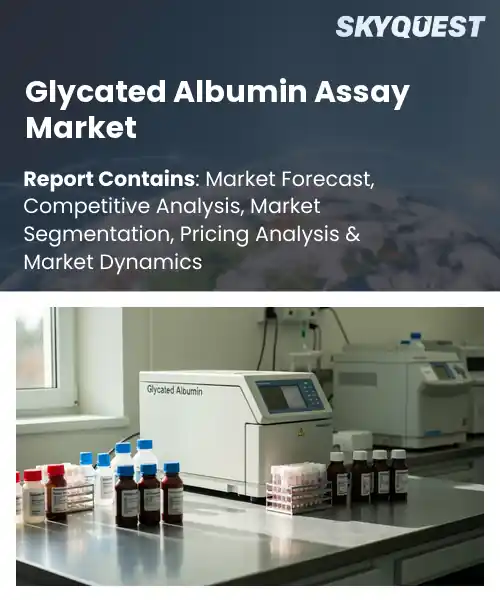
Glycated Albumin Assay Market
Report ID: SQMIG35A3734
Report ID: SQMIG35A3734
[email protected]
USA +1 351-333-4748
Report ID:
SQMIG35A3734 |
Region:
Global |
Published Date: June, 2026
Pages:
157
|Tables:
90
|Figures:
76


Global Glycated Albumin Assay Market size was valued at USD 470.79 Million in 2024 and is poised to grow from USD 509.16 Million in 2025 to USD 952.94 Million by 2033, growing at a CAGR of 8.15% during the forecast period (2026-2033).
The main factor driving the glycosylated albumin assay market is increasing disease burden and demand for intermediate glycemic assessment to supplement A1c tests. Glycated albumin measures average blood sugar levels during the previoustwo to three weeks, hence its importance when hemoglobin measurements cannot be relied on or require a more rapid assessment method. In the last 10 years, glycated albumin assays have shifted from laborious immunoassay kits to automated systems, a trend confirmed by new product introductions and guidelines updates. The utility of the assays has been proven by actual experience in pregnant women, hemodialysis patients, and hemoglobinopathy patients.
Approval by regulators, reimbursement, and technological advances make up another driver, as when an assay gains coverage and produces reliable results, then there will be changes in clinical practices and investment in laboratories. This has happened before with the advent of the automatic glycated albumin kit, where once they had received their regulatory approval and had been assigned codes for billing purposes, endocrinology clinics began to perform the tests on their patients as part of their insulin adjustment process and obstetrics clinics performed gestational testing on their pregnant mothers more vigorously. These made their usage increase, thus reducing their costs per unit and encouraging manufacturers to produce point-of-care versions of them.
How is AI Improving Accuracy and Adoption in the Glycated Albumin Assay Market?
The testing for glycated albumin is useful for an intermediate-term view of exposure to blood glucose and is important where traditional Hb-based testing is unreliable. Some issues to consider in their implementation include signal reliability, interference recognition, and calibration consistency. Over time, the industry has evolved from simple enzymatic test kits to integrated systems. The application of artificial intelligence will enhance the accuracy of the system in terms of improved signal processing, interference detection, and automatic calibration. Moreover, artificial intelligence helps accelerate the implementation of such tests because quality assurance processes will be automated and results will be better correlated with the laboratory information systems. This makes results more reliable for the clinicians in different clinical environments thus encouraging greater use of the test.Nagase Diagnostics July 2025, the company underwent restructuring of its diagnostics business and solidified the position of its Lucica glycated albumin portfolio. Application of AI-driven analysis to this test can help improve calibration and interference detection.
Market snapshot - (2026-2033)
Global Market Size
USD 470.79 Million
Largest Segment
Enzymatic Assay
Fastest Growth
Enzymatic Assay
Growth Rate
8.15% CAGR
To get more insights on this market click here to Request a Free Sample Report
Global glycated albumin assay market is segmented by method, application, end-user and region. Based on method, the market is segmented into Enzymatic Assay, Colorimetric Assay and Others. Based on application, the market is segmented into Diabetes Management, Chronic Kidney Disease Monitoring and Others. Based on end-user, the market is segmented into Hospitals, Diagnostic Centers and Research Institutes. Based on region, the market is segmented into North America, Europe, Asia Pacific, Latin America and Middle East & Africa.
The Enzymatic Assay segment will lead since enzymatic assays provide better specificity and precision in detecting glycated albumin, allowing healthcare practitioners to depend on precise readings when measuring the glycemic levels of a patient. Automated analyzers and ready-to-use enzyme-based reagent kits make the use of these assays less complicated. With strong support from manufacturers and easy validation process, this method is gaining more acceptance and thus attracting continuous investments in assay improvement and automation technology.
On the other hand, the most dynamic growth rate can be observed for the Colorimetric Assay segment owing to reduced investment requirements and ease of implementation. Improvements in colorimetric reagent chemistry and miniaturized reader devices are making it possible to use this technique in decentralized facilities such as point-of-care settings and small laboratories.
The reason Diagnostic Centers emerge as the leader segments is due to the nature of their business as independent labs and centralized testing centers, which offer high throughput of patients as well as advanced laboratory infrastructure needed for performing glycated albumin tests on a regular basis. This commercial inclination makes Diagnostic Centers quick adopters of validated assays and automation tools, which ensure quality and time efficiency that is valued by physicians. Moreover, close ties with referring doctors as well as fast purchase processes facilitate quick adoptions, thereby making them the biggest sources of demand for glycated albumin assays.
By contrast, Research Institutes account for the fastest growing end-user category as their studies translate the use of glycated albumin into new applications, thus creating demand for new assays to be developed.
To get detailed segments analysis, Request a Free Sample Report
The North American region has been able to retain its position as the market leader thanks to factors such as maturity of its healthcare infrastructure, robustness of its clinical research ecosystem, and presence of numerous manufacturers and innovation clusters within the diagnostic industry. Efficient laboratory and clinical knowledge enable quick adoption of novel alternatives to traditional glycemic markers. The existence of positive regulatory approval processes and well-established reimbursement frameworks make it easier for companies to enter the market. Collaboration among the industry players, universities, and prominent hospital chains help hasten the process of product validation and guidelines creation.
The Glycated Albumin Test Market in the US is supported by the extensive backing of clinical research, an elaborate infrastructure of reference labs and hospitals, and the presence of key diagnostic companies in the field. Payment models and testing guidelines of specialty medical associations are important for clinical adoption, whereas cooperation between industry players and academic healthcare centers stimulates stringent validation studies and real-world evidence gathering. Commercial success is facilitated by efficient marketing strategies, awareness of clinicians about complicated indicators of diabetes, and ongoing automation of assays.
The Canadian Glycated Albumin Assay Market operates within the framework of a healthcare system that is characterized by a publicly driven healthcare system with lab networks and centralized purchasing processes. The acceptance of the test is likely to follow a pattern where laboratories evaluate and collaborate with academic hospitals in validating their use, thus ensuring clinician confidence. There is an expectation for manufacturers to partner with reference labs and universities in order to provide proof of concept.
Market growth in Asia Pacific is driven by the increased medical awareness of the importance of alternative glycemic markers, higher demand for diagnostics solutions, and production within the region which decreases costs of accessing these tests. Increased investment in laboratory infrastructure through health-related projects and the partnerships of international diagnostic companies with local distributors facilitate access to these tests. An active research community and the implementation of assays in specific fields of practice, endocrinology and nephrology, foster market development. Japan and South Korea serve as examples of fast technology adoption in the region owing to the advancement of laboratory testing processes and the readiness to adopt new biomarkers in clinical practices.
The Glycated Albumin Assay Market in Japan is supported by the presence of a very advanced diagnostic environment along with a strong focus on clinical validations through hospital research projects. The laboratories are equipped to perform the test in an automated manner, ensuring that the test will be adopted quickly once its clinical utility is established. The regulatory and reimbursement framework ensures that this test undergoes a proper evaluation process, and diagnostic firms collaborate closely with the hospitals to ensure the assay fits local conditions.
Factors such as an active medical devices and diagnostics industry, fast clinical acceptance, and relationships between manufacturers and tertiary care hospitals drive the Glycated Albumin Assay market in South Korea. The market enjoys flexible regulations and prioritization of innovations, which helps in the development and launching of innovative diagnostic assays and automation solutions for laboratories. Furthermore, export-driven manufacturers help in distributing the product regionally, and collaborations with academic institutions enable clinical trials.
There is an increasing role of Europe in developing its place with harmonization of regulations, clinical research networks, and collaboration between diagnostic companies and healthcare organizations. Processes of health technology assessments by countries, as well as laboratory accreditation criteria, contribute to the evaluation process and provide consistent quality assurance across the markets. Diagnostic companies have access to the unique knowledge base about medtech innovation and cooperate with scientific communities that provide data on clinical usefulness. Collaborations across borders, as well as guidance from societies of experts, will contribute to the spreading of best practices. Collaboration with hospitals and regional distribution channels increase market penetration, whereas the focus on personalized medicine makes glycomics increasingly important.
German Glycated Albumin Assay Market thrives because of a thriving medical technology sector, an already developed laboratory set-up in hospitals, and ongoing clinical studies within the field of endocrinology. Parties involved participate in thorough evaluation regarding the clinical significance through research with university hospitals, and laboratory accreditation leads to standardized levels of performance. The role of reimbursement policies and relationship building with statutory health insurance companies plays an important part in the adoption process of the German glycated albumin assay market.
The Glycated Albumin Test Market in the United Kingdom is influenced by central appraisal systems and guideline organizations that affect the adoption of tests within the NHS and specialized units. Clinical evidence from joint projects between research institutions and pathology organizations influences decisions and facilitates implementation under procurement mechanisms. Cost effectiveness and outcome-based evaluation make the healthcare system adopt assays that provide good clinical utility to patients.
Glycated Albumin Test Market in France enjoys an infrastructure of publicly funded hospitals and regional health administrations that focus on clinical verification and integration. Diagnostic companies work with clinical opinion leaders and institutions of research to build their local evidence base, while laboratory networks maintain testing quality standards. The process of reimbursement and evaluation is based on clinical benefit and impact on the health care system, resulting in the moderate adoption of glycated albumin tests within hospitals and specialists.
To know more about the market opportunities by region and country, click here to
Buy The Complete Report
Increasing Demand for Continuous Monitoring
The popularity of the glycated albumin test is due to the increasing need for ongoing and short-term glucose levels assessment, since physicians need markers showing current fluctuations in glucose management and allowing adjustment of their patients' treatment regimens accordingly. The test will be valuable in combination with other markers because its ability to show intermediate glucose management is very useful in addition to long-term biomarkers. Wider use by diabetes specialists means an increased demand for this type of test, which stimulates production companies to supply more tests and testing kits.
Technological Advancements in Assays
Assay design and automation advancements have enhanced convenience and integration, thereby making glycated albumin testing more favorable for laboratories and point-of-care applications. Improved stability and standardization of assays, as well as enhanced compatibility with various platforms, make the adoption of glycated albumin testing easier and less complicated in clinical environments. Manufacturers’ optimization of assay technology will lead laboratories to incorporate glycated albumin testing into their panel of tests, thereby driving demand in the market for glycated albumin testing assays.
Reimbursement and Regulatory Barriers
The limited availability of reimbursement pathways and complicated regulatory frameworks affect the adoption of glycated albumin testing because they raise issues regarding reimbursement and usage in routine clinical practice, with practitioners being reluctant to introduce testing that is not uniformly reimbursable. Regional differences in regulation, as well as the inconsistent endorsement of these methods by guideline panels, further complicate adoption into regular care pathways and thus discourage laboratory investment in such tests.
Limited Clinical Awareness and Adoption
Lack of awareness by clinicians about the application of glycated albumin analysis and preference towards well-known markers to minimize the number of requests and laboratory analysis, resulting in slow acceptance in the market. The lack of knowledge of the clinical conditions in which the test can be more advantageous will make clinicians less prone to order the test. Thus, the lack of knowledge of clinicians and laboratory managers is one of the major reasons that leads to lack of demand from end users and hinders further commercialization.
Request Free Customization of this report to help us to meet your business objectives.
The competitive landscape comprises both established diagnostic companies and deep tech startups that compete in bringing out glycemic biomarkers in an intermediate-term window via glycated albumin products. This is propelled by the need for point of care testing and assay modalities. These strategies range from partnership between Sysmex and Provigate in the POCT space, consolidation within diagnostics companies, and academia spinoffs with new assay chemistries.
Point of Care Expansion: The movement towards decentralization is creating demand for glycated albumin tests among the use of such tests in outpatients’ clinics, community labs, and specialty care centers where immediate and relevant results can have an impact on clinical practice. The convenience factor, coupled with fast results and compatibility with small instruments, facilitates this process. Partnerships with diagnostic service providers and manufacturers of point-of-care instrumentation are helping to promote the uptake of these glycated albumin tests into mainstream practice.
Integration with Digital Health: The increased focus on connectivity in healthcare has led to a greater push for interoperability between glycoalbumin testing technology and other tools such as electronic health records, telemedicine systems, and remote monitoring devices that can be used to conduct longitudinal glycemic analysis. Data flow ensures better workflow processes, improved engagement of patients in their own care, and collaboration among caregivers in their treatment decisions. Collaboration with software developers, cloud computing, and data standardization are some ways through which novel value propositions have been generated.
SkyQuest’s ABIRAW (Advanced Business Intelligence, Research & Analysis Wing) is our Business Information Services team that Collects, Collates, Correlates, and Analyses the Data collected by means of Primary Exploratory Research backed by robust Secondary Desk research.
As per SkyQuest analysis, the primary growth drivers for the Glycated Albumin Assay Market include the increasing prevalence of diabetes worldwide as well as the need for an effective intermediate test to support A1C. The lack of consistent insurance coverage as well as regulatory challenges serve as major constraints on its market growth. North America leads the market because of the presence of advanced healthcare facilities, dense diagnostic networks, and better commercialization avenues. Enzyme-based methods take the lead owing to their better specificity and automation capabilities. The second driver includes the rapid advancements being made in technology like AI-based interference detection and calibration.
| Report Metric | Details |
|---|---|
| Market size value in 2024 | USD 470.79 Million |
| Market size value in 2033 | USD 952.94 Million |
| Growth Rate | 8.15% |
| Base year | 2024 |
| Forecast period | (2026-2033) |
| Forecast Unit (Value) | USD Million |
| Segments covered |
|
| Regions covered | North America (US, Canada), Europe (Germany, France, United Kingdom, Italy, Spain, Rest of Europe), Asia Pacific (China, India, Japan, Rest of Asia-Pacific), Latin America (Brazil, Rest of Latin America), Middle East & Africa (South Africa, GCC Countries, Rest of MEA) |
| Companies covered |
|
| Customization scope | Free report customization with purchase. Customization includes:-
|
To get a free trial access to our platform which is a one stop solution for all your data requirements for quicker decision making. This platform allows you to compare markets, competitors who are prominent in the market, and mega trends that are influencing the dynamics in the market. Also, get access to detailed SkyQuest exclusive matrix.
Table Of Content
Executive Summary
Market overview
Parent Market Analysis
Market overview
Market size
KEY MARKET INSIGHTS
COVID IMPACT
MARKET DYNAMICS & OUTLOOK
Market Size by Region
KEY COMPANY PROFILES
Methodology
For the Glycated Albumin Assay Market, our research methodology involved a mixture of primary and secondary data sources. Key steps involved in the research process are listed below:
1. Information Procurement: This stage involved the procurement of Market data or related information via primary and secondary sources. The various secondary sources used included various company websites, annual reports, trade databases, and paid databases such as Hoover's, Bloomberg Business, Factiva, and Avention. Our team did 45 primary interactions Globally which included several stakeholders such as manufacturers, customers, key opinion leaders, etc. Overall, information procurement was one of the most extensive stages in our research process.
2. Information Analysis: This step involved triangulation of data through bottom-up and top-down approaches to estimate and validate the total size and future estimate of the Glycated Albumin Assay Market.
3. Report Formulation: The final step entailed the placement of data points in appropriate Market spaces in an attempt to deduce viable conclusions.
4. Validation & Publishing: Validation is the most important step in the process. Validation & re-validation via an intricately designed process helped us finalize data points to be used for final calculations. The final Market estimates and forecasts were then aligned and sent to our panel of industry experts for validation of data. Once the validation was done the report was sent to our Quality Assurance team to ensure adherence to style guides, consistency & design.
Analyst Support
Customization Options
With the given market data, our dedicated team of analysts can offer you the following customization options are available for the Glycated Albumin Assay Market:
Product Analysis: Product matrix, which offers a detailed comparison of the product portfolio of companies.
Regional Analysis: Further analysis of the Glycated Albumin Assay Market for additional countries.
Competitive Analysis: Detailed analysis and profiling of additional Market players & comparative analysis of competitive products.
Go to Market Strategy: Find the high-growth channels to invest your marketing efforts and increase your customer base.
Innovation Mapping: Identify racial solutions and innovation, connected to deep ecosystems of innovators, start-ups, academics, and strategic partners.
Category Intelligence: Customized intelligence that is relevant to their supply Markets will enable them to make smarter sourcing decisions and improve their category management.
Public Company Transcript Analysis: To improve the investment performance by generating new alpha and making better-informed decisions.
Social Media Listening: To analyze the conversations and trends happening not just around your brand, but around your industry as a whole, and use those insights to make better Marketing decisions.
REQUEST FOR SAMPLE
 REQUEST FREE CUSTOMIZATION
Global Glycated Albumin Assay Market size was valued at USD 470.79 Million in 2024 and is poised to grow from USD 509.16 Million in 2025 to USD 952.94 Million by 2033, growing at a CAGR of 8.15% during the forecast period (2026-2033).
Competitive landscape features established diagnostics manufacturers and deep tech entrants competing to deliver intermediate term glycemic markers like glycated albumin, with competition driven by demand for point of care monitoring and differentiated assay modalities. Real strategies include partnerships such as Sysmex teaming with Provigate for POCT development, consolidation moves by diagnostics groups, and academic spinouts commercializing novel assay chemistries. 'Asahi Kasei', 'Abbott Laboratories', 'Roche Holding', 'Danaher', 'Siemens Energy', 'Sysmex Corporation', 'Thermo Fisher Scientific', 'Merck KGaA', 'LifeSpan BioSciences', 'MyBioSource', 'Cusabio Technology', 'Wuhan Fine Biotech', 'Bio-Rad Laboratories', 'Randox Laboratories', 'Diazyme Laboratories', 'Abnova Corporation', 'Kamiya Biomedical', 'Genzyme', 'DiaSys Diagnostic Systems', 'Biotech Atlantic'
Glycated albumin assays benefit from growing interest in continuous and short term glycemic monitoring because clinicians seek biomarkers that reflect recent changes in glucose control and can guide timely treatment adjustments. The assay’s ability to indicate intermediate term glycemic status complements long term measures, enabling more responsive clinical decisions. Adoption by diabetes care teams and specialist clinics increases demand for accessible assays and platforms, encouraging manufacturers to expand offerings and develop tests that integrate into monitoring workflows, thereby supporting market expansion. This also supports improved patient engagement and personalized care.
Point Of Care Expansion: The shift toward decentralized testing is driving adoption of glycated albumin assays in outpatient clinics, community laboratories, and specialized care settings where rapid, actionable results improve clinical decision making. Ease of use, shorter turnaround times, and compatibility with compact analyzers support integration into routine workflows, enabling more timely therapeutic adjustments and personalized patient management. Partnerships with diagnostic service providers and point of care instrument makers further accelerate market penetration by simplifying procurement and connectivity for widespread clinical use and adoption.
Why does North America Dominate the Global Glycated Albumin Assay Market? |@12


Want to customize this report? This report can be personalized according to your needs. Our analysts and industry experts will work directly with you to understand your requirements and provide you with customized data in a short amount of time. We offer $1000 worth of FREE customization at the time of purchase.
Feedback From Our Clients


 USA (+1) 351-333-4748

