Glass Fiber Market
Report ID: SQMIG15E2761
Report ID: SQMIG15E2761
[email protected]
USA +1 351-333-4748
Report ID:
SQMIG15E2761 |
Region:
Global |
Published Date: July, 2025
Pages:
174
|Tables:
125
|Figures:
68


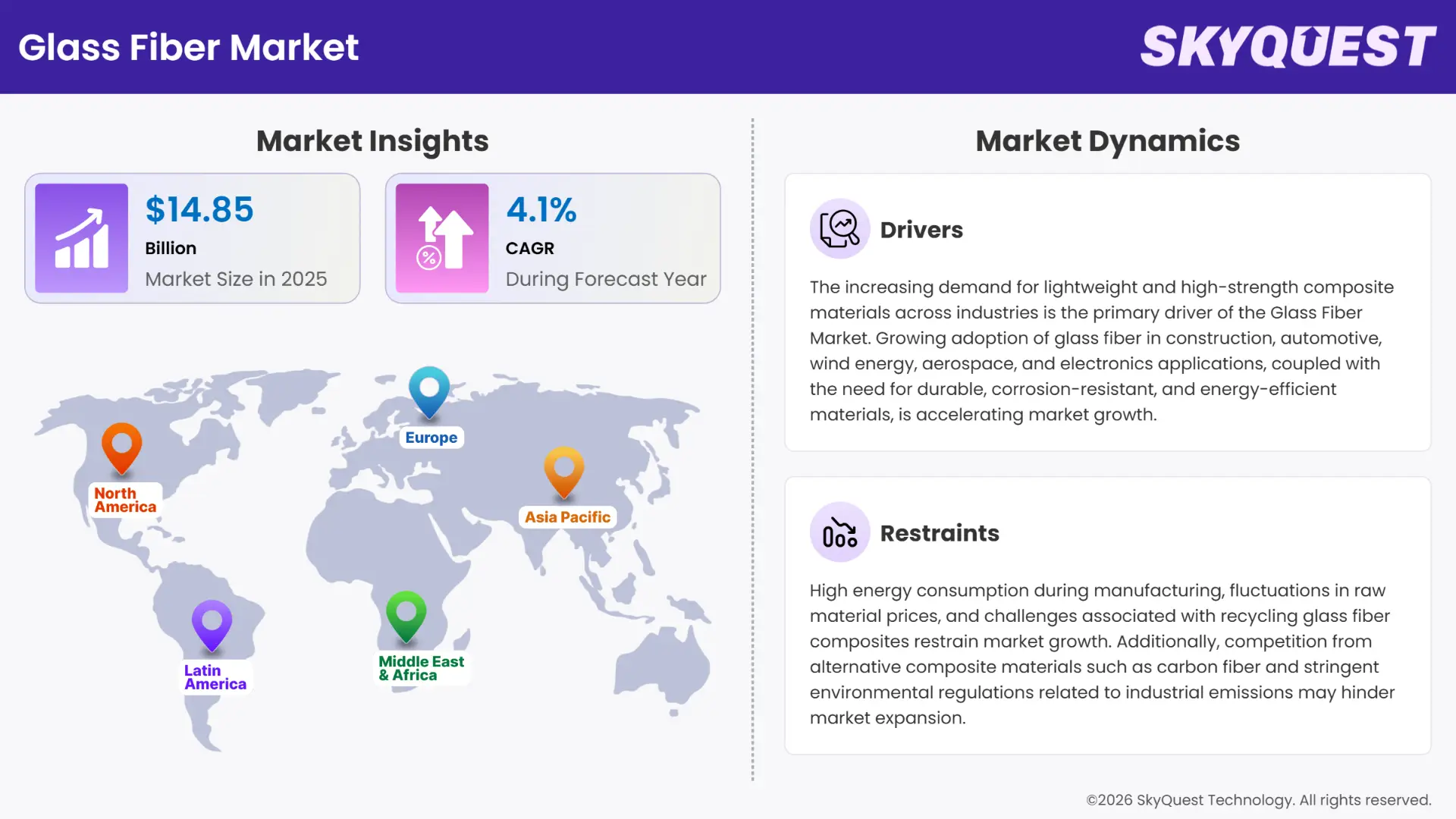
Global Glass Fiber Market size was valued at USD 14.26 Billion in 2024 and is poised to grow from USD 14.85 Billion in 2025 to USD 20.48 Billion by 2033, growing at a CAGR of 4.1% during the forecast period (2026–2033).
Key Takeaways: Market Trends & Insights
The world glass fiber market is surging robustly on the strength of its widespread application in construction, automobile, aerospace, and electronic industries. Its strength-to-weight ratio, corrosion resistance, and insulation capabilities render it as a best-suited material for a wide range of structural and reinforcement applications. Growing demand for lightweight, long-lasting, and environmentally friendly materials continues to drive adoption. Companies are investing in advanced production technology to keep pace with growing performance pressures in markets, especially in green-tech industries and emerging markets.
Increased demand from the automobile and aerospace industries for lightweight material is one of the leading impulses driving the market for glass fibers. The fuel efficiency and emissions-cutting measures by governments have led to the use of composite materials. Urbanization and infrastructure development in the emerging economies also lead to higher demand for glass fiber reinforcement products. More wind energy projects and more applications of fiberglass in the electronics and telecommunication industries are other factors driving persistent growth in the market.
Although having high growth potential, the glass fiber industry is constrained by a number of factors. High energy use and emissions during production create environmental and regulatory concerns. Fracture behavior of glass fiber compared to substitutes also restricts application in certain cases. Competition from carbon fiber and natural fiber composites in the marketplace also affects growth. Raw material price volatility and labor shortages in skilled workers can also affect normal manufacture output as well as profitability.
How is Artificial Intelligence Reshaping the Landscape of glass fiber market?
Artificial Intelligence technologies are transforming the glass fiber industry by facilitating intelligent manufacturing, real-time monitoring, and data-driven decision-making. AI algorithms examine production data to optimize quality control, reduce defects, and forecast machine downtime, reducing downtime and optimizing yield. IoT sensors deliver insights into temperature, pressure, and line productivity, allowing teams to react in real-time to aberrations. These systems combined enable leaner, more agile operations that are able to rapidly respond to shifts in demand and rigorous industry regulations.
Supply-side, they are supported by AI-enabled infrastructure such as 5G networks and data centers, which are fueling record demand for optical fiber—a prime use of glass fiber. Cloud and telecom operators utilize high-speed connectivity using fiber to host AI workloads, resulting in output exploding. Demand in India will be expected to triple to about 60 million fiber kilometers annually by the year 2030 due to growth in adoption of AI, 5G rollouts, and digitalization initiatives.
Piramal Glass implemented India's largest IoT platform across its manufacturing lines. Networking more than 4,000 sensors with Microsoft Azure and Precimetrix's platform, the firm realized furnace and conveyor real-time monitoring, reduced rejection rates, and energy usage. This IoT implementation—ranging from stage-to-stage loss in production to quality notifications—was done for less than a third of the cost of legacy MES systems. The outcome: quicker decision-making, enhanced yield, and better efficiency for almost 90% of plant stakeholders.
To get more insights on this market click here to Request a Free Sample Report
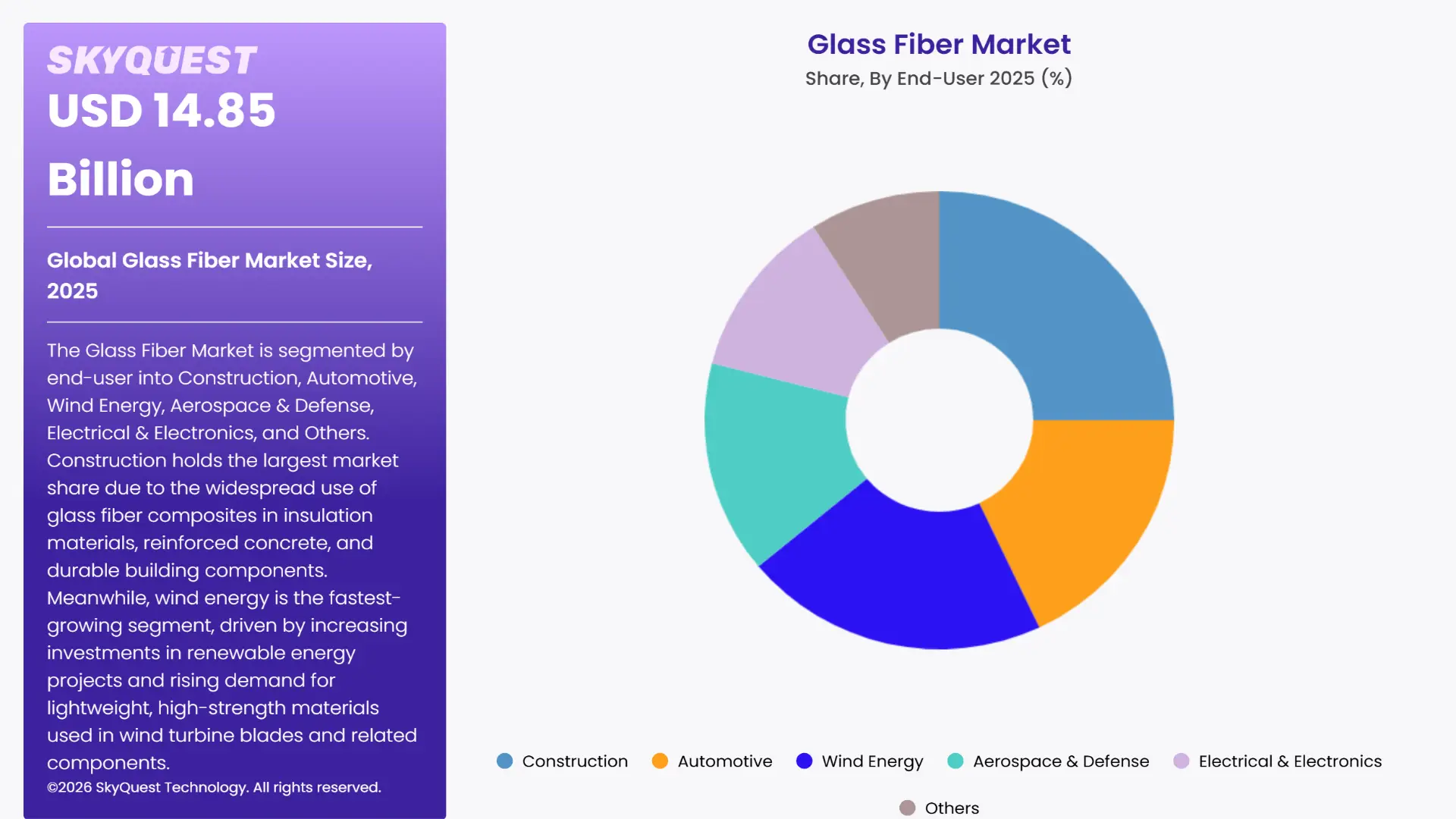
The global Glass Fiber market is segmented by Product Type, Glass Type, Application, End-user and region. Based on Product Type, the market is segmented into Glass Wool, Yarn, Roving, Chopped Strand and Others. Based on Glass Type, the market is segmented into E Glass, ECR Glass, H Glass, AR Glass, S Glass and Others. Based on Application, the market is segmented into Insulation, Composites and Others. Based on End-user, the market is segmented into Automobile, Construction, Aerospace, Wind Energy and Others. Based on region, the market is segmented into North America, Europe, Asia Pacific, Latin America and Middle East & Africa.
According to the 2024 global market outlook for Glass Fiber, the construction industry led the market by capturing the biggest share of all end-users. The reasons for this leadership are growing demand for energy-efficient buildings, green building, and urban infrastructure development. Glass fiber is extensively applied to insulation, water resistance, and strengthening because it is very efficient in heat and strength. In Europe and North America, one can observe significant levels of commercial building work and residential retrofitting in accordance with net-zero goals and green building regulations.
Conversely, glass fiber use for building construction is projected to increase steadily at a 6.6% CAGR through 2033 with the backing of government-sponsored housing schemes and industrial infrastructure developments worldwide.
The wind energy market was the fastest-growing end-users’ market, according to the 2024 global market report on Glass Fiber. This expansion is led by the world's transition to net-zero carbon and renewable energy. Glass fiber plays a fundamental role in the production of wind turbine blades because of its high strength-to-weight ratio, cost-affordability, and corrosion resistance. The capacity for wind power is being expanded fast in European nations as well as Asian Pacific countries, thus driving high demand for durable and light composite materials such as glass fiber.
In contrast, glass fiber usage on the basis of wind power is expected to increase at a CAGR of over 10.1% during the period 2033 due to increasing numbers of countries making long-term investments in green energy.
To get detailed segments analysis, Request a Free Sample Report
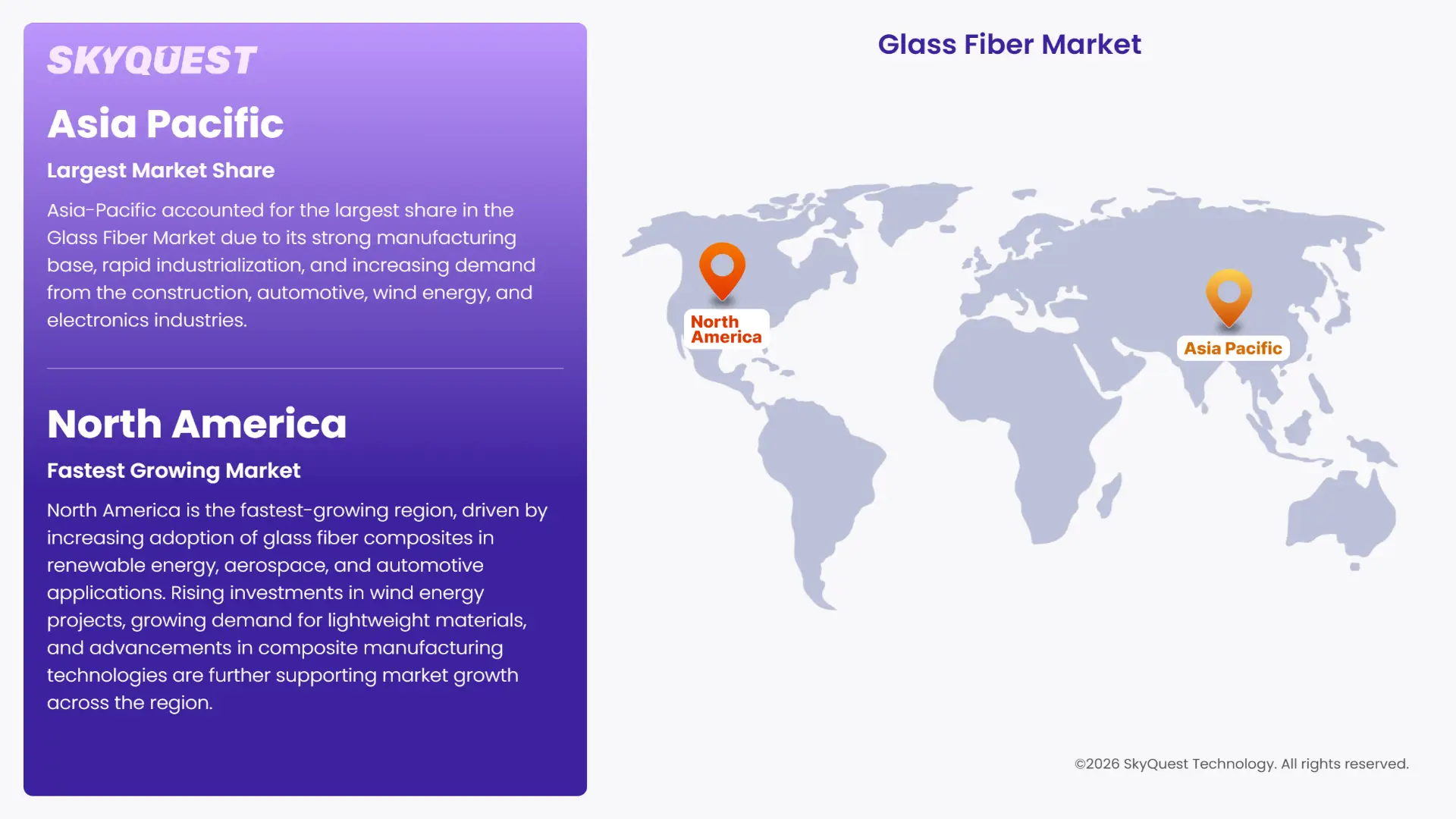
North America is the largest in glass fiber because of robust construction, automotive, and wind industry markets. The United States is a leader in adopting fiberglass for insulation and composite products in infrastructure and aerospace. Canada facilitates growth through building remodels and retrofitting homes with energy-efficient materials. Enhanced technology, enabling policies, and high investment in renewables keep bolstering the region's position as a global leader in the glass fiber market.
United States Glass Fiber Market
The U.S. lags behind strong demand for glass fiber in building and optical fiber use. Increasing AI data centers and 5G infrastructure have pushed optical fiber consumption at a great rate. At the start of 2025, there was one of the major producers announcing better-than-projected sales, which were fueled by increasing infrastructure requirements as well as AI connectivity expansion. This comes in line with the nation's focus on digitalization, pushing more investment into high-performance glass fiber material.
Canada Glass Fiber Market
Demand for fiberglass in Canada is stimulated by rising construction activity and ongoing retrofitting on aging residential and commercial properties. The government emphasis on net-zero emissions and energy-efficient building codes is promoting the use of fiberglass insulation. New provincial funding schemes introduced in the recent past to encourage the use of sustainable material in building should add to local fiberglass use and decrease foreign-source insulation product reliance.
Asia Pacific has been the growth driver on the back of urbanization at a fast pace, growth in infrastructure and manufacturing. Government policies on green buildings, EV manufacturing, and installation of wind power provide the core of increasing demand for glass fiber. Adoption of technology and industrial upscaling are fueled by countries such as Japan, South Korea, and China, leading to growth at an increasing rate in construction, electronics, and use of composites.
Japan Glass Fiber Market
Japan is growing its aerospace and electronics applications of glass fiber, led by strong demand for lighter and heat-resistant materials. Domestic manufacturers have ramped up the manufacturing of ultra-pure and ultra-thin fibers. In 2025, a Japan top-ranking glassmaker widened its portfolio of composite fibers to meet next-gen auto electronics and semiconductors' packaging, riding on Japan's strategy of innovation-driven and export-led high-tech production.
South Korea Glass Fiber Market
South Korea is also at the forefront of vacuum-insulated glass fiber composites, especially for energy storage. Another new partnership between a foreign industrial company and a domestic shipbuilder seeks to produce advanced fiberglass microspheres for hydrogen fuel transport. The materials hold the potential to enhance insulation and efficiency in hydrogen supply. Coupled with increased exports of electric vehicles, South Korea is becoming a major high-tech player in the fiberglass industry.
China Glass Fiber Market
China is still one of the world's largest glass fiber manufacturers and consumers. Among the leading manufacturers towards the end of 2024, a significant investment was made in a zero-carbon fiberglass factory fueled by clean energy, which reflects China's transition to cleaner production processes. This is consistent with national goals for reducing carbon intensity while continuing to drive economic growth. The mass production from the plant and vertical integration set a new standard for green manufacturing within the sector.
Europe retains its leadership position in the glass fiber market with regulatory backing, industrialization, and activities of environmental building. Germany, France, and Britain are major movers, investing in high-performance fibers, as well as optical technology. EU climate policy as well as research subsidies are building market resilience as well as technological advancement.
Germany Glass Fiber Market
Germany is pushing the use of glass fiber for communications and quantum technologies. In early 2025, it rolled out a nationwide glass fiber-based quantum communications network. The secure data network will demand precision-grade fiber and unlock new prospects for domestic glass fiber producers. Germany's dual emphasis on industrial power and digital infrastructure boosts both manufacturing and application scope for fiberglass.
France Glass Fiber Market
France is at the forefront of scientific uses of glass fiber. National scientific projects are employing fiber networks to synch time and frequency standards among laboratories in order to develop quantum physics and calibrate satellites. One of the biggest initiatives in 2025 was its increase of this fiber network throughout southern France, further demonstrating the country's leadership in cutting-edge, low-loss fiber installations.
UK Glass Fiber Market
The UK fiberglass market was hard hit mid-2025 when one of its largest manufacturers said it would shut down its flagship factory, citing increasing operating expenses and global price competition. Although this is unfortunate, it has injected debate on re-sustaining the domestically based value chain for fiberglass through energy subsidies and incentives for high-tech production. The nation's construction and clean-tech industries continue to have stable demand for fiberglass products.
To know more about the market opportunities by region and country, click here to
Buy The Complete Report
Surge in Demand from Automotive & Aerospace Sectors
Expansion of Renewable Energy Infrastructure
High Energy Consumption & Emissions in Production
Competition from Carbon Fiber and Natural Composites
Request Free Customization of this report to help us to meet your business objectives.
Competitive dynamics of the glass fiber industry are evolving with the tactical shift by market leaders and the influx of technology-based startups. Corning signed a $1 billion multi-year deal with AT&T to facilitate nation-wide deployment of fiber broadband and solidify its leadership in optical communications. Owens Corning sold its glass reinforcement business last year to India's Praana Group for $755 million and is focusing primarily on building products and insulation. These actions are strategic investments and rationalization of the portfolio in order to address higher demand and specificity.
Shift Toward Sustainable Manufacturing
Integration of Smart Monitoring Technologies
SkyQuest’s ABIRAW (Advanced Business Intelligence, Research & Analysis Wing) is our Business Information Services team that Collects, Collates, Correlates, and Analyses the Data collected using Primary Exploratory Research backed by robust Secondary Desk research.
SkyQuest’s study suggests that the glass fiber industry is growing with growing demand from the automobile and aerospace industries, where strong and light material is essential to fuel performance and efficiency. High energy consumption manufacturing and environment standards, however, remain giant brakes. North America dominates the market on account of strong building construction and technological advancements in the United States. The building sector takes the largest market share since fiberglass is widely applied in reinforcement and insulation. The second growth driver is the accelerated investment in renewable energy infrastructure, especially wind power, which uses glass fiber heavily in turbine blades and components. The two aspects continue to propel a competitive and innovation-stimulated market climate.
| Report Metric | Details |
|---|---|
| Market size value in 2024 | USD 14.26 Billion |
| Market size value in 2033 | USD 20.48 Billion |
| Growth Rate | 4.1% |
| Base year | 2024 |
| Forecast period | 2026–2033 |
| Forecast Unit (Value) | USD Billion |
| Segments covered |
|
| Regions covered | North America (US, Canada), Europe (Germany, France, United Kingdom, Italy, Spain, Rest of Europe), Asia Pacific (China, India, Japan, Rest of Asia-Pacific), Latin America (Brazil, Rest of Latin America), Middle East & Africa (South Africa, GCC Countries, Rest of MEA) |
| Companies covered |
|
| Customization scope | Free report customization with purchase. Customization includes:-
|
To get a free trial access to our platform which is a one stop solution for all your data requirements for quicker decision making. This platform allows you to compare markets, competitors who are prominent in the market, and mega trends that are influencing the dynamics in the market. Also, get access to detailed SkyQuest exclusive matrix.
Table Of Content
Executive Summary
Market overview
Parent Market Analysis
Market overview
Market size
KEY MARKET INSIGHTS
COVID IMPACT
MARKET DYNAMICS & OUTLOOK
Market Size by Region
KEY COMPANY PROFILES
Methodology
For the Glass Fiber Market, our research methodology involved a mixture of primary and secondary data sources. Key steps involved in the research process are listed below:
1. Information Procurement: This stage involved the procurement of Market data or related information via primary and secondary sources. The various secondary sources used included various company websites, annual reports, trade databases, and paid databases such as Hoover's, Bloomberg Business, Factiva, and Avention. Our team did 45 primary interactions Globally which included several stakeholders such as manufacturers, customers, key opinion leaders, etc. Overall, information procurement was one of the most extensive stages in our research process.
2. Information Analysis: This step involved triangulation of data through bottom-up and top-down approaches to estimate and validate the total size and future estimate of the Glass Fiber Market.
3. Report Formulation: The final step entailed the placement of data points in appropriate Market spaces in an attempt to deduce viable conclusions.
4. Validation & Publishing: Validation is the most important step in the process. Validation & re-validation via an intricately designed process helped us finalize data points to be used for final calculations. The final Market estimates and forecasts were then aligned and sent to our panel of industry experts for validation of data. Once the validation was done the report was sent to our Quality Assurance team to ensure adherence to style guides, consistency & design.
Analyst Support
Customization Options
With the given market data, our dedicated team of analysts can offer you the following customization options are available for the Glass Fiber Market:
Product Analysis: Product matrix, which offers a detailed comparison of the product portfolio of companies.
Regional Analysis: Further analysis of the Glass Fiber Market for additional countries.
Competitive Analysis: Detailed analysis and profiling of additional Market players & comparative analysis of competitive products.
Go to Market Strategy: Find the high-growth channels to invest your marketing efforts and increase your customer base.
Innovation Mapping: Identify racial solutions and innovation, connected to deep ecosystems of innovators, start-ups, academics, and strategic partners.
Category Intelligence: Customized intelligence that is relevant to their supply Markets will enable them to make smarter sourcing decisions and improve their category management.
Public Company Transcript Analysis: To improve the investment performance by generating new alpha and making better-informed decisions.
Social Media Listening: To analyze the conversations and trends happening not just around your brand, but around your industry as a whole, and use those insights to make better Marketing decisions.
REQUEST FOR SAMPLE
 REQUEST FREE CUSTOMIZATION
Global Glass Fiber Market size was valued at USD 14.26 Billion in 2024 and is poised to grow from USD 14.85 Billion in 2025 to USD 20.48 Billion by 2033, growing at a CAGR of 4.1% during the forecast period (2026–2033).
Key vendors in the Glass Fiber Market include Owens Corning, Jushi Group Co., Ltd., Nippon Electric Glass Co., Ltd., Saint-Gobain S.A., Johns Manville Corporation, China Beihai Fiberglass Co., Ltd., Chongqing Polycomp International Corporation, Taishan Fiberglass Inc., AGY Holding Corp., and 3B-the fibreglass company. These companies manufacture a wide range of glass fiber products for applications in construction, automotive, aerospace, wind energy, electronics, and industrial composites, focusing on lightweight, high-strength, and sustainable material solutions.
The key driver of the Glass Fiber Market is the increasing demand for lightweight and high-strength composite materials across multiple industries. Growing adoption of glass fiber in construction, automotive, wind energy, aerospace, and electronics applications, coupled with the need for durable and energy-efficient materials, is driving market growth.
The key market trend in the Glass Fiber Market is the growing adoption of glass fiber composites in renewable energy and lightweight applications. Manufacturers are increasingly developing advanced glass fiber materials with enhanced mechanical properties to support wind turbine components, electric vehicles, and sustainable construction solutions, while improving recyclability and production efficiency.
Asia-Pacific accounted for the largest share in the Glass Fiber Market due to its strong manufacturing base, rapid industrialization, and increasing demand from the construction, automotive, wind energy, and electronics industries. The region benefits from large-scale production capabilities, expanding infrastructure projects, and significant investments in renewable energy and advanced composite materials across countries such as China, India, and Japan.


Want to customize this report? This report can be personalized according to your needs. Our analysts and industry experts will work directly with you to understand your requirements and provide you with customized data in a short amount of time. We offer $1000 worth of FREE customization at the time of purchase.
Feedback From Our Clients


 USA (+1) 351-333-4748

