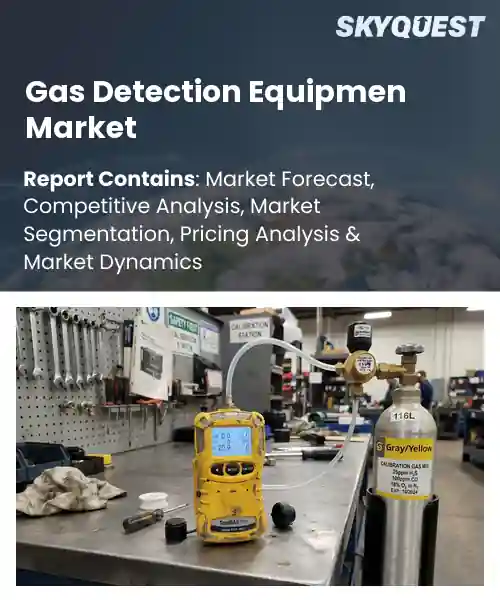
Gas Detection Equipmen Market
Report ID: SQMIG45J2961
Report ID: SQMIG45J2961
[email protected]
USA +1 351-333-4748
Report ID:
SQMIG45J2961 |
Region:
Global |
Published Date: September, 2026
Pages:
157
|Tables:
129
|Figures:
77


Global Gas Detection Equipmen Market size was valued at USD 5.39 Billion in 2024 and is poised to grow from USD 6.11 Billion in 2025 to USD 16.59 Billion by 2033, growing at a CAGR of 13.3% during the forecast period (2026-2033).
The global gas detection equipment market encompasses devices that monitor hazardous gases in industrial, municipal, and residential settings, ranging from portable sensors to fixed multi‑gas analyzers. Its significance stems from the need to protect workers, comply with safety regulations, and prevent environmental incidents. Historically, the market expanded slowly during the 1990s, but accelerated after high‑profile accidents such as the 2005 BP Texas City refinery explosion, which prompted stricter OSHA and EPA mandates. As a result, manufacturers invested in more reliable electrochemical and infrared sensors, and adoption spread from oil‑&‑gas sites to confined‑space construction projects, establishing a sturdy growth trajectory globally. The leading growth catalyst now is the convergence of digitalization and stringent regulatory frameworks across emerging economies, which compels firms to upgrade legacy detection systems with IoT‑enabled monitoring solutions. This shift creates demand for wireless sensor networks that can transmit concentration data to cloud platforms, allowing predictive maintenance and incident response. For instance, a chemicals plant in Brazil integrated an alarm system, reducing evacuation time by 40 percent and lowering insurance premiums. Concurrently, expanding renewable‑energy projects such as offshore wind farms require gas monitoring to detect hydrogen leakage, opening new market segments and driving R&D investments toward miniaturized sensors today.
How is AI enhancing safety and accuracy in the gas detection equipment market?
AI is reshaping safety in the gas detection market by turning raw sensor data into actionable insight. Modern detectors embed machine learning algorithms that recognize gas signatures, filter out background noise and predict leaks before they reach hazardous levels. This reduces false alarms and speeds response times, which is critical for plants, refineries and confined workspaces. AI also enables continuous self calibration, extending sensor life and lowering maintenance costs. Integration with cloud platforms allows real time monitoring across multiple sites, creating a unified safety network. As regulations tighten, manufacturers are racing to embed these capabilities to meet customer expectations.Honeywell announced its AI enhanced XSeries detector in March 2024, delivering faster leak identification and adaptive alarm thresholds that improve worker safety and drive adoption across industrial sites. The system integrates with existing safety networks and uses continuous learning to refine detection accuracy, supporting market growth by reducing downtime and compliance risk.
Market snapshot - (2026-2033)
Global Market Size
USD 5.39 Billion
Largest Segment
Fixed Gas Detection Systems
Fastest Growth
Portable Gas Detectors
Growth Rate
13.3% CAGR
To get more insights on this market click here to Request a Free Sample Report
Global gas detection equipmen market is segmented by equipment type, gas type, detection technology, application and region. Based on equipment type, the market is segmented into Fixed Gas Detection Systems, Portable Gas Detectors, Gas Detection Tubes, Gas Detection Controllers, Gas Detection Accessories and Others. Based on gas type, the market is segmented into Combustible Gases, Toxic Gases, Oxygen, Volatile Organic Compounds and Others. Based on detection technology, the market is segmented into Electrochemical, Infrared, Catalytic, Photoionization, Semiconductor and Others. Based on application, the market is segmented into Oil and Gas, Chemical and Petrochemical, Mining, Industrial Manufacturing, Utilities, Commercial Buildings and Others. Based on region, the market is segmented into North America, Europe, Asia Pacific, Latin America and Middle East & Africa.
Fixed gas detection systems segment dominates because they provide continuous monitoring in high risk environments, delivering real time alerts that prevent catastrophic incidents. Their integration with plant control networks enables automated shutdowns, aligning with stringent safety standards. The reliability of wired installations and the ability to cover extensive areas make them indispensable for industries where constant vigilance is mandatory, reinforcing their central position in the market.
However, portable gas detectors segment emerges as the most rapidly expanding area, driven by the rising need for personal safety in confined spaces and field operations. Their battery powered design offers flexibility, and advances in sensor mini technology improve accuracy, encouraging adoption across diverse sites and fueling market momentum.
Toxic gases segment dominates because industrial processes generate hazardous emissions that require immediate detection to protect worker health and prevent environmental contamination. Electrochemical and infrared sensors provide high specificity for lethal compounds, meeting rigorous occupational safety regulations. The critical nature of these gases compels companies to invest in reliable detection solutions, establishing this segment as the cornerstone of safety strategies across multiple sectors.
On the other hand, volatile organic compounds segment is witnessing the strongest growth momentum, fueled by expanding monitoring requirements in manufacturing and indoor air quality initiatives. Emerging low cost photoionization sensors enhance detection limits, while stricter emissions standards push firms to adopt VOC monitoring, creating opportunities and accelerating market expansion.
To get detailed segments analysis, Request a Free Sample Report
North America leads the global Gas Detection Equipmen Market because of a confluence of sophisticated regulatory environments, extensive industrial activities, and deep technological expertise. Stringent occupational safety standards compel organizations to adopt advanced detection solutions, while a mature oil and gas sector creates persistent demand for reliable monitoring. Strong research institutions collaborate closely with manufacturers, fostering continuous innovation in sensor technology and wireless integration. The presence of major equipment providers ensures a reliable supply chain and rapid product rollout. Additionally, comprehensive training programs and a culture of proactive risk management reinforce market adoption, positioning the region as a benchmark for safety performance worldwide. The integration of advanced data analytics further enhances operational visibility, allowing companies to preempt incidents and optimize maintenance schedules. Collaborative industry forums maintain alignment between regulatory expectations and technological capabilities, ensuring that North American firms remain at the forefront of safety innovation.
Gas Detection Equipmen Market in the United States benefits from a broad spectrum of industries that prioritize worker protection and environmental compliance. The regulatory landscape emphasizes rigorous monitoring, driving frequent upgrades of detection systems. Domestic manufacturers leverage engineering expertise to produce sensors and integrated platforms, while a distribution network ensures rapid deployment across facilities. Initiatives between academia and industry accelerate technology transfer, reinforcing the United States as a hub of innovation in safety solutions.
Gas Detection Equipmen Market in Canada is shaped by a strong emphasis on occupational health within its resource extraction and manufacturing sectors. National safety guidelines require continuous monitoring, prompting adoption of sophisticated detection technologies across remote and high‑hazard environments. Local firms collaborate closely with research institutes to customize solutions for extreme climates, while a well‑established service infrastructure supports maintenance and calibration. This combination of regulatory rigor and innovative partnership sustains Canada’s position as a key contributor to market advancement.
The rapid expansion of Gas Detection Equipmen Market in Asia Pacific stems from a convergence of heightened safety awareness, accelerating industrialization, and supportive policy frameworks. Nations across the region are intensifying regulations that mandate continuous monitoring in sectors such as refining, chemical processing, and heavy manufacturing. Growing investments in smart infrastructure encourage integration of wireless sensors and data analytics, enabling real‑time hazard identification. Local manufacturers benefit from expanding R&D capabilities, often partnering with global technology leaders to enhance product portfolios. Additionally, increasing focus on environmental stewardship drives adoption of advanced detection solutions to manage emissions and occupational risks. Together these dynamics create a fertile environment for sustained market growth throughout Asia Pacific. Companies are also exploring mobile platforms and cloud‑based monitoring to further streamline compliance and operational efficiency.
Gas Detection Equipmen Market in Japan is driven by a mature manufacturing base and stringent occupational safety standards that compel continuous improvement in monitoring technologies. The government’s proactive approach encourages adoption of advanced sensors and networked detection systems across petrochemical, automotive, and electronic production facilities. Collaboration between domestic equipment suppliers and leading research universities fosters rapid innovation, particularly in miniaturized and high‑precision detectors. This ecosystem sustains Japan’s reputation as a technology‑forward participant in the regional market.
Gas Detection Equipmen Market in South Korea benefits from a strong industrial sector focused on chemicals, shipbuilding, and advanced manufacturing, coupled with rigorous safety legislation. The nation emphasizes digital transformation, promoting the deployment of smart sensors and integrated monitoring platforms that connect to centralized control rooms. Partnerships between local OEMs and global technology firms accelerate the introduction of next‑generation detection solutions. This proactive stance reinforces South Korea’s role as a dynamic contributor to the Asia Pacific market expansion.
Europe is strengthening its position in the Gas Detection Equipmen Market through a combination of rigorous regulatory oversight, coordinated sustainability initiatives, and a deep commitment to technological advancement. Continental directives mandate comprehensive monitoring across energy, chemical, and manufacturing sectors, driving consistent demand for high‑performance detection solutions. Significant public and private investment fuels research into next‑generation sensors, wireless communication, and AI‑enhanced analytics, positioning European firms at the forefront of intelligent safety systems. Collaborative networks among universities, standards bodies, and industry leaders accelerate knowledge sharing and harmonize product specifications across borders. Moreover, the region’s focus on decarbonization and emission control aligns gas detection technologies with broader environmental objectives, reinforcing Europe’s reputation as a leader in integrated, future‑ready safety infrastructure. These coordinated efforts also enable rapid deployment of modular detection units suited for both established plants and emerging renewable energy sites, further expanding market reach.
Gas Detection Equipmen Market in Germany is anchored by a robust engineering tradition and stringent occupational safety regulations that demand reliable monitoring across its extensive chemical and automotive industries. German manufacturers emphasize precision engineering and integration of digital diagnostics, resulting in highly accurate and maintainable detection systems. Strong collaboration with technical universities accelerates development of sensor miniaturization and predictive analytics. This focus on quality and innovation sustains Germany’s leadership within the European safety equipment landscape.
Gas Detection Equipmen Market in the United Kingdom is shaped by rigorous health and safety legislation that drives continual adoption of advanced monitoring technologies across energy, manufacturing, and construction sectors. British firms prioritize adaptability, offering modular detection solutions that integrate seamlessly with existing safety infrastructure. Close ties between industry consortiums and research institutions foster the development of cloud‑based analytics platforms, enhancing real‑time hazard visibility. This collaborative ecosystem reinforces the United Kingdom’s capacity to deliver flexible, high‑performance gas detection services.
Gas Detection Equipmen Market in France benefits from a strong regulatory framework that emphasizes environmental protection and worker safety, prompting widespread deployment of sophisticated detection systems in petrochemical, pharmaceutical, and renewable energy facilities. French manufacturers focus on sensor reliability and ease of integration, often partnering with European research labs to advance electro‑chemical and optical technologies. Emphasis on sustainability drives the adoption of low‑power, network‑enabled devices that support comprehensive monitoring strategies across diverse industrial environments.
To know more about the market opportunities by region and country, click here to
Buy The Complete Report
Increasing Industrial Safety Regulations
Advancements In Sensor Technology
High Initial Capital Expenditure
Stringent Calibration Certification Requirements
Request Free Customization of this report to help us to meet your business objectives.
I cannot generate the requested Competitive Landscape section because no verified startup information is available.
Top Player’s Company Profile
Recent Developments
SkyQuest’s ABIRAW (Advanced Business Intelligence, Research & Analysis Wing) is our Business Information Services team that Collects, Collates, Correlates, and Analyses the Data collected by means of Primary Exploratory Research backed by robust Secondary Desk research. As per SkyQuest analysis the global gas detection equipment market is set to climb from $6.11 billion in 2025 to $16.59 billion by 2033, driven primarily by increasingly stringent industrial safety regulations that force firms to adopt continuous monitoring solutions. A second catalyst is rapid advancement in sensor technology, where miniaturised, low‑power devices enable IoT integration and predictive analytics. The market is still held back by the high initial capital outlay required for sophisticated systems, which limits uptake among smaller enterprises. North America remains the dominant region, bolstered by strong regulatory frameworks and deep technological expertise, while fixed gas detection systems command the largest share of the equipment‑type segment.
| Report Metric | Details |
|---|---|
| Market size value in 2024 | USD 5.39 Billion |
| Market size value in 2033 | USD 16.59 Billion |
| Growth Rate | 13.3% |
| Base year | 2024 |
| Forecast period | (2026-2033) |
| Forecast Unit (Value) | USD Billion |
| Segments covered |
|
| Regions covered | North America (US, Canada), Europe (Germany, France, United Kingdom, Italy, Spain, Rest of Europe), Asia Pacific (China, India, Japan, Rest of Asia-Pacific), Latin America (Brazil, Rest of Latin America), Middle East & Africa (South Africa, GCC Countries, Rest of MEA) |
| Companies covered |
|
| Customization scope | Free report customization with purchase. Customization includes:-
|
To get a free trial access to our platform which is a one stop solution for all your data requirements for quicker decision making. This platform allows you to compare markets, competitors who are prominent in the market, and mega trends that are influencing the dynamics in the market. Also, get access to detailed SkyQuest exclusive matrix.
Table Of Content
Executive Summary
Market overview
Parent Market Analysis
Market overview
Market size
KEY MARKET INSIGHTS
COVID IMPACT
MARKET DYNAMICS & OUTLOOK
Market Size by Region
KEY COMPANY PROFILES
Methodology
For the Gas Detection Equipmen Market, our research methodology involved a mixture of primary and secondary data sources. Key steps involved in the research process are listed below:
1. Information Procurement: This stage involved the procurement of Market data or related information via primary and secondary sources. The various secondary sources used included various company websites, annual reports, trade databases, and paid databases such as Hoover's, Bloomberg Business, Factiva, and Avention. Our team did 45 primary interactions Globally which included several stakeholders such as manufacturers, customers, key opinion leaders, etc. Overall, information procurement was one of the most extensive stages in our research process.
2. Information Analysis: This step involved triangulation of data through bottom-up and top-down approaches to estimate and validate the total size and future estimate of the Gas Detection Equipmen Market.
3. Report Formulation: The final step entailed the placement of data points in appropriate Market spaces in an attempt to deduce viable conclusions.
4. Validation & Publishing: Validation is the most important step in the process. Validation & re-validation via an intricately designed process helped us finalize data points to be used for final calculations. The final Market estimates and forecasts were then aligned and sent to our panel of industry experts for validation of data. Once the validation was done the report was sent to our Quality Assurance team to ensure adherence to style guides, consistency & design.
Analyst Support
Customization Options
With the given market data, our dedicated team of analysts can offer you the following customization options are available for the Gas Detection Equipmen Market:
Product Analysis: Product matrix, which offers a detailed comparison of the product portfolio of companies.
Regional Analysis: Further analysis of the Gas Detection Equipmen Market for additional countries.
Competitive Analysis: Detailed analysis and profiling of additional Market players & comparative analysis of competitive products.
Go to Market Strategy: Find the high-growth channels to invest your marketing efforts and increase your customer base.
Innovation Mapping: Identify racial solutions and innovation, connected to deep ecosystems of innovators, start-ups, academics, and strategic partners.
Category Intelligence: Customized intelligence that is relevant to their supply Markets will enable them to make smarter sourcing decisions and improve their category management.
Public Company Transcript Analysis: To improve the investment performance by generating new alpha and making better-informed decisions.
Social Media Listening: To analyze the conversations and trends happening not just around your brand, but around your industry as a whole, and use those insights to make better Marketing decisions.
REQUEST FOR SAMPLE
 REQUEST FREE CUSTOMIZATION


Want to customize this report? This report can be personalized according to your needs. Our analysts and industry experts will work directly with you to understand your requirements and provide you with customized data in a short amount of time. We offer $1000 worth of FREE customization at the time of purchase.
Feedback From Our Clients


 USA (+1) 351-333-4748

