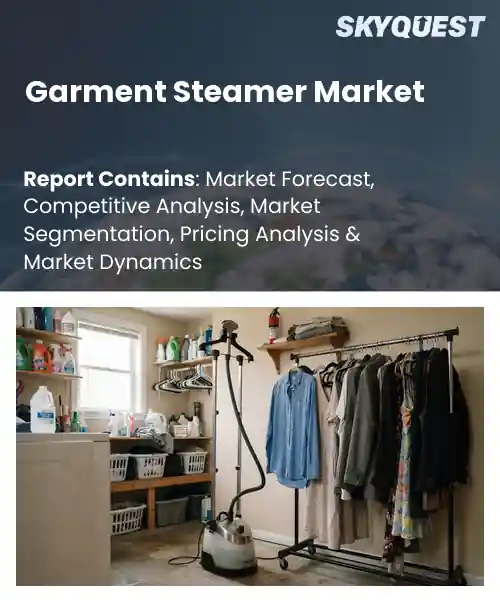
Garment Steamer Market
Report ID: SQMIG25H2170
Report ID: SQMIG25H2170
[email protected]
USA +1 351-333-4748
Report ID:
SQMIG25H2170 |
Region:
Global |
Published Date: August, 2026
Pages:
157
|Tables:
154
|Figures:
78


Global Garment Steamer Market size was valued at USD 3.28 Billion in 2024 and is poised to grow from USD 3.48 Billion in 2025 to USD 5.59 Billion by 2033, growing at a CAGR of 6.1% during the forecast period (2026-2033).
The garment steamer market includes manufacturers and distributors of handheld and standing steam units that remove wrinkles from clothing, upholstery and delicate fabrics. Its relevance arises from rising consumer demand for quick‑care solutions that preserve garment integrity while avoiding the chemical exposure of traditional ironing. The market originated early 2000s as electronics enabled heating elements and gained momentum after 2008 financial crisis when households sought alternatives to professional dry‑cleaning. Brands such as Philips and Jiffy seized the opportunity with affordable models, and luxury hotels adopted steamers to enhance guest experience, demonstrating how convenience and environmental concerns have fueled significant growth. A pivotal growth factor for the global garment steamer market is the expanding professional laundry and hospitality sector, where speed and fabric care directly affect service quality and operating costs. When hotels replace traditional irons with steamers, they reduce labor hours and energy consumption, allowing faster room turnover and lower utility bills; the resulting cost savings encourage wider adoption across chains. Simultaneously, retail clothing stores employ portable steamers for garment refresh, which enhances visual appeal and boosts sales conversion. These applications demonstrate how efficiency gains and customer‑experience improvements create a feedback loop that drives demand for low‑maintenance steamer technologies worldwide.
How is AI-driven automation influencing product innovation in the global garment steamer market?
AI driven automation is reshaping how garment steamers are designed and built. Sensors now monitor fabric type, humidity and wrinkle depth, feeding data to onboard processors that adjust steam flow in real time. Machine learning models learn from each use, enabling the next generation of devices to deliver consistent results with less energy. This shift moves the product focus from simple heating elements to intelligent platforms that can be updated with new software features. Manufacturers are integrating voice assistants and mobile apps, turning a household appliance into a connected service that responds to user preferences and schedules. The market therefore sees a blend of traditional engineering and digital innovation that keeps the product relevant and appealing.In June 2024 a leading steamer brand launched an AI driven temperature control system, showing how smart automation can cut drying time and improve fabric care while supporting overall market growth.
Market snapshot - (2026-2033)
Global Market Size
USD 3.28 Billion
Largest Segment
Handheld Garment Steamers
Fastest Growth
Travel Garment Steamers
Growth Rate
6.1% CAGR
To get more insights on this market click here to Request a Free Sample Report
Global garment steamer market is segmented by product type, power rating, water tank capacity, distribution channel, end user and region. Based on product type, the market is segmented into Handheld Garment Steamers, Upright Garment Steamers, Travel Garment Steamers, Professional Garment Steamers and Others. Based on power rating, the market is segmented into Below 1,000 W, 1,000–1,500 W and Above 1,500 W. Based on water tank capacity, the market is segmented into Below 0.5 Liter, 0.5–1.0 Liter and Above 1.0 Liter. Based on distribution channel, the market is segmented into Online Retail, Supermarkets & Hypermarkets, Specialty Stores, Department Stores and Others. Based on end user, the market is segmented into Residential, Commercial, Hospitality, Laundry & Garment Care Services and Others. Based on region, the market is segmented into North America, Europe, Asia Pacific, Latin America and Middle East & Africa.
Handheld garment steamers segment dominates because consumers prioritize portability and quick‑heat performance for daily wardrobe upkeep. The compact design fits cramped living spaces, while instant steam eliminates ironing time, aligning with busy lifestyles. Manufacturers focus on sleek ergonomics and safety features, reinforcing buyer confidence. This convergence of convenience, aesthetic appeal, and functional reliability fuels sustained demand across residential users. Additionally, the rising trend of minimal‑care fabrics amplifies the appeal of handheld solutions, encouraging repeat purchases and brand loyalty.
However, professional garment steamers segment is witnessing the strongest growth momentum as commercial laundries and boutique tailors adopt high‑capacity equipment for efficient bulk processing. Advanced temperature controls and durable construction meet rigorous service standards, unlocking new revenue streams and prompting manufacturers to innovate, thereby accelerating market expansion through broader product portfolios.
Online retail segment dominates because digital platforms provide unmatched convenience, extensive product assortments, and seamless price comparison for garment steamer shoppers. E‑commerce ecosystems integrate user reviews, video demos, and rapid delivery, reducing friction in purchase decisions. Brands leverage data analytics to personalize recommendations, enhancing engagement. This omnipresent accessibility drives continuous consumer acquisition and repeat buying, cementing online retail as the primary sales conduit and fostering brand loyalty through subscription services and after‑sales support.
Meanwhile, specialty stores segment emerges as the key high‑growth area as discerning consumers seek curated selections and expert assistance for premium garment steamers. In‑store demonstrations showcase advanced steam technologies, building trust and prompting higher spend per transaction. Retailers are expanding dedicated appliance zones, which amplifies product visibility and accelerates market penetration.
To get detailed segments analysis, Request a Free Sample Report
North America leads the garment steamer market through a confluence of consumer lifestyle preferences, robust retail ecosystems, and sustained innovation from key manufacturers. High disposable income and a cultural emphasis on convenience drive frequent use of quick‑care appliances in both residential and professional settings. The United States and Canada benefit from well‑established distribution networks that integrate online platforms with specialty retailers, enabling rapid product diffusion. Strong emphasis on sustainability encourages the adoption of energy‑efficient steam technologies, while a proactive regulatory environment supports safety and performance standards. Together, these factors create a fertile landscape for brand loyalty, product differentiation, and continuous market expansion, cementing North America’s dominant position.
Garment Steamer Market in United States thrives on a consumer base that values time‑saving solutions for personal and professional attire. Retail channels combine large‑scale electronics chains with niche boutiques, offering diverse price points and advanced features. Influential lifestyle media and strong online review cultures accelerate product awareness, while manufacturers focus on energy efficiency and portable designs to meet urban living demands. This synergy sustains strong demand across multiple consumer segments.
Garment Steamer Market in Canada benefits from consumer awareness of garment care alternatives that reduce reliance on traditional ironing. Distribution networks emphasize a blend of big‑box retailers and online specialty platforms, ensuring broad accessibility. Environmental considerations encourage preference for low‑energy steam devices, and manufacturers tailor products to colder climates with rapid heating capabilities. Collaborative promotions with fashion retailers reinforce the perception of steam technology as an essential wardrobe maintenance tool.
The European garment steamer market expands rapidly thanks to an evolving fashion culture that prioritizes quick touch‑ups and sustainable garment care. Consumers across the continent favor low‑heat steam solutions that preserve fabric integrity while reducing energy consumption compared with conventional ironing. Strong retail presence in both physical specialty stores and sophisticated e‑commerce platforms accelerates product exposure. Collaborative initiatives between manufacturers and design schools stimulate innovative form factors tailored to compact living spaces. Additionally, regulatory encouragement of energy‑efficient appliances fuels adoption of advanced steam technologies, reinforcing Europe’s reputation as a hub for refined, eco‑conscious personal care solutions.
Garment Steamer Market in Germany reflects a consumer preference for precision engineering and durability. Retail circuits combine large electronics chains with dedicated appliance boutiques, offering a range of premium and mid‑range models. Environmental guidelines motivate manufacturers to emphasize water‑efficiency and quick‑heat technologies, aligning with German expectations for high performance and sustainability. Partnerships with fashion retailers further embed steam solutions into the broader wardrobe maintenance narrative for everyday consumers seeking convenience.
Garment Steamer Market in United Kingdom experiences swift adoption driven by a fashion consumer base that values rapid garment refresh without compromising style. Online shopping channels enable quick access to new steam technologies, while boutique retailers highlight design. Sustainability narratives encourage low‑energy devices, and collaboration with heritage tailoring firms showcases steam’s role in preserving delicate fabrics. This dynamic environment fuels the region’s reputation as the fastest growing market in Europe.
Garment Steamer Market in France is emerging as consumers embrace garment care that aligns with chic lifestyle preferences. Retail distribution leverages a mix of department stores and boutique e‑commerce sites, spotlighting compact designs suited to urban apartments. Emphasis on energy‑saving performance resonates with national sustainability initiatives, prompting manufacturers to highlight reduced water usage. Collaborative showcases with French fashion houses underline steam’s ability to maintain haute‑couture fabrics, fostering gradual market uptake.
The Asia Pacific region is fortifying its role in the garment steamer arena through a blend of technological advancement, rising consumer expectations, and expanding retail infrastructures. Rapid urbanization drives demand for compact, high‑performance steam devices that accommodate constrained living spaces. Local manufacturers invest heavily in research focused on rapid heating cycles and water‑conservation features, positioning the region as an innovator in efficient steam technology. Growing e‑commerce platforms and cross‑border trade enhance product accessibility, while cultural emphasis on meticulous personal appearance encourages regular use of steam solutions. Collaborative efforts between technology firms and fashion brands further integrate steam appliances into lifestyle narratives, consolidating Asia Pacific’s emerging influence.
Garment Steamer Market in Japan reflects a consumer ethos that prioritizes precision, compactness and quiet operation. Retail avenues combine electronics megastores with specialized home‑appliance boutiques, showcasing devices designed for small apartments. Innovation focus on ultra‑fast heating and low‑noise performance aligns with Japanese expectations for efficiency. Partnerships with local fashion retailers emphasize steam’s role in preserving delicate fabrics, while sustainability drives the promotion of water‑saving technologies, supporting steady market continual growth.
Garment Steamer Market in South Korea thrives on a tech‑savvy consumer base that seeks advanced functionality and aesthetics. Distribution blends major electronics retailers with online marketplaces, showcasing models featuring rapid heat-up and smart‑control interfaces. Strong cultural emphasis on polished appearance drives frequent use for casual and formal attire. Collaboration with domestic design studios yields appliances that complement interior trends, while energy‑efficiency standards encourage development of steam units, reinforcing market momentum.
To know more about the market opportunities by region and country, click here to
Buy The Complete Report
Increasing Consumer Preference For Convenience
Expansion Of Retail Distribution Channels
High Initial Purchase Cost
Limited Awareness Of Benefits
Request Free Customization of this report to help us to meet your business objectives.
I’m sorry, but I don’t have enough information about recent garment‑steamer startups to complete the requested competitive‑landscape section.
Top Player’s Company Profile
Recent Developments
SkyQuest’s ABIRAW (Advanced Business Intelligence, Research & Analysis Wing) is our Business Information Services team that Collects, Collates, Correlates, and Analyses the Data collected by means of Primary Exploratory Research backed by robust Secondary Desk research. As per SkyQuest analysis, the global garment steamer market is being propelled primarily by the rising consumer preference for convenient, quick‑care solutions that replace traditional ironing, while the expansion of retail distribution channels—especially online platforms—further accelerates adoption. The handheld garment steamer segment leads the market, driven by its portability and instant‑heat performance that aligns with busy lifestyles. North America dominates the market thanks to high disposable incomes, strong e‑commerce infrastructure, and early adoption of smart‑connected appliances. However, the high initial purchase cost of premium steamers restrains broader uptake, particularly in price‑sensitive regions, tempering overall growth. Manufacturers are therefore focusing on energy‑efficient designs to balance price and performance.
| Report Metric | Details |
|---|---|
| Market size value in 2024 | USD 3.28 Billion |
| Market size value in 2033 | USD 5.59 Billion |
| Growth Rate | 6.1% |
| Base year | 2024 |
| Forecast period | (2026-2033) |
| Forecast Unit (Value) | USD Billion |
| Segments covered |
|
| Regions covered | North America (US, Canada), Europe (Germany, France, United Kingdom, Italy, Spain, Rest of Europe), Asia Pacific (China, India, Japan, Rest of Asia-Pacific), Latin America (Brazil, Rest of Latin America), Middle East & Africa (South Africa, GCC Countries, Rest of MEA) |
| Companies covered |
|
| Customization scope | Free report customization with purchase. Customization includes:-
|
To get a free trial access to our platform which is a one stop solution for all your data requirements for quicker decision making. This platform allows you to compare markets, competitors who are prominent in the market, and mega trends that are influencing the dynamics in the market. Also, get access to detailed SkyQuest exclusive matrix.
Table Of Content
Executive Summary
Market overview
Parent Market Analysis
Market overview
Market size
KEY MARKET INSIGHTS
COVID IMPACT
MARKET DYNAMICS & OUTLOOK
Market Size by Region
KEY COMPANY PROFILES
Methodology
For the Garment Steamer Market, our research methodology involved a mixture of primary and secondary data sources. Key steps involved in the research process are listed below:
1. Information Procurement: This stage involved the procurement of Market data or related information via primary and secondary sources. The various secondary sources used included various company websites, annual reports, trade databases, and paid databases such as Hoover's, Bloomberg Business, Factiva, and Avention. Our team did 45 primary interactions Globally which included several stakeholders such as manufacturers, customers, key opinion leaders, etc. Overall, information procurement was one of the most extensive stages in our research process.
2. Information Analysis: This step involved triangulation of data through bottom-up and top-down approaches to estimate and validate the total size and future estimate of the Garment Steamer Market.
3. Report Formulation: The final step entailed the placement of data points in appropriate Market spaces in an attempt to deduce viable conclusions.
4. Validation & Publishing: Validation is the most important step in the process. Validation & re-validation via an intricately designed process helped us finalize data points to be used for final calculations. The final Market estimates and forecasts were then aligned and sent to our panel of industry experts for validation of data. Once the validation was done the report was sent to our Quality Assurance team to ensure adherence to style guides, consistency & design.
Analyst Support
Customization Options
With the given market data, our dedicated team of analysts can offer you the following customization options are available for the Garment Steamer Market:
Product Analysis: Product matrix, which offers a detailed comparison of the product portfolio of companies.
Regional Analysis: Further analysis of the Garment Steamer Market for additional countries.
Competitive Analysis: Detailed analysis and profiling of additional Market players & comparative analysis of competitive products.
Go to Market Strategy: Find the high-growth channels to invest your marketing efforts and increase your customer base.
Innovation Mapping: Identify racial solutions and innovation, connected to deep ecosystems of innovators, start-ups, academics, and strategic partners.
Category Intelligence: Customized intelligence that is relevant to their supply Markets will enable them to make smarter sourcing decisions and improve their category management.
Public Company Transcript Analysis: To improve the investment performance by generating new alpha and making better-informed decisions.
Social Media Listening: To analyze the conversations and trends happening not just around your brand, but around your industry as a whole, and use those insights to make better Marketing decisions.
REQUEST FOR SAMPLE
 REQUEST FREE CUSTOMIZATION


Want to customize this report? This report can be personalized according to your needs. Our analysts and industry experts will work directly with you to understand your requirements and provide you with customized data in a short amount of time. We offer $1000 worth of FREE customization at the time of purchase.
Feedback From Our Clients


 USA (+1) 351-333-4748

