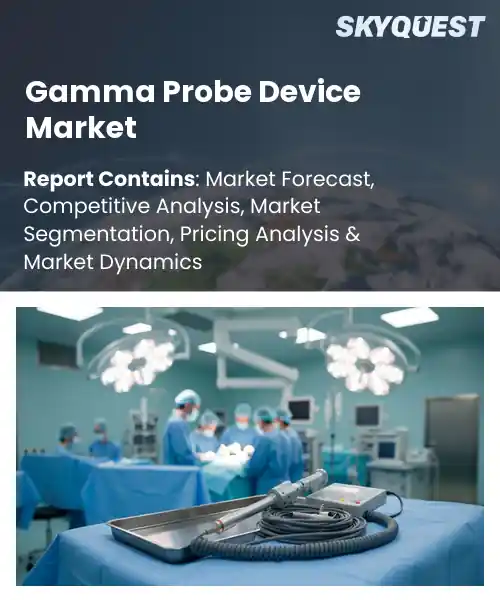
Gamma Probe Device Market
Report ID: SQMIG35A4114
Report ID: SQMIG35A4114
[email protected]
USA +1 351-333-4748
Report ID:
SQMIG35A4114 |
Region:
Global |
Published Date: July, 2026
Pages:
157
|Tables:
122
|Figures:
77


Global Gamma Probe Device Market size was valued at USD 451.1 Million in 2024 and is poised to grow from USD 490.35 Million in 2025 to USD 955.74 Million by 2033, growing at a CAGR of 8.7% during the forecast period (2026-2033).
The global gamma probe device market consists of handheld radiation detectors used by surgeons to identify malignant tissue during intra-operative procedures. Its value is in the ability to improve surgical precision, reduce recurrence rates and shorten hospital stays. The market has grown as minimally invasive procedures have become more popular and the growth of radioguided techniques, such as sentinel lymph-node biopsy, has driven demand. The early 1990s saw the first North American users of gamma probes, driving manufacturers to improve detector sensitivity and ergonomic design. Over the last decade, the emerging economies have invested in oncology infrastructure, which has increased the user base and established the market’s relevance.
Regulatory approvals and reimbursement policies are major market growth drivers, as they convert clinical acceptance into sustainable sources of income. Combined SPECT-CT guided gamma probing was cleared by health agencies in 2018, and hospitals were able to bill the procedure under oncologic surgery codes, which prompted a wider adoption of the technology by surgeons. Incentives have led to an increasing investigation of probes with wireless telemetry and imaging that allow intra-operative decision making in complex cases such as pancreatic cancer resections. Device manufacturers have partnered with imaging firms to provide bundled software analytics, broadening their market and accessing countries with increasing oncology spending.
How is AI-enhanced Imaging Improving The Gamma Probe Device Market?
AI-powered imaging is transforming gamma probe devices by providing more precise visual cues in real time to help surgeons distinguish cancerous tissue from normal tissue. The technology combines deep-learning algorithms with conventional scintillation detectors to reduce background noise and improve localisation accuracy. This allows clinicians to make decisions faster during oncologic procedures, leading to reduced operating time and risk of incomplete resections.
Manufacturers are integrating AI modules directly into probe hardware to enable adaptive calibration that maintains performance across different patient anatomies. The convergence of imaging intelligence and surgical tools is driving broader acceptance of gamma probes in both academic hospitals and community surgical centers, enabling ongoing growth of the market. Team‑NB published a framework on cybersecurity for AI‑enabled gamma probes in March 2026, reinforcing data protection and supporting broader clinical use.
Market snapshot - (2026-2033)
Global Market Size
USD 451.1 Million
Largest Segment
Handheld Gamma Probes
Fastest Growth
Wireless Gamma Probes
Growth Rate
8.7% CAGR
To get more insights on this market click here to Request a Free Sample Report
Global gamma probe device market is segmented by system modality, detector crystal type, clinical application, end user and region. Based on system modality, the market is segmented into Handheld Gamma Probes, Wireless Gamma Probes, Wired Gamma Probes and Console Based Systems. Based on detector crystal type, the market is segmented into Sodium Iodide Detectors, Cesium Iodide Detectors, Cadmium Zinc Telluride Detectors and Others. Based on clinical application, the market is segmented into Sentinel Lymph Node Biopsy, Parathyroid Localization, Breast Cancer Staging, Melanoma Detection and Gynecological Cancer Mapping. Based on end user, the market is segmented into Hospitals, Ambulatory Surgical Centers, Oncology Research Institutes and Specialty Clinics. Based on region, the market is segmented into North America, Europe, Asia Pacific, Latin America and Middle East & Africa.
The Handheld Gamma Probes segment is expected to dominate the market, as surgeons prefer direct tactile feedback and immediate visual alignment during procedures, as it increases precision in the detection of sentinel lymph nodes. The ergonomic design integrates with today’s operating tables reducing setup time and training complexity. This practicality leads to the widespread acceptance by hospitals and specialty clinics, which establishes its leadership in the gamma probe device market and enables long term clinical outcomes with reliable quantification of radiation and confidence in its use.
However, the Wireless Gamma Probes segment is experiencing the strongest growth momentum as emerging battery technologies allow cordless operations, improving the freedom of the surgeon and the integrity of the sterile field. Institutions are investing in integrated wireless platforms that stream real-time data to consoles, accelerating adoption among minimally invasive settings and creating new opportunities for market expansion.
Cadmium Zinc Telluride Detectors segment dominates the market due to its semiconductor nature which provides better energy resolution and operation at room temperature, eliminating the need for cooling which complicates the device design. This performance yields clearer intraoperative imaging, empowering clinicians to confidently differentiate malignant from benign tissue. Thanks to its small form factor and reliable operation, it can be integrated into handheld and console based probes, leading to its widespread use in hospitals and research institutes for diagnostic accuracy and workflow efficiency.
In contrast, the Sodium Iodide Detectors segment is emerging as an area as manufacturers refine crystal purity and coupling methods that boost sensitivity while maintaining cost effectiveness. This affordability is helping ambulatory surgical centers and specialty clinics adopt advanced probes that have been previously restricted by budget constraints, thus expanding the overall market footprint.
To get detailed segments analysis, Request a Free Sample Report
The dominance of North America continues on account of mature health-care infrastructure, robust research ecosystems and the widespread use of minimally invasive surgical techniques. Strong reimbursement policies encourage hospitals and clinics to use advanced detection tools. Leading manufacturers have established dedicated innovation centers, which drive product improvement. Academic device company collaborative relationships accelerate clinical validation and build surgeon confidence Furthermore, a resilient supply chain ensures consistent distribution, which helps to maintain market confidence and high adoption rates across a range of surgical specialties.
The presence of extensive clinical research networks that continuously evaluate evolving technologies, thereby increasing the confidence of practitioners in the technology, is supporting the United States Gamma Probe Device Market. A robust insurance environment results in prompt reimbursement, incentivizing institutions to embrace state-of-the-art intra-operative localization technology. Partnerships with leading industry players and academic hospitals speed up product refinement, and a sophisticated distribution framework guarantees consistent availability across various care settings. This confluence of research, reimbursement and supply chain excellence supports a strong market environment.
The Canada Gamma Probe Device Market is driven by a public health system that supports the adoption of evidence-based technology which promotes systematic integration of advanced surgical tools. The province’s health authorities are concerned about cost effectiveness, and recommend that clinical evaluations should be done to the extent necessary to confirm that the device works. Collaborating with research institutes and manufacturers accelerates the innovation pipeline, while a coordinated logistics network ensures a steady flow of products to the regional hospitals. This convergence of policy, research and distribution underpins steady market growth.
Europe experiences accelerated expansion as healthcare systems emphasize precision surgery and patient‑centered outcomes. Strong regulatory frameworks promote rigorous clinical validation, creating trust in novel detection devices. Investment in cross‑border research collaborations accelerates technology transfer, while a diverse network of specialized surgical centers drives early adoption. Market participants leverage localized manufacturing hubs to meet region‑specific standards, enhancing supply reliability. Additionally, increased focus on minimally invasive procedures across national health agendas fuels demand, positioning Europe as a hub for innovative surgical solutions.
Gamma Probe Device Market in Germany is anchored by a dense concentration of research hospitals that actively evaluate intra‑operative imaging technologies, reinforcing clinical confidence. Comprehensive health insurance schemes facilitate reimbursement pathways, encouraging hospitals to integrate sophisticated localization tools. Domestic manufacturing capabilities align closely with stringent regulatory expectations, ensuring high‑quality product availability. Collaborative ecosystems linking academia, industry, and clinical practice accelerate product iteration, sustaining Germany’s leadership in market adoption.
Gamma Probe Device Market in United Kingdom benefits from a proactive National Health Service that supports early adoption of cutting‑edge surgical technologies through pilot programmes and structured evaluation. Strong ties between leading medical schools and device firms foster rapid translation of research into clinical practice. Reimbursement mechanisms prioritize cost‑effective interventions, promoting sustained investment in precision tools. An agile distribution framework ensures timely access across both urban and regional hospitals, reinforcing the United Kingdom’s position as a fast‑moving market.
Gamma Probe Device Market in France is shaped by a health system that emphasizes clinical evidence and cost‑benefit analysis, driving cautious yet progressive integration of advanced devices. National research institutions collaborate closely with manufacturers to conduct multicenter studies, building a robust evidence base. Reimbursement pathways are designed to support innovative procedures that demonstrate clear patient benefit. A well‑organized logistics network ensures consistent product availability, enabling emerging adoption across diverse surgical specialties.
Asia Pacific is enhancing its market role by leveraging rapid advancements in surgical technology and expanding access to modern health‑care facilities. Strong governmental support for medical innovation encourages local manufacturing and technology transfer, reducing reliance on imports. Growing expertise in minimally invasive techniques among surgeons drives demand for precise intra‑operative tools. Regional collaborations among academic centers, industry, and health ministries streamline regulatory approvals, accelerating product entry. Improved distribution infrastructures and rising investment in health‑care infrastructure collectively position the region as an emerging hub for sophisticated surgical devices.
Gamma Probe Device Market in Japan thrives on a culture of meticulous clinical evaluation paired with high adoption of minimally invasive procedures. National health insurance provides structured reimbursement, encouraging hospitals to incorporate advanced detection equipment. Partnerships between leading university hospitals and device manufacturers foster continuous innovation and validation. A sophisticated supply chain ensures prompt delivery to both metropolitan and regional medical centers, reinforcing Japan’s strong market presence.
Gamma Probe Device Market in South Korea is propelled by a dynamic health‑care ecosystem that embraces cutting‑edge surgical technologies. Government incentives support domestic research and development, fostering a vibrant innovation landscape. Clinical practitioners prioritize precision tools to enhance surgical outcomes, driving steady demand. Efficient logistics and a robust network of specialized hospitals guarantee rapid product dissemination, consolidating South Korea’s growing influence in the regional market.
To know more about the market opportunities by region and country, click here to
Buy The Complete Report
Increasing Surgical Precision Demand
Adoption of Minimally Invasive Techniques
High Device Cost Barriers
Regulatory Approval Complexity
Request Free Customization of this report to help us to meet your business objectives.
The competitive landscape is shaped by intense rivalry among established manufacturers and emerging innovators, driving accelerated product differentiation and market share battles. Recent M&A activity, such as a leading imaging firm acquiring a niche gamma probe specialist, and strategic partnerships linking detector technology with hospital networks, are intensifying competition. Concurrently, firms are investing in miniaturized detector designs and AI‑enhanced imaging algorithms to secure a technological edge.
SkyQuest’s ABIRAW (Advanced Business Intelligence, Research & Analysis Wing) is our Business Information Services team that Collects, Collates, Correlates, and Analyses the Data collected by means of Primary Exploratory Research backed by robust Secondary Desk research.
As per SkyQuest analysis, the market is being propelled primarily by the rising demand for surgical precision which pushes hospitals to adopt gamma probes that enable real‑time lesion localization while a secondary catalyst is the surge in minimally invasive techniques that require compact accurate intra‑operative tools. The main restraint comes from the high device cost which slows uptake especially in budget‑constrained facilities. North America remains the dominant region due to mature reimbursement systems and strong research networks and handheld gamma probes dominate the segment landscape because surgeons value tactile feedback and ease of use.
| Report Metric | Details |
|---|---|
| Market size value in 2024 | USD 451.1 Million |
| Market size value in 2033 | USD 955.74 Million |
| Growth Rate | 8.7% |
| Base year | 2024 |
| Forecast period | (2026-2033) |
| Forecast Unit (Value) | USD Million |
| Segments covered |
|
| Regions covered | North America (US, Canada), Europe (Germany, France, United Kingdom, Italy, Spain, Rest of Europe), Asia Pacific (China, India, Japan, Rest of Asia-Pacific), Latin America (Brazil, Rest of Latin America), Middle East & Africa (South Africa, GCC Countries, Rest of MEA) |
| Companies covered |
|
| Customization scope | Free report customization with purchase. Customization includes:-
|
To get a free trial access to our platform which is a one stop solution for all your data requirements for quicker decision making. This platform allows you to compare markets, competitors who are prominent in the market, and mega trends that are influencing the dynamics in the market. Also, get access to detailed SkyQuest exclusive matrix.
Table Of Content
Executive Summary
Market overview
Parent Market Analysis
Market overview
Market size
KEY MARKET INSIGHTS
COVID IMPACT
MARKET DYNAMICS & OUTLOOK
Market Size by Region
KEY COMPANY PROFILES
Methodology
For the Gamma Probe Device Market, our research methodology involved a mixture of primary and secondary data sources. Key steps involved in the research process are listed below:
1. Information Procurement: This stage involved the procurement of Market data or related information via primary and secondary sources. The various secondary sources used included various company websites, annual reports, trade databases, and paid databases such as Hoover's, Bloomberg Business, Factiva, and Avention. Our team did 45 primary interactions Globally which included several stakeholders such as manufacturers, customers, key opinion leaders, etc. Overall, information procurement was one of the most extensive stages in our research process.
2. Information Analysis: This step involved triangulation of data through bottom-up and top-down approaches to estimate and validate the total size and future estimate of the Gamma Probe Device Market.
3. Report Formulation: The final step entailed the placement of data points in appropriate Market spaces in an attempt to deduce viable conclusions.
4. Validation & Publishing: Validation is the most important step in the process. Validation & re-validation via an intricately designed process helped us finalize data points to be used for final calculations. The final Market estimates and forecasts were then aligned and sent to our panel of industry experts for validation of data. Once the validation was done the report was sent to our Quality Assurance team to ensure adherence to style guides, consistency & design.
Analyst Support
Customization Options
With the given market data, our dedicated team of analysts can offer you the following customization options are available for the Gamma Probe Device Market:
Product Analysis: Product matrix, which offers a detailed comparison of the product portfolio of companies.
Regional Analysis: Further analysis of the Gamma Probe Device Market for additional countries.
Competitive Analysis: Detailed analysis and profiling of additional Market players & comparative analysis of competitive products.
Go to Market Strategy: Find the high-growth channels to invest your marketing efforts and increase your customer base.
Innovation Mapping: Identify racial solutions and innovation, connected to deep ecosystems of innovators, start-ups, academics, and strategic partners.
Category Intelligence: Customized intelligence that is relevant to their supply Markets will enable them to make smarter sourcing decisions and improve their category management.
Public Company Transcript Analysis: To improve the investment performance by generating new alpha and making better-informed decisions.
Social Media Listening: To analyze the conversations and trends happening not just around your brand, but around your industry as a whole, and use those insights to make better Marketing decisions.
REQUEST FOR SAMPLE
 REQUEST FREE CUSTOMIZATION
Global Gamma Probe Device Market size was valued at USD 451.1 Million in 2024 and is poised to grow from USD 490.35 Million in 2025 to USD 955.74 Million by 2033, growing at a CAGR of 8.7% during the forecast period (2026-2033).
The competitive landscape is shaped by intense rivalry among established manufacturers and emerging innovators, driving accelerated product differentiation and market share battles. Recent M&A activity, such as a leading imaging firm acquiring a niche gamma probe specialist, and strategic partnerships linking detector technology with hospital networks, are intensifying competition. Concurrently, firms are investing in miniaturized detector designs and AI‑enhanced imaging algorithms to secure a technological edge. 'Mirion Technologies, Inc.', 'Devicor Medical Devices, Inc.', 'Dilon Technologies, Inc.', 'IntraMedical Imaging, LLC', 'Eurorad SA', 'SurgicEye GmbH', 'NodeSeeker', 'Crystal Photonics GmbH', 'Capintec, Inc.', 'RMD Instruments', 'Trois-Rivières Medical Devices', 'Lightpoint Medical Ltd.', 'Polimaster Ltd.', 'OncoBeta GmbH', 'Mediso Medical Imaging Systems', 'Gamma Medical Inc.', 'Ziteo Medical', 'Sveprom Medical', 'Radical Medical Systems', 'Scintis Diagnostic'
The growing emphasis on surgical precision motivates hospitals to adopt gamma probe devices, as they enable real‑time localization of sentinel lymph nodes and malignant lesions with minimal disturbance to surrounding tissue. This capability boosts clinician confidence, reduces intraoperative uncertainty, and facilitates quicker patient recovery, making the technology attractive for institutions seeking improved procedural quality. Consequently, demand for gamma probes rises, supporting market expansion. Moreover, reliable feedback from these probes fosters team collaboration and encourages integration into a broader range of oncologic surgeries, sustaining growth across clinical settings.
Minimally Invasive Imaging Expansion: The growing preference for minimally invasive procedures is driving hospitals to adopt gamma probe devices that enhance intra‑operative localization while preserving tissue integrity. Surgeons value the ability to precisely target lesions, reducing patient recovery time and postoperative complications. This clinical shift encourages manufacturers to design slimmer, ergonomically optimized probes with intuitive controls, aligning with operating‑room efficiency goals. Consequently, procurement decisions increasingly prioritize devices that support less disruptive surgeries, fostering broader market acceptance across diverse specialty groups and improving overall outcomes.
Why does North America Dominate the Global Gamma Probe Device Market? |@12


Want to customize this report? This report can be personalized according to your needs. Our analysts and industry experts will work directly with you to understand your requirements and provide you with customized data in a short amount of time. We offer $1000 worth of FREE customization at the time of purchase.
Feedback From Our Clients


 USA (+1) 351-333-4748

