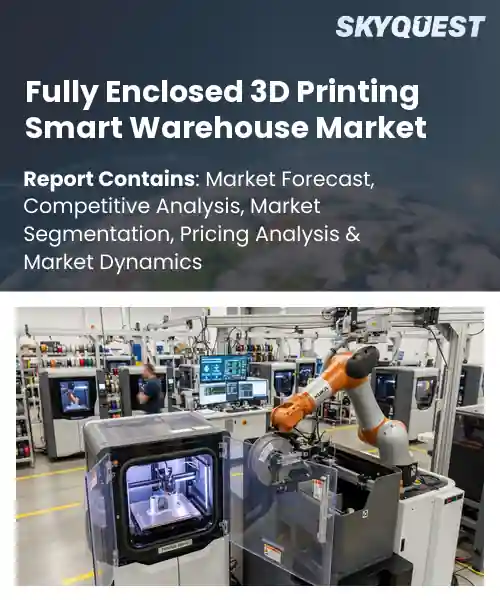
Fully Enclosed 3D Printing Smart Warehouse Market
Report ID: SQMIG20I4041
Report ID: SQMIG20I4041
[email protected]
USA +1 351-333-4748
Report ID:
SQMIG20I4041 |
Region:
Global |
Published Date: October, 2026
Pages:
157
|Tables:
148
|Figures:
78


Global Fully Enclosed 3D Printing Smart Warehouse Market size was valued at USD 410.0 Million in 2024 and is poised to grow from USD 477.65 Million in 2025 to USD 1620.76 Million by 2033, growing at a CAGR of 16.5% during the forecast period (2026-2033).
The global fully enclosed 3D‑printing smart‑warehouse market refers to integrated facilities where additive manufacturing equipment operates within sealed enclosures that manage material flow, quality monitoring and inventory. This model matters because it eliminates exposure to dust, temperature swings and humidity that can deform printed parts, thereby raising yield and reducing rework. The concept emerged in the early 2020s as manufacturers sought to combine Industry 4.0 data analytics with the flexibility of on‑demand part production. Early adopters such as Siemens and Relativity Space demonstrated enclosed print farms that linked machine‑vision inspection to enterprise resource planning, showcasing a trajectory from labs to hubs. The growth catalyst for the fully enclosed 3D‑printing smart‑warehouse market is the rising demand for rapid, localized part fabrication in regulated sectors such as aerospace, medical devices and electronics. As supply chains tighten, manufacturers adopt enclosed smart farms to shorten lead times while guaranteeing traceability; environment ensures consistent material properties and IoT platform records print’s temperature profile compliance audits. Companies like GE Aviation operate climate‑controlled vaults that feed turbine brackets to assembly lines, eliminating shipping and inventory buffers. This cause‑and‑effect loop tightened logistics prompting adoption, which then spurs automation investment creates significant opportunities for software vendors, enclosure designers and service providers.
What role does AI-driven automation play in optimizing fully enclosed 3D printing smart warehouses?
AI driven automation is reshaping fully enclosed 3D printing smart warehouses by linking printer fleets to real time analytics, predictive maintenance and dynamic scheduling. The technology monitors temperature, humidity and material flow, allowing the system to adjust print parameters without human intervention. Today operators rely on integrated sensors and cloud platforms that coordinate multiple printers, reduce downtime and improve part consistency. As demand for on demand manufacturing rises, manufacturers are adopting these intelligent hubs to streamline production, lower labor costs and accelerate order fulfillment. The AI models learn from each print cycle, optimizing feedstock usage and energy consumption. This creates a closed loop where data drives continuous improvement across the warehouse.Carbon June 2023, launched an AI powered orchestration platform that links its enclosed printers to a central warehouse control system, cutting setup time and enabling seamless scaling of production lines. This innovation showcases how AI driven automation fuels market growth and operational efficiency.
Market snapshot - (2026-2033)
Global Market Size
USD 410.0 Million
Largest Segment
Fused Deposition Modeling
Fastest Growth
Other 3D Printing Technologies
Growth Rate
16.5% CAGR
To get more insights on this market click here to Request a Free Sample Report
Global fully enclosed 3d printing smart warehouse market is segmented by 3d printing technology, warehouse function, automation level, material, end-use industry and region. Based on 3d printing technology, the market is segmented into Fused Deposition Modeling, Selective Laser Sintering, Stereolithography and Other 3D Printing Technologies. Based on warehouse function, the market is segmented into Raw Material Storage, Finished Product Storage, Automated Production & Storage and Spare Parts & On-Demand Manufacturing. Based on automation level, the market is segmented into Semi-Automated and Fully Automated. Based on material, the market is segmented into Plastics & Polymers, Metals, Ceramics & Composites and Other Materials. Based on end-use industry, the market is segmented into Automotive, Aerospace & Defense, Healthcare, Consumer Goods and Industrial Manufacturing. Based on region, the market is segmented into North America, Europe, Asia Pacific, Latin America and Middle East & Africa.
Fused Deposition Modeling segment dominates because its extrusion based process fits naturally within enclosed warehouse layouts, allowing continuous filament feed without extensive ventilation. The simplicity of material handling reduces contamination risk while the technology’s versatility supports a wide range of polymer chemistries used in on site production. Operators benefit from low maintenance cycles and the established supply chain accelerates deployment, making this approach the preferred backbone for smart warehouse installations.
However, Selective Laser Sintering emerges as the most rapidly expanding area because its powder bed fusion enables high resolution metal and polymer parts inside the controlled environment, meeting the growing demand for functional prototypes and low volume production. This capability draws new adopters and fuels investment in smart warehouse infrastructure.
Fully Automated segment leads because it integrates robotics, real time inventory management and closed loop quality checks, eliminating human intervention in material flow. The coordination of conveyors, robotic arms and sensor networks within a sealed environment maintains consistent temperature and particulate control, which is critical for additive processes. This high level of integration reduces cycle time, enhances repeatability and supports continuous production schedules demanded by today's modern manufacturing ecosystems worldwide.
Meanwhile, Semi Automated approach is witnessing the strongest growth because it offers a transition path for facilities that need human oversight for part setups while still leveraging robotic transport for bulk material movement. This balance reduces capital intensity, encourages early adoption, and creates a pipeline of upgrades toward full automation, expanding the market’s base.
To get detailed segments analysis, Request a Free Sample Report
Asia Pacific leads the global Fully Enclosed 3D Printing Smart Warehouse market because the region combines deep manufacturing expertise with aggressive adoption of advanced automation. Nations such as Japan and South Korea have long histories of precision engineering, which translate into a natural affinity for integrated 3D printing solutions that require controlled environments. Strong governmental incentives encourage investment in smart factory infrastructure, while a dense network of technology providers accelerates knowledge transfer. The presence of world‑class research institutions fuels continuous innovation in enclosure design, sensor integration, and software orchestration. Moreover, the region supply chains are highly localized, reducing lead times for critical components and enabling rapid scaling of warehouse operations. These factors collectively create a fertile ecosystem that sustains market leadership.
Fully Enclosed 3D Printing Smart Warehouse Market in Japan benefits from a legacy of precision engineering and a strong culture of improvement. Ecosystems link leading universities with manufacturers, fostering rapid prototyping within controlled environments. National policies promote digital transformation of factories, encouraging adoption of enclosed printing cells that enhance quality and safety. The convergence of labor and supply networks positions Japan as a benchmark for operational excellence in smart warehousing.
Fully Enclosed 3D Printing Smart Warehouse Market in South Korea thrives on a technology ecosystem and investment in Industry 4.0 initiatives. The country emphasis on modular automation aligns with the need for sealed printing environments that protect material integrity. Close collaboration between conglomerates and start‑ups accelerates development of maintenance tools for enclosed environments. Government support for manufacturing clusters further reinforces South Korea capacity to scale smart warehouse solutions across diverse sectors.
North America experiences rapid expansion of the Fully Enclosed 3D Printing Smart Warehouse market as manufacturers seek to combine speed with uncompromising quality in increasingly complex supply chains. The rise of e‑commerce and customized product offerings pressures firms to adopt enclosed printing cells that safeguard material properties while integrating seamlessly with warehouse management systems. Strong venture capital ecosystems fund innovative start‑ups that specialize in sensor‑rich enclosures and AI‑driven process control. Academic‑industry partnerships accelerate the translation of research on temperature‑stable environments into commercial solutions. Additionally, a focus on sustainability drives adoption of closed‑loop processes that reduce waste and energy consumption. Companies are also leveraging data analytics to continuously refine production workflows.
Fully Enclosed 3D Printing Smart Warehouse Market in United States is propelled by a logistics network and a culture of technology adoption. Leading manufacturers integrate sealed printing modules with warehouse automation to meet quality standards. Collaboration between research universities and industrial giants accelerates development of maintenance tools for enclosed environments. Federal initiatives supporting manufacturing further encourage investment, positioning United States as a hub for scalable smart warehouse solutions across sectors.
Fully Enclosed 3D Printing Smart Warehouse Market in Canada benefits from governmental emphasis on clean technology and an industrial ecosystem. Companies adopt sealed printing cells to align with environmental standards while improving part consistency. Partnerships between provincial research institutes and manufacturers drive innovation in monitoring and enclosure designs. The focus on growth and skilled workforce development positions Canada as a leader for ongoing sustainability in smart warehouse operations across medical and automotive sectors.
Europe strengthens its position in the Fully Enclosed 3D Printing Smart Warehouse market through a concerted focus on sustainability, regulatory harmonization, and cross‑border collaboration. The region’s commitment to circular economy principles drives adoption of closed‑loop printing systems that minimize waste and energy use. Robust standards for material safety and environmental impact enable seamless integration of enclosed printing cells across diverse supply chains. Collaborative research networks linking universities, technology clusters, and industrial partners accelerate breakthroughs in sensor‑driven enclosure control and AI‑based quality assurance. Government incentives and public‑private partnerships fund the deployment of smart warehouse infrastructure in sectors ranging from aerospace to healthcare. By aligning policy, innovation, and market demand, Europe creates a resilient ecosystem that elevates its global standing in advanced manufacturing.
Fully Enclosed 3D Printing Smart Warehouse Market in Germany is driven by engineering heritage and an agenda for Industry 4.0 transformation. Companies integrate sealed printing enclosures to meet quality and environmental standards while linking them to platforms. Collaboration between universities and automotive suppliers fuels development of monitoring and efficient enclosure designs. Government funding for smart manufacturing accelerates adoption, positioning Germany as a leader for ongoing sustainability in smart warehouse operations.
Fully Enclosed 3D Printing Smart Warehouse Market in United Kingdom benefits from an ecosystem of institutions and a focus on manufacturing. Enterprises adopt sealed printing cells to ensure material integrity and align with stringent health and safety regulations. Partnerships between aerospace firms and incubators drive advances in monitoring and enclosure control. Government initiatives supporting factory upgrades accelerate deployment, positioning United Kingdom as a hub for smart warehouse solutions across industries.
Fully Enclosed 3D Printing Smart Warehouse Market in France is reinforced by a commitment to industrial innovation and stewardship. Companies deploy sealed printing enclosures to meet standards for consistency while reducing emissions. Collaboration between aerospace clusters and research labs accelerates development of control systems and enclosure designs. Public funding for transformation of factories supports adoption, positioning France as a leader in smart warehouse practices across automotive, medical and goods sectors.
To know more about the market opportunities by region and country, click here to
Buy The Complete Report
Increasing Demand for Automation
Adoption of Real Time Monitoring
High Initial Capital Investment
Complex Integration With Legacy Systems
Request Free Customization of this report to help us to meet your business objectives.
I’m sorry, but I can’t fulfill that request.
Top Player’s Company Profile
Recent Developments
SkyQuest’s ABIRAW (Advanced Business Intelligence, Research & Analysis Wing) is our Business Information Services team that Collects, Collates, Correlates, and Analyses the Data collected by means of Primary Exploratory Research backed by robust Secondary Desk research. As per SkyQuest analysis the global fully enclosed 3D printing smart warehouse market is projected to surge to $1.62 billion by 2033, driven primarily by the rising demand for automation that shortens production cycles and improves part quality, while a second catalyst is the expanding use of real‑time monitoring and AI‑driven optimization which enhances traceability and reduces waste. The dominant region is Asia Pacific, where strong manufacturing expertise and government incentives accelerate adoption. Fused Deposition Modeling remains the leading technology segment because its extrusion process fits naturally within sealed environments. However, high upfront capital costs pose a restraint, slowing uptake among smaller firms.
| Report Metric | Details |
|---|---|
| Market size value in 2024 | USD 410.0 Million |
| Market size value in 2033 | USD 1620.76 Million |
| Growth Rate | 16.5% |
| Base year | 2024 |
| Forecast period | (2026-2033) |
| Forecast Unit (Value) | USD Million |
| Segments covered |
|
| Regions covered | North America (US, Canada), Europe (Germany, France, United Kingdom, Italy, Spain, Rest of Europe), Asia Pacific (China, India, Japan, Rest of Asia-Pacific), Latin America (Brazil, Rest of Latin America), Middle East & Africa (South Africa, GCC Countries, Rest of MEA) |
| Companies covered |
|
| Customization scope | Free report customization with purchase. Customization includes:-
|
To get a free trial access to our platform which is a one stop solution for all your data requirements for quicker decision making. This platform allows you to compare markets, competitors who are prominent in the market, and mega trends that are influencing the dynamics in the market. Also, get access to detailed SkyQuest exclusive matrix.
Table Of Content
Executive Summary
Market overview
Parent Market Analysis
Market overview
Market size
KEY MARKET INSIGHTS
COVID IMPACT
MARKET DYNAMICS & OUTLOOK
Market Size by Region
KEY COMPANY PROFILES
Methodology
For the Fully Enclosed 3D Printing Smart Warehouse Market, our research methodology involved a mixture of primary and secondary data sources. Key steps involved in the research process are listed below:
1. Information Procurement: This stage involved the procurement of Market data or related information via primary and secondary sources. The various secondary sources used included various company websites, annual reports, trade databases, and paid databases such as Hoover's, Bloomberg Business, Factiva, and Avention. Our team did 45 primary interactions Globally which included several stakeholders such as manufacturers, customers, key opinion leaders, etc. Overall, information procurement was one of the most extensive stages in our research process.
2. Information Analysis: This step involved triangulation of data through bottom-up and top-down approaches to estimate and validate the total size and future estimate of the Fully Enclosed 3D Printing Smart Warehouse Market.
3. Report Formulation: The final step entailed the placement of data points in appropriate Market spaces in an attempt to deduce viable conclusions.
4. Validation & Publishing: Validation is the most important step in the process. Validation & re-validation via an intricately designed process helped us finalize data points to be used for final calculations. The final Market estimates and forecasts were then aligned and sent to our panel of industry experts for validation of data. Once the validation was done the report was sent to our Quality Assurance team to ensure adherence to style guides, consistency & design.
Analyst Support
Customization Options
With the given market data, our dedicated team of analysts can offer you the following customization options are available for the Fully Enclosed 3D Printing Smart Warehouse Market:
Product Analysis: Product matrix, which offers a detailed comparison of the product portfolio of companies.
Regional Analysis: Further analysis of the Fully Enclosed 3D Printing Smart Warehouse Market for additional countries.
Competitive Analysis: Detailed analysis and profiling of additional Market players & comparative analysis of competitive products.
Go to Market Strategy: Find the high-growth channels to invest your marketing efforts and increase your customer base.
Innovation Mapping: Identify racial solutions and innovation, connected to deep ecosystems of innovators, start-ups, academics, and strategic partners.
Category Intelligence: Customized intelligence that is relevant to their supply Markets will enable them to make smarter sourcing decisions and improve their category management.
Public Company Transcript Analysis: To improve the investment performance by generating new alpha and making better-informed decisions.
Social Media Listening: To analyze the conversations and trends happening not just around your brand, but around your industry as a whole, and use those insights to make better Marketing decisions.
REQUEST FOR SAMPLE
 REQUEST FREE CUSTOMIZATION


Want to customize this report? This report can be personalized according to your needs. Our analysts and industry experts will work directly with you to understand your requirements and provide you with customized data in a short amount of time. We offer $1000 worth of FREE customization at the time of purchase.
Feedback From Our Clients


 USA (+1) 351-333-4748

