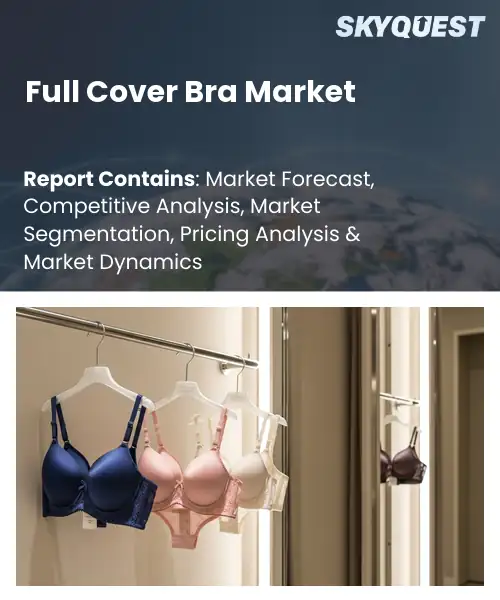
Full Cover Bra Market
Report ID: SQMIG25K2169
Report ID: SQMIG25K2169
[email protected]
USA +1 351-333-4748
Report ID:
SQMIG25K2169 |
Region:
Global |
Published Date: April, 2026
Pages:
157
|Tables:
140
|Figures:
78


Global Full Cover Bra Market size was valued at USD 15.0 Billion in 2024 and is poised to grow from USD 15.67 Billion in 2025 to USD 22.29 Billion by 2033, growing at a CAGR of 4.5% during the forecast period (2026-2033).
The primary driver of the full cover bra market is shifting consumer preference toward comfort, support and modesty, which has pushed brands to expand design, sizing and material options. Defined as bras that encapsulate breast tissue for maximum coverage, this market matters because it intersects apparel, health and inclusivity, offering solutions for larger-breasted, post-surgical and conservative consumers. Historically the category evolved from utilitarian foundation garments to fashion-forward, engineered pieces as advances in textile technology, underwire design and inclusive marketing emerged; for example specialty offerings from lingerie houses and mass-market retailers demonstrate parallel development, with premium niche labels introducing adaptive features.Building on that evolution, a pivotal factor driving global growth is technological integration in product development and distribution, which creates measurable opportunities across channels. When brands adopt stretch-engineered fabrics, molded cups and adjustable support, they can serve diverse anatomies, reducing returns and increasing loyalty as seen with custom-fit services and virtual sizing tools used by major retailers. Similarly, integrating prosthetic pockets and soft seams in post-mastectomy lines improves patient recovery outcomes and expands clinical partnerships. As sustainability standards prompt recycled fibers and transparent supply chains, price-premium consumers reward responsible brands, enabling market expansion into emerging economies and specialty retail segments.
How is AI improving sizing accuracy in the full cover bra market?
AI is improving sizing accuracy in the full cover bra market by turning fit into measured shape data and adaptive recommendations. Computer vision and smartphone based 3D scanning capture torso geometry and breast shape so size suggestions reflect true body contours. Machine learning then links those shapes to cup construction and band behavior so full coverage styles fit without gaping or digging. Personalization engines learn fit preferences and reduce guesswork for shoppers. With retailers prioritizing inclusive ranges and fewer returns, these tools help brands boost shopper confidence while streamlining inventory and design for fuller coverage needs.Brarista June 2025, introduced Brarista 2.0 AI bra fitting technology that applies fitter trained models to recommend precise sizes and cup shapes. This deployment reduces size uncertainty and returns while speeding purchase decisions, supporting growth and greater efficiency in full coverage lines.
Market snapshot - (2026-2033)
Global Market Size
USD 15.0 Billion
Largest Segment
Underwire Full Cover
Fastest Growth
Non-Underwire Full Cover
Growth Rate
4.5% CAGR
To get more insights on this market click here to Request a Free Sample Report
Global full cover bra market is segmented by product type, material, size range, end user, sales channel and region. Based on product type, the market is segmented into Underwire Full Cover and Non-Underwire Full Cover. Based on material, the market is segmented into Cotton Blend, Synthetic Blend and Lace. Based on size range, the market is segmented into Small to Medium and Large to Plus Size. Based on end user, the market is segmented into Teenagers and Adults. Based on sales channel, the market is segmented into Online Retail and Brick-and-Mortar. Based on region, the market is segmented into North America, Europe, Asia Pacific, Latin America and Middle East & Africa.
Underwire Full Cover segment dominates because consumers prioritize structured support and shaping in full coverage styles, prompting brands to concentrate product development and merchandising around wired constructions. Retailers favor wired options for clear fit standards and return predictability, while designers exploit underwire compatibility with advanced cup technologies and multi way fittings, reinforcing distribution, marketing focus and perceived value. This cause and effect chain sustains underwire prominence across pricing tiers and retailer assortments.
However, Non-Underwire Full Cover is the fastest growing area as comfort first preferences and advances in supportive bands and molded fabrics reduce dependence on wires. Rising athleisure influence and demand for everyday comfort propel adoption, prompting brands to increase wire free offerings and drive new product development and market expansion.
Lace segment dominates because its aesthetic versatility and perceived premium appeal drive assortment prioritization among fashion forward and premium brands in the full cover bra market. Visual design attributes enable seasonal collections and influencer led campaigns, while craftsmanship and trim techniques justify higher price positioning and retail focus. This dynamic encourages retailers and brands to allocate marketing spend and develop capsule ranges around lace, reinforcing demand and stylistic leadership across product lines.
Meanwhile, Cotton Blend is the fastest growing material as comfort and breathability become primary drivers for everyday wear. Improved stretch, durability and sustainable cotton offerings increase appeal across online and store channels, encouraging brands to expand core ranges, reinforce value positioning and drive steady repeat purchase behavior.
To get detailed segments analysis, Request a Free Sample Report
Asia Pacific dominates the global full cover bra market due to a blend of entrenched cultural preferences for modest, functional lingerie and a mature textile and apparel ecosystem that supports large scale production and rapid product iteration. Consumers across diverse markets prioritize comfort, fit, and fabric quality, encouraging brands to expand inclusive size ranges and elevated basic categories. Local manufacturers and private labels benefit from integrated supply chains, proximity to raw material sources, and well developed export channels, enabling competitive pricing and variety. Digital retail platforms and omnichannel strategies accelerate reach into both metropolitan and regional communities, while collaborations between designers and technology providers spur fabric innovation and improved fit solutions. Combined market depth and operational efficiency sustain the region as the market leader.
Full Cover Bra Market in Japan emphasizes fit precision, premium fabrics, and understated aesthetic, prompting brands to prioritize technical construction and seamless finishes. Retailers combine curated boutique experiences with efficient omnichannel services to serve discerning shoppers. Domestic and international labels work with local fit specialists and textile innovators to refine sizes and materials. This culture supports high product quality, enduring brand loyalty, and mature distribution across urban and regional outlets.
Full Cover Bra Market in South Korea reflects a fusion of fashion awareness and technology adoption, with consumers favoring coverage combined with contemporary silhouettes. Brands invest in innovative fabrics, seamless engineering, and fit customization to differentiate offerings. Online communities and influencer channels amplify discovery, while domestic manufacturers enable rapid sampling and scale. The market emphasizes design collaboration, rigorous quality standards, and adaptive retail models across varied sales channels and regions.
Europe is experiencing rapid expansion in the full cover bra market driven by shifting consumer priorities toward comfort, inclusivity, and sustainable sourcing, combined with strong retail sophistication. Established brands and emerging independents are positioning offerings that meet a wider range of body types while emphasizing responsible materials and transparent supply chains. Retailers are refining fit services and in store experiences, and online platforms provide personalized recommendations and greater convenience. Cross border collaborations among designers, textile specialists, and fit technologists accelerate innovation. Diverse national markets allow localized product strategies while pan regional brand building and regulatory alignment around product safety and labeling facilitate market access and consumer trust. These dynamics collectively push the market toward broader adoption and premiumization across Europe.
Full Cover Bra Market in Germany emphasizes high quality construction, precise fit standards, and durable fabrics, with established domestic brands and skilled manufacturers leading supply. Retailers offer technical fitting services and curated assortments to pragmatic consumers who value longevity and comfort. Commitment to local production, sustainable material sourcing, and professional fit education underpins a mature premium segment. The market prefers innovation and technical refinement across established retail and digital channels.
Full Cover Bra Market in United Kingdom is marked by strong consumer interest in inclusive sizing, comfort oriented design, and accessible premium offerings, prompting retailers to expand personal fit services, omnichannel experiences. Emerging brands introduce collections that connect with varied lifestyle segments, amplified by social influence and digital merchandising. Agile supply chains and retail partnerships support assortment updates. The market rewards targeted marketing, precise fit guidance and purchase support overall.
Full Cover Bra Market in France is emerging with emphasis on design led modesty, artisanal craftsmanship, and sustainable practices that attract style conscious consumers seeking coverage and elegance. Boutiques and niche labels promote refined silhouettes and premium materials, while collaborations between designers and manufacturers yield distinctive assortments. Improved fit education and curated retail experiences encourage trial among discerning shoppers. This environment nurtures premiumization, differentiation and growth of local specialist brands.
North America is strengthening its position in the full cover bra market through a combination of product innovation, expanded inclusivity, and enhanced retail experiences that prioritize fit and comfort. Brands place renewed emphasis on wider size ranges, customizable supports, and fabric technologies that balance coverage with breathability. Retailers are investing in fit consultations, fitting rooms optimized for modest styles, and integrated online tools for size discovery. Collaboration between intimate apparel designers and performance textile suppliers accelerates functional improvements. Marketing shifts toward body positive narratives and lifestyle segmentation broaden appeal across consumer cohorts. Robust direct to consumer channels and partnerships with specialty retailers enable rapid product iteration and targeted assortment strategies. These initiatives collectively elevate market relevance and consumer engagement across the region.
Full Cover Bra Market in United States blends legacy intimates brands with agile direct to consumer entrants, driving innovation in fit, support, and inclusive sizing. Retailers expand personalized fit services and online tools to guide selection, while curated assortments address diverse lifestyle needs. Partnerships with textile innovators advance breathable, supportive fabrics. Marketing centers on body positive messaging and elegance, and omnichannel distribution and specialty retail strengthen product discovery and relationships.
Full Cover Bra Market in Canada shows increasing demand for comfortable, well fitting lingerie that balances coverage with contemporary aesthetics, supported by specialty retailers and digital channels. Brands emphasize ethical sourcing and adaptable sizing to meet diverse consumer preferences, and collaborations with local manufacturers enable tailored assortments. Retailers prioritize fit consultations and community engagement to build trust. The market favors transparent practices, quality craftsmanship, and responsive product development and markets.
To know more about the market opportunities by region and country, click here to
Buy The Complete Report
Rising Demand For Comfort
Innovation In Fabric Technology
High Production Material Costs
Limited Awareness In Emerging Markets
Request Free Customization of this report to help us to meet your business objectives.
Competitive dynamics in the global full coverage bra market are shaped by consolidation, wholesale partnerships, and fit technology. Examples include acquisitive moves by intimates groups acquiring digital challengers, wholesale rollouts and flagship store openings by digitally native labels, and proprietary online fit tools used to differentiate offerings. These concrete strategies are accelerating product diversification and channel competition.
Top Player’s Company Profile
Recent Developments
SkyQuest’s ABIRAW (Advanced Business Intelligence, Research & Analysis Wing) is our Business Information Services team that Collects, Collates, Correlates, and Analyses the Data collected by means of Primary Exploratory Research backed by robust Secondary Desk research. As per SkyQuest analysis, the global full cover bra market is propelled by rising demand for comfort and support as a key driver, while high production material costs act as a significant restraint. Asia Pacific remains the dominating region thanks to established textile ecosystems and strong consumer preference for modest, functional lingerie, and the underwire full cover segment is the dominating product segment driven by consumer need for structured shaping. A second driver is technological integration, including AI-driven sizing and advanced fabric innovations that improve fit and personalization, enabling brands to expand inclusive ranges, reduce returns and support premiumization across channels.
| Report Metric | Details |
|---|---|
| Market size value in 2024 | USD 15.0 Billion |
| Market size value in 2033 | USD 22.29 Billion |
| Growth Rate | 4.5% |
| Base year | 2024 |
| Forecast period | (2026-2033) |
| Forecast Unit (Value) | USD Billion |
| Segments covered |
|
| Regions covered | North America (US, Canada), Europe (Germany, France, United Kingdom, Italy, Spain, Rest of Europe), Asia Pacific (China, India, Japan, Rest of Asia-Pacific), Latin America (Brazil, Rest of Latin America), Middle East & Africa (South Africa, GCC Countries, Rest of MEA) |
| Companies covered |
|
| Customization scope | Free report customization with purchase. Customization includes:-
|
To get a free trial access to our platform which is a one stop solution for all your data requirements for quicker decision making. This platform allows you to compare markets, competitors who are prominent in the market, and mega trends that are influencing the dynamics in the market. Also, get access to detailed SkyQuest exclusive matrix.
Table Of Content
Executive Summary
Market overview
Parent Market Analysis
Market overview
Market size
KEY MARKET INSIGHTS
COVID IMPACT
MARKET DYNAMICS & OUTLOOK
Market Size by Region
KEY COMPANY PROFILES
Methodology
For the Full Cover Bra Market, our research methodology involved a mixture of primary and secondary data sources. Key steps involved in the research process are listed below:
1. Information Procurement: This stage involved the procurement of Market data or related information via primary and secondary sources. The various secondary sources used included various company websites, annual reports, trade databases, and paid databases such as Hoover's, Bloomberg Business, Factiva, and Avention. Our team did 45 primary interactions Globally which included several stakeholders such as manufacturers, customers, key opinion leaders, etc. Overall, information procurement was one of the most extensive stages in our research process.
2. Information Analysis: This step involved triangulation of data through bottom-up and top-down approaches to estimate and validate the total size and future estimate of the Full Cover Bra Market.
3. Report Formulation: The final step entailed the placement of data points in appropriate Market spaces in an attempt to deduce viable conclusions.
4. Validation & Publishing: Validation is the most important step in the process. Validation & re-validation via an intricately designed process helped us finalize data points to be used for final calculations. The final Market estimates and forecasts were then aligned and sent to our panel of industry experts for validation of data. Once the validation was done the report was sent to our Quality Assurance team to ensure adherence to style guides, consistency & design.
Analyst Support
Customization Options
With the given market data, our dedicated team of analysts can offer you the following customization options are available for the Full Cover Bra Market:
Product Analysis: Product matrix, which offers a detailed comparison of the product portfolio of companies.
Regional Analysis: Further analysis of the Full Cover Bra Market for additional countries.
Competitive Analysis: Detailed analysis and profiling of additional Market players & comparative analysis of competitive products.
Go to Market Strategy: Find the high-growth channels to invest your marketing efforts and increase your customer base.
Innovation Mapping: Identify racial solutions and innovation, connected to deep ecosystems of innovators, start-ups, academics, and strategic partners.
Category Intelligence: Customized intelligence that is relevant to their supply Markets will enable them to make smarter sourcing decisions and improve their category management.
Public Company Transcript Analysis: To improve the investment performance by generating new alpha and making better-informed decisions.
Social Media Listening: To analyze the conversations and trends happening not just around your brand, but around your industry as a whole, and use those insights to make better Marketing decisions.
REQUEST FOR SAMPLE
 REQUEST FREE CUSTOMIZATION


Want to customize this report? This report can be personalized according to your needs. Our analysts and industry experts will work directly with you to understand your requirements and provide you with customized data in a short amount of time. We offer $1000 worth of FREE customization at the time of purchase.
Feedback From Our Clients


 USA (+1) 351-333-4748

