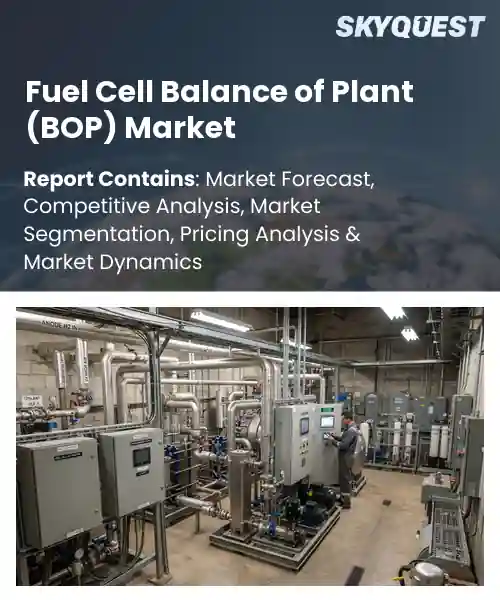
Fuel Cell Balance of Plant (BOP) Market
Report ID: SQMIG20E2256
Report ID: SQMIG20E2256
[email protected]
USA +1 351-333-4748
Report ID:
SQMIG20E2256 |
Region:
Global |
Published Date: August, 2026
Pages:
157
|Tables:
121
|Figures:
77


Global Fuel Cell Balance Of Plant (Bop) Market size was valued at USD 2.94 Billion in 2024 and is poised to grow from USD 3.42 Billion in 2025 to USD 11.36 Billion by 2033, growing at a CAGR of 16.2% during the forecast period (2026-2033).
The fuel‑cell Balance of Plant (BOP) market comprises all subsystems compressors, humidifiers, heat exchangers, power electronics, and control units that enable a stack to generate usable electricity. Its importance stems from the need to translate the stack’s electrochemical output into grid‑compatible power, a prerequisite for transport, stationary and portable applications. The primary driver today is the tightening of emissions regulations, especially in Europe and California, which compel manufacturers to replace internal‑combustion generators with clean alternatives. Historically, BOP components were niche, but the 2010s saw a surge in projects such as the Fukushima micro‑grid and the Hyundai Nexo, accelerating cost reductions and standardisation. Technology integration and economies of scale now drive the BOP market’s expansion because larger production volumes suppress unit costs while boosting reliability. As automotive OEMs mass‑produce fuel‑cell vehicles, they require homogeneous BOP kits, prompting suppliers such as Cummins and Air Liquide to consolidate components and adopt modular designs usable across bus, truck and passenger‑car platforms. This cost compression enables projects previously marginal, exemplified by the 2023 HyDeploy station in the United Kingdom, where a turnkey BOP package delivers 5 MW of power for renewable‑hydrogen blending. The resulting price advantage attracts utility developers, creating a feedback loop that accelerates investment and standardisation.
How is AI-driven automation influencing fuel cell balance-of-plant design and cost efficiency?
AI‑driven automation is reshaping fuel cell balance‑of‑plant design by introducing digital twins, generative layout tools and predictive maintenance algorithms. These technologies allow engineers to simulate thermal and fluid flows before hardware is built, reducing the need for physical prototypes and cutting material waste. At the same time, AI‑guided CNC machining and robotic assembly streamline component fabrication, lowering labor intensity and shortening build cycles. The BOP market, which is expanding as hydrogen projects scale, benefits from faster time‑to‑market and more affordable systems. Early adopters report simpler stack housings, optimized coolant routing and fewer custom parts, making overall plant cost more predictable.In June 2024, a leading fuel cell BOP supplier launched an AI‑driven design platform that automates component sizing and assembly sequencing, delivering faster project delivery and lower engineering spend, thereby reinforcing market momentum toward cost‑effective hydrogen solutions. The system also integrates real‑time performance data, enabling continuous optimization throughout the plant lifecycle.
Market snapshot - (2026-2033)
Global Market Size
USD 2.94 Billion
Largest Segment
Power Electronics
Fastest Growth
Hydrogen Supply Systems
Growth Rate
16.2% CAGR
To get more insights on this market click here to Request a Free Sample Report
Global fuel cell balance of plant (bop) market is segmented by component, fuel cell type, application, end user and region. Based on component, the market is segmented into Air Supply Systems, Thermal Management Systems, Hydrogen Supply Systems, Water Management Systems, Power Electronics and Control Systems. Based on fuel cell type, the market is segmented into PEM Fuel Cells, SOFC, PAFC and MCFC. Based on application, the market is segmented into Transportation, Stationary Power and Portable Power. Based on end user, the market is segmented into Automotive, Power Generation and Industrial. Based on region, the market is segmented into North America, Europe, Asia Pacific, Latin America and Middle East & Africa.
Power Electronics segment leads because it integrates converters, inverters, and DC DC modules that manage voltage and current flow across the fuel cell stack, ensuring efficient energy extraction and grid compatibility. Its central role in optimizing power quality and enabling rapid response to load variations makes it indispensable, driving widespread adoption in BOP designs. The reliability and modularity of power electronics also simplify system integration, reinforcing its leadership.
However, control systems segment emerging as the key high growth area because advanced algorithms and real time monitoring enable precise management of fuel cell dynamics, enhancing safety and efficiency. The integration of AI driven diagnostics and predictive maintenance reduces downtime, attracting new adopters across diverse applications and accelerating overall market expansion.
PEM Fuel Cells segment dominates because its low operating temperature and rapid start up characteristics align perfectly with BOP requirements for compact responsive power solutions. The membrane technology delivers high power density while simplifying thermal management, enabling streamlined system designs that reduce overall footprint. Its compatibility with existing hydrogen infrastructure and proven reliability in transportation and stationary applications further solidifies its preeminence in the market.
Meanwhile, SOFC segment is witnessing the strongest growth momentum because its high temperature delivers high electrical efficiency and enables cogeneration, attracting industrial and large scale power users. Material breakthroughs are lowering degradation, and rising interest in combined heat power systems fuels demand, positioning SOFC as a catalyst for broader BOP expansion.
To get detailed segments analysis, Request a Free Sample Report
The region benefits from a mature industrial ecosystem that couples deep expertise in fuel cell technology with extensive manufacturing capabilities. Strong governmental policies encourage clean‑energy adoption and provide incentives for hydrogen infrastructure, while leading corporations invest heavily in research and development. Collaborative networks between universities, research institutes, and industry accelerate innovation cycles, allowing rapid prototyping and scaling of BOP components. A well‑established supply chain ensures reliable access to high‑quality materials and precision engineering services. Moreover, the proximity to major automotive and power generation markets drives demand for integrated solutions, reinforcing the region’s position as a hub for both technology advancement and commercial deployment.
Fuel Cell Balance of Plant (BOP) Market in Japan is shaped by a long history of hydrogen research and a robust industrial base that excels in precision manufacturing. National strategies prioritize hydrogen as a cornerstone of energy transition, fostering partnerships between automotive leaders and specialized component suppliers. The country’s emphasis on quality standards and reliability supports export‑oriented production, while domestic pilot projects showcase the integration of BOP systems in transport and stationary power applications.
Fuel Cell Balance of Plant (BOP) Market in South Korea is driven by aggressive government initiatives that promote hydrogen as a strategic energy vector. The nation’s strong electronics and heavy‑industry sectors provide a foundation for advanced component design and mass production. Collaborative platforms linking research universities with leading conglomerates accelerate technology transfer, while a focus on export markets expands the global footprint of Korean BOP solutions. Domestic demonstration projects reinforce confidence in system performance and reliability.
Europe’s expansion is propelled by a cohesive policy framework that aligns climate objectives with substantial funding for hydrogen projects. Strong emphasis on decarbonizing transport, industry, and power generation creates a fertile market for BOP solutions. Collaborative research programs across borders foster innovation, while established engineering expertise ensures high‑quality component manufacturing. The region’s commitment to standardization and safety enhances market confidence, encouraging adoption across diverse sectors. Additionally, strategic partnerships between energy utilities, automotive manufacturers, and technology providers accelerate deployment of integrated fuel cell systems, positioning Europe as a leading arena for sustainable energy infrastructure.
Fuel Cell Balance of Plant (BOP) Market in Germany benefits from a deep engineering tradition and a strong industrial base that excels in precision tooling and system integration. National energy strategies prioritize hydrogen as a key pillar of the transition, fostering collaborations between automotive giants, equipment manufacturers, and research institutes. Robust standards and certification processes ensure reliability, while pilot installations in transport and industrial settings demonstrate the scalability of German BOP solutions.
Fuel Cell Balance of Plant (BOP) Market in the United Kingdom is characterized by rapid growth fueled by ambitious decarbonization targets and substantial public‑private investment. A vibrant ecosystem of startups, research universities, and established engineering firms drives innovation in modular BOP designs. Policy incentives encourage deployment in maritime, rail, and stationary power applications, while collaborative testbeds accelerate technology validation and market acceptance.
Fuel Cell Balance of Plant (BOP) Market in France is emerging through focused government programs that support hydrogen clusters and industrial pilots. The country leverages its strong chemical and aerospace sectors to develop high‑performance components and system integration expertise. Collaborative initiatives between research institutions and industry aim to create scalable BOP solutions for transport, renewable energy storage, and distributed power generation, positioning France as an emerging hub for hydrogen technology.
North America advances its role through a combination of robust private investment, strategic policy support, and a diversified industrial landscape. Strong emphasis on clean‑energy transition across multiple states and provinces drives demand for BOP solutions in transportation, utilities, and heavy industry. The region’s deep talent pool and leading research universities foster continuous innovation, while established manufacturing capabilities ensure high‑quality production at scale. Collaborative ecosystems linking technology firms, energy providers, and end‑users accelerate commercialization, reinforcing North America’s growing influence in the global fuel cell arena.
Fuel Cell Balance of Plant (BOP) Market in the United States is propelled by a dynamic mix of federal incentives, state‑level clean‑energy mandates, and a vibrant venture capital environment. Leading automotive and energy companies partner with specialized component manufacturers to develop integrated BOP solutions for a range of applications, from heavy‑duty trucks to stationary power. Strong research institutions and a culture of rapid prototyping support continuous improvement and market expansion.
Fuel Cell Balance of Plant (BOP) Market in Canada benefits from abundant natural resources and a national focus on low‑carbon technologies. Collaborative initiatives between provincial governments, research centers, and industry players drive the development of BOP components suited for cold‑climate operations and remote power generation. Strategic investments in hydrogen hubs and transportation pilots enhance the visibility and adoption of Canadian BOP expertise on the international stage.
To know more about the market opportunities by region and country, click here to
Buy The Complete Report
Increasing Renewable Energy Adoption
Advancements In Hydrogen Storage Technology
High Initial Capital Expenditure
Regulatory Uncertainty Across Regions
Request Free Customization of this report to help us to meet your business objectives.
The competitive landscape of the global fuel cell balance‑of‑plant market is shaped by intense rivalry between established manufacturers such as FuelCell Energy and fast‑growing APAC players that are scaling air, hydrogen and thermal system capacities to capture emerging demand. Market pressure is driving strategic moves including technology upgrades by FuelCell Energy, regional expansion plans in Asia, and seed‑fund financing for new entrants that accelerates product development and market entry.
Top Player’s Company Profile
Recent Developments
SkyQuest’s ABIRAW (Advanced Business Intelligence, Research & Analysis Wing) is our Business Information Services team that Collects, Collates, Correlates, and Analyses the Data collected by means of Primary Exploratory Research backed by robust Secondary Desk research. As per SkyQuest analysis, the global fuel‑cell balance‑of‑plant market is being propelled primarily by the surge in renewable‑energy adoption, which pushes manufacturers to create BOP components that integrate smoothly with solar and wind projects, while a second strong catalyst comes from recent breakthroughs in hydrogen‑storage technology that make systems more compact and reliable. The power‑electronics segment leads the market because its converters and inverters are essential for efficient energy extraction and grid compatibility. Asia Pacific dominates the landscape thanks to its mature industrial ecosystem and supportive policies, yet the high initial capital expenditure required for BOP installations remains a notable restraint that could slow broader uptake.
| Report Metric | Details |
|---|---|
| Market size value in 2024 | USD 2.94 Billion |
| Market size value in 2033 | USD 11.36 Billion |
| Growth Rate | 16.2% |
| Base year | 2024 |
| Forecast period | (2026-2033) |
| Forecast Unit (Value) | USD Billion |
| Segments covered |
|
| Regions covered | North America (US, Canada), Europe (Germany, France, United Kingdom, Italy, Spain, Rest of Europe), Asia Pacific (China, India, Japan, Rest of Asia-Pacific), Latin America (Brazil, Rest of Latin America), Middle East & Africa (South Africa, GCC Countries, Rest of MEA) |
| Companies covered |
|
| Customization scope | Free report customization with purchase. Customization includes:-
|
To get a free trial access to our platform which is a one stop solution for all your data requirements for quicker decision making. This platform allows you to compare markets, competitors who are prominent in the market, and mega trends that are influencing the dynamics in the market. Also, get access to detailed SkyQuest exclusive matrix.
Table Of Content
Executive Summary
Market overview
Parent Market Analysis
Market overview
Market size
KEY MARKET INSIGHTS
COVID IMPACT
MARKET DYNAMICS & OUTLOOK
Market Size by Region
KEY COMPANY PROFILES
Methodology
For the Fuel Cell Balance of Plant (BOP) Market, our research methodology involved a mixture of primary and secondary data sources. Key steps involved in the research process are listed below:
1. Information Procurement: This stage involved the procurement of Market data or related information via primary and secondary sources. The various secondary sources used included various company websites, annual reports, trade databases, and paid databases such as Hoover's, Bloomberg Business, Factiva, and Avention. Our team did 45 primary interactions Globally which included several stakeholders such as manufacturers, customers, key opinion leaders, etc. Overall, information procurement was one of the most extensive stages in our research process.
2. Information Analysis: This step involved triangulation of data through bottom-up and top-down approaches to estimate and validate the total size and future estimate of the Fuel Cell Balance of Plant (BOP) Market.
3. Report Formulation: The final step entailed the placement of data points in appropriate Market spaces in an attempt to deduce viable conclusions.
4. Validation & Publishing: Validation is the most important step in the process. Validation & re-validation via an intricately designed process helped us finalize data points to be used for final calculations. The final Market estimates and forecasts were then aligned and sent to our panel of industry experts for validation of data. Once the validation was done the report was sent to our Quality Assurance team to ensure adherence to style guides, consistency & design.
Analyst Support
Customization Options
With the given market data, our dedicated team of analysts can offer you the following customization options are available for the Fuel Cell Balance of Plant (BOP) Market:
Product Analysis: Product matrix, which offers a detailed comparison of the product portfolio of companies.
Regional Analysis: Further analysis of the Fuel Cell Balance of Plant (BOP) Market for additional countries.
Competitive Analysis: Detailed analysis and profiling of additional Market players & comparative analysis of competitive products.
Go to Market Strategy: Find the high-growth channels to invest your marketing efforts and increase your customer base.
Innovation Mapping: Identify racial solutions and innovation, connected to deep ecosystems of innovators, start-ups, academics, and strategic partners.
Category Intelligence: Customized intelligence that is relevant to their supply Markets will enable them to make smarter sourcing decisions and improve their category management.
Public Company Transcript Analysis: To improve the investment performance by generating new alpha and making better-informed decisions.
Social Media Listening: To analyze the conversations and trends happening not just around your brand, but around your industry as a whole, and use those insights to make better Marketing decisions.
REQUEST FOR SAMPLE
 REQUEST FREE CUSTOMIZATION


Want to customize this report? This report can be personalized according to your needs. Our analysts and industry experts will work directly with you to understand your requirements and provide you with customized data in a short amount of time. We offer $1000 worth of FREE customization at the time of purchase.
Feedback From Our Clients


 USA (+1) 351-333-4748

