Fruit Beer Market
Report ID: SQMIG30E2062
Report ID: SQMIG30E2062
[email protected]
USA +1 351-333-4748
Report ID:
SQMIG30E2062 |
Region:
Global |
Published Date: March, 2025
Pages:
197
|Tables:
64
|Figures:
69


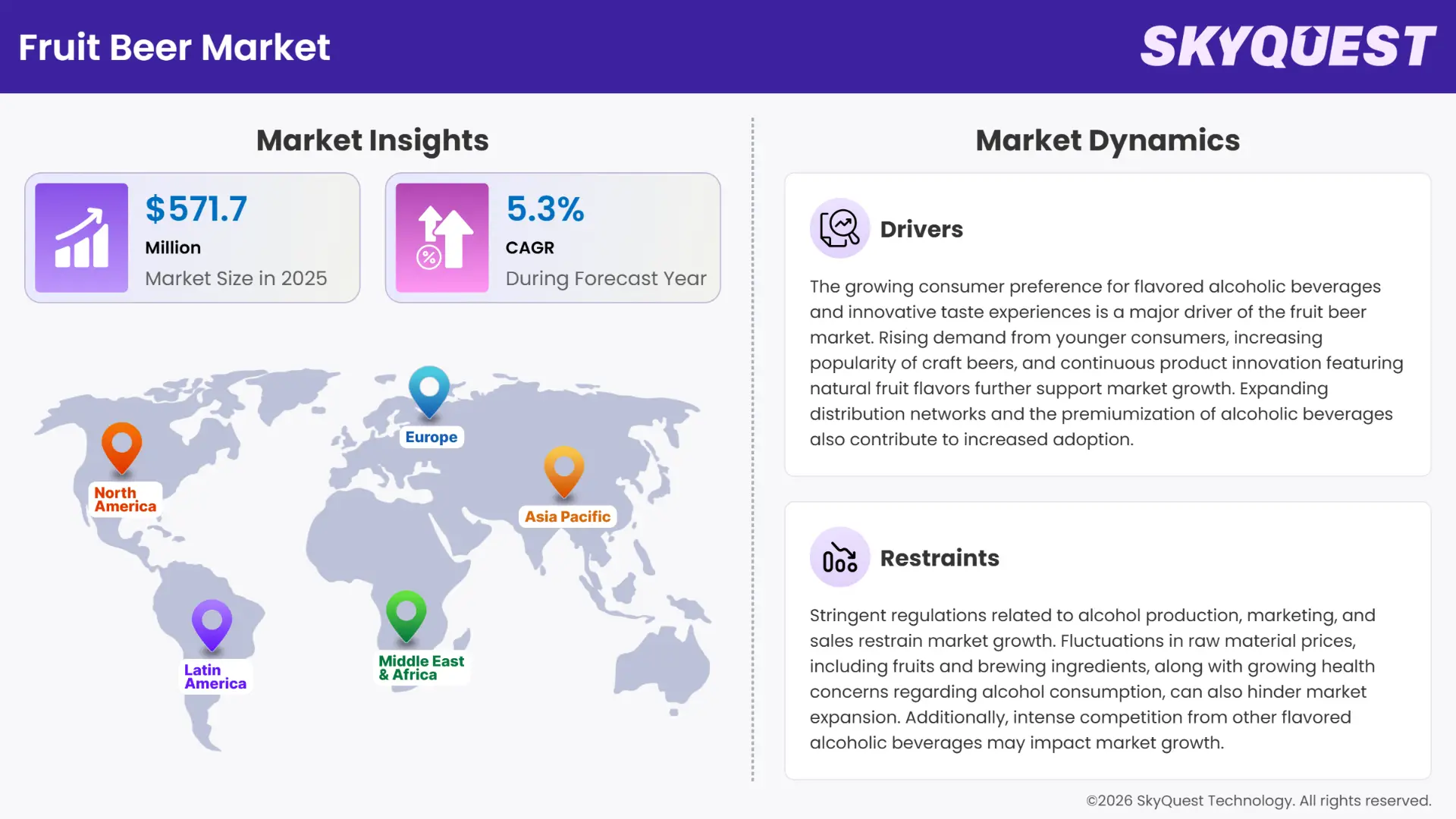
Fruit Beer Market size was valued at USD 542.93 Million in 2024 and is poised to grow from USD 571.7 Million in 2025 to USD 864.16 Million by 2033, growing at a CAGR of 5.3% during the forecast period (2026–2033).
Key Takeaways: Market Trends & Insights
Rapidly evolving consumer preferences, high demand for healthier beverages, expansion of craft breweries around the world, use of innovative marketing and branding, and growing disposable income of people are estimated to favor the consumption of fruit beer in the future.
Rapidly increasing disposable income of people around the world is forecasted to create an opportune setting for fruit beer suppliers. Rising consumer willingness to have unique drinking experiences is also expected to boost the sales of fruit beers and craft beverages on a global level. Evolving taste palates of beer enthusiasts and new consumers are also favoring the consumption of fruit beer.
Growing health consciousness and gravitation of consumers towards healthy perception food and beverages are estimated to bolster the global fruit beer market growth in the long run. The increase in the number of craft breweries around the world and their emphasis on the development of innovative beer flavors, including fruit-infused variants, are also expected to offer new opportunities for market players going forward. The festive and seasonal appeal of fruit beer is also expected to boost its consumption at times of the year.
Rising investments in the development of highly creative and attractive marketing and branding strategies by fruit beer companies are also helping them enhance their sales and revenue generation potential. Eye-catching packaging, limited-edition releases, and partnerships with local fruit producers are some preferred strategies that help boost fruit beer sales. However, competition from alternative beverages, ingredient sourcing issues, seasonal demand fluctuations, consumer health concerns, and high production costs are anticipated to impede the demand for fruit beer across the forecast period and beyond.
Key Market Attributes
Launching new beers with unique flavors is the prime focus of almost all market players. Collaborating with established craft breweries and developing limited edition and exclusive beers can also help boost sales of fruit beer in the long run. Entering new markets and bolstering our share in current markets should also be a priority as competition in the fruit beer business increases rapidly.
To get more insights on this market click here to Request a Free Sample Report
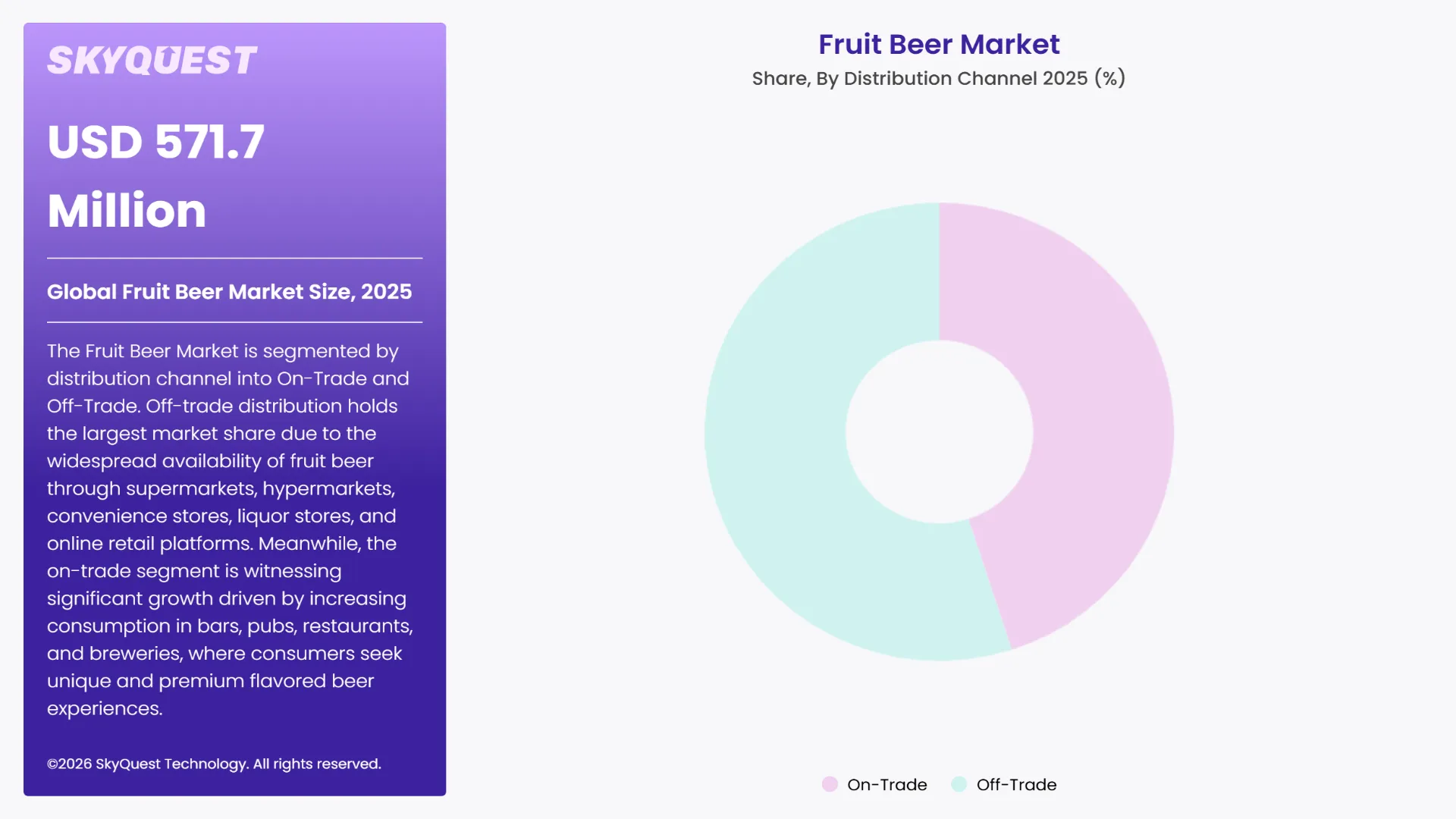
Global Fruit Beer Market is segmented by Flavor, Packaging, Alcohol Content, Distribution Channel and region. Based on Flavor, the market is segmented into Peach, Raspberry, Cherry, Apricot and Others. Based on Packaging, the market is segmented into Bottles, Cans and Others. Based on Alcohol Content, the market is segmented into Low Alcohol and Non-Alcoholic. Based on Distribution Channel, the market is segmented into On-Trade and Off-Trade. Based on region, the market is segmented into North America, Europe, Asia Pacific, Latin America and Middle East & Africa.
The raspberry segment is forecasted to bring in the most revenue for fruit beer suppliers over the coming years. Sweet, succulent taste with hints of tartness and rose notes offered by raspberry makes it a perfect combination of flavor with beer and other alcoholic beverages thereby cementing the dominance of this segment. The presence of essential nutrients such as vitamins, minerals, and antioxidants in raspberries also allows fruit beer companies to make their products healthier and attract health-conscious consumers as well. Excellent pairing of raspberry fruit beer with a wide variety of meal choices ranging from grilled meats to desserts is also expected to bolster its high global fruit beer market share through 2032.
Meanwhile, the sales of cherry flavored fruit beer are anticipated to rise at an impressive CAGR over the coming years. Rich Belgian heritage of cherry beers style popularly known as Kriek is helping this segment generate new opportunities for market players. High versatility of flavor profiles from extremely tart to sweet can be obtained by using different types of cherries thereby allowing fruit beer companies to cater to different taste profiles and preferences. Cherry beers are projected to be highly popular among women owing to its rich and tart sweetness. Casual and health-conscious drinkers are more inclined to opt for cherry beers in the future.
The on-trade segment is forecasted to account for the highest global fruit beer market share through 2032. Rising popularity of social drinking around the world and unique drinking experience offered by bars and pubs are helping this segment lead the sales of fruit beer on a global level. The rising number of bars and pubs holding beer-tasting events or festivals is also expected to create new opportunities for market players focusing on this distribution channel. Moreover, on-trade venues establish relationships with their customers through interaction from educated staff regarding nuances of different fruit beers is also expected to help this segment bring in the most revenue of all going forward.
On the other hand, sales of fruit beers via off-trade channels are estimated to increase at the fastest CAGR in the long run. The growing preference of consumers to enjoy craft fruit beers from the comfort of their homes is offering new opportunities via this segment. Availability of a wide variety of fruit beer flavors for home consumption through different retail channels and e-commerce platforms are also helping generate new business scope for market players. Younger consumers such as millennials and Gen Z are more inclined to purchase fruit beer through off-trade channels in the future. High investments in retail infrastructure development are also expected to help this segment boost growth in the global fruit beer industry.
To get detailed segments analysis, Request a Free Sample Report
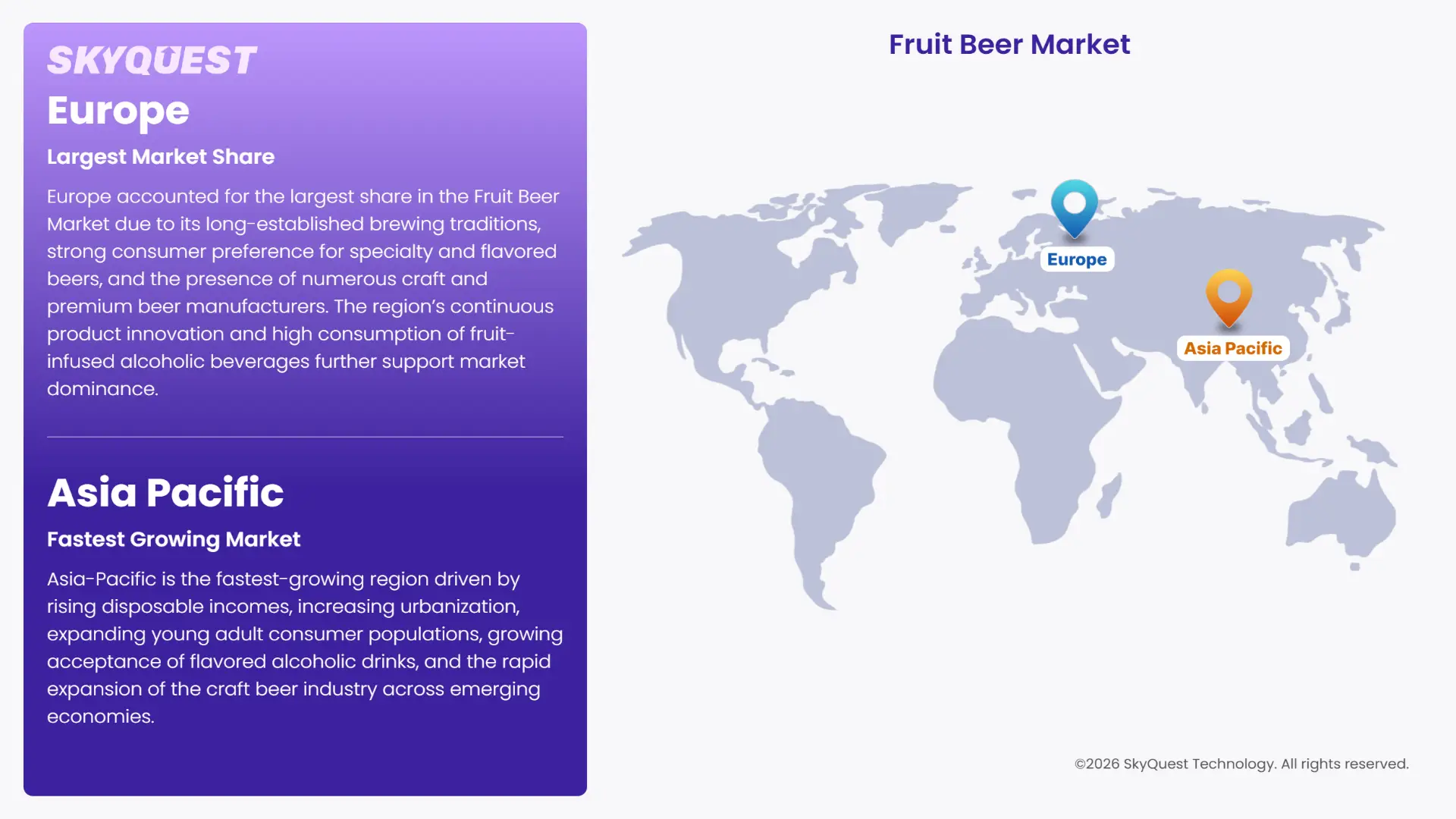
Europe is forecasted to account for a prominent chunk of the global fruit beer market share. Rich brewing heritage, rising popularity of plant-based food and beverages, and strong consumer demand for unique flavors are expected to help this region lead the consumption of fruit beer through 2032 and beyond.
Belgium is predicted to emerge as the leading country for fruit beer companies operating in the European region. Rich brewing culture, high adoption of traditional fruit-infused brewing methods, and presence of multiple breweries are helping this country cement its dominance. Demand for fruit beers in Europe is forecasted to rise at the fastest pace owing to evolving consumer preference for unique flavored beverages.
Asia Pacific is slated to emerge as the fastest expanding regional market in the world for fruit beer providers. Growing disposable income, increasing willingness of consumers to try different flavors, and rising popularity of beer and alcohol consumption are helping create new opportunities in this region.
Surge in popularity of craft beverages in China is helping it emerge as the top country in the Asia Pacific. High demand for premium beverages, increasing commercial production of beer, and evolving consumer preferences are other factors helping China bring in the most revenue.
North America is anticipated to emerge as a highly opportune market for fruit beer vendors in the long run. Rising preference for health-conscious drinking, presence of a strong alcohol and beer consumption culture, and rising availability of different fruit flavor infused beverages are offering new business scope for market players.
The United States is slated to spearhead the consumption of fruit beer in this region owing to high spending potential of consumers, growing preference for craft beer and beverages, and increasing interest of Americans in exploring new tastes and flavors. Canada is also a highly opportune market in this region.
Latin America is projected to emerge as another lucrative region for fruit beer suppliers looking to expand their presence across the global fruit beer market forecast. Favorable alcohol consumption regulations, growing popularity of craft brewing culture, increasing consumer preference for lighter beers, growing urbanization, and rising disposable income are key factors driving sales of fruit beer in this region. Brazil and Mexico are estimated to be the most opportune countries for fruit beer providers looking to boost their business in the Latin American region going forward.
To know more about the market opportunities by region and country, click here to
Buy The Complete Report
Availability of Diverse Flavors
High Consumer Preference for Flavored Beverages
Competition from Alternative Beverages
Seasonal Demand Fluctuations
Request Free Customization of this report to help us to meet your business objectives.
Fruit beer companies are focusing on launching new flavors to appease different consumers. The use of innovative packaging and marketing strategies are also expected to offer new business scope for fruit beer providers in the long run. Developing low alcohol and non-alcoholic fruit beers can also help companies stand out from the competition as per this global fruit beer market analysis.
Sustainable and Ethical Sourcing
Collaborations and Limited-Edition Releases
SkyQuest’s ABIRAW (Advanced Business Intelligence, Research & Analysis Wing) is our Business Information Services team that Collects, Collates, Correlates, and Analyses the Data collected by means of Primary Exploratory Research backed by robust Secondary Desk research.
As per SkyQuest analysis, high consumer preference for flavored beverages and availability of diverse fruit beer flavors are slated to boost the sales of fruit beer over the coming years. However, seasonal demand fluctuations and competition from alternative beverages are forecasted to impede the demand for fruit beers in the long run. Rich heritage of brewing and growing preference for plant-based food and beverages are forecasted to help Europe emerge as the top regional market for fruit beer providers. Use of ethical sourcing practices and collaborations to launch limited edition collections are projected to help create new opportunities for fruit beer suppliers.
| Report Metric | Details |
|---|---|
| Market size value in 2024 | USD 542.93 Million |
| Market size value in 2033 | USD 864.16 Million |
| Growth Rate | 5.3% |
| Base year | 2024 |
| Forecast period | 2026–2033 |
| Forecast Unit (Value) | USD Million |
| Segments covered |
|
| Regions covered | North America (US, Canada), Europe (Germany, France, United Kingdom, Italy, Spain, Rest of Europe), Asia Pacific (China, India, Japan, Rest of Asia-Pacific), Latin America (Brazil, Rest of Latin America), Middle East & Africa (South Africa, GCC Countries, Rest of MEA) |
| Companies covered |
|
| Customization scope | Free report customization with purchase. Customization includes:-
|
To get a free trial access to our platform which is a one stop solution for all your data requirements for quicker decision making. This platform allows you to compare markets, competitors who are prominent in the market, and mega trends that are influencing the dynamics in the market. Also, get access to detailed SkyQuest exclusive matrix.
Table Of Content
Executive Summary
Market overview
Parent Market Analysis
Market overview
Market size
KEY MARKET INSIGHTS
COVID IMPACT
MARKET DYNAMICS & OUTLOOK
Market Size by Region
KEY COMPANY PROFILES
Methodology
For the Fruit Beer Market, our research methodology involved a mixture of primary and secondary data sources. Key steps involved in the research process are listed below:
1. Information Procurement: This stage involved the procurement of Market data or related information via primary and secondary sources. The various secondary sources used included various company websites, annual reports, trade databases, and paid databases such as Hoover's, Bloomberg Business, Factiva, and Avention. Our team did 45 primary interactions Globally which included several stakeholders such as manufacturers, customers, key opinion leaders, etc. Overall, information procurement was one of the most extensive stages in our research process.
2. Information Analysis: This step involved triangulation of data through bottom-up and top-down approaches to estimate and validate the total size and future estimate of the Fruit Beer Market.
3. Report Formulation: The final step entailed the placement of data points in appropriate Market spaces in an attempt to deduce viable conclusions.
4. Validation & Publishing: Validation is the most important step in the process. Validation & re-validation via an intricately designed process helped us finalize data points to be used for final calculations. The final Market estimates and forecasts were then aligned and sent to our panel of industry experts for validation of data. Once the validation was done the report was sent to our Quality Assurance team to ensure adherence to style guides, consistency & design.
Analyst Support
Customization Options
With the given market data, our dedicated team of analysts can offer you the following customization options are available for the Fruit Beer Market:
Product Analysis: Product matrix, which offers a detailed comparison of the product portfolio of companies.
Regional Analysis: Further analysis of the Fruit Beer Market for additional countries.
Competitive Analysis: Detailed analysis and profiling of additional Market players & comparative analysis of competitive products.
Go to Market Strategy: Find the high-growth channels to invest your marketing efforts and increase your customer base.
Innovation Mapping: Identify racial solutions and innovation, connected to deep ecosystems of innovators, start-ups, academics, and strategic partners.
Category Intelligence: Customized intelligence that is relevant to their supply Markets will enable them to make smarter sourcing decisions and improve their category management.
Public Company Transcript Analysis: To improve the investment performance by generating new alpha and making better-informed decisions.
Social Media Listening: To analyze the conversations and trends happening not just around your brand, but around your industry as a whole, and use those insights to make better Marketing decisions.
REQUEST FOR SAMPLE
 REQUEST FREE CUSTOMIZATION
Fruit Beer Market size was valued at USD 542.93 Million in 2024 and is poised to grow from USD 571.7 Million in 2025 to USD 864.16 Million by 2033, growing at a CAGR of 5.3% during the forecast period (2026–2033).
Key vendors in the Fruit Beer Market include Anheuser-Busch InBev, Heineken N.V., Carlsberg Group, Molson Coors Beverage Company, Asahi Group Holdings Ltd., Lindemans Brewery, New Belgium Brewing Company, Magic Hat Brewing Company, Boon Brewery, and The Boston Beer Company. These companies offer a wide range of fruit-flavored beers and specialty brews, leveraging innovative flavors, craft brewing expertise, and expanding consumer demand for flavored alcoholic beverages.
The key driver of the Fruit Beer Market is the growing consumer preference for flavored alcoholic beverages with unique taste profiles and lower bitterness compared to traditional beers. Rising demand from younger consumers, increasing popularity of craft and specialty beers, and continuous innovation in fruit-infused flavors are significantly driving market growth globally.
The key market trend in the Fruit Beer Market is the increasing popularity of craft and premium fruit-infused beer varieties. Breweries are introducing innovative flavors using natural fruit ingredients, low-alcohol formulations, and seasonal offerings to attract health-conscious and younger consumers. Growing demand for unique drinking experiences and the expansion of flavored alcoholic beverage portfolios are further shaping market growth.
Europe accounted for the largest share in the Fruit Beer Market due to its strong brewing heritage, high consumption of specialty and craft beers, and widespread consumer acceptance of fruit-flavored alcoholic beverages. The presence of established breweries, continuous product innovation, and growing demand for premium and flavored beer varieties further support the region’s market dominance.


Want to customize this report? This report can be personalized according to your needs. Our analysts and industry experts will work directly with you to understand your requirements and provide you with customized data in a short amount of time. We offer $1000 worth of FREE customization at the time of purchase.
Feedback From Our Clients


 USA (+1) 351-333-4748

