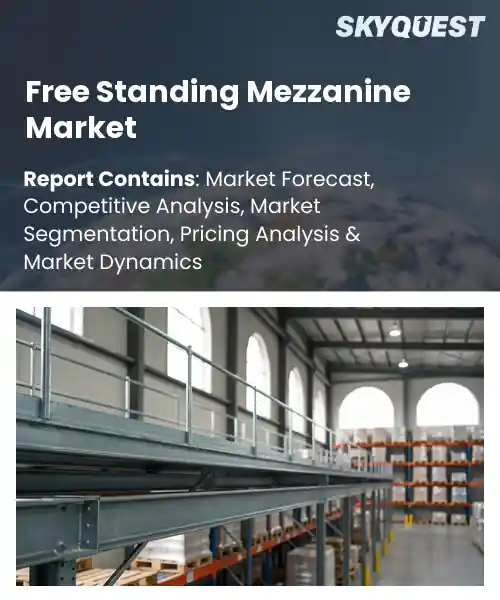
Free Standing Mezzanine Market
Report ID: SQMIG20B2295
Report ID: SQMIG20B2295
[email protected]
USA +1 351-333-4748
Report ID:
SQMIG20B2295 |
Region:
Global |
Published Date: August, 2026
Pages:
157
|Tables:
124
|Figures:
77


Global Free Standing Mezzanine Market size was valued at USD 2.18 Billion in 2024 and is poised to grow from USD 2.32 Billion in 2025 to USD 3.82 Billion by 2033, growing at a CAGR of 6.4% during the forecast period (2026-2033).
Free‑standing mezzanines are elevated platforms inside a building that function without supports, creating storage, processing or office space. Their importance lies in expanding usable area without expensive building extensions, a feature that became vital as manufacturers and distributors pursue denser layouts.
Advances in steel framing and prefabrication broadened adoption across automotive, food‑processing and pharmaceutical sectors, cementing mezzanines as a cost‑effective practical expansion solution. The dominant catalyst for the global free standing mezzanine market is the drive toward supply‑chain resilience, prompting firms to expand existing footprints instead of building new facilities. Adding a mezzanine lifts capacity instantly, speeding order fulfillment and lowering dependence on external warehousing; a European beverage producer installed a stainless‑steel mezzanine to meet seasonal spikes, cutting lead time by two days and avoiding a costly lease. This efficiency attracts logistics providers, automotive assemblers and cold‑chain operators, generating projects that use modular design, low‑carbon steel and digital integration. Consequently, adopters achieve higher throughput while preserving capital, positioning the segment for continued double‑digit growth.
How is AI-driven design automation impacting the free standing mezzanine market?
AI-driven design automation is reshaping the free‑standing mezzanine market by streamlining layout creation, structural analysis, and material optimization. Engineers now rely on generative algorithms that propose multiple configurations in minutes, reducing manual drafting time and enabling rapid iteration. The technology integrates real‑world constraints such as load capacity, floor‑to‑ceiling height, and site dimensions, producing designs that meet safety standards while maximizing usable space. As manufacturers adopt these tools, project lead times shrink and collaboration between architects, fabricators, and installers becomes more fluid. The result is a more responsive supply chain that can adapt to fluctuating demand for warehouse expansion and industrial upgrades, positioning the market for sustained growth.I do not have a specific recent development to cite at this time.
Market snapshot - (2026-2033)
Global Market Size
USD 2.18 Billion
Largest Segment
Freestanding Work Platforms
Fastest Growth
Multi-Tier Mezzanines
Growth Rate
6.4% CAGR
To get more insights on this market click here to Request a Free Sample Report
Global free standing mezzanine market is segmented by mezzanine type, material, application, end user and region. Based on mezzanine type, the market is segmented into Freestanding Work Platforms, Rack-Supported Mezzanines, Shelving-Supported Mezzanines, Multi-Tier Mezzanines and Others. Based on material, the market is segmented into Steel, Aluminum and Others. Based on application, the market is segmented into Warehousing & Distribution, Manufacturing, Retail, E-commerce, Cold Storage and Others. Based on end user, the market is segmented into Logistics & Warehousing, Manufacturing, Retail & E-commerce, Food & Beverage and Others. Based on region, the market is segmented into North America, Europe, Asia Pacific, Latin America and Middle East & Africa.
E commerce segment leads with large free standing mezzanine market share because the rapid surge in online order volumes forces fulfillment centers to maximize vertical space, making freestanding mezzanines essential for efficient inventory staging. The need for rapid order picking and flexible storage layouts drives operators to adopt adaptable platforms that can be reconfigured as catalog assortments evolve. Moreover, the pressure to shorten delivery windows incentivizes investment in mezzanines that streamline material flow and improve throughput.
As per free standing mezzanine market outlook, cold storage segment emerges as a high growth area as temperature controlled facilities need specialized mezzanines that support insulated shelving while maintaining climate parameters. Advances in modular insulation panels enable quicker deployment, and growing demand for perishable goods in online grocery channels fuels the need for scalable vertical solutions, driving market expansion and new design opportunities.
As per free standing mezzanine market forecast, aluminum segment dominates because its lightweight nature reduces floor load, allowing facilities with limited structural capacity to add vertical storage without costly reinforcements. The material’s corrosion resistance extends service life in humid environments, appealing to operators seeking durable yet easy‑to‑assemble solutions. Additionally, its compatibility with prefabricated modules accelerates deployment, meeting the fast‑track timelines of modern warehouse expansions.
However, others segment is witnessing the strongest growth momentum as manufacturers experiment with composite and hybrid materials that combine strength with reduced weight. Emerging alloy technologies improve fire ratings and environmental sustainability, opening doors for projects with strict safety or green building criteria. These innovations broaden the application scope of freestanding mezzanines, creating fresh market opportunities and encouraging broader adoption across diverse industries.
To get detailed segments analysis, Request a Free Sample Report
North America benefits from a mature engineering ecosystem that blends deep technical expertise with a strong culture of innovation. The region’s industrial landscape demands flexible vertical solutions that accommodate high‑value manufacturing and logistics operations, prompting widespread adoption of free standing mezzanines. Regulatory frameworks encourage safety and sustainability standards, while a well‑established supply chain ensures rapid delivery of modular components. Collaborative relationships between architects, engineers, and manufacturers foster customized designs that meet diverse client needs. Additionally, a proactive approach to integrating smart technologies enhances operational efficiency, reinforcing the region’s leadership position in the global arena.
As per free standing mezzanine market regional outlook, United States thrives on a blend of sophisticated design capabilities and extensive project execution experience. Broad industrial diversification drives demand for adaptable vertical space, while a strong emphasis on safety and sustainability shapes product development. Close collaboration between engineering firms and construction contractors accelerates project timelines and promotes innovative material use. Market participants leverage advanced digital tools to optimize layout and structural performance, reinforcing the United States as a hub of cutting‑edge mezzanine solutions.
As per free standing mezzanine market regional forecast, Canada reflects a focus on efficient space utilization within a climate‑responsive design context. Emphasis on modular construction methods supports rapid deployment across varied industrial sectors. Strong environmental guidelines inspire the use of sustainable materials and energy‑saving configurations. Integration of local engineering expertise with global best practices enables tailored solutions that address specific operational challenges. The Canadian market benefits from collaborative networks that prioritize safety, durability, and adaptability in mezzanine installations.
Europe’s expansion is propelled by a convergence of design ambition, regulatory encouragement, and a shift toward resilient manufacturing footprints. Companies seek flexible vertical platforms to maximize limited floor area while adhering to stringent building codes that prioritize worker safety and environmental stewardship. Cross‑border engineering collaborations stimulate knowledge transfer, fostering innovative structural approaches that suit diverse market contexts. Growing awareness of circular economy principles drives the adoption of reusable and recyclable mezzanine components. In addition, heightened focus on automation and smart factory concepts encourages integration of mezzanines as strategic nodes within advanced production ecosystems, positioning Europe as a dynamic growth arena for this segment.
Germany benefits from a tradition of engineering precision and a strong industrial base that values high‑performance vertical solutions. Emphasis on rigorous standards ensures robust safety and quality outcomes. Collaborative partnerships between research institutes and manufacturers foster continuous improvement in material efficiency and modular design. The market responds to a demand for space‑saving structures that support complex production processes, while sustainability considerations shape the selection of eco‑friendly components.
United Kingdom experiences rapid adoption driven by a push for flexible manufacturing layouts and post‑Brexit re‑tooling initiatives. The sector leverages agile design practices that enable swift adaptation to evolving business needs. Integration of digital planning tools enhances project coordination, reducing lead times. Regulatory focus on health and safety reinforces the demand for compliant mezzanine systems, while emerging interest in sustainable construction fuels the use of recyclable materials.
France is emerging as firms prioritize efficient utilization of existing footprints amid urban density pressures. Emphasis on modularity and ease of installation aligns with a growing preference for cost‑effective expansion options. Collaborative networks between architects and specialist suppliers encourage innovative configurations that meet both aesthetic and functional criteria. Environmental directives promote the selection of low‑impact materials, reinforcing France’s commitment to greener industrial practices.
Asia Pacific is advancing its role through a combination of rapid industrial modernization, heightened focus on space optimization, and increasing adoption of advanced construction methodologies. Companies across the region are embracing modular mezzanine solutions to address the need for scalable production capacity without extensive footprint enlargement. Integration of smart building technologies enhances monitoring and operational efficiency, aligning with broader digital transformation trends. Strong governmental support for infrastructure development encourages investment in flexible vertical expansions, while collaborative engineering communities drive knowledge sharing and innovation. These dynamics collectively position Asia Pacific as a burgeoning leader in the free standing mezzanine landscape.
Japan leverages a culture of precision engineering and compact facility design to maximize vertical space. Modular construction techniques enable swift deployment in densely populated industrial zones. Emphasis on high‑quality materials ensures durability and compliance with rigorous safety standards. Integration of intelligent control systems supports efficient workflow management, reflecting Japan’s broader commitment to technological excellence.
South Korea reflects a dynamic industrial environment focused on rapid scalability and technology integration. Modular designs facilitate flexible expansion for high‑mix production lines. Collaborative innovation between manufacturers and research institutions drives the adoption of lightweight yet robust structural solutions. Strong emphasis on safety and sustainability guides material selection and design approaches, reinforcing South Korea’s growing influence in the mezzanine sector.
To know more about the market opportunities by region and country, click here to
Buy The Complete Report
Increasing Urbanization Drives Demand
Advancements In Prefabrication Technologies
High Initial Capital Investment
Regulatory Compliance Complexity
Request Free Customization of this report to help us to meet your business objectives.
The global free standing mezzanine industry is shaped by intense competition among structural‑steel specialists and modular‑construction firms that are racing to capture price‑sensitive industrial and logistics projects. Recent acquisitions, such as a leading steel fabricator’s purchase of a niche mezzanine designer, and strategic partnerships linking software‑driven design platforms with traditional manufacturers, are accelerating time‑to‑market and enabling customized load‑bearing solutions that differentiate participants in this crowded space.
SkyQuest’s ABIRAW (Advanced Business Intelligence, Research & Analysis Wing) is our Business Information Services team that Collects, Collates, Correlates, and Analyses the Data collected by means of Primary Exploratory Research backed by robust Secondary Desk research.
As per SkyQuest analysis the global free standing mezzanine market growth driven primarily by increasing urbanization that pushes developers to add vertical space without costly building extensions, while a second driver comes from advancements in prefabrication technologies that cut installation time and waste. A notable restraint is the high initial capital investment required for design, engineering and material procurement, which can delay projects. North America remains the dominating region due to its mature engineering ecosystem and strong supply chain, and the freestanding work platforms segment is the leading mezzanine type, capturing the largest share of new installations. The global free standing mezzanine market growth is being driven by the growing need to maximize vertical space in warehouses, distribution centers, manufacturing facilities, and retail environments without undertaking major structural modifications.
| Report Metric | Details |
|---|---|
| Market size value in 2024 | USD 2.18 Billion |
| Market size value in 2033 | USD 3.82 Billion |
| Growth Rate | 6.4% |
| Base year | 2024 |
| Forecast period | (2026-2033) |
| Forecast Unit (Value) | USD Billion |
| Segments covered |
|
| Regions covered | North America (US, Canada), Europe (Germany, France, United Kingdom, Italy, Spain, Rest of Europe), Asia Pacific (China, India, Japan, Rest of Asia-Pacific), Latin America (Brazil, Rest of Latin America), Middle East & Africa (South Africa, GCC Countries, Rest of MEA) |
| Companies covered |
|
| Customization scope | Free report customization with purchase. Customization includes:-
|
To get a free trial access to our platform which is a one stop solution for all your data requirements for quicker decision making. This platform allows you to compare markets, competitors who are prominent in the market, and mega trends that are influencing the dynamics in the market. Also, get access to detailed SkyQuest exclusive matrix.
Table Of Content
Executive Summary
Market overview
Parent Market Analysis
Market overview
Market size
KEY MARKET INSIGHTS
COVID IMPACT
MARKET DYNAMICS & OUTLOOK
Market Size by Region
KEY COMPANY PROFILES
Methodology
For the Free Standing Mezzanine Market, our research methodology involved a mixture of primary and secondary data sources. Key steps involved in the research process are listed below:
1. Information Procurement: This stage involved the procurement of Market data or related information via primary and secondary sources. The various secondary sources used included various company websites, annual reports, trade databases, and paid databases such as Hoover's, Bloomberg Business, Factiva, and Avention. Our team did 45 primary interactions Globally which included several stakeholders such as manufacturers, customers, key opinion leaders, etc. Overall, information procurement was one of the most extensive stages in our research process.
2. Information Analysis: This step involved triangulation of data through bottom-up and top-down approaches to estimate and validate the total size and future estimate of the Free Standing Mezzanine Market.
3. Report Formulation: The final step entailed the placement of data points in appropriate Market spaces in an attempt to deduce viable conclusions.
4. Validation & Publishing: Validation is the most important step in the process. Validation & re-validation via an intricately designed process helped us finalize data points to be used for final calculations. The final Market estimates and forecasts were then aligned and sent to our panel of industry experts for validation of data. Once the validation was done the report was sent to our Quality Assurance team to ensure adherence to style guides, consistency & design.
Analyst Support
Customization Options
With the given market data, our dedicated team of analysts can offer you the following customization options are available for the Free Standing Mezzanine Market:
Product Analysis: Product matrix, which offers a detailed comparison of the product portfolio of companies.
Regional Analysis: Further analysis of the Free Standing Mezzanine Market for additional countries.
Competitive Analysis: Detailed analysis and profiling of additional Market players & comparative analysis of competitive products.
Go to Market Strategy: Find the high-growth channels to invest your marketing efforts and increase your customer base.
Innovation Mapping: Identify racial solutions and innovation, connected to deep ecosystems of innovators, start-ups, academics, and strategic partners.
Category Intelligence: Customized intelligence that is relevant to their supply Markets will enable them to make smarter sourcing decisions and improve their category management.
Public Company Transcript Analysis: To improve the investment performance by generating new alpha and making better-informed decisions.
Social Media Listening: To analyze the conversations and trends happening not just around your brand, but around your industry as a whole, and use those insights to make better Marketing decisions.
REQUEST FOR SAMPLE
 REQUEST FREE CUSTOMIZATION
Global Free Standing Mezzanine Market size was valued at USD 2.18 Billion in 2024 and is poised to grow from USD 2.32 Billion in 2025 to USD 3.82 Billion by 2033, growing at a CAGR of 6.4% during the forecast period (2026-2033).
The global free‑standing mezzanine market is shaped by intense competition among structural‑steel specialists and modular‑construction firms that are racing to capture price‑sensitive industrial and logistics projects. Recent acquisitions, such as a leading steel fabricator’s purchase of a niche mezzanine designer, and strategic partnerships linking software‑driven design platforms with traditional manufacturers, are accelerating time‑to‑market and enabling customized load‑bearing solutions that differentiate participants in this crowded space. 'SSI SCHAEFER Group', 'Kardex Group', 'Mecalux, S.A.', 'Jungheinrich AG', 'Daifuku Co., Ltd.', 'Dematic GmbH', 'MiTek Industries, Inc.', 'Constructor Group AS', 'AR Racking', 'NOEGA Systems, Inc.', 'Weland AB', 'MiTek Mezzanine Systems', 'MiTek Racking Systems', 'Penco Products, Inc.', 'Wildeck, Inc.', 'Cogan Wire and Metal Products Ltd.', 'Equipto Electronics Corporation', 'AK Material Handling Systems', 'Konstant Group', 'Avanta UK Ltd.'
The rising pace of urban development creates a persistent need for space‑saving structures, encouraging architects and developers to adopt free‑standing mezzanines as flexible floor extensions. By offering additional usable area without extensive core construction, these systems streamline project timelines and reduce disruption to existing operations. Their adaptability to varied floor layouts aligns with the push for efficient land use, making them an attractive solution for expanding commercial, retail, and institutional facilities, thereby propelling market expansion in the global construction sector.
Modular Construction Adoption Accelerates: Developers are increasingly specifying free‑standing mezzanines as modular components that can be fabricated off‑site and installed rapidly, reducing on‑site disruption and labor constraints. This approach aligns with broader preferences for flexible building footprints, allowing tenants to adapt floor plans without extensive structural modifications. Suppliers are expanding standardised panel libraries and offering design‑to‑order services, which shortens lead times and improves cost predictability. The resulting agility supports mixed‑use projects and fast‑track expansions in densely populated urban markets through collaborative stakeholder engagement globally.
Why does North America Dominate the Global Free Standing Mezzanine Market? |@12


Want to customize this report? This report can be personalized according to your needs. Our analysts and industry experts will work directly with you to understand your requirements and provide you with customized data in a short amount of time. We offer $1000 worth of FREE customization at the time of purchase.
Feedback From Our Clients


 USA (+1) 351-333-4748

