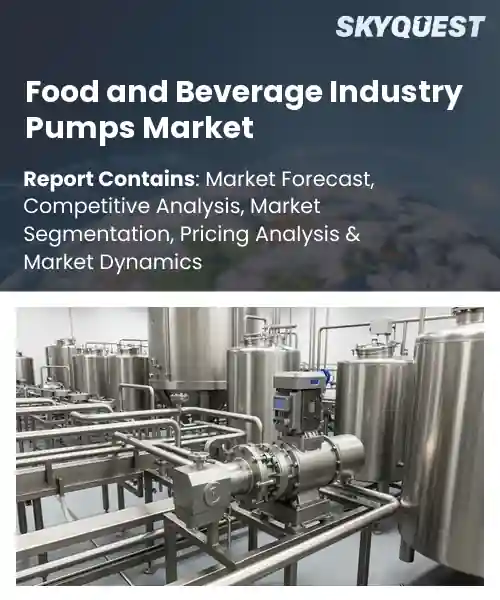
Food and Beverage Industry Pumps Market
Report ID: SQMIG20I3303
Report ID: SQMIG20I3303
[email protected]
USA +1 351-333-4748
Report ID:
SQMIG20I3303 |
Region:
Global |
Published Date: July, 2026
Pages:
157
|Tables:
174
|Figures:
79


Global Food And Beverage Industry Pumps Market size was valued at USD 2.14 Billion in 2024 and is poised to grow from USD 2.24 Billion in 2025 to USD 3.26 Billion by 2033, growing at a CAGR of 4.8% during the forecast period (2026-2033).
The food and beverage industry pumps market includes centrifugal, positive‑displacement and diaphragm pumps used to transfer liquids such as dairy, juices, beer, and sauces throughout processing plants. Its significance lies in ensuring product hygiene, maintaining flow rates, and meeting safety regulations, which directly affect product quality and operational efficiency. The primary driver of market expansion has been the rise of production lines that demand pumping solutions. Over the past decade, manufacturers have shifted from manually operated gear pumps to IoT‑enabled units that monitor pressure and temperature, reducing downtime and waste. This evolution illustrates how technological integration fuels demand for advanced pump systems.
Another pivotal factor shaping the food and beverage industry pumps market is the focus on sustainability and energy efficiency, which pushes processors to adopt efficient pumps. As governments impose stricter carbon‑emission targets, manufacturers replace centrifugal units with drives that adjust flow, cutting electricity use by up to 30 percent. This shift creates opportunities for vendors offering connected pumps that integrate with plant monitoring platforms, enabling maintenance and reducing loss. For example, a firm retrofitted its pasteurization line with diaphragm pumps, achieving a 12% reduction in bills while extending equipment life, illustrating how regulatory pressure translates into cost‑saving innovation and market growth.
How is AI-driven Automation Enhancing Performance In The Food And Beverage Industry Pumps Market?
AI driven automation is reshaping the food and beverage industry pumps market by embedding sensors, edge computing and machine learning into pump hardware. The technology enables real time monitoring of pressure, flow and temperature, allowing predictive maintenance that prevents unexpected breakdowns. It also powers adaptive speed control that matches demand, cutting energy use while preserving product quality. Operators can access dashboards that translate raw data into actionable insights, making troubleshooting faster and planning more accurate. As manufacturers seek higher hygiene standards and lower operating costs, AI driven solutions are becoming a core differentiator for pump suppliers across global production lines today.
Alfa Laval in March 2024, introduced an AI driven pump optimization platform that continuously learns from process data to fine tune flow rates and detect anomalies, boosting throughput and reducing waste while maintaining strict food safety standards. This rollout illustrates how automation accelerates efficiency and supports market growth across the industry.
Market snapshot - (2026-2033)
Global Market Size
USD 2.14 Billion
Largest Segment
Centrifugal Pumps
Fastest Growth
Peristaltic Pumps
Growth Rate
4.8% CAGR
To get more insights on this market click here to Request a Free Sample Report
Global food and beverage industry pumps market is segmented by pump type, operation mode, flow rate, application, hygiene standard, distribution channel and region. Based on pump type, the market is segmented into Centrifugal Pumps, Positive Displacement Pumps, Diaphragm Pumps, Peristaltic Pumps and Others. Based on operation mode, the market is segmented into Electric Pumps, Pneumatic Pumps and Hydraulic Pumps. Based on flow rate, the market is segmented into Low Flow Rate, Medium Flow Rate and High Flow Rate. Based on application, the market is segmented into Dairy Processing, Beverage Processing, Food Processing, Brewing & Distilling, Confectionery Processing and Others. Based on hygiene standard, the market is segmented into Hygienic Pumps and Ultra-Hygienic/Aseptic Pumps. Based on distribution channel, the market is segmented into Original Equipment Manufacturers (OEMs) and Aftermarket. Based on region, the market is segmented into North America, Europe, Asia Pacific, Latin America and Middle East & Africa.
Centrifugal pumps segment dominates because they provide simple, robust designs that efficiently handle large volumes typical of food and beverage processing lines. They can maintain a consistent flow at various pressures, resulting in less wear and tear on equipment. This aligns with manufacturers' goals for reliability and reduced total cost of ownership. They are the pump of choice for a variety of applications from bulk liquid transfer to ingredient dosing. Their versatility is inherent and that’s why they dominate the market.
The positive displacement pumps segment is experiencing the fastest growth momentum, due to their capability to provide accurate, pulseless flow that meets the increasing demand for precise dosing in high-value products like flavored syrups and dairy concentrates. Ongoing innovation in the area of sanitary sealing and compact designs is driving their use on niche process lines.
The electric pumps segment is dominating as it is integrated directly with the modern control systems that allows for the precise speed modulation that matches the energy saving strategies across the processing facilities. Their high motor efficiencies with variable frequency drives reduce power consumption with steady flow and achieve stringent sustainability goals. They cement their market leadership by aligning the projects with the goal of reducing costs and with regulatory pressure on energy use. They also improve the overall reliability of the plant.
Meanwhile, the pneumatic pumps segment is identified as a key high growth area due to their explosion-proof nature which is becoming increasingly important in places that deal with volatile flavors and alcohols. They are simple and require little maintenance. This attracts a lot of producers who want to work with a robust solution. They are adopted very fast and the market opportunities are increasing.
To get detailed segments analysis, Request a Free Sample Report
Asia Pacifc offers an integrated manufacturing ecosystem with a combination of world-class engineering skill and cost-effective manufacturing. Strong focus on research and development drives the ongoing improvement of pump technologies specifically designed to meet high-volume food processing requirements. Continued demand for reliable fluid handling solutions driven by rapid urbanisation and increasing consumer demand for processed foods. Good logistics systems and proximity to important sources of raw materials can reduce lead times and make the supply chain more resilient. The collaborative partnerships between equipment manufacturers and food processors to develop customized solutions help build the region’s reputation as a center of innovative, high-quality pump systems.
In Japan, the food and beverage industry pumps market is marked by precision engineering and a long tradition of reliability standards. Offerings from domestic manufacturers are increasingly high efficiency designs that meet strict hygiene regulations and are suitable for a broad spectrum of beverage and processed food producers. The collaboration between pump vendors and food processors continues to refine equipment for changing product formulations and sustainability objectives.
South Korea Food and Beverage Industry Pumps Market is characterized by rapid technology adoption and high export orientation. Smart manufacturing is a key focus in the country, where the company’s pump solutions include digital monitoring and predictive maintenance to enhance operational uptime for food processors. Demand for sophisticated pumping equipment is also supported by the increasing domestic consumption of processed foods and the expanding network of food‑service facilities.
The market is propelled by a focus on product safety and efficiency, prompting food processors to invest in pumps that meet high sanitary standards while reducing energy use. Regulatory frameworks encourage adoption of advanced pump technologies that minimise contamination risks. Consumer preference for convenience foods fuels scale‑up of production lines, requiring robust fluid handling systems. Strong aftermarket support and a mature supplier base provide reliable service and parts availability, sustaining confidence in equipment upgrades. Innovation in pump materials and designs aligns with sustainability initiatives, reinforcing the region’s momentum.
Food and Beverage Industry Pumps Market in the United States emphasizes high‑performance solutions that comply with rigorous food safety protocols. Industry leaders prioritize pumps with seamless clean‑in‑place capabilities, supporting large‑scale beverage and dairy operations. Integration of IoT sensors enables real‑time performance monitoring, reducing downtime and optimizing energy consumption across extensive processing facilities.
Food and Beverage Industry Pumps Market in Canada reflects a balance between advanced technology adoption and environmental stewardship. Suppliers focus on pumps that operate efficiently in colder climates and support the growing demand for plant‑based food products. Collaborative research initiatives with academic institutions drive development of low‑noise, high‑precision pumps suited to artisanal and large‑scale food manufacturers alike.
European manufacturers are leveraging a deep heritage of engineering excellence to deliver pumps that meet exacting hygiene and sustainability criteria. Emphasis on modular designs allows processors to adapt equipment to changing product lines without extensive retrofits. Regulatory alignment across the continent encourages harmonised standards, simplifying cross‑border equipment deployment. Investment in eco‑friendly materials and energy‑saving technologies responds to heightened environmental expectations from both industry and consumers. Strong collaboration between pump producers, food safety agencies, and research bodies fosters continuous innovation, ensuring Europe remains a leading source of sophisticated pumping solutions.
Food and Beverage Industry Pumps Market in Germany is distinguished by precision engineering and adherence to rigorous quality benchmarks. Manufacturers deliver high‑efficiency centrifugal and diaphragm pumps that support the extensive brewing and confectionery sectors. Focus on modular automation and seamless integration with existing production lines enhances flexibility for diverse food processing applications.
Food and Beverage Industry Pumps Market in the United Kingdom concentrates on adaptable pump solutions that comply with stringent food safety regulations. The sector benefits from a strong network of specialist suppliers offering customized pump designs for the growing specialty beverage market. Emphasis on energy efficiency aligns with national sustainability agendas.
Food and Beverage Industry Pumps Market in France leverages a tradition of culinary innovation, driving demand for pumps that handle delicate formulations in bakery and dairy segments. Suppliers prioritize sanitary designs with easy disassembly for thorough cleaning, supporting compliance with rigorous hygiene standards.
To know more about the market opportunities by region and country, click here to
Buy The Complete Report
Rising Demand for Processed Foods
Adoption Of Energy Efficient Technologies
High Capital Investment Requirements
Stringent Hygiene Certification Standards
Request Free Customization of this report to help us to meet your business objectives.
The food and beverage industry pumps market is shaped by a blend of established manufacturers and agile newcomers, with competition intensified by strategic M&A, joint ventures, and rapid tech adoption; recent examples include Alfa Laval’s acquisition of a niche beverage‑pump specialist in 2025 and Grundfos’s partnership with a major beverage packaging firm to co‑develop IoT‑enabled pump solutions, driving differentiation and market penetration.
SkyQuest’s ABIRAW (Advanced Business Intelligence, Research & Analysis Wing) is our Business Information Services team that Collects, Collates, Correlates, and Analyses the Data collected by means of Primary Exploratory Research backed by robust Secondary Desk research.
As per SkyQuest analysis, the food and beverage industry pumps market is being propelled primarily by the rising demand for processed foods which pushes manufacturers to adopt larger, more efficient pump solutions, while a second strong catalyst is the shift toward energy‑efficient and AI‑driven technologies that lower power use and improve hygiene compliance. The market faces a restraint in the form of high capital investment requirements that deter smaller processors from upgrading to advanced units. Asia Pacific dominates the landscape due to its integrated manufacturing ecosystem and rapid consumption growth, and centrifugal pumps remain the leading segment due to their robust, high‑volume handling capability across diverse processing lines.
| Report Metric | Details |
|---|---|
| Market size value in 2024 | USD 2.14 Billion |
| Market size value in 2033 | USD 3.26 Billion |
| Growth Rate | 4.8% |
| Base year | 2024 |
| Forecast period | (2026-2033) |
| Forecast Unit (Value) | USD Billion |
| Segments covered |
|
| Regions covered | North America (US, Canada), Europe (Germany, France, United Kingdom, Italy, Spain, Rest of Europe), Asia Pacific (China, India, Japan, Rest of Asia-Pacific), Latin America (Brazil, Rest of Latin America), Middle East & Africa (South Africa, GCC Countries, Rest of MEA) |
| Companies covered |
|
| Customization scope | Free report customization with purchase. Customization includes:-
|
To get a free trial access to our platform which is a one stop solution for all your data requirements for quicker decision making. This platform allows you to compare markets, competitors who are prominent in the market, and mega trends that are influencing the dynamics in the market. Also, get access to detailed SkyQuest exclusive matrix.
Table Of Content
Executive Summary
Market overview
Parent Market Analysis
Market overview
Market size
KEY MARKET INSIGHTS
COVID IMPACT
MARKET DYNAMICS & OUTLOOK
Market Size by Region
KEY COMPANY PROFILES
Methodology
For the Food and Beverage Industry Pumps Market, our research methodology involved a mixture of primary and secondary data sources. Key steps involved in the research process are listed below:
1. Information Procurement: This stage involved the procurement of Market data or related information via primary and secondary sources. The various secondary sources used included various company websites, annual reports, trade databases, and paid databases such as Hoover's, Bloomberg Business, Factiva, and Avention. Our team did 45 primary interactions Globally which included several stakeholders such as manufacturers, customers, key opinion leaders, etc. Overall, information procurement was one of the most extensive stages in our research process.
2. Information Analysis: This step involved triangulation of data through bottom-up and top-down approaches to estimate and validate the total size and future estimate of the Food and Beverage Industry Pumps Market.
3. Report Formulation: The final step entailed the placement of data points in appropriate Market spaces in an attempt to deduce viable conclusions.
4. Validation & Publishing: Validation is the most important step in the process. Validation & re-validation via an intricately designed process helped us finalize data points to be used for final calculations. The final Market estimates and forecasts were then aligned and sent to our panel of industry experts for validation of data. Once the validation was done the report was sent to our Quality Assurance team to ensure adherence to style guides, consistency & design.
Analyst Support
Customization Options
With the given market data, our dedicated team of analysts can offer you the following customization options are available for the Food and Beverage Industry Pumps Market:
Product Analysis: Product matrix, which offers a detailed comparison of the product portfolio of companies.
Regional Analysis: Further analysis of the Food and Beverage Industry Pumps Market for additional countries.
Competitive Analysis: Detailed analysis and profiling of additional Market players & comparative analysis of competitive products.
Go to Market Strategy: Find the high-growth channels to invest your marketing efforts and increase your customer base.
Innovation Mapping: Identify racial solutions and innovation, connected to deep ecosystems of innovators, start-ups, academics, and strategic partners.
Category Intelligence: Customized intelligence that is relevant to their supply Markets will enable them to make smarter sourcing decisions and improve their category management.
Public Company Transcript Analysis: To improve the investment performance by generating new alpha and making better-informed decisions.
Social Media Listening: To analyze the conversations and trends happening not just around your brand, but around your industry as a whole, and use those insights to make better Marketing decisions.
REQUEST FOR SAMPLE
 REQUEST FREE CUSTOMIZATION
Global Food And Beverage Industry Pumps Market size was valued at USD 2.14 Billion in 2024 and is poised to grow from USD 2.24 Billion in 2025 to USD 3.26 Billion by 2033, growing at a CAGR of 4.8% during the forecast period (2026-2033).
The beverage pumps market is shaped by a blend of established manufacturers and agile newcomers, with competition intensified by strategic M&A, joint ventures, and rapid tech adoption; recent examples include Alfa Laval’s acquisition of a niche beverage‑pump specialist in 2025 and Grundfos’s partnership with a major beverage packaging firm to co‑develop IoT‑enabled pump solutions, driving differentiation and market penetration. 'Alfa Laval AB', 'SPX FLOW Inc', 'Fristam Pumpen KG', 'GEA Group AG', 'Wangen Pumps', 'Pumpenfabrik Wangen GmbH', 'Grundfos Holding AS', 'Xylem Inc', 'Idex Corporation', 'Watson-Marlow Fluid Technology Group', 'Netzsch Group', 'Sulzer Ltd', 'KSB SE & Co KGaA', 'Flowserve Corporation', 'Crane Co', 'ITT Inc', 'Dover Corporation', 'Iwaki Co Ltd', 'Verder International BV', 'Unibloc Pump'
The expanding consumer preference for ready‑to‑eat and convenience foods drives manufacturers to adopt larger, more efficient pump solutions that can handle higher throughput while maintaining product integrity. This shift encourages equipment suppliers to develop advanced dosing and filling technologies, which in turn stimulates market growth as processors seek reliable pumps to meet speed, hygiene, and scalability requirements across diverse product lines, and regulatory compliance demands for traceability and sanitation, which also pushes producers to prioritize equipment that offers easy cleaning cycles and minimal downtime.
Sustainable Pump Design Adoption: The industry is rapidly embracing pumps built from recyclable materials and engineered for energy efficiency, driven by consumer demand for greener production and stricter environmental regulations. Manufacturers are integrating low‑friction impellers, variable‑speed drives, and smart control systems that minimize waste and carbon footprints. This shift not only aligns brands with sustainability narratives but also reduces operational costs, creating a competitive advantage for early adopters in a market increasingly judged on ecological performance and long‑term stakeholder value creation across supply chains.
Why does Asia Pacific Dominate the Global Food and Beverage Industry Pumps Market? |@12


Want to customize this report? This report can be personalized according to your needs. Our analysts and industry experts will work directly with you to understand your requirements and provide you with customized data in a short amount of time. We offer $1000 worth of FREE customization at the time of purchase.
Feedback From Our Clients


 USA (+1) 351-333-4748

