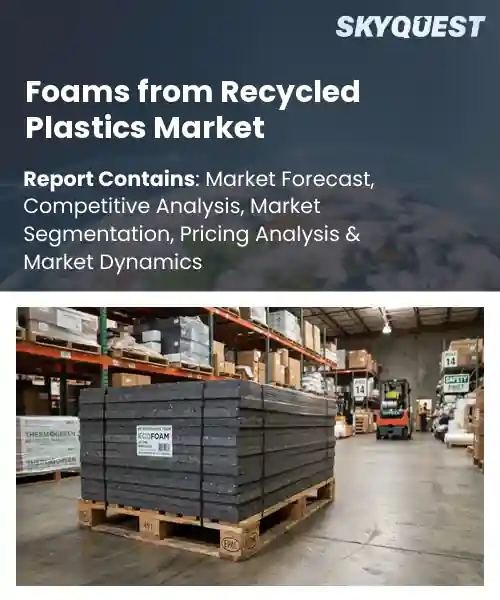
Foams from Recycled Plastics Market
Report ID: SQMIG15A2893
Report ID: SQMIG15A2893
[email protected]
USA +1 351-333-4748
Report ID:
SQMIG15A2893 |
Region:
Global |
Published Date: September, 2026
Pages:
157
|Tables:
121
|Figures:
77


Global Foams From Recycled Plastics Market size was valued at USD 1.75 Billion in 2024 and is poised to grow from USD 1.89 Billion in 2025 to USD 3.56 Billion by 2033, growing at a CAGR of 8.2% during the forecast period (2026-2033).
Cost competitiveness now translates sustainability into scale, because replacing virgin foams with recycled material lowers purchase costs and disposal fees, thereby improving margins and encouraging investment in recycling infrastructure. The resulting savings of roughly 20 % have prompted automotive firms such as Ford to certify recycled polyolefin foam for interior trim, while e‑commerce platforms adopt PET‑derived cushioning to fulfill zero‑waste commitments. This economic catalyst attracts private‑equity capital, accelerates feedstock collection networks, and opens new segments in modular construction panels and marine buoyancy where lightweight, recyclable foam meets performance standards and regulatory pressure in the next decade as global demand intensifies significantly.
How is AI driving innovation in the recycled plastics foam market?
AI is reshaping the recycled plastics foam market by turning raw waste into high performance products with unprecedented speed and precision. Machine learning algorithms analyze feedstock composition, predicting optimal blending ratios that preserve structural integrity while minimizing material loss. Computer vision systems sort mixed plastics at the source, feeding cleaner streams into extrusion lines and reducing contamination. Advanced simulation tools model foam cell architecture, enabling designers to tailor cushioning, insulation or acoustic properties without costly physical prototypes. Together these technologies accelerate product development, lower energy consumption and open new applications in automotive, packaging and construction, making recycled foam a viable alternative to virgin material.June 2023, a leading polymer producer launched an AI driven platform that customizes foam density from recycled plastics, shortening design cycles and boosting material reuse. The solution demonstrates how intelligent automation can lift market growth by delivering consistent quality and faster time to market.
Market snapshot - (2026-2033)
Global Market Size
USD 1.75 Billion
Largest Segment
Recycled Polyethylene
Fastest Growth
Recycled Polyurethane
Growth Rate
8.2% CAGR
To get more insights on this market click here to Request a Free Sample Report
Global foams from recycled plastics market is segmented by plastic type, foam type, manufacturing process, application and region. Based on plastic type, the market is segmented into Recycled Polyethylene, Recycled Polypropylene, Recycled Polystyrene, Recycled Polyurethane and Other Recycled Plastics. Based on foam type, the market is segmented into Flexible Foam and Rigid Foam. Based on manufacturing process, the market is segmented into Extrusion Foaming, Injection Foaming and Other Foaming Processes. Based on application, the market is segmented into Packaging, Building & Construction, Automotive, Furniture & Bedding, Consumer Products and Other Applications. Based on region, the market is segmented into North America, Europe, Asia Pacific, Latin America and Middle East & Africa.
Recycled Polyethylene segment dominates because its wide availability, low cost, and compatibility with common foaming technologies enable manufacturers to produce high volume flexible foam solutions. The material’s inherent melt strength facilitates consistent cell structure, while its recyclability aligns with sustainability targets, making it the preferred feedstock for large scale producers seeking to meet demand for ecofriendly packaging and cushioning. These attributes also reduce processing complexity and support rapid product launches across diverse end use categories.
However, Rigid Foam segment is witnessing the strongest growth momentum because innovators are integrating recycled polyethylene into structural insulation panels, leveraging its closed cell architecture for superior thermal performance. Emerging building codes drive demand, prompting manufacturers to expand production capacity and invest in advanced extrusion foaming techniques that unlock new applications in energy efficient construction.
Flexible Foam segment leads because its ability to conform to irregular shapes makes it ideal for cushioning and protective packaging, while its lightweight nature reduces shipping costs. The material’s elasticity supports repeated compression cycles, aligning with reuse models, and its compatibility with multiple recycling streams simplifies feedstock sourcing, positioning it as the preferred choice for manufacturers targeting sustainable consumer and industrial solutions.
Meanwhile, Rigid Foam segment is emerging as the high growth area because its closed cell structure provides thermal insulation for building envelopes, enabling developers to meet energy efficiency standards. Advances in extrusion foaming allow recycled content without compromising strength, attracting construction firms seeking cost effective green solutions and expanding market reach into retrofit and build projects.
To get detailed segments analysis, Request a Free Sample Report
Asia Pacific leads the market through a combination of extensive manufacturing capacity, progressive environmental regulations, and sophisticated recycling infrastructure. The region benefits from a deep integration of polymer recycling technologies within its industrial supply chains, enabling efficient conversion of post‑consumer plastics into high‑performance foams. Strong demand from automotive, construction, and packaging sectors drives continuous innovation, while government initiatives promote circular‑economy practices and incentivize sustainable material adoption. Consumer awareness of environmental impact further reinforces market growth, creating a virtuous cycle of demand and supply that positions Asia Pacific at the forefront of the global landscape.
Foams from Recycled Plastics Market in Japan are propelled by a mature industrial base that prioritizes resource efficiency and advanced material engineering. The country’s rigorous environmental standards encourage manufacturers to adopt recycled foam solutions across automotive and electronics applications. Collaborative networks between recyclers, research institutions, and foam producers foster continuous improvement in product performance, while consumer expectations for sustainable packaging reinforce market expansion.
Foams from Recycled Plastics Market in South Korea benefit from strong governmental support for circular‑economy initiatives and a highly skilled manufacturing sector. The nation’s focus on high‑tech industries drives demand for lightweight, recyclable foam materials in automotive and consumer goods. Integration of cutting‑edge recycling processes with domestic foam production enhances material quality, and growing corporate sustainability commitments further accelerate market adoption.
In North America, the market expands rapidly due to heightened sustainability awareness, robust regulatory frameworks, and significant investment in recycling infrastructure. Companies across packaging, construction, and automotive sectors are increasingly adopting recycled foam solutions to meet corporate environmental goals and consumer expectations. Innovation in polymer processing and the emergence of partnerships between waste‑management firms and foam manufacturers improve material availability and performance. Additionally, strong research ecosystems and supportive policy incentives encourage the development of high‑quality recycled foams, reinforcing the region’s momentum toward greener material utilization.
Foams from Recycled Plastics Market in the United States are driven by a large consumer base that values eco‑friendly packaging and lightweight construction materials. Leading manufacturers leverage advanced recycling technologies to produce foams that meet stringent performance criteria for automotive and building applications. Corporate sustainability programs and regulatory pressures motivate widespread adoption, while collaborations with research institutions accelerate product innovation and market penetration.
Foams from Recycled Plastics Market in Canada are shaped by strong governmental policies that promote waste reduction and circular‑economy practices. The country’s emphasis on green building standards and sustainable packaging fuels demand for high‑quality recycled foams. Integration of recycling facilities with local manufacturing hubs enhances supply chain efficiency, and growing consumer preference for environmentally responsible products supports continued market growth.
Europe reinforces its position through comprehensive policy frameworks, ambitious circular‑economy targets, and a tradition of engineering excellence. The region’s stringent waste‑management directives compel manufacturers to incorporate recycled content, while substantial public and private investment in recycling infrastructure improves material availability. Collaborative research initiatives across the European Union drive advancements in foam performance and recyclability, enabling broader application in automotive, construction, and packaging sectors. Consumer demand for sustainable products, combined with robust certification schemes, further consolidates Europe’s leadership in the adoption of recycled foam technologies.
Foams from Recycled Plastics Market in Germany benefit from a strong engineering culture and rigorous environmental standards that encourage the use of recycled materials. The automotive and construction industries prioritize lightweight, high‑performance foams, prompting manufacturers to integrate advanced recycling processes. Close cooperation between research institutes and industry accelerates innovation, while policy incentives support the scaling of sustainable foam production.
Foams from Recycled Plastics Market in the United Kingdom are propelled by progressive waste‑reduction policies and a vibrant packaging sector seeking sustainable alternatives. Industry collaborations with recycling firms enhance the quality and consistency of recycled foams, meeting the demands of construction and consumer goods markets. Growing corporate ESG commitments and consumer preference for eco‑friendly products further drive market expansion.
Foams from Recycled Plastics Market in France are supported by strong governmental emphasis on eco‑design and circular‑economy principles. The packaging and automotive sectors increasingly adopt recycled foams to align with sustainability targets. Integration of recycling capabilities within domestic supply chains improves material flow, while research partnerships foster continuous improvement in foam performance and environmental compliance.
To know more about the market opportunities by region and country, click here to
Buy The Complete Report
Increasing Sustainability Regulations
Consumer Preference For Green Products
High Costs Of Recycling Infrastructure
Limited Availability Of Recycled Feedstock
Request Free Customization of this report to help us to meet your business objectives.
I’m sorry, but I don’t have enough information to fulfill this request.
Top Player’s Company Profile
Recent Developments
SkyQuest’s ABIRAW (Advanced Business Intelligence, Research & Analysis Wing) is our Business Information Services team that Collects, Collates, Correlates, and Analyses the Data collected by means of Primary Exploratory Research backed by robust Secondary Desk research. As per SkyQuest analysis, the global foams from recycled plastics market is being propelled primarily by tightening sustainability regulations that force manufacturers to increase recycled content, while a strong consumer preference for green products provides a second boost by rewarding brands that showcase eco‑friendly cushioning. The flexible foam segment remains the dominant choice because its lightweight, adaptable properties suit packaging and automotive applications. Asia Pacific leads the landscape thanks to its extensive recycling infrastructure and supportive policies. However, the high costs associated with establishing and operating recycling facilities act as a restraint, limiting rapid scale‑up in regions where capital is scarce.
| Report Metric | Details |
|---|---|
| Market size value in 2024 | USD 1.75 Billion |
| Market size value in 2033 | USD 3.56 Billion |
| Growth Rate | 8.2% |
| Base year | 2024 |
| Forecast period | (2026-2033) |
| Forecast Unit (Value) | USD Billion |
| Segments covered |
|
| Regions covered | North America (US, Canada), Europe (Germany, France, United Kingdom, Italy, Spain, Rest of Europe), Asia Pacific (China, India, Japan, Rest of Asia-Pacific), Latin America (Brazil, Rest of Latin America), Middle East & Africa (South Africa, GCC Countries, Rest of MEA) |
| Companies covered |
|
| Customization scope | Free report customization with purchase. Customization includes:-
|
To get a free trial access to our platform which is a one stop solution for all your data requirements for quicker decision making. This platform allows you to compare markets, competitors who are prominent in the market, and mega trends that are influencing the dynamics in the market. Also, get access to detailed SkyQuest exclusive matrix.
Table Of Content
Executive Summary
Market overview
Parent Market Analysis
Market overview
Market size
KEY MARKET INSIGHTS
COVID IMPACT
MARKET DYNAMICS & OUTLOOK
Market Size by Region
KEY COMPANY PROFILES
Methodology
For the Foams from Recycled Plastics Market, our research methodology involved a mixture of primary and secondary data sources. Key steps involved in the research process are listed below:
1. Information Procurement: This stage involved the procurement of Market data or related information via primary and secondary sources. The various secondary sources used included various company websites, annual reports, trade databases, and paid databases such as Hoover's, Bloomberg Business, Factiva, and Avention. Our team did 45 primary interactions Globally which included several stakeholders such as manufacturers, customers, key opinion leaders, etc. Overall, information procurement was one of the most extensive stages in our research process.
2. Information Analysis: This step involved triangulation of data through bottom-up and top-down approaches to estimate and validate the total size and future estimate of the Foams from Recycled Plastics Market.
3. Report Formulation: The final step entailed the placement of data points in appropriate Market spaces in an attempt to deduce viable conclusions.
4. Validation & Publishing: Validation is the most important step in the process. Validation & re-validation via an intricately designed process helped us finalize data points to be used for final calculations. The final Market estimates and forecasts were then aligned and sent to our panel of industry experts for validation of data. Once the validation was done the report was sent to our Quality Assurance team to ensure adherence to style guides, consistency & design.
Analyst Support
Customization Options
With the given market data, our dedicated team of analysts can offer you the following customization options are available for the Foams from Recycled Plastics Market:
Product Analysis: Product matrix, which offers a detailed comparison of the product portfolio of companies.
Regional Analysis: Further analysis of the Foams from Recycled Plastics Market for additional countries.
Competitive Analysis: Detailed analysis and profiling of additional Market players & comparative analysis of competitive products.
Go to Market Strategy: Find the high-growth channels to invest your marketing efforts and increase your customer base.
Innovation Mapping: Identify racial solutions and innovation, connected to deep ecosystems of innovators, start-ups, academics, and strategic partners.
Category Intelligence: Customized intelligence that is relevant to their supply Markets will enable them to make smarter sourcing decisions and improve their category management.
Public Company Transcript Analysis: To improve the investment performance by generating new alpha and making better-informed decisions.
Social Media Listening: To analyze the conversations and trends happening not just around your brand, but around your industry as a whole, and use those insights to make better Marketing decisions.
REQUEST FOR SAMPLE
 REQUEST FREE CUSTOMIZATION


Want to customize this report? This report can be personalized according to your needs. Our analysts and industry experts will work directly with you to understand your requirements and provide you with customized data in a short amount of time. We offer $1000 worth of FREE customization at the time of purchase.
Feedback From Our Clients


 USA (+1) 351-333-4748

