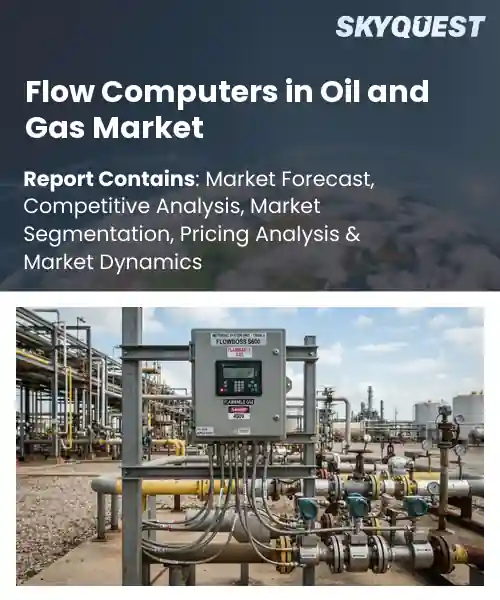
Flow Computers in Oil and Gas Market
Report ID: SQMIG45J2976
Report ID: SQMIG45J2976
[email protected]
USA +1 351-333-4748
Report ID:
SQMIG45J2976 |
Region:
Global |
Published Date: September, 2026
Pages:
157
|Tables:
144
|Figures:
78


Global Flow Computers In Oil And Gas Market size was valued at USD 980.5 Million in 2024 and is poised to grow from USD 1038.35 Million in 2025 to USD 1642.53 Million by 2033, growing at a CAGR of 5.9% during the forecast period (2026-2033).
Flow computers have become the backbone of measurement, turning raw sensor data into accurate volume, mass and energy figures needed for custody transfer, regulatory compliance and production optimization. The market, which includes hardware, software and services, began in the 1970s when analog meters could not handle multiphase streams; Shell and ExxonMobil added processors to reconcile pressure, temperature and flow‑rate inputs. In decades, platforms, fields and unconventional reservoirs have driven demand for algorithms that survive pressure, temperature conditions, prompting vendors to embed cybersecurity functions. This shift underscores the role of flow computers in protecting revenue and safety throughout oil‑and‑gas global chain. The primary growth catalyst for the global flow computer market is the tightening of regulations that require precise metering and reporting. As governments impose stricter emissions caps and agreements, operators must install measurement suites that automatically correct for temperature, density and multiphase effects, thereby reducing manual reconciliation errors. Companies such as BP have deployed flow computers on North Sea platforms, enabling data streaming to dashboards that trigger valve adjustments and compliance alerts. This pressure drives demand for modular devices, opens opportunities for SaaS analytics, and fuels investment in AI‑based leak detection, expanding global market size while improving overall operational safety.
How is AI-driven automation enhancing accuracy of flow computers in the oil and gas market?
AI driven automation is reshaping flow computers by embedding machine learning models that continuously calibrate measurement algorithms. Sensors feed raw data into adaptive software which corrects for temperature pressure and fluid composition changes in real time. This reduces manual tuning and eliminates human error while increasing reliability. Operators now see clearer diagnostics and predictive alerts that prevent drift before it impacts production. The market is seeing faster adoption as upstream producers seek tighter custody transfer and regulatory compliance. Real world examples include predictive leak detection and automated valve control that tie directly into the flow computer platform.Honeywell announced its AI enabled Flow Computer solution in March 2024, delivering self learning algorithms that refine flow calculations as operating conditions evolve. The rollout has accelerated field deployments and helped operators achieve higher measurement confidence, supporting overall market efficiency and growth.
Market snapshot - (2026-2033)
Global Market Size
USD 980.5 Million
Largest Segment
Hardware
Fastest Growth
Services
Growth Rate
5.9% CAGR
To get more insights on this market click here to Request a Free Sample Report
Global flow computers in oil and gas market is segmented by component, measurement type, application, deployment, end user and region. Based on component, the market is segmented into Hardware, Software and Services. Based on measurement type, the market is segmented into Liquid Measurement, Gas Measurement and Multiphase Measurement. Based on application, the market is segmented into Upstream, Midstream and Downstream. Based on deployment, the market is segmented into Onshore and Offshore. Based on end user, the market is segmented into Oil & Gas Producers, Pipeline Operators, Refiners & Processors and Oilfield Service Companies. Based on region, the market is segmented into North America, Europe, Asia Pacific, Latin America and Middle East & Africa.
Multiphase measurement segment dominates because it addresses the complexity of simultaneously handling oil, gas, and water streams, eliminating the need for separate metering devices. By delivering accurate volume and mass calculations across mixed phases, it reduces installation costs and simplifies custody transfer processes. The integrated approach aligns with operators seeking streamlined asset management, thus positioning multiphase capability as the preferred choice for modern flow computer deployments.
Meanwhile, Gas measurement segment emerges as the key high‑growth area as natural gas production expands and regulatory scrutiny tightens. Enhanced turbine and ultrasonic technologies improve accuracy and reliability, prompting operators to upgrade legacy systems. The surge in demand for precise gas accounting and emissions reporting drives procurement of advanced flow computers, accelerating market expansion and creating new service opportunities.
Hardware segment dominates because it provides the physical robustness required for harsh field conditions, ensuring continuous data capture and processing in flow computer installations. The intrinsic reliability of rugged processors, I/O modules, and power supplies minimizes downtime, which is critical for producers and pipeline operators. Moreover, the ability to integrate directly with existing instrumentation builds confidence among end users, cementing hardware as the core foundation of flow computer solutions.
However, Software segment is witnessing the strongest growth momentum as digital analytics, cloud connectivity, and edge intelligence become central to operational optimization. Advanced algorithms enable real‑time diagnostics, predictive maintenance, and seamless integration with enterprise systems, broadening the appeal of flow computers beyond basic measurement. This innovation fuels new deployment scenarios and expands market opportunities.
To get detailed segments analysis, Request a Free Sample Report
The region combines a deep legacy of upstream activity with persistent investment in advanced measurement technologies. Strong engineering expertise, a dense network of technology vendors, and a regulatory climate that encourages precision and safety drive adoption. Energy operators prioritize real‑time data fidelity to optimize production and reduce emissions, creating sustained demand for sophisticated flow computing solutions. Integrated service ecosystems support rapid deployment and continuous upgrades, reinforcing a feedback loop of innovation and market confidence. Collaborative research initiatives among universities, industry groups, and technology firms further cement the region’s leadership by nurturing next‑generation capabilities that align with evolving operational and environmental expectations.
Flow Computers in Oil and Gas Market benefit from a robust ecosystem of leading manufacturers and extensive field experience across shale and deepwater projects. Operators emphasize high reliability and seamless integration with digital platforms, prompting continual refinement of algorithms and hardware resilience. The market responds to stringent performance standards and a culture of early technology adoption, fostering a competitive environment that accelerates product evolution. Close collaboration between oil and gas firms and technology providers underpins customised solutions that address complex flow regimes and regulatory reporting requirements.
Flow Computers in Oil and Gas Market are supported by a strong emphasis on environmental stewardship and precision in production monitoring. Operators leverage sophisticated computing tools to enhance reservoir management and reduce operational waste, aligning with national sustainability goals. The market draws on a network of experienced engineering firms that specialise in cold climate operations, ensuring reliable performance under challenging conditions. Partnerships between domestic technology innovators and global equipment suppliers facilitate the transfer of best practices, reinforcing a resilient supply chain that meets the specific needs of the Canadian hydrocarbon sector.
Europe’s expansion is propelled by a convergence of stringent environmental directives, digital transformation agendas, and a long‑standing engineering tradition. Operators seek highly accurate flow measurement to optimise resource utilisation while complying with rigorous emission reporting standards. Collaborative research programmes across the region foster innovation in sensor integration and data analytics, positioning flow computers as central components of smart field deployments. Market participants benefit from an ecosystem of specialist manufacturers that blend legacy expertise with modern software capabilities, delivering tailored solutions for diverse hydrocarbon assets. The emphasis on standardisation and cross‑border projects further amplifies demand, creating a fertile environment for sustained growth.
Flow Computers in Oil and Gas Market in Germany are characterised by a reputation for precision engineering and strong quality standards. Companies integrate advanced control algorithms with robust hardware to meet demanding operational requirements across both mature and emerging fields. The market benefits from close cooperation between industrial research institutes and equipment providers, fostering continuous improvement in measurement accuracy and reliability. German operators place high value on interoperability with digital twins and predictive maintenance platforms, driving adoption of sophisticated flow computing solutions that enhance overall asset performance.
Flow Computers in Oil and Gas Market in the United Kingdom experience accelerated uptake as operators modernise aging infrastructure and pursue digital optimisation. Emphasis on offshore developments and mature onshore assets creates a need for flexible, high‑resolution flow measurement tools. The market is buoyed by strong collaborations between academic research centres and technology firms, delivering innovative algorithms that address complex multiphase flow scenarios. Regulatory focus on transparent reporting and emissions reduction further incentivises the deployment of advanced computing solutions that provide granular insight into production dynamics.
Flow Computers in Oil and Gas Market in France are emerging alongside a broader push for energy transition and operational efficiency. Companies adopt sophisticated flow measurement to support tighter control of production processes and to satisfy evolving environmental obligations. The market leverages a network of specialised engineering consultancies that tailor solutions for diverse field conditions, ensuring compatibility with national safety and reporting frameworks. Growing partnerships with international equipment manufacturers enable French operators to access cutting‑edge technology while maintaining a focus on local regulatory compliance and performance excellence.
Asia Pacific advances its role through rapid industrialisation, expanding offshore activity, and a strategic focus on digital integration. Energy firms prioritize high‑precision flow measurement to optimize increasingly complex reservoirs and to align with regional sustainability initiatives. Local manufacturers invest heavily in research and development, delivering cost‑effective yet reliable computing platforms that cater to both mature and frontier projects. Collaborative ventures between multinational technology providers and domestic engineering houses accelerate technology transfer, fostering a skilled workforce capable of implementing sophisticated solutions. The region’s emphasis on modular, scalable designs supports diverse operational scales, reinforcing its growing influence in the global market.
Flow Computers in Oil and Gas Market in Japan are distinguished by meticulous engineering and a strong orientation towards reliability under seismically active conditions. Operators integrate advanced diagnostic features to ensure continuous performance and to meet rigorous safety standards. The market benefits from close ties between research universities and equipment manufacturers, fostering innovation in sensor fusion and real‑time analytics. Japanese firms value seamless connectivity with broader digital platforms, enabling predictive maintenance and enhanced production insight across both onshore and offshore projects.
Flow Computers in Oil and Gas Market in South Korea are driven by a proactive approach to technology adoption and a focus on export‑oriented engineering capabilities. Companies develop compact, high‑accuracy computing modules that cater to the region’s diverse field environments. Collaborative initiatives with global technology leaders accelerate the incorporation of artificial intelligence for flow analysis, improving decision‑making speed for operators. The market emphasizes adaptability to rapid project timelines and regulatory compliance, positioning South Korean solutions as competitive choices for both domestic and international oil and gas enterprises.
To know more about the market opportunities by region and country, click here to
Buy The Complete Report
Rising Demand for Real‑Time Monitoring
Adoption of Integrated Control Systems
High Initial Capital Expenditure
Complex Integration with Legacy Systems
Request Free Customization of this report to help us to meet your business objectives.
The competitive landscape is shaped by major integrators leveraging acquisitions, strategic alliances, and advanced analytics to differentiate flow‑computer offerings; Schlumberger’s 2021 acquisition of CygNet accelerated its digital oil‑field suite, Honeywell’s 2023 partnership with ABB integrated cross‑platform data analytics, and Emerson’s launch of AI‑enhanced Ovation Flow modules intensified product innovation, driving intensified rivalry among established and emerging players.
Top Player’s Company Profile
Recent Developments
SkyQuest’s ABIRAW (Advanced Business Intelligence, Research & Analysis Wing) is our Business Information Services team that Collects, Collates, Correlates, and Analyses the Data collected by means of Primary Exploratory Research backed by robust Secondary Desk research. As per SkyQuest analysis, the global flow‑computer market is being propelled primarily by the rising demand for real‑time monitoring, which pushes operators to invest in devices that instantly flag anomalies and optimise production. A second strong driver is the growing adoption of integrated control systems that tie flow computers to predictive‑maintenance platforms, enhancing overall plant efficiency. The hardware segment remains dominant because its rugged processors and I/O modules ensure reliable performance in harsh field conditions. However, high initial capital expenditure acts as a restraint, especially for operators of legacy or marginal assets. North America leads the market, leveraging deep upstream activity, strong vendor ecosystems and stringent regulatory pressures to maintain its top position.
| Report Metric | Details |
|---|---|
| Market size value in 2024 | USD 980.5 Million |
| Market size value in 2033 | USD 1642.53 Million |
| Growth Rate | 5.9% |
| Base year | 2024 |
| Forecast period | (2026-2033) |
| Forecast Unit (Value) | USD Million |
| Segments covered |
|
| Regions covered | North America (US, Canada), Europe (Germany, France, United Kingdom, Italy, Spain, Rest of Europe), Asia Pacific (China, India, Japan, Rest of Asia-Pacific), Latin America (Brazil, Rest of Latin America), Middle East & Africa (South Africa, GCC Countries, Rest of MEA) |
| Companies covered |
|
| Customization scope | Free report customization with purchase. Customization includes:-
|
To get a free trial access to our platform which is a one stop solution for all your data requirements for quicker decision making. This platform allows you to compare markets, competitors who are prominent in the market, and mega trends that are influencing the dynamics in the market. Also, get access to detailed SkyQuest exclusive matrix.
Table Of Content
Executive Summary
Market overview
Parent Market Analysis
Market overview
Market size
KEY MARKET INSIGHTS
COVID IMPACT
MARKET DYNAMICS & OUTLOOK
Market Size by Region
KEY COMPANY PROFILES
Methodology
For the Flow Computers in Oil and Gas Market, our research methodology involved a mixture of primary and secondary data sources. Key steps involved in the research process are listed below:
1. Information Procurement: This stage involved the procurement of Market data or related information via primary and secondary sources. The various secondary sources used included various company websites, annual reports, trade databases, and paid databases such as Hoover's, Bloomberg Business, Factiva, and Avention. Our team did 45 primary interactions Globally which included several stakeholders such as manufacturers, customers, key opinion leaders, etc. Overall, information procurement was one of the most extensive stages in our research process.
2. Information Analysis: This step involved triangulation of data through bottom-up and top-down approaches to estimate and validate the total size and future estimate of the Flow Computers in Oil and Gas Market.
3. Report Formulation: The final step entailed the placement of data points in appropriate Market spaces in an attempt to deduce viable conclusions.
4. Validation & Publishing: Validation is the most important step in the process. Validation & re-validation via an intricately designed process helped us finalize data points to be used for final calculations. The final Market estimates and forecasts were then aligned and sent to our panel of industry experts for validation of data. Once the validation was done the report was sent to our Quality Assurance team to ensure adherence to style guides, consistency & design.
Analyst Support
Customization Options
With the given market data, our dedicated team of analysts can offer you the following customization options are available for the Flow Computers in Oil and Gas Market:
Product Analysis: Product matrix, which offers a detailed comparison of the product portfolio of companies.
Regional Analysis: Further analysis of the Flow Computers in Oil and Gas Market for additional countries.
Competitive Analysis: Detailed analysis and profiling of additional Market players & comparative analysis of competitive products.
Go to Market Strategy: Find the high-growth channels to invest your marketing efforts and increase your customer base.
Innovation Mapping: Identify racial solutions and innovation, connected to deep ecosystems of innovators, start-ups, academics, and strategic partners.
Category Intelligence: Customized intelligence that is relevant to their supply Markets will enable them to make smarter sourcing decisions and improve their category management.
Public Company Transcript Analysis: To improve the investment performance by generating new alpha and making better-informed decisions.
Social Media Listening: To analyze the conversations and trends happening not just around your brand, but around your industry as a whole, and use those insights to make better Marketing decisions.
REQUEST FOR SAMPLE
 REQUEST FREE CUSTOMIZATION


Want to customize this report? This report can be personalized according to your needs. Our analysts and industry experts will work directly with you to understand your requirements and provide you with customized data in a short amount of time. We offer $1000 worth of FREE customization at the time of purchase.
Feedback From Our Clients


 USA (+1) 351-333-4748

