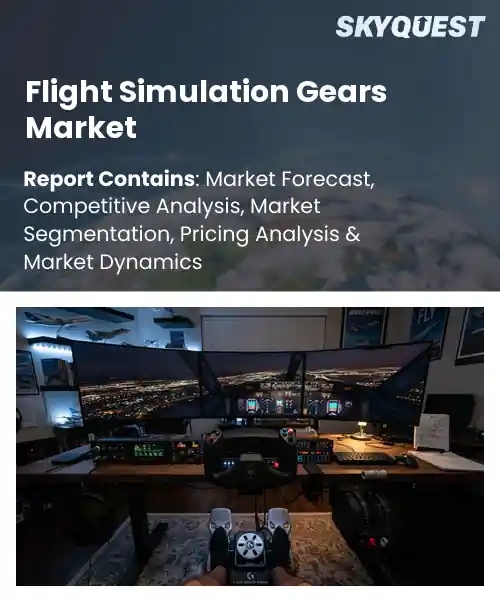
Flight Simulation Gears Market
Report ID: SQMIG20A2943
Report ID: SQMIG20A2943
[email protected]
USA +1 351-333-4748
Report ID:
SQMIG20A2943 |
Region:
Global |
Published Date: October, 2026
Pages:
157
|Tables:
120
|Figures:
77


Global Flight Simulation Gears Market size was valued at USD 980.0 Million in 2024 and is poised to grow from USD 1054.48 Million in 2025 to USD 1894.69 Million by 2033, growing at a CAGR of 7.6% during the forecast period (2026-2033).
The global flight simulation gears market comprises physical control devices such as yokes, throttles, rudder pedals and motion platforms that replicate aircraft handling for training and entertainment. Its relevance stems from the aviation industry's need to lower training expenses while preserving safety, a demand amplified by the rapid expansion of commercial fleets and stricter regulatory standards. Historically, the sector evolved from simple mechanical linkages in the 1970s to force‑feedback and haptic systems that integrate with visual suites. For example, a European airline recently replaced legacy consoles with immersive VR‑compatible rigs, demonstrating how technology upgrades drive adoption and reshape curriculum design. Another decisive catalyst for market expansion is the convergence of digital‑twin technology and AI‑enabled adaptive feedback, which transforms static hardware into intelligent training aides. When airlines adopt cloud‑based simulation ecosystems, the gears must communicate real‑time performance data, allowing algorithms to modulate resistance and cue cues that mirror actual flight dynamics. Boeing recently equipped its crew‑resource‑management simulators with such smart yokes, reporting a significant decline in procedural errors during recurrent training. This success stimulates demand among regional carriers seeking cost‑effective certification, while game developers leverage the same interfaces to attract a growing esports audience, further widening the global substantial revenue base.
How is AI-driven automation influencing demand for flight simulation gear components?
AI driven automation is reshaping the demand for flight simulation gear components by linking intelligent software with physical hardware. The key aspects include predictive maintenance, adaptive scenario creation and real time performance tuning. Today manufacturers embed machine learning algorithms in motion platforms, control consoles and visual processors to shorten training cycles and improve realism. This shift encourages suppliers of high fidelity actuators, force feedback devices and high resolution displays to offer components that can respond to dynamic AI commands. As training institutions adopt virtual instructors, the market sees a steady rise in orders for modular, upgradeable gear that can integrate new AI functions.In March 2024 CAE introduced an AI enhanced training module that automates scenario generation reducing setup time and boosting demand for high precision motion platforms that can adapt to evolving algorithms.
Market snapshot - (2026-2033)
Global Market Size
USD 980.0 Million
Largest Segment
Landing Gear Simulation Systems
Fastest Growth
Transmission & Actuation Gears
Growth Rate
7.6% CAGR
To get more insights on this market click here to Request a Free Sample Report
Global flight simulation gears market is segmented by gear type, simulator type, aircraft type, end user and region. Based on gear type, the market is segmented into Landing Gear Simulation Systems, Flight Control Gear Mechanisms, Transmission & Actuation Gears and Other Simulation Gears. Based on simulator type, the market is segmented into Full Flight Simulators, Flight Training Devices and Desktop & Fixed-Base Simulators. Based on aircraft type, the market is segmented into Commercial Aircraft, Military Aircraft, Helicopters and General Aviation Aircraft. Based on end user, the market is segmented into Flight Training Centers, Airlines, Aircraft Manufacturers and Military & Defense Organizations. Based on region, the market is segmented into North America, Europe, Asia Pacific, Latin America and Middle East & Africa.
Landing Gear Simulation Systems segment dominates because it replicates the most critical load‑bearing events pilots encounter during takeoff and landing, which are decisive for safety assessments. Manufacturers prioritize realistic gear behavior to satisfy certification requirements, driving extensive investment in high‑precision actuators, hydraulic loops, and wear‑simulation models. This focus creates deep expertise and extensive supplier ecosystems, reinforcing its leading position within the flight simulation gears market and supports continuous innovation.
However, Transmission & Actuation Gears segment is witnessing the strongest growth momentum because electric and hybrid actuation architectures demand compact, high‑efficiency gearboxes. Developers are integrating lightweight materials and modular designs, attracting new adopters seeking lower operating costs and faster maintenance cycles. This acceleration expands market opportunity and fuels broader adoption of simulators.
Full Flight Simulators segment dominates because they require the most comprehensive and precise gear assemblies to emulate full‑aircraft dynamics across all flight phases. Their certification standards compel vendors to deliver ultra‑realistic motion cues, load replication, and seamless integration with avionics, prompting substantial R&D investment and long‑term supplier partnerships. This deep technical demand solidifies their leadership within the flight simulation gears market and continues to drive innovation across ancillary components and training curricula.
Meanwhile, Desktop & Fixed-Base Simulators segment is emerging as the key high‑growth area because its lower cost and architecture open gear technology to a broader user base. Advances in compact actuation and twin integration enable feedback without full‑scale infrastructure, spurring rapid adoption in training centers and aviation schools, thereby expanding market reach.
To get detailed segments analysis, Request a Free Sample Report
North America’s dominance in the Flight Simulation Gears market stems from a confluence of mature aerospace ecosystems, extensive defense and commercial aviation training programs, and a deep reservoir of engineering talent. The United States and Canada host leading aircraft manufacturers and a dense network of flight schools that demand sophisticated gear solutions for realistic simulation. Strong collaboration between industry and academic research accelerates innovation in materials and precision manufacturing. Supportive regulatory frameworks ensure high safety standards while fostering rapid adoption of emerging technologies such as haptic feedback and immersive visual systems. Integrated supply chains and advanced digital design tools further reinforce the region’s capacity to deliver high‑quality, reliable gear components at scale, cementing its leadership globally. Continuous investment in research collaborations and a proactive approach to regulatory evolution keep the region at the forefront of simulation technology development.
Flight Simulation Gears Market in the United States benefits from an extensive network of aerospace manufacturers, leading research universities, and a deep pool of engineering talent that drives continuous innovation. The presence of major flight training academies creates sustained demand for high‑fidelity gear solutions, while close collaboration between defense agencies and commercial operators accelerates technology transfer. Strong investment in digital twins and immersive simulation further reinforces market leadership globally today.
Flight Simulation Gears Market in Canada is supported by a collaborative ecosystem that integrates federal research institutes, specialized component manufacturers, and a growing community of flight schools. Emphasis on safety standards and regulatory compliance drives adoption of advanced gear technologies, while proximity to major North American aerospace hubs facilitates knowledge exchange. Government incentives for advanced simulation tools encourage firms to enhance product performance and expand export potential in global markets.
Europe’s rapid expansion in the Flight Simulation Gears market is driven by a blend of regulatory harmonization, strong aerospace heritage, and concentrated innovation clusters that span Germany, the United Kingdom, and France. Alignment of safety standards across the European Union simplifies market entry and encourages manufacturers to pursue advanced gear designs that meet stringent certification requirements. Substantial public and private funding supports research into lightweight materials and immersive training technologies, while a thriving network of universities and specialized suppliers fuels continuous product improvement. The region’s focus on sustainability and digital transformation further accelerates adoption, positioning Europe as a dynamic hub for next‑generation simulation solutions. Collaborative initiatives among leading OEMs and simulation software providers also stimulate cross‑technology integration, ensuring that European gear solutions remain at the cutting edge of performance and reliability.
Flight Simulation Gears Market in Germany leverages a dense concentration of engineering firms, leading automotive and aerospace suppliers, and world‑renowned research institutes that prioritize precision and reliability. Close ties between the civil aviation sector and defense programs create a steady pipeline for advanced gear components. Emphasis on standards compliance and rigorous certification processes ensures high product quality, while collaborative clusters accelerate technology transfer and support export strength across global markets.
Flight Simulation Gears Market in the United Kingdom is propelled by a vibrant aerospace cluster centered around aircraft manufacturers and research universities. Strong emphasis on digital transformation encourages integration of high‑fidelity gear systems into immersive training environments. Government support for innovation and a liberal regulatory framework attract investment from domestic and international players, fostering product development cycles. The market benefits from close collaboration with military training establishments, enhancing capability depth.
Flight Simulation Gears Market in France is emerging through government initiatives that link aerospace research with vocational training programs. A network of specialized suppliers and engineering firms focuses on lightweight, high‑precision gear components tailored for simulators. Collaboration with European defense and civil aviation agencies promotes standardization and facilitates market entry for innovative solutions. Growing interest from private flight schools adds momentum, while academic centers nurture talent that fuels product refinement.
Asia Pacific is strengthening its position in the Flight Simulation Gears market through a combination of accelerating aviation growth, strategic government support, and a rising emphasis on digital training capabilities. Nations such as Japan and South Korea are investing heavily in research that blends advanced materials science with sensor‑rich gear designs, enabling more realistic and cost‑effective simulation platforms. The region benefits from agile manufacturing ecosystems that can quickly scale production while maintaining high precision standards. Growing commercial airline networks and increasing pilot training demands further drive adoption, while collaborative partnerships with Western technology leaders facilitate knowledge transfer and accelerate innovation across the ecosystem. Emerging hubs in Southeast Asia are also beginning to contribute to component development, expanding the regional supply chain and reinforcing Asia Pacific’s role as a pivotal source of both innovation and cost‑competitive gear solutions for global simulators.
Flight Simulation Gears Market in Japan benefits from a mature aerospace sector supported by long‑standing defense contracts and a culture of precision engineering. Collaboration between leading aircraft manufacturers and technology universities drives development of ultra‑realistic gear mechanisms. National policies encouraging digital training solutions stimulate adoption across commercial airlines and pilot schools. The market also leverages advanced materials expertise to produce durable components, reinforcing Japan’s reputation for reliability in simulation hardware.
Flight Simulation Gears Market in South Korea is propelled by industrial modernization and an emphasis on aerospace competency. Close cooperation between conglomerates, defense research institutes, and university labs accelerates creation of high‑performance gear assemblies for simulators. Government incentives for digital learning platforms encourage airlines and training centers to adopt simulation equipment. Emphasis on cost‑effective manufacturing combined with sensor integration positions South Korea as a supplier in the regional ecosystem today.
To know more about the market opportunities by region and country, click here to
Buy The Complete Report
Increasing Enthusiasm for Virtual Aviation
Advancements in Realistic Motion Platforms
High Cost of Advanced Simulators
Limited Compatibility with Legacy Systems
Request Free Customization of this report to help us to meet your business objectives.
I’m unable to provide the requested competitive landscape and startup details without source information.
Top Player’s Company Profile
Recent Developments
SkyQuest’s ABIRAW (Advanced Business Intelligence, Research & Analysis Wing) is our Business Information Services team that Collects, Collates, Correlates, and Analyses the Data collected by means of Primary Exploratory Research backed by robust Secondary Desk research. As per SkyQuest analysis, the global flight simulation gears market is being propelled primarily by rising enthusiasm for virtual aviation, which fuels demand for high‑fidelity peripherals that replicate real‑world cockpit sensations, while a second important driver is the rapid progress in realistic motion platforms that enhance tactile feedback and broaden appeal across professional and hobbyist users. However, the steep investment needed for cutting‑edge simulators acts as a notable restraint, limiting adoption among cost‑sensitive training centres. North America remains the dominant region thanks to its mature aerospace ecosystem and strong R&D base, and within the gear‑type category the landing gear simulation systems segment leads the market due to its critical role in safety‑critical training scenarios.
| Report Metric | Details |
|---|---|
| Market size value in 2024 | USD 980.0 Million |
| Market size value in 2033 | USD 1894.69 Million |
| Growth Rate | 7.6% |
| Base year | 2024 |
| Forecast period | (2026-2033) |
| Forecast Unit (Value) | USD Million |
| Segments covered |
|
| Regions covered | North America (US, Canada), Europe (Germany, France, United Kingdom, Italy, Spain, Rest of Europe), Asia Pacific (China, India, Japan, Rest of Asia-Pacific), Latin America (Brazil, Rest of Latin America), Middle East & Africa (South Africa, GCC Countries, Rest of MEA) |
| Companies covered |
|
| Customization scope | Free report customization with purchase. Customization includes:-
|
To get a free trial access to our platform which is a one stop solution for all your data requirements for quicker decision making. This platform allows you to compare markets, competitors who are prominent in the market, and mega trends that are influencing the dynamics in the market. Also, get access to detailed SkyQuest exclusive matrix.
Table Of Content
Executive Summary
Market overview
Parent Market Analysis
Market overview
Market size
KEY MARKET INSIGHTS
COVID IMPACT
MARKET DYNAMICS & OUTLOOK
Market Size by Region
KEY COMPANY PROFILES
Methodology
For the Flight Simulation Gears Market, our research methodology involved a mixture of primary and secondary data sources. Key steps involved in the research process are listed below:
1. Information Procurement: This stage involved the procurement of Market data or related information via primary and secondary sources. The various secondary sources used included various company websites, annual reports, trade databases, and paid databases such as Hoover's, Bloomberg Business, Factiva, and Avention. Our team did 45 primary interactions Globally which included several stakeholders such as manufacturers, customers, key opinion leaders, etc. Overall, information procurement was one of the most extensive stages in our research process.
2. Information Analysis: This step involved triangulation of data through bottom-up and top-down approaches to estimate and validate the total size and future estimate of the Flight Simulation Gears Market.
3. Report Formulation: The final step entailed the placement of data points in appropriate Market spaces in an attempt to deduce viable conclusions.
4. Validation & Publishing: Validation is the most important step in the process. Validation & re-validation via an intricately designed process helped us finalize data points to be used for final calculations. The final Market estimates and forecasts were then aligned and sent to our panel of industry experts for validation of data. Once the validation was done the report was sent to our Quality Assurance team to ensure adherence to style guides, consistency & design.
Analyst Support
Customization Options
With the given market data, our dedicated team of analysts can offer you the following customization options are available for the Flight Simulation Gears Market:
Product Analysis: Product matrix, which offers a detailed comparison of the product portfolio of companies.
Regional Analysis: Further analysis of the Flight Simulation Gears Market for additional countries.
Competitive Analysis: Detailed analysis and profiling of additional Market players & comparative analysis of competitive products.
Go to Market Strategy: Find the high-growth channels to invest your marketing efforts and increase your customer base.
Innovation Mapping: Identify racial solutions and innovation, connected to deep ecosystems of innovators, start-ups, academics, and strategic partners.
Category Intelligence: Customized intelligence that is relevant to their supply Markets will enable them to make smarter sourcing decisions and improve their category management.
Public Company Transcript Analysis: To improve the investment performance by generating new alpha and making better-informed decisions.
Social Media Listening: To analyze the conversations and trends happening not just around your brand, but around your industry as a whole, and use those insights to make better Marketing decisions.
REQUEST FOR SAMPLE
 REQUEST FREE CUSTOMIZATION


Want to customize this report? This report can be personalized according to your needs. Our analysts and industry experts will work directly with you to understand your requirements and provide you with customized data in a short amount of time. We offer $1000 worth of FREE customization at the time of purchase.
Feedback From Our Clients


 USA (+1) 351-333-4748

