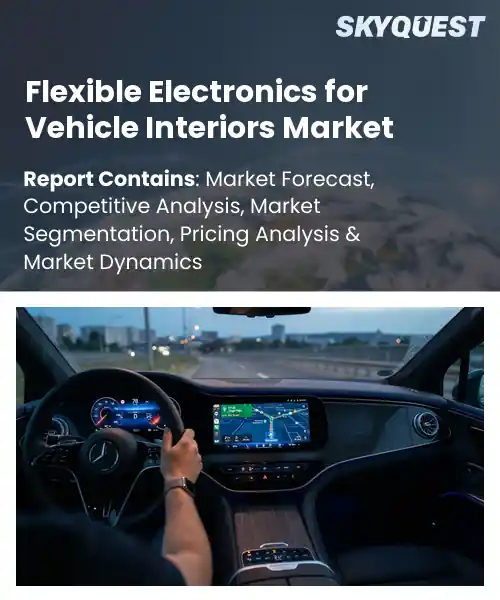
Flexible Electronics for Vehicle Interiors Market
Report ID: SQMIG25A3004
Report ID: SQMIG25A3004
[email protected]
USA +1 351-333-4748
Report ID:
SQMIG25A3004 |
Region:
Global |
Published Date: October, 2026
Pages:
157
|Tables:
149
|Figures:
78


Global Flexible Electronics For Vehicle Interiors Market size was valued at USD 2.6 Billion in 2024 and is poised to grow from USD 3.06 Billion in 2025 to USD 11.36 Billion by 2033, growing at a CAGR of 17.8% during the forecast period (2026-2033).
Flexible electronics for vehicle interiors refer to thin, bendable circuits and sensors integrated into dashboards, seat trims, and lighting systems, enabling real‑time data exchange, adaptive aesthetics, and weight reduction. The primary driver behind this market is the automotive industry’s shift toward electrification and autonomous features, which demand sophisticated human‑machine interfaces and distributed sensor networks. Historically, rigid printed circuit boards dominated cabin components, but advances in organic semiconductors and roll‑to‑roll manufacturing have lowered costs and increased reliability. For instance, a German brand recently replaced instrument clusters with OLED‑based curved displays, illustrating how consumer expectations for seamless interfaces are reshaping interior design. Regulatory pressure to cut emissions and expansion of platforms act as a catalyst for electronics in interiors, prompting manufacturers to choose components that exchange data with infrastructure while drawing power. Consequently, automakers laminate antenna meshes and solar‑harvesting films onto seat backs and overhead consoles, delivering V2X links and energy capture without added weight. A Japanese supplier launched a dashboard skin merging photovoltaic layers with a display, reducing wiring complexity and supporting updates. This cause‑effect loop stricter climate rules, consumer demand for experiences, and falling production costs creates growth potential for vendors offering modular interior solutions that can be retrofitted across model lines.
How are AI and IoT driving adoption of flexible electronics in vehicle interiors?
AI and IoT are reshaping vehicle interiors by turning flexible electronics into intelligent surfaces. AI algorithms process data from bendable sensors to adjust climate, lighting and infotainment in real time. IoT links these components to cloud services, allowing over‑the‑air updates and seamless integration with smartphones. Flexible circuits and thin‑film displays conform to curved dashboards, door panels and seats, reducing wiring complexity and weight. Automakers are now embedding stretchable pressure sensors in seats to monitor occupant posture and health, while flexible OLED strips provide adaptive ambient lighting that reacts to driving conditions. This convergence creates a more personalized, connected cabin and fuels demand for lightweight, reconfigurable components.LG Display announced a flexible OLED panel for vehicle interiors in June 2023, enabling AI driven personalized dashboards and IoT linked ambient lighting. The thin conformable screen reduces panel weight and supports real time data exchange, illustrating how the technology accelerates market adoption and cabin efficiency.
Market snapshot - (2026-2033)
Global Market Size
USD 2.6 Billion
Largest Segment
Flexible Sensors
Fastest Growth
Flexible Displays
Growth Rate
17.8% CAGR
To get more insights on this market click here to Request a Free Sample Report
Global flexible electronics for vehicle interiors market is segmented by component type, technology, application, vehicle type, propulsion type and region. Based on component type, the market is segmented into Flexible Displays, Flexible Sensors, Flexible Printed Circuits, Flexible Lighting and Flexible Touch Interfaces. Based on technology, the market is segmented into OLED, Printed Electronics, Thin-Film Electronics and Other Technologies. Based on application, the market is segmented into Instrument Clusters, Infotainment Systems, Interior Lighting, Seat & Cabin Controls and Other Interior Applications. Based on vehicle type, the market is segmented into Passenger Cars, Light Commercial Vehicles and Heavy Commercial Vehicles. Based on propulsion type, the market is segmented into Internal Combustion Engine Vehicles, Hybrid Electric Vehicles and Battery Electric Vehicles. Based on region, the market is segmented into North America, Europe, Asia Pacific, Latin America and Middle East & Africa.
Flexible Displays segment dominates because automotive designers prioritize seamless visual integration that enhances driver engagement and cabin aesthetics. The thin form factor allows curvature around dashboards, reducing mechanical hinges and weight. This capability aligns with trends toward digital instrument panels and ambient visual cues, creating immersive user experiences. Manufacturers also benefit from simplified assembly and reduced part count, reinforcing the appeal of flexible display technology throughout vehicle interiors.
Meanwhile, Flexible Lighting emerges as the most rapidly expanding area, driven by growing demand for customizable ambient illumination that supports mood setting and safety signaling. Innovations in polymer LEDs and low power driver integration enable designers to embed light sources directly into trims, creating new revenue streams and enriching the cabin experience.
OLED segment dominates because it delivers high brightness, contrast, and vivid color while using a bendable substrate that conforms to curved dashboards. The technology’s fast response time enhances real time visual feedback for driver assistance displays. Its proven reliability under automotive temperature variations and compatibility with existing manufacturing lines make it the preferred choice for interior visual systems. Low power consumption further supports vehicle energy efficiency, encouraging OEM adoption.
Conversely, Printed Electronics emerges as the most rapidly expanding area, driven by its ability to apply functional inks directly onto interior surfaces, enabling low cost, large sensor mats and touch interfaces. Compatibility with roll to roll manufacturing reduces footprint and speeds design iteration, creating new customizable cabin features and fresh revenue streams for suppliers.
To get detailed segments analysis, Request a Free Sample Report
Asia Pacific holds a preeminent position in the flexible electronics for vehicle interiors market due to a confluence of advanced manufacturing capabilities, strong automotive design culture, and aggressive investment in next‑generation materials. The region benefits from deep expertise in thin‑film technologies and a supply chain that integrates semiconductor producers with automotive OEMs seamlessly. Collaborative ecosystems between research institutes and tier‑one suppliers accelerate product development, while consumer demand for high‑tech cabin experiences fuels rapid adoption. Moreover, supportive policy frameworks encourage innovation in lightweight and energy‑efficient components, reinforcing regional leadership and creating a robust pipeline of disruptive interior solutions. The presence of major automotive hubs in Japan and South Korea also enables close collaboration on vehicle integration, ensuring that flexible displays, sensors and lighting modules are tailored to local design preferences and regulatory requirements. This synergy between technology providers and carmakers sustains a virtuous cycle of demand and capability expansion.
Flexible Electronics for Vehicle Interiors Market in Japan benefits from a mature automotive ecosystem that blends precision engineering with cutting‑edge material science. Domestic manufacturers leverage long‑standing expertise in miniaturized sensors and high‑resolution displays to embed flexible solutions throughout cabin interiors. Close cooperation with electronics firms accelerates prototyping, while consumer expectations for premium, interactive environments drive rapid incorporation of customizable lighting and touch interfaces across vehicle segments in future models globally.
Flexible Electronics for Vehicle Interiors Market in South Korea is propelled by a strong electronics manufacturing base that seamlessly integrates with the country’s automotive sector. Leading semiconductor firms provide advanced flexible substrates that enable innovative dashboard displays and ambient lighting solutions. Collaboration between carmakers and research institutes fosters rapid iteration of form‑factor designs, while a keen focus on sustainability encourages the adoption of lightweight, low‑power components throughout vehicle cabins interior.
The rapid expansion of flexible electronics for vehicle interiors in North America is anchored by a convergence of consumer demand for immersive cabin experiences and strong innovation ecosystems in key automotive hubs. Leading vehicle manufacturers collaborate closely with technology firms to embed flexible displays, advanced haptic touch surfaces, and adaptive lighting that respond to driver and passenger preferences. Investment in research and development is amplified by a supportive venture capital environment, while regulatory emphasis on safety and energy efficiency pushes manufacturers toward lightweight, integrated solutions. Additionally, the regional emphasis on premium vehicle segments creates a market eager to adopt cutting‑edge interior technologies, reinforcing a cycle of continuous product refinement and adoption across a broad range of vehicle classes. The collaborative culture between automakers and software developers further accelerates the rollout of personalized interior ecosystems.
United States Flexible Electronics for Vehicle Interiors Market is shaped by a reservoir of technology talent and a vibrant automotive supply chain that embraces rapid prototyping. Major OEMs partner with Silicon Valley innovators to integrate flexible touch panels and intelligent ambient lighting into both luxury and mainstream vehicles. Emphasis on user‑centred design drives inclusion of customizable interfaces, while stringent safety standards ensure flexible components meet durability requirements across driving conditions.
Canada Flexible Electronics for Vehicle Interiors Market benefits from a collaborative ecosystem that blends research institutions with an expanding automotive base. Provincial innovation hubs develop flexible sensor arrays and adaptive interior lighting for cold‑climate performance. Partnerships between national automakers and tech startups enable rapid integration of touch‑sensitive surfaces and health‑monitoring modules in cabins. Emphasis on sustainability promotes low‑energy flexible components that improve passenger comfort while lowering vehicle power use significantly.
Europe is strengthening its position in the flexible electronics for vehicle interiors market through a combination of advanced research collaborations, rigorous standards, and a focus on premium automotive experiences. Leading automotive manufacturers partner with universities and specialized material firms to develop high‑resolution flexible displays and smart surface technologies that cater to luxury and sustainable mobility trends. The regulatory environment emphasizes safety, recyclability and energy efficiency, encouraging the adoption of lightweight, integrated components. Moreover, a tradition of design excellence drives the integration of ambient lighting, tactile interfaces and customizable aesthetic features, positioning European vehicles as benchmarks for sophisticated, user‑centric cabin environments. Collaborative funding programs across the EU facilitate the scaling of flexible substrate production, reducing cost barriers and accelerating market entry for innovative interior solutions. Automotive suppliers also invest in digital twin tools to optimize integration of bendable electronics, ensuring performance meets European consumer expectations.
Germany Flexible Electronics for Vehicle Interiors Market is driven by a strong engineering tradition and a dense network of automotive suppliers focused on precision manufacturing. Research centers collaborate with OEMs to create flexible cockpit displays and adaptive lighting that align with German vehicle performance standards. Emphasis on energy efficiency promotes the use of low‑power flexible circuits, while design integration teams ensure seamless aesthetic and functional harmony throughout the interior environment.
United Kingdom Flexible Electronics for Vehicle Interiors Market benefits from a vibrant tech ecosystem that blends automotive heritage with cutting‑edge digital innovation. Collaborative projects between universities and Tier‑one suppliers accelerate development of flexible touch interfaces and smart ambient lighting suited to vehicle cabins. Regulatory focus on safety and sustainability drives the adoption of lightweight, recyclable flexible components, while design specialists emphasize tactile richness and customizable aesthetics to enhance passenger experience.
France Flexible Electronics for Vehicle Interiors Market leverages a strong design culture and a research network to pioneer flexible interior solutions. Partnerships between automotive manufacturers and French material science institutes foster the creation of flexible displays and lighting that align with the country emphasis on elegance and sustainability. Government incentives support flexible component production, while automotive designers focus on seamless integration that enhances ergonomics and appeal within the vehicle cabin.
To know more about the market opportunities by region and country, click here to
Buy The Complete Report
Increasing Demand for Lightweight Interiors
Advancements in Printable Conductive Materials
High Initial Investment Costs
Limited Standardization and Certification
Request Free Customization of this report to help us to meet your business objectives.
I’m unable to provide the requested competitive‑landscape overview and startup details because no source information is available.
Top Player’s Company Profile
Recent Developments
SkyQuest’s ABIRAW (Advanced Business Intelligence, Research & Analysis Wing) is our Business Information Services team that Collects, Collates, Correlates, and Analyses the Data collected by means of Primary Exploratory Research backed by robust Secondary Desk research. As per SkyQuest analysis, the market is being propelled primarily by the increasing demand for lightweight interiors, which pushes automakers to replace rigid circuits with thinner flexible components, while a second strong catalyst comes from recent advancements in printable conductive materials that simplify roll‑to‑roll production and accelerate new designs. However, the high initial investment costs required for specialized equipment and training act as a notable restraint, slowing broader adoption. Asia Pacific emerges as the dominant region thanks to its advanced manufacturing base and close OEM‑supplier collaborations, and flexible displays lead the segment landscape by offering curved, low‑weight visual interfaces that enhance cabin aesthetics and driver engagement.
| Report Metric | Details |
|---|---|
| Market size value in 2024 | USD 2.6 Billion |
| Market size value in 2033 | USD 11.36 Billion |
| Growth Rate | 17.8% |
| Base year | 2024 |
| Forecast period | (2026-2033) |
| Forecast Unit (Value) | USD Billion |
| Segments covered |
|
| Regions covered | North America (US, Canada), Europe (Germany, France, United Kingdom, Italy, Spain, Rest of Europe), Asia Pacific (China, India, Japan, Rest of Asia-Pacific), Latin America (Brazil, Rest of Latin America), Middle East & Africa (South Africa, GCC Countries, Rest of MEA) |
| Companies covered |
|
| Customization scope | Free report customization with purchase. Customization includes:-
|
To get a free trial access to our platform which is a one stop solution for all your data requirements for quicker decision making. This platform allows you to compare markets, competitors who are prominent in the market, and mega trends that are influencing the dynamics in the market. Also, get access to detailed SkyQuest exclusive matrix.
Table Of Content
Executive Summary
Market overview
Parent Market Analysis
Market overview
Market size
KEY MARKET INSIGHTS
COVID IMPACT
MARKET DYNAMICS & OUTLOOK
Market Size by Region
KEY COMPANY PROFILES
Methodology
For the Flexible Electronics for Vehicle Interiors Market, our research methodology involved a mixture of primary and secondary data sources. Key steps involved in the research process are listed below:
1. Information Procurement: This stage involved the procurement of Market data or related information via primary and secondary sources. The various secondary sources used included various company websites, annual reports, trade databases, and paid databases such as Hoover's, Bloomberg Business, Factiva, and Avention. Our team did 45 primary interactions Globally which included several stakeholders such as manufacturers, customers, key opinion leaders, etc. Overall, information procurement was one of the most extensive stages in our research process.
2. Information Analysis: This step involved triangulation of data through bottom-up and top-down approaches to estimate and validate the total size and future estimate of the Flexible Electronics for Vehicle Interiors Market.
3. Report Formulation: The final step entailed the placement of data points in appropriate Market spaces in an attempt to deduce viable conclusions.
4. Validation & Publishing: Validation is the most important step in the process. Validation & re-validation via an intricately designed process helped us finalize data points to be used for final calculations. The final Market estimates and forecasts were then aligned and sent to our panel of industry experts for validation of data. Once the validation was done the report was sent to our Quality Assurance team to ensure adherence to style guides, consistency & design.
Analyst Support
Customization Options
With the given market data, our dedicated team of analysts can offer you the following customization options are available for the Flexible Electronics for Vehicle Interiors Market:
Product Analysis: Product matrix, which offers a detailed comparison of the product portfolio of companies.
Regional Analysis: Further analysis of the Flexible Electronics for Vehicle Interiors Market for additional countries.
Competitive Analysis: Detailed analysis and profiling of additional Market players & comparative analysis of competitive products.
Go to Market Strategy: Find the high-growth channels to invest your marketing efforts and increase your customer base.
Innovation Mapping: Identify racial solutions and innovation, connected to deep ecosystems of innovators, start-ups, academics, and strategic partners.
Category Intelligence: Customized intelligence that is relevant to their supply Markets will enable them to make smarter sourcing decisions and improve their category management.
Public Company Transcript Analysis: To improve the investment performance by generating new alpha and making better-informed decisions.
Social Media Listening: To analyze the conversations and trends happening not just around your brand, but around your industry as a whole, and use those insights to make better Marketing decisions.
REQUEST FOR SAMPLE
 REQUEST FREE CUSTOMIZATION


Want to customize this report? This report can be personalized according to your needs. Our analysts and industry experts will work directly with you to understand your requirements and provide you with customized data in a short amount of time. We offer $1000 worth of FREE customization at the time of purchase.
Feedback From Our Clients


 USA (+1) 351-333-4748

