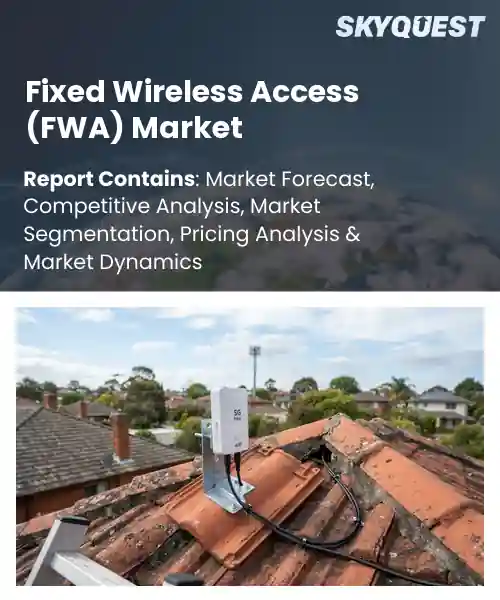
Fixed Wireless Access (FWA) Market
Report ID: SQMIG50C2079
Report ID: SQMIG50C2079
[email protected]
USA +1 351-333-4748
Report ID:
SQMIG50C2079 |
Region:
Global |
Published Date: August, 2026
Pages:
157
|Tables:
170
|Figures:
79


Global Fixed Wireless Access (Fwa) Market size was valued at USD 49.73 Billion in 2024 and is poised to grow from USD 57.79 Billion in 2025 to USD 192.08 Billion by 2033, growing at a CAGR of 16.2% during the forecast period (2026-2033).
The global Fixed Wireless Access (FWA) market delivers broadband connectivity by linking homes and enterprises to fiber‑grade networks through radio links rather than cables. Its significance stems from the ability to provide internet in underserved, rural, or expanding urban zones where laying fiber is prohibitive. The primary driver has been the proliferation of 4G LTE and recently 5G spectrum, which supplies the throughput and latency required for residential streaming, cloud gaming, and remote work. Early deployments in Sweden and Australia showed that base stations could replace miles of conduit, prompting telcos worldwide to invest in spectrum auctions and infrastructure upgrades. A pivotal factor shaping the FWA market is the surge in demand for services driven by the hybrid work model and the rollout of immersive applications such as augmented reality training and tele‑medicine diagnostics. When enterprises adopt office layouts, they require reliable broadband that rivals fiber, prompting companies like Verizon and Telstra to pair 5G‑NR fixed nodes with edge‑computing platforms, thereby reducing backhaul congestion and improving user experience. This synergy creates a feedback loop: enhanced service quality attracts residential subscribers, whose subscription fees fund spectrum acquisition and network densification, expanding coverage into local mountain communities and delivering significant socioeconomic uplift.
How is AI-driven automation reshaping the Fixed Wireless Access market?
AI‑driven automation is reshaping Fixed Wireless Access by making network design more agile and service delivery faster. Machine‑learning models analyze traffic patterns to allocate spectrum in real time, while predictive analytics anticipate equipment failures and trigger pre‑emptive repairs. Automated provisioning reduces the time needed to activate new sites, and AI‑based quality‑of‑service engines continuously tune beamforming and power levels to maintain optimal performance. These capabilities lower operational costs and improve user experience, encouraging operators to expand coverage into underserved areas. As the market moves toward higher capacity 5G FWA, AI becomes a core enabler for scaling infrastructure efficiently.In April 2026, a major telecom operator launched an AI‑powered network management platform for its 5G FWA services, streamlining deployment and reducing latency, thereby supporting market growth and efficiency.
Market snapshot - (2026-2033)
Global Market Size
USD 49.73 Billion
Largest Segment
Powders
Fastest Growth
Aqueous Dispersions
Growth Rate
16.2% CAGR
To get more insights on this market click here to Request a Free Sample Report
Global fixed wireless access (fwa) market is segmented by offering, technology, frequency band, connectivity type, end user, application and region. Based on offering, the market is segmented into Hardware and Services. Based on technology, the market is segmented into 4G/LTE, 5G, Wi-Fi and Other Technologies. Based on frequency band, the market is segmented into Sub-6 GHz and mmWave. Based on connectivity type, the market is segmented into Licensed and Unlicensed. Based on end user, the market is segmented into Residential, Commercial and Industrial. Based on application, the market is segmented into Broadband Internet Access, Enterprise Connectivity, IoT Connectivity and Other Applications. Based on region, the market is segmented into North America, Europe, Asia Pacific, Latin America and Middle East & Africa.
Services segment dominates because it provides the essential managed support that enables operators to quickly deploy and maintain FWA networks, reducing complexity for customers. The recurring revenue model aligns with operators’ need for predictable cash flow, while bundled service packages enhance user experience and loyalty. Consequently, service‑oriented offerings attract investment and drive market consolidation, reinforcing their leadership position across diverse verticals and geographic markets, fostering broader adoption in the industry.
However, Hardware segment is witnessing the strongest growth momentum because advances in antenna design and cost effective radio units are enabling faster higher capacity deployments. Operators are capitalizing on modular equipment to scale networks rapidly, and the push for edge computing drives demand for on premise hardware, accelerating market expansion.
5G segment leads because it delivers the ultra low latency and high throughput required for next generation FWA services, enabling seamless streaming and real time applications. The integration of massive MIMO and beamforming enhances spectral efficiency, while network slicing allows operators to tailor services for varied user profiles. These technical advantages attract both residential and enterprise customers, solidifying 5G’s central role in shaping the market’s evolution across global ecosystems today.
On the other hand, Wi Fi segment emerges as the key high growth area because its unlicensed spectrum offers cost effective rollout for indoor FWA solutions. Consumer demand for broadband drives operators to integrate Wi Fi extenders, and advancements in Wi Fi 6E expand capacity, fueling accelerated adoption and market diversification.
To get detailed segments analysis, Request a Free Sample Report
North America retains a leading position in the Fixed Wireless Access market because of a mature broadband ecosystem, extensive carrier investment, and favorable regulatory frameworks that encourage spectrum sharing and rapid deployment. The United States benefits from a competitive telecommunications landscape where multiple operators leverage advanced antenna technologies and dense urban infrastructure to deliver high‑capacity services. Canada complements this dominance with strong government support for rural connectivity initiatives and a commitment to open‑access policies that lower barriers for new entrants. Together, these factors produce a robust supply chain, skilled engineering talent, and a forward‑looking consumer base that values high‑speed wireless alternatives to traditional fiber, reinforcing the region’s overall market leadership.
Fixed Wireless Access (FWA) Market in United States is characterized by aggressive rollout of next‑generation radio access networks, with carriers focusing on dense urban corridors and high‑value suburban pockets. Market participants emphasize spectrum efficiency and low‑latency solutions, leveraging millimeter‑wave bands to meet demanding data applications. Consumer demand for flexible, high‑speed connectivity drives continuous innovation, while partnerships with equipment manufacturers accelerate equipment availability and reduce rollout timelines, enhancing overall market resilience.
Fixed Wireless Access (FWA) Market in Canada benefits from coordinated national strategies aimed at bridging the digital divide in remote and indigenous communities. Policy frameworks prioritize spectrum accessibility and incentivize infrastructure sharing, encouraging operators to extend coverage beyond metropolitan centers. The market sees collaboration between telecom incumbents and local providers to tailor solutions for varied terrain, while an emphasis on sustainable deployment practices aligns with broader environmental objectives and strengthens long‑term network viability.
Europe experiences rapid expansion of Fixed Wireless Access because of concerted policy initiatives that prioritize digital inclusion, the availability of mid‑band spectrum, and a competitive telecom landscape eager to diversify service portfolios. Germany leads with a robust manufacturing base and strong emphasis on network densification, while the United Kingdom benefits from a deregulated market encouraging innovative business models and agile spectrum allocation. France adds momentum through targeted rural connectivity programs and collaborative public‑private partnerships. Across the region, consumer preferences for flexible, high‑capacity connections drive operators to invest in advanced antenna systems and cloud‑native architectures, reinforcing Europe’s position as a dynamic arena for FWA growth.
Fixed Wireless Access (FWA) Market in Germany is propelled by a strong engineering ecosystem and a strategic focus on spectrum efficiency. German operators prioritize dense urban deployments, integrating massive MIMO technologies to deliver gigabit‑grade speeds. Collaboration with domestic equipment manufacturers accelerates technology rollouts, while regulatory support facilitates flexible licensing. This environment fosters rapid adoption among enterprise and residential users, reinforcing Germany’s role as a dominant force within the European FWA landscape.
Fixed Wireless Access (FWA) Market in United Kingdom accelerates through liberal spectrum policies and a vibrant competitive environment. Operators exploit newly freed mid‑band frequencies to expand coverage in densely populated cities and emerging suburban zones. The market benefits from agile regulatory frameworks that encourage rapid service launches and innovative pricing structures. Consumer appetite for high‑speed wireless alternatives to legacy broadband fuels investment, positioning the United Kingdom as the fastest‑growing FWA market across Europe.
Fixed Wireless Access (FWA) Market in France emerges from targeted governmental programs that aim to improve connectivity in underserved rural areas. Policy incentives encourage spectrum sharing and lower deployment costs, prompting incumbent carriers and niche providers to pilot innovative solutions. French operators prioritize beam‑forming antennas to address geographic challenges, while partnerships with local municipalities enable network designs. These initiatives foster an emerging FWA ecosystem gaining traction among consumers seeking high‑speed wireless access.
Asia Pacific strengthens its position in Fixed Wireless Access by leveraging a combination of high technology adoption, supportive regulatory environments, and a growing appetite for mobile‑first connectivity solutions. Japan emphasizes ultra‑reliable low‑latency networks to support advanced industrial and consumer applications, while South Korea leads with dense urban deployments and aggressive spectrum utilization. Both markets benefit from advanced semiconductor manufacturing capabilities that reduce equipment costs and accelerate innovation cycles. Consumer expectations for seamless, high‑speed wireless access drive operators to invest in next‑generation antenna arrays and integrate cloud‑centric network architectures, reinforcing the region’s role as a catalyst for global FWA advancement.
Fixed Wireless Access (FWA) Market in Japan is driven by a focus on ultra‑reliable low‑latency services that underpin smart city initiatives and advanced manufacturing. Japanese operators deploy dense small‑cell networks, utilizing high‑frequency bands to deliver gigabit‑class speeds to both urban and suburban users. Collaboration with domestic chip makers enhances equipment availability, while regulatory frameworks promote flexible spectrum sharing. This ecosystem supports rapid adoption among enterprises and residential customers seeking cutting‑edge wireless connectivity.
Fixed Wireless Access (FWA) Market in South Korea thrives on aggressive spectrum utilization and pervasive urban densification. Operators capitalize on extensive mid‑band allocations to roll out high‑capacity networks that serve densely populated cities and emerging smart‑home markets. Partnerships with leading device manufacturers accelerate the deployment of advanced antenna systems, while government policies facilitate swift licensing processes. The result is accelerated consumer uptake of high‑speed wireless services, reinforcing South Korea’s reputation as a benchmark for FWA innovation in the region.
To know more about the market opportunities by region and country, click here to
Buy The Complete Report
Rising Demand for High‑Speed Broadband
Expansion of 5G Infrastructure
Limited Spectrum Availability
High Deployment Cost Concerns
Request Free Customization of this report to help us to meet your business objectives.
The competitive landscape is shaped by aggressive 5G mid‑band FWA rollouts, with Ericsson partnering with multiple carriers to integrate its radio and core solutions, while AT&T accelerated deployment by nearly doubling its FWA‑served sites in a single year, intensifying pressure on rivals to expand coverage; meanwhile, emerging players such as Aervivo are injecting fiber‑grade technology and fresh capital, prompting incumbents to pursue innovation alliances and strategic acquisitions to protect market share.
Top Player’s Company Profile
Recent Developments
SkyQuest’s ABIRAW (Advanced Business Intelligence, Research & Analysis Wing) is our Business Information Services team that Collects, Collates, Correlates, and Analyses the Data collected by means of Primary Exploratory Research backed by robust Secondary Desk research. As per SkyQuest analysis, the Fixed Wireless Access market is being propelled primarily by rising demand for high‑speed broadband, while the rollout of 5G infrastructure provides a second powerful boost by delivering gigabit‑class capacity and low latency. The services segment leads the market because managed support and recurring revenue simplify deployments, and North America remains the dominant region thanks to mature broadband ecosystems and supportive regulation. However, limited spectrum availability restrains growth, forcing operators to balance capacity needs with costly licensing. Together, strong broadband demand, 5G expansion, and AI‑driven network optimization are shaping a fast‑moving landscape, prompting operators worldwide to seek innovative solutions today.
| Report Metric | Details |
|---|---|
| Market size value in 2024 | USD 49.73 Billion |
| Market size value in 2033 | USD 192.08 Billion |
| Growth Rate | 16.2% |
| Base year | 2024 |
| Forecast period | (2026-2033) |
| Forecast Unit (Value) | USD Billion |
| Segments covered |
|
| Regions covered | North America (US, Canada), Europe (Germany, France, United Kingdom, Italy, Spain, Rest of Europe), Asia Pacific (China, India, Japan, Rest of Asia-Pacific), Latin America (Brazil, Rest of Latin America), Middle East & Africa (South Africa, GCC Countries, Rest of MEA) |
| Companies covered |
|
| Customization scope | Free report customization with purchase. Customization includes:-
|
To get a free trial access to our platform which is a one stop solution for all your data requirements for quicker decision making. This platform allows you to compare markets, competitors who are prominent in the market, and mega trends that are influencing the dynamics in the market. Also, get access to detailed SkyQuest exclusive matrix.
Table Of Content
Executive Summary
Market overview
Parent Market Analysis
Market overview
Market size
KEY MARKET INSIGHTS
COVID IMPACT
MARKET DYNAMICS & OUTLOOK
Market Size by Region
KEY COMPANY PROFILES
Methodology
For the Fixed Wireless Access (FWA) Market, our research methodology involved a mixture of primary and secondary data sources. Key steps involved in the research process are listed below:
1. Information Procurement: This stage involved the procurement of Market data or related information via primary and secondary sources. The various secondary sources used included various company websites, annual reports, trade databases, and paid databases such as Hoover's, Bloomberg Business, Factiva, and Avention. Our team did 45 primary interactions Globally which included several stakeholders such as manufacturers, customers, key opinion leaders, etc. Overall, information procurement was one of the most extensive stages in our research process.
2. Information Analysis: This step involved triangulation of data through bottom-up and top-down approaches to estimate and validate the total size and future estimate of the Fixed Wireless Access (FWA) Market.
3. Report Formulation: The final step entailed the placement of data points in appropriate Market spaces in an attempt to deduce viable conclusions.
4. Validation & Publishing: Validation is the most important step in the process. Validation & re-validation via an intricately designed process helped us finalize data points to be used for final calculations. The final Market estimates and forecasts were then aligned and sent to our panel of industry experts for validation of data. Once the validation was done the report was sent to our Quality Assurance team to ensure adherence to style guides, consistency & design.
Analyst Support
Customization Options
With the given market data, our dedicated team of analysts can offer you the following customization options are available for the Fixed Wireless Access (FWA) Market:
Product Analysis: Product matrix, which offers a detailed comparison of the product portfolio of companies.
Regional Analysis: Further analysis of the Fixed Wireless Access (FWA) Market for additional countries.
Competitive Analysis: Detailed analysis and profiling of additional Market players & comparative analysis of competitive products.
Go to Market Strategy: Find the high-growth channels to invest your marketing efforts and increase your customer base.
Innovation Mapping: Identify racial solutions and innovation, connected to deep ecosystems of innovators, start-ups, academics, and strategic partners.
Category Intelligence: Customized intelligence that is relevant to their supply Markets will enable them to make smarter sourcing decisions and improve their category management.
Public Company Transcript Analysis: To improve the investment performance by generating new alpha and making better-informed decisions.
Social Media Listening: To analyze the conversations and trends happening not just around your brand, but around your industry as a whole, and use those insights to make better Marketing decisions.
REQUEST FOR SAMPLE
 REQUEST FREE CUSTOMIZATION


Want to customize this report? This report can be personalized according to your needs. Our analysts and industry experts will work directly with you to understand your requirements and provide you with customized data in a short amount of time. We offer $1000 worth of FREE customization at the time of purchase.
Feedback From Our Clients


 USA (+1) 351-333-4748

