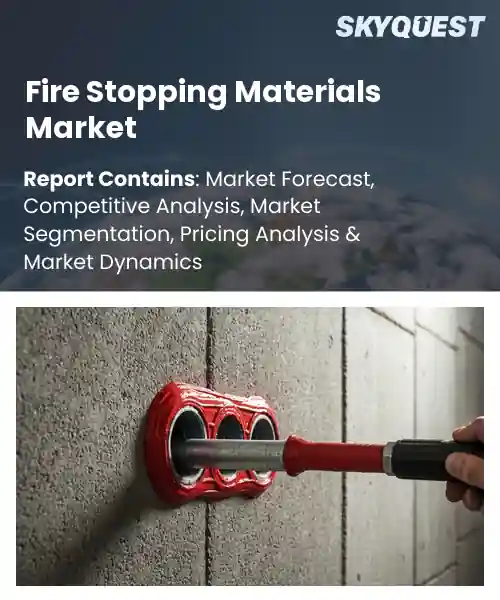
Fire Stopping Materials Market
Report ID: SQMIG15F2335
Report ID: SQMIG15F2335
[email protected]
USA +1 351-333-4748
Report ID:
SQMIG15F2335 |
Region:
Global |
Published Date: June, 2026
Pages:
157
|Tables:
179
|Figures:
79


Global Fire Stopping Materials Market size was valued at USD 1.9 Billion in 2024 and is poised to grow from USD 2.06 Billion in 2025 to USD 3.86 Billion by 2033, growing at a CAGR of 8.2% during the forecast period (2026-2033).
Regulatory tightening and heightened occupant safety concerns are the primary driver shaping the fire stopping materials market, because codes increasingly mandate tested penetration and joint systems to limit flame and smoke spread. The market supplies sealants, intumescent paints, collars, mortars and firestopping composites used around pipes, ducts and cable penetrations to protect life safety and continuity of operations, so it matters to builders, asset owners and insurers. Historically the sector evolved from rudimentary mortars and silicones to systemized tested solutions certified to standards such as ASTM E814 and EN 1366, with examples including retrofit programs after high-profile building fires globally.
For example, the rise of data centers and hospitals causes procurement of advanced intumescent sealants and modular collars to ensure service continuity, while insurers offer lower premiums when buildings demonstrate compliant firestopping, incentivizing adoption. Technological advances in testing and modularization reduce installation time and labor costs, which lowers total lifecycle expenses and opens opportunities for prefabricated firestop solutions in modular construction and renovation supply chains worldwide, and supports market consolidation.
How is AI improving product development in the fire stopping materials market?
The development of fire stopping materials has been influenced positively by artificial intelligence in many areas of its design process. AI helps designers find, test and specify product options by streamlining material discovery (reduction in time and processes when developing a new product). Additionally, using machine learning will allow designers to obtain predictions on how well various firestop materials will perform in fire or last based on data from their formulation and microstructure. Using simulation-driven design also allows for reduced cycles of physical testing and thus reduce the time between iterations of new intumescent and sealant chemistries as well as for determining the overall product performance during installation.
Moreover, the advent of models based on natural language and images aids in establishing consistent specifications while also allowing teams to capture feedback from the field regarding refinements needed to products. By creating digital selector tools and materials hubs, manufacturers and specifiers can also select solutions more quickly when identifying assemblies to assemble a system; thus improving compliance and decreasing the cost of rework at the field level.
In May 2026, Hilti have introduced AI-enabled updates to its firestop selector and its firestop software application. The enhanced capabilities of both of these tools will provide a much more efficient method of automating product selection and also provide the ability to generate inspections ready documentation. This improvement will demonstrate how AI can shorten the development cycle, improve specification accuracy, and improve installation efficiency resulting in more rapid market acceptance and lower waste.
Market snapshot - (2026-2033)
Global Market Size
USD 1.9 Billion
Largest Segment
Sealants
Fastest Growth
Fire Stop Collars & Wraps
Growth Rate
8.2% CAGR
To get more insights on this market click here to Request a Free Sample Report
Global fire stopping materials market is segmented by product type, material type, application, end user, installation type, distribution channel and region. Based on product type, the market is segmented into Sealants, Mortars, Putties, Fire Stop Collars & Wraps, Boards & Pillows and Others. Based on material type, the market is segmented into Silicone-Based, Acrylic-Based, Intumescent Materials, Cementitious Materials and Others. Based on application, the market is segmented into Electrical Penetrations, Mechanical Penetrations, Plumbing Penetrations, Construction Joints, Cable Management Systems and Others. Based on end user, the market is segmented into Commercial Buildings, Industrial Facilities, Residential Buildings and Institutional Buildings. Based on installation type, the market is segmented into New Construction and Renovation & Retrofit. Based on distribution channel, the market is segmented into Direct Sales, Distributors & Dealers and Retail Stores. Based on region, the market is segmented into North America, Europe, Asia Pacific, Latin America and Middle East & Africa.
Intumescent materials segment dominates with large fire stopping materials market share because their ability to expand and form an insulating char under heat directly addresses core fire containment needs for varied penetrations and joints. This performance advantage drives preference among specifiers and contractors, while wide compatibility with common substrates reduces installation complexity. Consequently, intumescent products are repeatedly specified for long term passive protection, reinforced by certification pathways and formulation improvements that bolster confidence and adoption.
As per fire stopping materials market analysis, silicone-based materials are witnessing the strongest growth momentum as installers prioritize flexible, durable sealants that tolerate movement and environmental exposure. Silicone-based materials are still the easiest to apply and fastest to cure, thereby helping facilitate the completion of retro-fit projects and reducing downtime for contractors. With low VOC formulas (emissions) and increased compatibility with a wide variety of cable and joint systems, more contractors are able to use silicone-based materials on projects and take advantage of new codes or regulations.
As per fire stopping materials market outlook, distributors & dealers segment dominates because the extensive network of distribution and long-standing relationships with contractors provide a reliable source of an array of fire stopping products; there is an array of fire stopping materials available through this distribution segment, making it much easier for contractors to procure them for their projects. The technical sales assistance provided by the distribution and dealer segments as well as having local inventory eliminates many of the procurement barriers associated with fire stopping materials and accelerates response times to changes in specification; the variety of assortment and efficiency within the procurement process allows for the development of code compliant solutions. Therefore, the distribution and dealer segments serve as a foundation of the market and help manufacturers achieve broad market penetration and continued use of their products by construction professionals.
As per fire stopping materials market forecast, direct sales are emerging as the most rapidly expanding channel as manufacturers pursue closer customer engagement and project customization. Direct ordering and dedicated technical support simplify specification alignment for major projects, while manufacturer led training and service contracts drive uptake of advanced systems and enable faster feedback driven product refinement.
To get detailed segments analysis, Request a Free Sample Report
As per global fire stopping materials market regional outlook, Asia Pacific remains the leader with a confluence of structural, regulatory and industrial elements that coalesce to provide sustained demand and supply sophistication. Intensive construction activity is being driven by rapid urban growth and big scale infrastructure programmes, and an increased specification of certified fire stopping solutions is being driven by increased regulatory attention to occupant safety. Technology adoption from leading manufacturers in Japan and South Korea enhances quality standards, and local production and customisation is supported by strong regional supply chains. Collaborative industry ecosystems support installation training and third-party testing, which builds market confidence. Increasingly, end users in the commercial, industrial and transit sectors are also prioritising integrated passive fire protection, which further cements the regional leadership in product innovation, project delivery and standards harmonization that together underpin supremacy. In addition, collaborative public private partnerships expedite uptake and increase specification clarity across building typologies.
As per global fire stopping materials market regional forecast, Japan reflects advanced manufacturing and rigorous regulatory frameworks that drive high quality expectations. A focus on seismic resilient design complements fire safety priorities, prompting integrated product solutions and meticulous installation practices. Research activity from established suppliers supports material innovation and durability. Urban renewal and complex infrastructure needs sustain demand for certified systems while training and third party certification bolster specification confidence across construction stakeholders broadly.
Advanced manufacturing capability and focus on high performance building systems are driving the South Korea fire stopping materials market. Strong collaboration between manufacturers and construction companies promotes specification of innovative sealants and collars, while rigorous product testing fosters market trust. The requirement for adaptive passive fire prevention is driven by urban density and transit infrastructure. Training programs and joint standard setting guarantee constant installation quality and increased stakeholder acceptance.
As per global fire stopping materials industry analysis, expansion in North America is driven by a combination of stringent building safety expectations, proactive regulatory frameworks, and a large portfolio of retrofit and new construction activity across commercial and institutional sectors. The United States and Canada exhibit strong demand for certified passive fire protection as asset owners and developers prioritize occupant safety and continuity of operations. Emphasis on life safety and property protection encourages specification of tested systems and comprehensive installer qualification. Industry consolidation among suppliers improves distribution reach and technical support, while innovation in materials and installation methods reduces installation risk and lifecycle maintenance burden. Close collaboration between code authorities, testing bodies, and industry associations helps streamline compliance and raise overall market maturity in the region.
U.S. market is founded on a wealth of codes and a mature building industry that is focused on proven system solutions. Demand is driven by corporate safety requirements and infrastructure needs among commercial and institutional projects. Design experts may specify with confidence, backed by certified items and recognized testing facilities. Training of installers and networks of contractors help to ensure consistent application and manufacturers provide technical support for difficult installations in urban and industrial settings.
Canada market is defined by focus on safety requirements and catering to diverse building typologies. Specification trends for public infrastructure, healthcare and commercial projects are for certified passive fire prevention. Testing laboratories, vendors and regulatory bodies work together to ensure products perform consistently and compliance is clearly defined. Installer accreditation and manufacturer training increase craftsmanship and regional distribution and technical consulting services promote project implementation throughout urban locations nationwide.
Europe is strengthening its position through harmonized regulatory initiatives, enhanced standards development, and concentrated innovation across materials and testing methodologies. Germany, United Kingdom, and France contribute significant technical leadership and market sophistication, with manufacturers and testing bodies collaborating to refine product performance criteria and installation protocols. Emphasis on safety in retrofit programs and major public infrastructure projects increases demand for reliable passive fire protection solutions. Cross border knowledge exchange, certification reciprocity, and professional training programs improve installer competence and specification clarity. Investment in research and development and growing focus on lifecycle performance further elevate market maturity and encourage adoption of advanced sealants, seals, and system based approaches that align with evolving safety expectations across the region. Public procurement preferences and collaborative pilot projects help validate new solutions and accelerate market uptake.
In Germany, strict engineering traditions and rigid standards that shape specification processes benefit the market. Strong product evaluation and system based techniques are ensured by robust links between testing institutes, manufacturers and construction enterprises. Demand from industry and commercial sectors encourages high performance sealants and solutions that combine with fire rated structures. The large projects have a uniform installation quality, underpinned by professional training, recognized testing, defined certification procedures and installer competency.
The market is driven by attention on building safety reform, stringent testing regimes and increased demand for retrofit solutions. Manufacturers focus on proven system performance and clear installation guidelines to meet regulatory scrutiny. Demand from commercial, residential and transport infrastructure projects is supporting the design of integrated passive fire protection. Accredited testing and installation competency programmes promote compliance and build confidence between specifiers and contractors across all types of buildings.
France combines strong regulatory oversight with research emphasis that advances product performance. Demand stems from public infrastructure, healthcare, and urban development projects that require reliable passive fire protection systems. Manufacturers and testing laboratories collaborate to refine performance criteria and installation methods tailored to mixed construction types. Training and certification processes promote installation quality while advisory services help specifiers navigate compliance and system selection for projects.
To know more about the market opportunities by region and country, click here to
Buy The Complete Report
Rising Construction Activity And Safety
Stringent Building Codes And Regulations
High Material Costs And Availability
Lengthy Certification And Approval Processes
Request Free Customization of this report to help us to meet your business objectives.
The landscape for global fire stopping materials is increasingly consolidated as the large suppliers are concentrating on mergers product launches to win specification driven contracts. Within the context of competitive mergers such as Sika’s acquisition of MBCC; Digital tools being developed by key suppliers for digital design and submittal; and manufacturers providing specialty installer trained façade firestop systems to meet the demands of stricter safety codes and faster speed to deliver projects.
SkyQuest’s ABIRAW (Advanced Business Intelligence, Research & Analysis Wing) is our Business Information Services team that Collects, Collates, Correlates, and Analyses the Data collected by means of Primary Exploratory Research backed by robust Secondary Desk research.
As per SkyQuest analysis, regulatory tightening and heightened occupant safety concerns serve as a key driver for the global fire stopping materials market growth compelling adoption of certified systems. However, high material costs and supply constraints pose a significant restraint that can slow specification and adoption. Asia Pacific dominates the market while intumescent materials lead product preference due to superior performance. A second driver is accelerated urbanization and expanding critical infrastructure, which increases new construction and retrofit demand. Together these forces, along with innovation in modular prefabrication and AI-enabled specification tools, push manufacturers toward sustainable chemistries, installer training and digitized services to win specification-led projects and improve compliance.
| Report Metric | Details |
|---|---|
| Market size value in 2024 | USD 1.9 Billion |
| Market size value in 2033 | USD 3.86 Billion |
| Growth Rate | 8.2% |
| Base year | 2024 |
| Forecast period | (2026-2033) |
| Forecast Unit (Value) | USD Billion |
| Segments covered |
|
| Regions covered | North America (US, Canada), Europe (Germany, France, United Kingdom, Italy, Spain, Rest of Europe), Asia Pacific (China, India, Japan, Rest of Asia-Pacific), Latin America (Brazil, Rest of Latin America), Middle East & Africa (South Africa, GCC Countries, Rest of MEA) |
| Companies covered |
|
| Customization scope | Free report customization with purchase. Customization includes:-
|
To get a free trial access to our platform which is a one stop solution for all your data requirements for quicker decision making. This platform allows you to compare markets, competitors who are prominent in the market, and mega trends that are influencing the dynamics in the market. Also, get access to detailed SkyQuest exclusive matrix.
Table Of Content
Executive Summary
Market overview
Parent Market Analysis
Market overview
Market size
KEY MARKET INSIGHTS
COVID IMPACT
MARKET DYNAMICS & OUTLOOK
Market Size by Region
KEY COMPANY PROFILES
Methodology
For the Fire Stopping Materials Market, our research methodology involved a mixture of primary and secondary data sources. Key steps involved in the research process are listed below:
1. Information Procurement: This stage involved the procurement of Market data or related information via primary and secondary sources. The various secondary sources used included various company websites, annual reports, trade databases, and paid databases such as Hoover's, Bloomberg Business, Factiva, and Avention. Our team did 45 primary interactions Globally which included several stakeholders such as manufacturers, customers, key opinion leaders, etc. Overall, information procurement was one of the most extensive stages in our research process.
2. Information Analysis: This step involved triangulation of data through bottom-up and top-down approaches to estimate and validate the total size and future estimate of the Fire Stopping Materials Market.
3. Report Formulation: The final step entailed the placement of data points in appropriate Market spaces in an attempt to deduce viable conclusions.
4. Validation & Publishing: Validation is the most important step in the process. Validation & re-validation via an intricately designed process helped us finalize data points to be used for final calculations. The final Market estimates and forecasts were then aligned and sent to our panel of industry experts for validation of data. Once the validation was done the report was sent to our Quality Assurance team to ensure adherence to style guides, consistency & design.
Analyst Support
Customization Options
With the given market data, our dedicated team of analysts can offer you the following customization options are available for the Fire Stopping Materials Market:
Product Analysis: Product matrix, which offers a detailed comparison of the product portfolio of companies.
Regional Analysis: Further analysis of the Fire Stopping Materials Market for additional countries.
Competitive Analysis: Detailed analysis and profiling of additional Market players & comparative analysis of competitive products.
Go to Market Strategy: Find the high-growth channels to invest your marketing efforts and increase your customer base.
Innovation Mapping: Identify racial solutions and innovation, connected to deep ecosystems of innovators, start-ups, academics, and strategic partners.
Category Intelligence: Customized intelligence that is relevant to their supply Markets will enable them to make smarter sourcing decisions and improve their category management.
Public Company Transcript Analysis: To improve the investment performance by generating new alpha and making better-informed decisions.
Social Media Listening: To analyze the conversations and trends happening not just around your brand, but around your industry as a whole, and use those insights to make better Marketing decisions.
REQUEST FOR SAMPLE
 REQUEST FREE CUSTOMIZATION
Global Fire Stopping Materials Market size was valued at USD 1.9 Billion in 2024 and is poised to grow from USD 2.06 Billion in 2025 to USD 3.86 Billion by 2033, growing at a CAGR of 8.2% during the forecast period (2026-2033).
Competitive landscape in the global fire stopping materials market is consolidating as large suppliers pursue acquisitions, targeted product launches, and digital services to win specification led contracts. Mergers such as Sika’s MBCC deal, digital design and submittal tools from major vendors, and recent specialty façade firestop rollouts illustrate concrete competitive moves that respond to tighter safety codes and faster project delivery demands. '3M', 'Hilti Group', 'Rockwool International', 'Sika', 'H. B. Fuller', 'Specified Technologies Inc.', 'RectorSeal', 'RPM International', 'Etex Group', 'FSi Limited', 'Knauf Group', 'Arkema', 'Morgan Advanced Materials', 'Walraven Group', 'Nelson Firestop Products', 'Everkem Diversified Products', 'Fosroc', 'Emseal Joint Systems', 'Saint-Gobain', 'BASF'
Growing urban populations and increased investment in residential and commercial development have expanded opportunities for fire protection solutions. As construction activity intensifies, developers and contractors prioritize products that can improve occupant safety and meet stakeholder expectations. This drives procurement of certified fire stopping materials to integrate fire compartmentation into building envelopes and service penetrations. Heightened emphasis on occupant protection and reputational risk mitigation encourages specification of reliable systems, prompting manufacturers to expand offerings and support services that align with modern construction practices and safety driven outcomes.
Sustainable Fire Barrier Demand: Growing regulatory emphasis on environmental performance and green building certifications is shifting procurement toward lowVOC, recyclable and biobased fire stopping materials. Manufacturers are innovating to replace halogenated formulations with sustainable chemistries while maintaining fire performance and installation ease. Clients increasingly prioritize product lifecycle impacts, supply chain transparency and endoflife handling, prompting ecolabeling and corporate sustainability commitments. This trend fosters collaboration across material scientists, architects and contractors to align overall safety objectives with carbon reduction goals, circularity principles and resilience planning.
Why does Asia Pacific Dominate the Global Fire Stopping Materials Market? |@12


Want to customize this report? This report can be personalized according to your needs. Our analysts and industry experts will work directly with you to understand your requirements and provide you with customized data in a short amount of time. We offer $1000 worth of FREE customization at the time of purchase.
Feedback From Our Clients


 USA (+1) 351-333-4748

