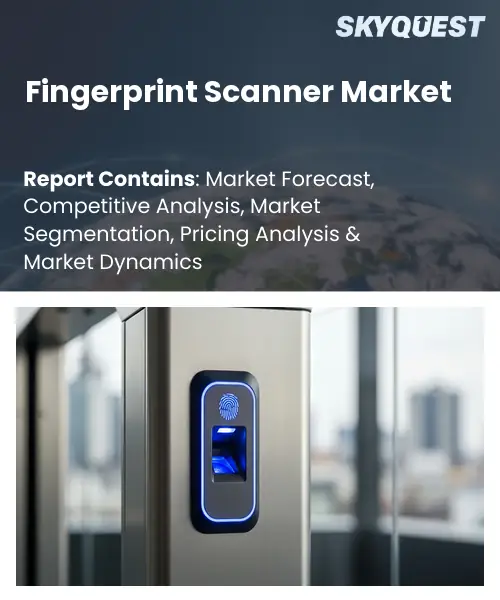
Fingerprint Scanner Market
Report ID: SQMIG45J2715
Report ID: SQMIG45J2715
[email protected]
USA +1 351-333-4748
Report ID:
SQMIG45J2715 |
Region:
Global |
Published Date: August, 2026
Pages:
157
|Tables:
118
|Figures:
77


Global Fingerprint Scanner Market size was valued at USD 486.2 Million in 2024 and is poised to grow from USD 527.04 Million in 2025 to USD 1004.8 Million by 2033, growing at a CAGR of 8.4% during the forecast period (2026-2033).
The global fingerprint scanner market comprises devices and software that help in capturing, storing, and validating unique ridges patterns for identification purposes. The significance of the market can be attributed to the rising need for security and fast access control in banking sector, mobile gadgets, and public safety systems. Key drivers include the rise in biometrics-capable smartphones that have prompted the incorporation of capacitive and ultrasonic scanners to fulfill customer requirements of security and reliability. During the last decade, the market has grown from being a specialized device for law enforcement to a common feature with the advent of Touch ID from Apple in 2013 and incorporation of fingerprint scanners in 300 million Android phones.
Focus on privacy regulations and use of contactless authentication technology fuel the growth of the fingerprint scanner market, as now authorities and businesses require identification proof that will not rely on passwords. In particular, the need to provide secure identification has led to increased funding for biometric systems that combine fingerprint scanners with face or iris recognition devices, used for border control and financial institutions. In the EU, for example, the adoption of eIDAS regulations made banks integrate fingerprint-enabled ATMs, resulting in fraud reduction by 30 percent. Therefore, component manufacturers experience an increase in orders for more advanced sensors and machine learning matching software.
How is AI Enhancing Security and Scalability in the Fingerprint Scanner Market?
The application of artificial intelligence in fingerprint scanning technology is changing how fingerprint scanners operate by incorporating adaptive algorithms which can detect any spoofing attempt and even improve enrollment. These machine learning techniques allow fingerprints to be scanned using minutiae analysis in real-time to speed up verification processes and minimize false rejections. Edge-AI chips now perform computations inside the sensor hence eliminating cloud callouts and improving privacy. This change comes at a time when fingerprint sensors are being integrated into smartphones, access control systems, and IoT gateways whose scalability requirements call for efficient security and low latency. Companies are also incorporating AI-powered liveness detection and multimodal fusion techniques in their technology for improved resilience against threats.
Market snapshot - (2026-2033)
Global Market Size
USD 486.2 Million
Largest Segment
Capacitive Scanners
Fastest Growth
Ultrasonic Scanners
Growth Rate
8.4% CAGR
To get more insights on this market click here to Request a Free Sample Report
Global fingerprint scanner market is segmented by product type, form factor, application, end user and region. Based on product type, the market is segmented into Optical Scanners, Capacitive Scanners and Ultrasonic Scanners. Based on form factor, the market is segmented into Standalone, Embedded and Portable. Based on application, the market is segmented into Consumer Electronics, Access Control, Banking & Finance and Government Identification. Based on end user, the market is segmented into Government, Enterprises and Consumers. Based on region, the market is segmented into North America, Europe, Asia Pacific, Latin America and Middle East & Africa.
The capacitive scanner segments dominate since it provides a perfect balance between high level of precision and affordability that satisfies the needs of the mass-market consumers. The advanced manufacturing technologies allow ensuring the stable image quality of various types of skin, making this technology widespread in smartphones and laptops. Also, this type is highly effective because of its energy efficiency and seamless integration with SOCs.
However, ultrasonic scanners segment shows the tendency of fast development since the possibility of capturing 3D images allows ensuring the high performance of the device even through the wet and oily skin as well as through the protective glass.
Consumer Electronics Segment is the leading position due to the adoption of fingerprint scanners by smartphone manufacturers, laptop makers and tablet producers as default security mechanism that meets users' expectations of convenience and data safety. OEMs install scanner right into the body of their devices, minimizing tactile sensation and simplifying process of user onboard. Intersection of biometric standards and OS ecosystems leads to constant updates of firmware, and promotes development of third-party applications based on modern fingerprint recognition technology.
The Banking & Finance Segment is the highest growth momentum as financial organizations require biometric verification due to regulatory anti-fraud requirements and customer satisfaction. Fingerprint scanner installation into ATMs, POS terminals and mobile banking apps triggers improvements in software development and creates a platform for signing contracts.
To get detailed segments analysis, Request a Free Sample Report
The Asia-Pacific region stands out in the world market of fingerprint scanners owing to the intersection of highly developed manufacturing technology, high demand for consumer electronics, and active development of security technologies. The region boasts an engineering workforce that facilitates quick invention and development of small and highly efficient sensors for use in mobile devices, banking, and security purposes. Affordable prices due to the high volume of production facilitate the penetration of fingerprint scanners into both the enterprise and consumer market. The government's focus on using biometrics for border control and the national identity system also contributes to the development of the market.
Fingerprint Scanner Market in Japan is shaped by a mature consumer electronics sector that values high security and seamless user experience. Domestic manufacturers integrate fingerprint technology into a broad array of smartphones, automotive infotainment systems, and industrial equipment. Strong emphasis on data privacy and rigorous regulatory standards drive demand for sensors that meet stringent accuracy requirements. Collaborative research initiatives between universities and corporations sustain a pipeline of innovative biometric solutions.
Fingerprint Scanner Market in South Korea flourishes due to the thriving ecosystem of technology that is a combination of advanced knowledge about semiconductors and rapid deployment of devices. Local companies integrate fingerprint scanners into their top-end mobile devices, wearables, and smart home systems, stressing the need for fast and reliable scanners. Public authorities’ investments in smart cities include biometrics and fingerprint scanners as the element of secure access control.
The rapid expansion of the fingerprint scanner market in North America is propelled by heightened focus on data protection, extensive deployment of biometric solutions across financial services, and a robust ecosystem of technology innovators. Enterprises prioritize multi‑factor authentication to safeguard sensitive information, prompting widespread integration of fingerprint sensors into workstations, access control systems, and point‑of‑sale terminals. Consumer appetite for secure mobile devices fuels demand for high‑resolution sensors that enable seamless unlocking and payment functions. Government directives encouraging biometric verification for public services and border management reinforce market momentum.
To know more about the market opportunities by region and country, click here to
Buy The Complete Report
Rising Demand for Contactless Authentication
Integration of Biometrics in IoT Devices
Privacy Concerns are Hindering Adoption
High Implementation Costs are Restricting Growth
Request Free Customization of this report to help us to meet your business objectives.
The fingerprint sensor industry is heating up, with players embarking on M&A and partnership deals aimed at expanding their sensor offerings and incorporating biometric data with AI-based security systems. Specifically, one of the biggest sensor makers bought out an optical fingerprint sensor player in order to improve image resolution, whereas one of the biggies entered into a joint venture with a mobile operating system maker for advanced liveness detection on phones.
Recent Developments in the Fingerprint Scanner Market
SkyQuest’s ABIRAW (Advanced Business Intelligence, Research & Analysis Wing) is our Business Information Services team that Collects, Collates, Correlates, and Analyses the Data collected by means of Primary Exploratory Research backed by robust Secondary Desk research.
As per SkyQuest analysis, global market for fingerprint scanners is growing at a CAGR of 8.4%, mainly due to increased need for contactless authentication in banking and retail sectors as well as in consumer devices, whereas privacy considerations represent a major barrier that is hampering the penetration rate in stringent markets. Capacitive scanners account for the biggest share within the product type category owing to the accuracy and cost-effectiveness of the technology, while Asia-Pacific represents the leading regional market due to its manufacturing strengths and heavy consumption of consumer electronics along with its biometric initiatives. Another key growth factor for this market is the deployment of fingerprint recognition in IoT devices.
| Report Metric | Details |
|---|---|
| Market size value in 2024 | USD 486.2 Million |
| Market size value in 2033 | USD 1004.8 Million |
| Growth Rate | 8.4% |
| Base year | 2024 |
| Forecast period | (2026-2033) |
| Forecast Unit (Value) | USD Million |
| Segments covered |
|
| Regions covered | North America (US, Canada), Europe (Germany, France, United Kingdom, Italy, Spain, Rest of Europe), Asia Pacific (China, India, Japan, Rest of Asia-Pacific), Latin America (Brazil, Rest of Latin America), Middle East & Africa (South Africa, GCC Countries, Rest of MEA) |
| Companies covered |
|
| Customization scope | Free report customization with purchase. Customization includes:-
|
To get a free trial access to our platform which is a one stop solution for all your data requirements for quicker decision making. This platform allows you to compare markets, competitors who are prominent in the market, and mega trends that are influencing the dynamics in the market. Also, get access to detailed SkyQuest exclusive matrix.
Table Of Content
Executive Summary
Market overview
Parent Market Analysis
Market overview
Market size
KEY MARKET INSIGHTS
COVID IMPACT
MARKET DYNAMICS & OUTLOOK
Market Size by Region
KEY COMPANY PROFILES
Methodology
For the Fingerprint Scanner Market, our research methodology involved a mixture of primary and secondary data sources. Key steps involved in the research process are listed below:
1. Information Procurement: This stage involved the procurement of Market data or related information via primary and secondary sources. The various secondary sources used included various company websites, annual reports, trade databases, and paid databases such as Hoover's, Bloomberg Business, Factiva, and Avention. Our team did 45 primary interactions Globally which included several stakeholders such as manufacturers, customers, key opinion leaders, etc. Overall, information procurement was one of the most extensive stages in our research process.
2. Information Analysis: This step involved triangulation of data through bottom-up and top-down approaches to estimate and validate the total size and future estimate of the Fingerprint Scanner Market.
3. Report Formulation: The final step entailed the placement of data points in appropriate Market spaces in an attempt to deduce viable conclusions.
4. Validation & Publishing: Validation is the most important step in the process. Validation & re-validation via an intricately designed process helped us finalize data points to be used for final calculations. The final Market estimates and forecasts were then aligned and sent to our panel of industry experts for validation of data. Once the validation was done the report was sent to our Quality Assurance team to ensure adherence to style guides, consistency & design.
Analyst Support
Customization Options
With the given market data, our dedicated team of analysts can offer you the following customization options are available for the Fingerprint Scanner Market:
Product Analysis: Product matrix, which offers a detailed comparison of the product portfolio of companies.
Regional Analysis: Further analysis of the Fingerprint Scanner Market for additional countries.
Competitive Analysis: Detailed analysis and profiling of additional Market players & comparative analysis of competitive products.
Go to Market Strategy: Find the high-growth channels to invest your marketing efforts and increase your customer base.
Innovation Mapping: Identify racial solutions and innovation, connected to deep ecosystems of innovators, start-ups, academics, and strategic partners.
Category Intelligence: Customized intelligence that is relevant to their supply Markets will enable them to make smarter sourcing decisions and improve their category management.
Public Company Transcript Analysis: To improve the investment performance by generating new alpha and making better-informed decisions.
Social Media Listening: To analyze the conversations and trends happening not just around your brand, but around your industry as a whole, and use those insights to make better Marketing decisions.
REQUEST FOR SAMPLE
 REQUEST FREE CUSTOMIZATION
Global Fingerprint Scanner Market size was valued at USD 486.2 Million in 2024 and is poised to grow from USD 527.04 Million in 2025 to USD 1004.8 Million by 2033, growing at a CAGR of 8.4% during the forecast period (2026-2033).
The fingerprint scanner market is intensifying as incumbents pursue strategic M&A and partnerships to broaden sensor portfolios and integrate biometric data with AI-driven security platforms. Notably, a leading sensor manufacturer acquired a smaller optical fingerprint firm to enhance high‑resolution imaging, while another major player forged a joint venture with a mobile OS developer to embed advanced liveness detection directly into smartphones, accelerating adoption across consumer and enterprise segments. 'IDEMIA', 'Thales S.A.', 'NEC Corporation', 'HID Global Corporation', 'Synaptics Incorporated', 'Goodix Technology Inc.', 'Fingerprint Cards AB', 'Egis Technology Inc.', 'Shenzhen Huiding Technology Co., Ltd.', 'ImageWare Systems, Inc.', 'Integrated Biometrics, LLC', 'Aratek Biometrics Technology Co., Ltd.', 'Suprema Inc.', 'ZKTeco Co., Ltd.', 'BIO-key International, Inc.', 'Crossmatch Technologies', 'Dermalog Identification Systems GmbH', 'SecuGen Corporation', 'Nitgen Co., Ltd.', 'Precise Biometrics AB'
The growing preference for touchless verification across financial, healthcare, and retail sectors fuels demand for fingerprint scanners, as organizations seek to enhance user convenience while maintaining security standards. This trend encourages manufacturers to innovate compact, reliable sensors that can be seamlessly embedded into devices, thereby expanding market reach and stimulating adoption among both enterprise and consumer applications. Additionally, the ease of integrating biometric verification with existing digital infrastructures reduces deployment barriers, allowing a broader range of businesses to implement robust identity management solutions without extensive retraining of staff.
Biometric Convergence Accelerates: Manufacturers are embedding fingerprint sensors alongside facial recognition, voice authentication, and iris scanning within a single device, creating seamless multi‑modal security platforms. This convergence reduces the need for separate hardware, simplifies user experiences, and meets increasing enterprise demands for layered protection. As operating systems standardize APIs for combined biometric inputs, developers can design unified authentication flows, driving broader adoption across smartphones, laptops, and access‑control terminals while reinforcing trust in digital identities across industries and government services worldwide today for security
Why does Asia Pacific Dominate the Global Fingerprint Scanner Market? |@12


Want to customize this report? This report can be personalized according to your needs. Our analysts and industry experts will work directly with you to understand your requirements and provide you with customized data in a short amount of time. We offer $1000 worth of FREE customization at the time of purchase.
Feedback From Our Clients


 USA (+1) 351-333-4748

