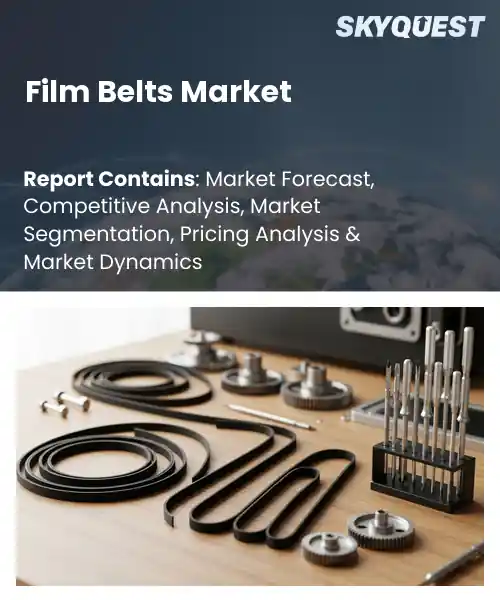
Film Belts Market
Report ID: SQMIG20I2885
Report ID: SQMIG20I2885
[email protected]
USA +1 351-333-4748
Report ID:
SQMIG20I2885 |
Region:
Global |
Published Date: April, 2026
Pages:
157
|Tables:
90
|Figures:
76


Global Film Belts Market size was valued at USD 542.1 Million in 2024 and is poised to grow from USD 564.87 Million in 2025 to USD 544.1 Million by 2033, growing at a CAGR of 4.2% during the forecast period (2026-2033).
The primary driver of the film belts market is the sustained acceleration of automated packaging across consumer goods, pharmaceuticals and food industries, which demands higher throughput and gentler handling of films. A film belts market supplies continuous polymer and fabric conveyors designed to transport, laminate or thermoform films; it matters because belt performance directly affects yield, product integrity and sanitation compliance. Historically the market evolved from metal mesh and rubber conveyors to engineered polymeric belts with PTFE, polyester and specialized coatings, prompted by material science advances and stricter hygiene standards, as seen when blister packaging replaced bulk bottle handling globally.Building on those operational demands, the dominant factor now is material innovation combined with digitalization, because improvements in polymer chemistry and sensor integration directly enable belts that resist abrasion, tolerate higher temperatures and signal wear before failure. As regulators tighten food safety and brands pursue sustainable packaging, manufacturers replace older belts with FDA-compliant, low-friction and recyclable-material options which lowers contamination risk and line stoppages. This creates opportunities for suppliers to offer retrofit kits, predictive maintenance services and bespoke belt geometries; for example dairy thermoforming plants adopt low-release coatings, while electronics assemblers specify anti-static, heat-resistant films to protect sensitive components further.
How is automation improving production efficiency in the film belts market?
Automation is improving production efficiency in the film belts market by reducing manual tasks and increasing process consistency. Key aspects include embedded sensors for tension and wear monitoring, machine controls that adapt speed and alignment in real time, automated splicing and cutting, and robotic handling for loading and inspection. The current state sees manufacturers prioritizing component reliability and repeatable performance to support packaging and conversion lines. Examples such as sensor driven predictive maintenance and PLC based control schemes shorten changeover time and reduce unplanned stoppages. These shifts make production more reliable and lower the labor intensity of high throughput operations.Ammeraal Beltech April 2026, launched a RAPPLON elastic flat belt aimed at logistics automation, demonstrating how automation improves production efficiency in the film belts market by enabling stable tracking, lower energy use, and reduced maintenance through design and material choices that support automated conveyors and AGV systems.
Market snapshot - (2026-2033)
Global Market Size
USD 542.1 Million
Largest Segment
Native Cloud Cost Management Tools (AWS/Azure/GCP)
Fastest Growth
Managed Services & Consulting
Growth Rate
4.2% CAGR
To get more insights on this market click here to Request a Free Sample Report
Global film belts market is segmented by solution type, organization size (major revenue logic), end-use vertical and region. Based on solution type, the market is segmented into Native Cloud Cost Management Tools (AWS/Azure/GCP), Third-party FinOps Platforms (Apptio/CloudHealth) and Managed Services & Consulting. Based on organization size (major revenue logic), the market is segmented into Large Enterprises (Multi-cloud Complexity) and SMEs (Cloud-native Startups). Based on end-use vertical, the market is segmented into BFSI & Fintech, IT, Cloud & Telecommunications and Others (Retail & Healthcare). Based on region, the market is segmented into North America, Europe, Asia Pacific, Latin America and Middle East & Africa.
Large Enterprises (Multi-cloud Complexity) segment dominates because their centralized procurement frameworks and continuous operational requirements push suppliers to prioritize high-durability, enterprise-grade film belts designed for heavy duty and predictable lifecycle performance. The need for vendor qualification, standardized specifications, and integrated maintenance contracts drives manufacturers to invest in robust materials, quality assurance, and after-sales support, reinforcing supplier focus on long-term reliability and tailored service models that align with complex buyer needs.
However, SMEs (Cloud-native Startups) are emerging as the fastest-growing area due to agile purchasing, demand for rapid prototyping and customizable small-batch film belts, and openness to novel materials and finishes. Their preference for quick turnaround and iterative testing accelerates supplier innovation, enabling faster validation of new formulations and drive to expand niche product lines that create fresh market opportunities.
BFSI & Fintech segment leads because high-security cash handling, automated sorting and secure document processing impose stringent performance and contamination control requirements on film belts. These buyers demand precise dimensional stability, anti-static and anti-microbial properties, and certified maintenance regimes, which compel manufacturers to develop specialized coatings, reinforced constructions and compliance-oriented testing, thereby steering product development toward higher-specification, reliability-focused belt designs.
However, IT, Cloud & Telecommunications is the fastest-growing area as increasing electronics assembly and component production require cleanroom-compatible, anti-static film belts with tighter tolerances. Rising demand for miniaturized devices and higher equipment throughput accelerates adoption of advanced materials and surface finishes, fostering innovation among suppliers and creating new opportunities for specialized belt variants tailored to electronics manufacturing needs.
To get detailed segments analysis, Request a Free Sample Report
Asia Pacific leads the global Film Belts Market due to a dense manufacturing ecosystem that spans electronics, display fabrication, automotive assembly, and flexible packaging. Regional strengths include deep supplier networks, proximity to raw material sources, and a workforce experienced in precision processing and material science. Manufacturers and equipment providers collaborate closely with OEMs and research institutions to co develop application specific belt solutions, accelerating technology adoption. Cost competitiveness and scale advantages support high volume production while strong investments in automation and continuous processing enable consistent quality. Supportive industrial policy frameworks, strong after market service networks, and a focus on customization for local supply needs further reinforce regional advantage, enabling faster time to market for new film handling technologies and material innovations.
Film Belts Market in Japan benefits from a mature electronics and automotive manufacturing base, concentrated high value production, and close supplier relationships. Manufacturers prioritize precision, material science expertise, and rigorous quality standards. Strong collaboration between OEMs, research institutions, and process equipment vendors enables tailored belt solutions for sensitive substrates. Demand emphasizes reliability, long operational life, and tight tolerances, supporting advanced film handling technologies and specialized coatings for high-performance applications environments.
Film Belts Market in South Korea draws strength from a technology driven production landscape with emphasis on semiconductors, displays, and advanced packaging. Local manufacturers exhibit rapid adoption of automation, high precision manufacturing practices, and integration with global supply networks. Focus on miniaturization and thin film handling drives demand for high stability belts with specialized surface treatments. Partnerships among component makers and industrial machinery firms foster innovation and tailored product development.
North America is experiencing rapid expansion in the Film Belts Market driven by diverse end market demand, established process engineering capabilities, and a focus on automation and quality assurance. The region benefits from a strong presence of food and beverage packaging, medical device manufacturing, and specialty converting operations that require reliable film transport solutions. Emphasis on sustainability, ease of integration with existing lines, and local service and replacement networks encourages adoption of higher performance belts. OEMs and integrators collaborate with material suppliers to specify belts that meet stringent regulatory and cleanroom requirements, while aftermarket support and customization services enable producers to optimize uptime and adapt to changing product mixes, reinforcing market momentum. Significant investment in application development, rapid prototyping, and cross border supply chain partnerships supports continuous product refinement and regional competitiveness.
Film Belts Market in United States is characterized by strong demand from packaging, medical device and high tech manufacturing sectors, with emphasis on performance and regulatory compliance. Manufacturers prioritize belts that enable quick changeovers, sanitary operation, and integration with automation platforms. A dense network of integrators and service providers supports deployment and maintenance, while collaboration with material innovators yields belts tailored to specialty films and recyclable material formats market needs.
Film Belts Market in Canada centers on industrial converting and food processing, with close integration into North American supply chains. Buyers prioritize hygienic design, energy efficient operation and substrate compatibility. Suppliers provide flexible service models, parts availability and collaborative engineering to tailor belts for small batch production. Focus on sustainable materials and robust end of line reliability sustains demand for durable, low maintenance belt solutions across varied manufacturing settings environments.
Europe is strengthening its presence in the Film Belts Market through a combination of material innovation, precision engineering, and a strong focus on regulatory compliance and sustainability. Established manufacturing clusters deliver high quality bespoke belt solutions for demanding sectors such as automotive, medical devices, and specialty packaging. Investment in recycled and bio based substrates, coupled with robust testing and certification infrastructure, supports adoption of belts engineered for circular economy objectives. Close collaboration between converters, equipment builders, and research centers drives incremental performance improvements, while responsive aftermarket networks and customization capabilities allow producers to address complex application requirements and maintain reliable, efficient film handling across diverse production environments. Harmonization of standards across regional markets, emphasis on workforce training, and adoption of automated continuous processing further enhance competitiveness and accelerate uptake of advanced belt technologies.
Film Belts Market in Germany is anchored by a precision engineering tradition and close integration with automotive manufacturing. Demand favors high durability, tight tolerances, and specialized surface treatments for challenging processing conditions. Local suppliers emphasize customization, quality validation, and long term service agreements, supported by advanced materials research and collaboration with equipment manufacturers. A focus on energy efficient operation and integration with industry automation platforms differentiates product offerings and reliability.
Film Belts Market in United Kingdom benefits from a diverse mix of food packaging and pharmaceutical production, demanding hygiene and precision. Suppliers cater with belts designed for sanitary cleaning, electrostatic control, and fine film handling. A network of converters and equipment specialists supports rapid customization and retrofit projects. Emphasis on low waste processing and recyclable film compatibility drives development of belts with improved surface finishes and adaptable tensioning systems requirements.
Film Belts Market in France is driven by activity in luxury packaging, food processing, and bespoke industrial machinery, creating demand for refined belt solutions. Suppliers emphasize aesthetic quality, precise tracking, and minimal marking for premium film applications. Collaboration with converters and machine builders results in belts with tailored surface properties and quiet operation. Focus on material innovation and service responsiveness supports adoption of specialty belts that meet stringent quality expectations.
To know more about the market opportunities by region and country, click here to
Buy The Complete Report
Expansion Of Industrial Applications
Rising Emphasis on Hygiene Standards
Material Property Limitations
Supply Chain Complexity
Request Free Customization of this report to help us to meet your business objectives.
Competitive landscape in the global film belts market is shaped by consolidation and technology driven differentiation, with incumbents pursuing acquisitions and strategic partnerships to secure materials and distribution. Examples include Habasit’s acquisition of Namil Belt, Continental’s purchase of WCCO and its sensor inspection initiative, and Intralox expanding modular belt technology to capture food and packaging segments.
Top Player’s Company Profile
Recent Developments
SkyQuest’s ABIRAW (Advanced Business Intelligence, Research & Analysis Wing) is our Business Information Services team that Collects, Collates, Correlates, and Analyses the Data collected by means of Primary Exploratory Research backed by robust Secondary Desk research. As per SkyQuest analysis, the global film belts market is propelled by automation and material innovation as a key driver, and a second driver is rising hygiene and sustainability requirements that push adoption of FDA-compliant, low-friction and recyclable options. Material property limitations act as a primary restraint, constraining use in extreme thermal or abrasive applications and prompting interest in alternative conveyors. Asia Pacific is the dominating region due to dense manufacturing ecosystems and scale advantages, while the large enterprises segment dominates procurement through centralized specifications and long-term maintenance contracts. Suppliers that couple advanced polymers with sensor-enabled predictive services are best positioned to capture growth across packaging, electronics and food processing sectors.
| Report Metric | Details |
|---|---|
| Market size value in 2024 | USD 542.1 Million |
| Market size value in 2033 | USD 544.1 Million |
| Growth Rate | 4.2% |
| Base year | 2024 |
| Forecast period | (2026-2033) |
| Forecast Unit (Value) | USD Million |
| Segments covered |
|
| Regions covered | North America (US, Canada), Europe (Germany, France, United Kingdom, Italy, Spain, Rest of Europe), Asia Pacific (China, India, Japan, Rest of Asia-Pacific), Latin America (Brazil, Rest of Latin America), Middle East & Africa (South Africa, GCC Countries, Rest of MEA) |
| Companies covered |
|
| Customization scope | Free report customization with purchase. Customization includes:-
|
To get a free trial access to our platform which is a one stop solution for all your data requirements for quicker decision making. This platform allows you to compare markets, competitors who are prominent in the market, and mega trends that are influencing the dynamics in the market. Also, get access to detailed SkyQuest exclusive matrix.
Table Of Content
Executive Summary
Market overview
Parent Market Analysis
Market overview
Market size
KEY MARKET INSIGHTS
COVID IMPACT
MARKET DYNAMICS & OUTLOOK
Market Size by Region
KEY COMPANY PROFILES
Methodology
For the Film Belts Market, our research methodology involved a mixture of primary and secondary data sources. Key steps involved in the research process are listed below:
1. Information Procurement: This stage involved the procurement of Market data or related information via primary and secondary sources. The various secondary sources used included various company websites, annual reports, trade databases, and paid databases such as Hoover's, Bloomberg Business, Factiva, and Avention. Our team did 45 primary interactions Globally which included several stakeholders such as manufacturers, customers, key opinion leaders, etc. Overall, information procurement was one of the most extensive stages in our research process.
2. Information Analysis: This step involved triangulation of data through bottom-up and top-down approaches to estimate and validate the total size and future estimate of the Film Belts Market.
3. Report Formulation: The final step entailed the placement of data points in appropriate Market spaces in an attempt to deduce viable conclusions.
4. Validation & Publishing: Validation is the most important step in the process. Validation & re-validation via an intricately designed process helped us finalize data points to be used for final calculations. The final Market estimates and forecasts were then aligned and sent to our panel of industry experts for validation of data. Once the validation was done the report was sent to our Quality Assurance team to ensure adherence to style guides, consistency & design.
Analyst Support
Customization Options
With the given market data, our dedicated team of analysts can offer you the following customization options are available for the Film Belts Market:
Product Analysis: Product matrix, which offers a detailed comparison of the product portfolio of companies.
Regional Analysis: Further analysis of the Film Belts Market for additional countries.
Competitive Analysis: Detailed analysis and profiling of additional Market players & comparative analysis of competitive products.
Go to Market Strategy: Find the high-growth channels to invest your marketing efforts and increase your customer base.
Innovation Mapping: Identify racial solutions and innovation, connected to deep ecosystems of innovators, start-ups, academics, and strategic partners.
Category Intelligence: Customized intelligence that is relevant to their supply Markets will enable them to make smarter sourcing decisions and improve their category management.
Public Company Transcript Analysis: To improve the investment performance by generating new alpha and making better-informed decisions.
Social Media Listening: To analyze the conversations and trends happening not just around your brand, but around your industry as a whole, and use those insights to make better Marketing decisions.
REQUEST FOR SAMPLE
 REQUEST FREE CUSTOMIZATION


Want to customize this report? This report can be personalized according to your needs. Our analysts and industry experts will work directly with you to understand your requirements and provide you with customized data in a short amount of time. We offer $1000 worth of FREE customization at the time of purchase.
Feedback From Our Clients


 USA (+1) 351-333-4748

