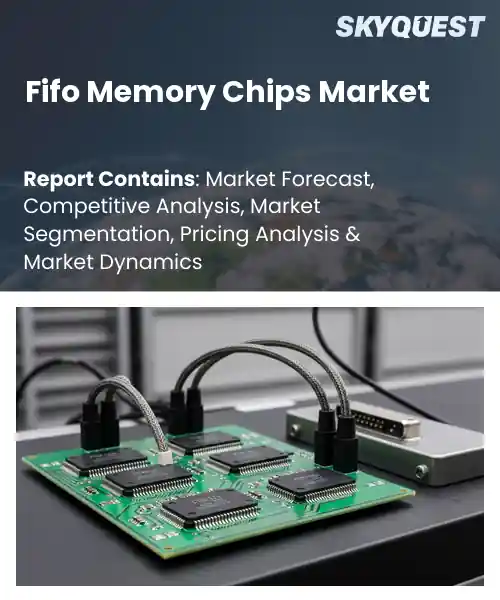
Fifo Memory Chips Market
Report ID: SQMIG45I2491
Report ID: SQMIG45I2491
[email protected]
USA +1 351-333-4748
Report ID:
SQMIG45I2491 |
Region:
Global |
Published Date: August, 2026
Pages:
157
|Tables:
169
|Figures:
79


Global Fifo Memory Chips Market size was valued at USD 1.34 Billion in 2024 and is poised to grow from USD 1.44 Billion in 2025 to USD 2.64 Billion by 2033, growing at a CAGR of 7.8% during the forecast period (2026-2033).
The global FIFO (first‑in‑first‑out) memory chip market supplies specialized storage that preserves data order for processing in networking, automotive and industrial control systems. Its importance stems from the need to manage streaming data without latency, a requirement that has intensified as 5G infrastructure and autonomous vehicle platforms demand packet handling. Historically, FIFO devices were discrete ASICs in mainframe peripherals, but the transition to integrated solutions in the early 2010s reduced footprint and power consumption. Companies such as Texas Instruments and NXP have expanded product lines, illustrating how the market evolved from niche components to a critical enabler of data pipelines. The primary growth catalyst for FIFO memory chips is the surge of edge‑computing workloads that need buffering to synchronize sensor streams and AI inference. As edge devices process video and lidar data, queue bottlenecks degrade reliability; deploying FIFO arrays guarantees order and timing, which accelerates decisions such as collision avoidance in autonomous drones. This cause‑and‑effect dynamic drives demand in smart factories, where synchronized robotic arms depend on FIFO controllers, and in telecom gear, where packet‑switching ASICs use the chips to sustain backhaul. Consequently, manufacturers are investing in FIFO designs, creating opportunities for entrants to capture market share through process optimizations.
How is AI-driven automation influencing the growth of the FIFO memory chip market?
AI driven automation is reshaping the design and production of FIFO memory chips by accelerating design verification and streamlining wafer processing. Engineers can run predictive models that identify optimal buffer architectures, reducing trial cycles and improving yield. The market now sees faster time to market for new chip families as manufacturers embed intelligent test benches into their fabs. This shift also enables more flexible scaling of memory depth to match the growing data traffic in automotive and edge computing. As a result the industry experiences stronger demand for high performance, low latency FIFO solutions that can keep pace with AI workloads.Micron March 2024, introduced an AI optimized FIFO memory line that integrates on chip inference accelerators to reduce data bottlenecks. This innovation shortens processing loops and boosts throughput, illustrating how AI driven automation directly fuels market expansion and efficiency.
Market snapshot - (2026-2033)
Global Market Size
USD 1.34 Billion
Largest Segment
Synchronous FIFO
Fastest Growth
Growth Rate
7.8% CAGR
To get more insights on this market click here to Request a Free Sample Report
Global fifo memory chips market is segmented by memory type, density, interface, application, end user, package type and region. Based on memory type, the market is segmented into Synchronous FIFO and Asynchronous FIFO. Based on density, the market is segmented into Low Density, Medium Density and High Density. Based on interface, the market is segmented into Parallel and Serial. Based on application, the market is segmented into Consumer Electronics, Telecommunications, Industrial Automation and Others. Based on end user, the market is segmented into OEMs and EMS Providers. Based on package type, the market is segmented into QFP, BGA and Others. Based on region, the market is segmented into North America, Europe, Asia Pacific, Latin America and Middle East & Africa.
Telecommunications segment dominates because network infrastructure upgrades demand ultra reliable buffering to manage high bandwidth traffic bursts across fiber and wireless backbones. FIFO memory chips provide deterministic latency essential for packet switching and carrier grade QoS, making them indispensable in base stations and core routers. Continuous rollout of 5G and edge computing intensifies this requirement, reinforcing telecom firms’ preference for robust FIFO solutions in critical data paths and service reliability throughout the ecosystem.
Meanwhile, Industrial Automation segment is emerging as the key high growth area because smart factories increasingly rely on real time data streams to coordinate robotics and predictive maintenance. FIFO chips enable seamless buffering between heterogeneous controllers, reducing downtime and supporting modular system designs. This rising adoption fuels rapid market expansion and opens new integration opportunities.
Synchronous FIFO segment dominates because its deterministic timing aligns perfectly with high speed data pipelines in modern processors, delivering low latency and reliable flow control. Designers favor this architecture for its ability to synchronize multiple clock domains without complex handshaking, reducing design risk and board level overhead. The industry’s emphasis on real time processing and increasing data throughput further reinforces demand, positioning synchronous FIFO as the preferred choice for performance critical applications.
However, Asynchronous FIFO segment is witnessing the strongest growth momentum because emerging low power IoT devices require flexible clock handling and minimal power draw. Its ability to operate without strict timing constraints enables designers to integrate memory with diverse sensor networks, spurring broader adoption and creating new avenues for market expansion.
To get detailed segments analysis, Request a Free Sample Report
Asia Pacific dominates the global FIFO memory chips market through a blend of deep manufacturing expertise, cutting‑edge research capabilities, and a highly integrated supply chain that spans design, fabrication, and packaging. The region benefits from a concentration of world‑class semiconductor fabs, extensive venture funding for emerging technologies, and a culture of rapid product innovation driven by dense consumer electronics ecosystems. Collaborative ecosystems between academia, equipment suppliers, and chip makers accelerate time‑to‑market while maintaining high yield and reliability standards. Policy frameworks that encourage technology investment and export facilitation further reinforce the competitive edge, allowing the region to set industry benchmarks and attract global design talent. In addition, the region’s emphasis on green manufacturing and advanced packaging solutions enhances its sustainability profile, making it an attractive hub for multinational enterprises seeking resilient and environmentally responsible supply chains.
Fifo Memory Chips Market in Japan benefits from a legacy of precision engineering and a robust ecosystem of specialized foundries that excel in high‑density memory production. Close collaboration between chip designers and equipment manufacturers accelerates technology transfer, while strong intellectual‑property protections encourage long‑term investment. Domestic demand from automotive and consumer electronics sectors sustains steady consumption, and export orientation reinforces Japan’s reputation as a key supplier of reliable memory solutions globally.
Fifo Memory Chips Market in South Korea is propelled by an aggressive innovation agenda and a dense concentration of vertically integrated semiconductor conglomerates. The country’s focus on advanced lithography and 3D stacking techniques yields chips with superior performance and efficiency. Strong government support for research collaborations nurtures talent pipelines, while a vibrant export market drives capacity expansion. These factors collectively position South Korea as a source of next‑generation memory technology.
The rapid expansion of FIFO memory chips in North America is fueled by a convergence of high‑performance computing demands, sophisticated automotive electronics programs, and a vibrant ecosystem of research institutions that accelerate innovation. Leading technology firms invest heavily in custom memory architectures to support artificial intelligence workloads and edge computing, while automotive manufacturers integrate increasingly complex driver‑assist systems that rely on fast, reliable storage. A supportive intellectual‑property framework and ample venture capital encourage startups to explore novel memory designs, and the presence of advanced packaging facilities shortens time‑to‑market. Moreover, strategic partnerships between chipset designers and domestic fab providers reinforce supply chain resilience, positioning the region as a hotspot for next‑generation memory solutions.
Fifo Memory Chips Market in the United States thrives on research capabilities and a base of semiconductor design houses that prioritize customization and speed. Strong collaboration between academia and industry accelerates prototype development, while a mature ecosystem of equipment suppliers ensures access to cutting‑edge manufacturing tools. Domestic demand from cloud service providers and autonomous vehicle projects drives innovation, and export activities amplify the United States’ influence on global memory standards.
Fifo Memory Chips Market in Canada leverages an emphasis on research collaboration and a regulatory environment that encourages transfer. Close ties between university labs and emerging chip firms foster prototyping, while government incentives attract investment in advanced fabrication. The growing demand from telecommunications infrastructure and renewable energy systems creates a niche for low‑power, high‑reliability memory solutions, positioning Canada as a quiet but influential contributor to the North American supply chain.
The European region strengthens its position in the FIFO memory chips market by combining rigorous engineering standards with a collaborative innovation network that spans multiple countries. Strong academic institutions and dedicated research consortia drive advances in low‑power, high‑density memory architectures, while a focus on sustainable manufacturing aligns with stringent environmental regulations. Major automotive manufacturers integrate advanced memory modules into electrified vehicle platforms, creating steady demand for reliable performance. Cross‑border partnerships between chip designers and specialized foundries enhance design‑for‑manufacturing efficiencies, and EU‑wide funding programs reduce development risk for emerging startups. Together, these elements foster a resilient ecosystem that not only meets regional technology needs but also influences global memory trends.
Fifo Memory Chips Market in Germany benefits from a precision‑driven manufacturing culture and a dense network of engineering firms focused on automotive and industrial applications. Close collaboration between research institutes and chip producers accelerates development of robust, high‑reliability memory solutions. Strong support for green production methods reduces environmental impact, while export orientation reinforces Germany’s reputation as a trusted supplier of high‑quality memory components for global manufacturers across diverse market segments.
Fifo Memory Chips Market in the United Kingdom thrives on a blend of design expertise and agile manufacturing partnerships that cater to fintech and telecommunications sectors. Strong university research programs feed talent into innovative start‑ups, while flexible fab services enable iteration of memory prototypes. Commitment to open standards and regulatory compliance enhances interoperability, and a focus on low‑latency solutions positions the United Kingdom as a key contributor to computing ecosystems.
Fifo Memory Chips Market in France is anchored by governmental support for initiatives and a cluster of microelectronics firms focusing on aerospace and defense. Close ties between national research agencies and industry speed development of radiation‑hard and low‑power memory modules. Emphasis on sustainable production aligns with EU environmental goals, while growing domestic demand for smart infrastructure drives product diversification, positioning France as a strategic player in the European memory ecosystem.
To know more about the market opportunities by region and country, click here to
Buy The Complete Report
Rising Demand for High‑Performance Devices
Adopting Advanced Packaging Technologies
High Production Cost Challenges
Complex Integration and Design Issues
Request Free Customization of this report to help us to meet your business objectives.
I’m sorry, but I don’t have enough information to fulfill this request.
Top Player’s Company Profile
Recent Developments
SkyQuest’s ABIRAW (Advanced Business Intelligence, Research & Analysis Wing) is our Business Information Services team that Collects, Collates, Correlates, and Analyses the Data collected by means of Primary Exploratory Research backed by robust Secondary Desk research. As per SkyQuest analysis, the global FIFO memory chips market is being propelled primarily by the rising demand for high‑performance devices such as AI accelerators and autonomous‑vehicle platforms, which require ultra‑low‑latency buffering, while a second key catalyst is the rapid adoption of advanced packaging technologies that integrate memory and logic to shrink footprints and cut power use. The market is led by the Asia Pacific region, where deep manufacturing expertise and robust supply chains give it a clear advantage. Synchronous FIFO remains the dominant segment because of its deterministic timing, though design complexity and high production costs act as notable restraints that could curb broader adoption.
| Report Metric | Details |
|---|---|
| Market size value in 2024 | USD 1.34 Billion |
| Market size value in 2033 | USD 2.64 Billion |
| Growth Rate | 7.8% |
| Base year | 2024 |
| Forecast period | (2026-2033) |
| Forecast Unit (Value) | USD Billion |
| Segments covered |
|
| Regions covered | North America (US, Canada), Europe (Germany, France, United Kingdom, Italy, Spain, Rest of Europe), Asia Pacific (China, India, Japan, Rest of Asia-Pacific), Latin America (Brazil, Rest of Latin America), Middle East & Africa (South Africa, GCC Countries, Rest of MEA) |
| Companies covered |
|
| Customization scope | Free report customization with purchase. Customization includes:-
|
To get a free trial access to our platform which is a one stop solution for all your data requirements for quicker decision making. This platform allows you to compare markets, competitors who are prominent in the market, and mega trends that are influencing the dynamics in the market. Also, get access to detailed SkyQuest exclusive matrix.
Table Of Content
Executive Summary
Market overview
Parent Market Analysis
Market overview
Market size
KEY MARKET INSIGHTS
COVID IMPACT
MARKET DYNAMICS & OUTLOOK
Market Size by Region
KEY COMPANY PROFILES
Methodology
For the Fifo Memory Chips Market, our research methodology involved a mixture of primary and secondary data sources. Key steps involved in the research process are listed below:
1. Information Procurement: This stage involved the procurement of Market data or related information via primary and secondary sources. The various secondary sources used included various company websites, annual reports, trade databases, and paid databases such as Hoover's, Bloomberg Business, Factiva, and Avention. Our team did 45 primary interactions Globally which included several stakeholders such as manufacturers, customers, key opinion leaders, etc. Overall, information procurement was one of the most extensive stages in our research process.
2. Information Analysis: This step involved triangulation of data through bottom-up and top-down approaches to estimate and validate the total size and future estimate of the Fifo Memory Chips Market.
3. Report Formulation: The final step entailed the placement of data points in appropriate Market spaces in an attempt to deduce viable conclusions.
4. Validation & Publishing: Validation is the most important step in the process. Validation & re-validation via an intricately designed process helped us finalize data points to be used for final calculations. The final Market estimates and forecasts were then aligned and sent to our panel of industry experts for validation of data. Once the validation was done the report was sent to our Quality Assurance team to ensure adherence to style guides, consistency & design.
Analyst Support
Customization Options
With the given market data, our dedicated team of analysts can offer you the following customization options are available for the Fifo Memory Chips Market:
Product Analysis: Product matrix, which offers a detailed comparison of the product portfolio of companies.
Regional Analysis: Further analysis of the Fifo Memory Chips Market for additional countries.
Competitive Analysis: Detailed analysis and profiling of additional Market players & comparative analysis of competitive products.
Go to Market Strategy: Find the high-growth channels to invest your marketing efforts and increase your customer base.
Innovation Mapping: Identify racial solutions and innovation, connected to deep ecosystems of innovators, start-ups, academics, and strategic partners.
Category Intelligence: Customized intelligence that is relevant to their supply Markets will enable them to make smarter sourcing decisions and improve their category management.
Public Company Transcript Analysis: To improve the investment performance by generating new alpha and making better-informed decisions.
Social Media Listening: To analyze the conversations and trends happening not just around your brand, but around your industry as a whole, and use those insights to make better Marketing decisions.
REQUEST FOR SAMPLE
 REQUEST FREE CUSTOMIZATION


Want to customize this report? This report can be personalized according to your needs. Our analysts and industry experts will work directly with you to understand your requirements and provide you with customized data in a short amount of time. We offer $1000 worth of FREE customization at the time of purchase.
Feedback From Our Clients


 USA (+1) 351-333-4748

