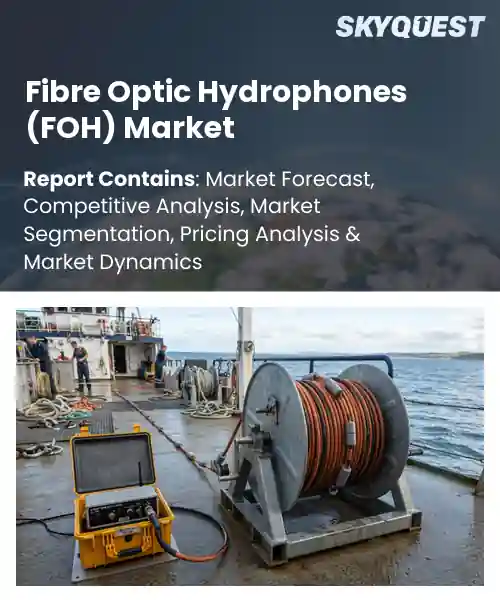
Fibre Optic Hydrophones (FOH) Market
Report ID: SQMIG45J2848
Report ID: SQMIG45J2848
[email protected]
USA +1 351-333-4748
Report ID:
SQMIG45J2848 |
Region:
Global |
Published Date: August, 2026
Pages:
157
|Tables:
145
|Figures:
78


Global Fibre Optic Hydrophones (Foh) Market size was valued at USD 1.84 Billion in 2024 and is poised to grow from USD 1.95 Billion in 2025 to USD 3.17 Billion by 2033, growing at a CAGR of 6.2% during the forecast period (2026-2033).
The global fibre‑optic hydrophone (FOH) market centers on devices that convert acoustic pressure waves into light‑modulated signals, enabling underwater sensing. Its relevance stems from the growing demand for precise marine monitoring in offshore oil‑and‑gas, renewable energy and defense, where traditional piezoelectric sensors face electromagnetic interference and limited bandwidth. Since the 2000s, advances in optical fiber technology and signal processing have lowered cost while improving durability, prompting adopters such as subsea cable‑laying firms to replace legacy hydrophones with FOH arrays. This evolution has expanded the market, turning FOH from a niche research tool into a commercial cornerstone for oceanic data acquisition. The growth catalyst for the FOH market is the surge in offshore renewable energy projects, particularly wind farms that mandate acoustic surveillance to protect marine fauna and verify turbine integrity. As regulatory bodies tighten noise‑emission standards, operators turn to FOH arrays because their wide bandwidth and immunity to electromagnetic interference deliver reliable data, enabling blade‑pitch control and fault detection. This benefit translates into reduced downtime and lower maintenance costs, prompting energy firms to allocate procurement budgets toward FOH solutions. Opportunities arise in naval anti‑submarine warfare, where the sensors’ detection capability supports surveillance, expanding the market’s footprint and driving research investment.
How is AI enhancing performance and adoption of fibre optic hydrophones in offshore monitoring?
AI boosts fibre optic hydrophone performance by turning raw acoustic streams into actionable insights. Machine‑learning models filter out vessel noise, isolate low‑frequency events and predict sensor drift before it impacts data quality. Real‑time analytics enable adaptive beamforming that widens coverage while reducing power consumption. These capabilities lower operational costs and make deployments more attractive to oil‑and‑gas operators and renewable energy developers. As offshore monitoring expands, AI‑driven diagnostics and automated reporting accelerate adoption, positioning hydrophones as a core element of next‑generation marine observatories.North America Fibre Optic Hydrophones (FOH) Market June 2026, introduced an AI‑enhanced array that continuously self‑optimises signal processing, shortening deployment cycles and supporting the market’s rapid growth.
Market snapshot - (2026-2033)
Global Market Size
USD 1.84 Billion
Largest Segment
Interferometric Hydrophones
Fastest Growth
Fiber Bragg Grating Hydrophones
Growth Rate
6.2% CAGR
To get more insights on this market click here to Request a Free Sample Report
Global fibre optic hydrophones (foh) market is segmented by product type, fiber type, application, end-use industry, deployment and region. Based on product type, the market is segmented into Interferometric Hydrophones, Intensity-Based Hydrophones and Fiber Bragg Grating Hydrophones. Based on fiber type, the market is segmented into Single-Mode Fiber and Multimode Fiber. Based on application, the market is segmented into Underwater Surveillance, Seismic Monitoring, Oil & Gas Exploration and Sonar Systems. Based on end-use industry, the market is segmented into Defense & Security, Oil & Gas, Marine Research and Seismic Research. Based on deployment, the market is segmented into Fixed, Towed and Distributed. Based on region, the market is segmented into North America, Europe, Asia Pacific, Latin America and Middle East & Africa.
Interferometric Hydrophones segment dominates because its ability to capture phase shift information provides unmatched acoustic sensitivity, enabling precise detection of low level signals in complex marine environments. This intrinsic precision aligns with defense and scientific requirements for high resolution monitoring, driving supplier focus on advanced interferometric designs. Consequently, manufacturers prioritize research and integration of interferometric technologies, reinforcing the segment’s leadership within the fibre optic hydrophones market and expanding its application base across emerging maritime projects.
Meanwhile, Fiber Bragg Grating Hydrophones segment emerges as the most rapidly expanding area in the fibre optic hydrophones market because advances in wavelength multiplexing simplify sensor arrays, reducing installation complexity. Growing interest from oil and gas operators for distributed acoustic sensing accelerates adoption, positioning this technology as a catalyst for broader market growth.
Fixed deployment segment dominates because stationary installations allow for long term acoustic baselines, essential for continuous monitoring of marine boundaries and seabed activity. This stability supports high resolution data acquisition required by defense surveillance and scientific research, encouraging investment in robust housing and power solutions. As a result, vendors prioritize fixed point hydrophone designs, reinforcing their market prominence and ensuring reliable performance over extended operational periods and facilitating integration with existing oceanographic networks worldwide.
Conversely, Distributed deployment segment is emerging as the key high growth area in the fibre optic hydrophones market because modular fiber arrays enable coverage of vast ocean zones with minimal cabling. Interest from seismic research and offshore monitoring projects fuels demand for scalable, low maintenance solutions, accelerating market expansion and opening new revenue streams for manufacturers.
To get detailed segments analysis, Request a Free Sample Report
Asia Pacific leverages a combination of cutting‑edge research institutions, robust manufacturing ecosystems, and extensive maritime activities that together create a fertile environment for FOH adoption. The region’s strong focus on offshore energy development, coupled with advanced naval and scientific monitoring programs, drives demand for high‑precision acoustic sensing. Collaborative initiatives between government agencies and private firms accelerate technology transfer and scale production capabilities. Additionally, supportive regulatory frameworks and investment in subsea infrastructure reinforce the market’s growth, positioning the region as a hub for innovation and deployment of fibre optic hydrophone solutions across diverse applications.
Japan Fibre Optic Hydrophones (FOH) Market
Fibre Optic Hydrophones (FOH) Market in Japan benefits from a long history of marine research and a sophisticated defence sector that prioritises acoustic surveillance. The country’s expertise in precision optics and electronics enhances the performance of FOH systems, while strong ties between academia and industry foster continuous improvement. Investment in offshore renewable projects further expands the need for reliable underwater monitoring, reinforcing Japan’s role as a leading adopter of advanced hydrophone technology.
South Korea Fibre Optic Hydrophones (FOH) Market
Fibre Optic Hydrophones (FOH) Market in South Korea is propelled by a dynamic electronics manufacturing base and a strategic emphasis on maritime security. The nation’s commitment to developing smart oceanic infrastructure encourages integration of FOH solutions for environmental and resource monitoring. Collaborative research programmes with leading universities accelerate innovation, while government incentives support the scaling of production capabilities. This combination of technological prowess and policy support positions South Korea as a key contributor to the region’s dominance.
North America experiences rapid expansion of the FOH market through a convergence of strong research funding, extensive offshore energy initiatives, and a proactive defence posture that values high‑resolution underwater sensing. The presence of leading technology firms and a culture of innovation accelerates product development and commercialization. Robust collaboration between federal agencies, academic institutions, and private enterprises ensures continuous advancement of acoustic monitoring capabilities. Moreover, growing environmental awareness and regulatory emphasis on marine ecosystem protection further stimulate demand for precise, reliable hydrophone solutions across the continent.
United States Fibre Optic Hydrophones (FOH) Market
Fibre Optic Hydrophones (FOH) Market in the United States is driven by extensive investment in deep‑water exploration and a sophisticated defence research community that prioritises acoustic intelligence. The country’s strong ecosystem of technology startups and established manufacturers fosters rapid innovation and deployment of FOH systems. Partnerships between federal research labs and commercial entities enhance capabilities for oceanographic studies, while regulatory focus on marine conservation expands applications in environmental monitoring, reinforcing the United States as a pivotal market for advanced hydrophone technology.
Canada Fibre Optic Hydrophones (FOH) Market
Fibre Optic Hydrophones (FOH) Market in Canada benefits from a vast coastline and a national emphasis on sustainable marine resource management. The country’s research institutions excel in ocean science, driving adoption of FOH for detailed acoustic mapping and environmental assessment. Collaborative projects between government agencies and industry promote the integration of FOH into offshore renewable energy initiatives and fisheries monitoring. This supportive environment, combined with a commitment to protecting marine habitats, positions Canada as a significant contributor to the North American FOH landscape.
Europe strengthens its FOH market position through coordinated research programmes, stringent environmental directives, and a mature offshore energy sector that demands sophisticated acoustic monitoring. The region’s emphasis on collaborative innovation across borders accelerates technology refinement and standardisation. Strong industrial capabilities in precision optics and telecommunications support high‑quality production, while policy frameworks encourage sustainable marine practices. Together, these factors foster a resilient ecosystem that enhances Europe’s influence and adoption of fibre optic hydrophone solutions across multiple sectors.
Germany Fibre Optic Hydrophones (FOH) Market
Fibre Optic Hydrophones (FOH) Market in Germany is underpinned by a robust engineering tradition and a proactive approach to marine research. The country’s leading universities and research institutes drive advancements in acoustic sensing, while its industrial base ensures high‑precision manufacturing. Integration of FOH into offshore wind monitoring and environmental assessment projects reflects Germany’s commitment to renewable energy and marine stewardship, reinforcing its role as a key European market for advanced hydrophone technologies.
United Kingdom Fibre Optic Hydrophones (FOH) Market
Fibre Optic Hydrophones (FOH) Market in the United Kingdom benefits from a strong maritime heritage and extensive investment in ocean science. Collaborative initiatives between government research bodies and private firms accelerate the development of FOH solutions for defence, offshore energy, and ecological monitoring. The United Kingdom’s regulatory focus on marine protection further drives adoption of precise acoustic monitoring tools, positioning the nation as a prominent player in the European FOH landscape.
France Fibre Optic Hydrophones (FOH) Market
Fibre Optic Hydrophones (FOH) Market in France is propelled by a vibrant research community and a strategic emphasis on marine environmental monitoring. The country’s leading scientific institutions contribute to the refinement of FOH technologies, while partnerships with industry facilitate their deployment in offshore renewable projects and coastal protection efforts. France’s commitment to sustainable ocean management enhances demand for high‑resolution acoustic sensing, solidifying its influence within the European FOH market.
To know more about the market opportunities by region and country, click here to
Buy The Complete Report
Growing Demand For Ocean Monitoring
Adoption Of High‑Resolution Sonar Systems
High Manufacturing Cost Challenges
Limited Standardization Across Applications
Request Free Customization of this report to help us to meet your business objectives.
The competitive landscape of the global fibre‑optic hydrophone market is shaped by intense rivalry among specialized sensor manufacturers, with firms pursuing strategic M&A to acquire niche technologies, forming partnerships with marine research institutes, and accelerating tech innovation through integrated photonic‑based hydrophone designs. Recent collaborations between leading optical component providers and ocean‑monitoring companies exemplify how alliances are driving faster deployment of low‑frequency, high‑sensitivity hydrophone arrays, directly influencing market positioning.
Top Player’s Company Profile
Recent Developments
SkyQuest’s ABIRAW (Advanced Business Intelligence, Research & Analysis Wing) is our Business Information Services team that Collects, Collates, Correlates, and Analyses the Data collected by means of Primary Exploratory Research backed by robust Secondary Desk research. As per SkyQuest analysis, the market is being propelled primarily by the growing demand for ocean monitoring, which pushes operators toward long‑term, low‑maintenance acoustic networks, while a second driver comes from the expanding use of high‑resolution sonar systems that need broadband, low‑noise sensors. The interferometric hydrophones segment remains the leader because of its superior phase‑shift sensitivity, especially in defense and scientific applications. Asia Pacific is the dominant region thanks to its strong research base, offshore energy projects and supportive policies. However, high manufacturing costs of the optical components act as a restraint, limiting price competitiveness and slowing adoption in cost‑sensitive markets.
| Report Metric | Details |
|---|---|
| Market size value in 2024 | USD 1.84 Billion |
| Market size value in 2033 | USD 3.17 Billion |
| Growth Rate | 6.2% |
| Base year | 2024 |
| Forecast period | (2026-2033) |
| Forecast Unit (Value) | USD Billion |
| Segments covered |
|
| Regions covered | North America (US, Canada), Europe (Germany, France, United Kingdom, Italy, Spain, Rest of Europe), Asia Pacific (China, India, Japan, Rest of Asia-Pacific), Latin America (Brazil, Rest of Latin America), Middle East & Africa (South Africa, GCC Countries, Rest of MEA) |
| Companies covered |
|
| Customization scope | Free report customization with purchase. Customization includes:-
|
To get a free trial access to our platform which is a one stop solution for all your data requirements for quicker decision making. This platform allows you to compare markets, competitors who are prominent in the market, and mega trends that are influencing the dynamics in the market. Also, get access to detailed SkyQuest exclusive matrix.
Table Of Content
Executive Summary
Market overview
Parent Market Analysis
Market overview
Market size
KEY MARKET INSIGHTS
COVID IMPACT
MARKET DYNAMICS & OUTLOOK
Market Size by Region
KEY COMPANY PROFILES
Methodology
For the Fibre Optic Hydrophones (FOH) Market, our research methodology involved a mixture of primary and secondary data sources. Key steps involved in the research process are listed below:
1. Information Procurement: This stage involved the procurement of Market data or related information via primary and secondary sources. The various secondary sources used included various company websites, annual reports, trade databases, and paid databases such as Hoover's, Bloomberg Business, Factiva, and Avention. Our team did 45 primary interactions Globally which included several stakeholders such as manufacturers, customers, key opinion leaders, etc. Overall, information procurement was one of the most extensive stages in our research process.
2. Information Analysis: This step involved triangulation of data through bottom-up and top-down approaches to estimate and validate the total size and future estimate of the Fibre Optic Hydrophones (FOH) Market.
3. Report Formulation: The final step entailed the placement of data points in appropriate Market spaces in an attempt to deduce viable conclusions.
4. Validation & Publishing: Validation is the most important step in the process. Validation & re-validation via an intricately designed process helped us finalize data points to be used for final calculations. The final Market estimates and forecasts were then aligned and sent to our panel of industry experts for validation of data. Once the validation was done the report was sent to our Quality Assurance team to ensure adherence to style guides, consistency & design.
Analyst Support
Customization Options
With the given market data, our dedicated team of analysts can offer you the following customization options are available for the Fibre Optic Hydrophones (FOH) Market:
Product Analysis: Product matrix, which offers a detailed comparison of the product portfolio of companies.
Regional Analysis: Further analysis of the Fibre Optic Hydrophones (FOH) Market for additional countries.
Competitive Analysis: Detailed analysis and profiling of additional Market players & comparative analysis of competitive products.
Go to Market Strategy: Find the high-growth channels to invest your marketing efforts and increase your customer base.
Innovation Mapping: Identify racial solutions and innovation, connected to deep ecosystems of innovators, start-ups, academics, and strategic partners.
Category Intelligence: Customized intelligence that is relevant to their supply Markets will enable them to make smarter sourcing decisions and improve their category management.
Public Company Transcript Analysis: To improve the investment performance by generating new alpha and making better-informed decisions.
Social Media Listening: To analyze the conversations and trends happening not just around your brand, but around your industry as a whole, and use those insights to make better Marketing decisions.
REQUEST FOR SAMPLE
 REQUEST FREE CUSTOMIZATION


Want to customize this report? This report can be personalized according to your needs. Our analysts and industry experts will work directly with you to understand your requirements and provide you with customized data in a short amount of time. We offer $1000 worth of FREE customization at the time of purchase.
Feedback From Our Clients


 USA (+1) 351-333-4748

