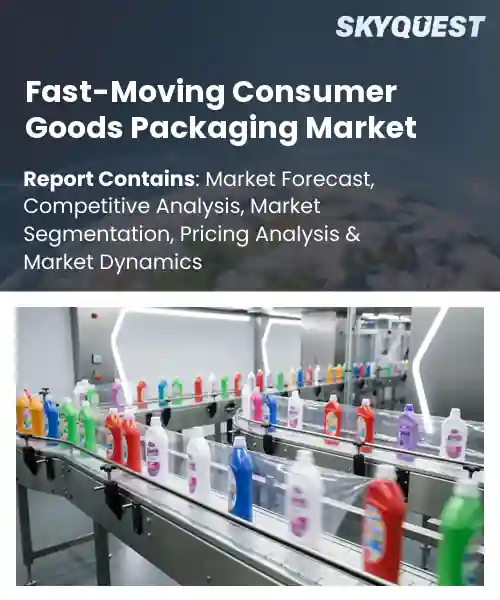
Fast-Moving Consumer Goods Packaging Market
Report ID: SQMIG15H2206
Report ID: SQMIG15H2206
[email protected]
USA +1 351-333-4748
Report ID:
SQMIG15H2206 |
Region:
Global |
Published Date: June, 2026
Pages:
157
|Tables:
144
|Figures:
78


Global Fast-Moving Consumer Goods Packaging Market size was valued at USD 53.6 Billion in 2024 and is poised to grow from USD 57.62 Billion in 2025 to USD 102.76 Billion by 2033, growing at a CAGR of 7.5% during the forecast period (2026-2033).
The primary driver of the fast-moving consumer goods packaging market is rising consumer demand for convenience and sustainability, which reshapes how products are designed, transported and displayed. This market encompasses packaging solutions for everyday items such as food, beverages, personal care and household products, and it matters because packaging protects goods, extends shelf life, reduces waste and communicates brand values to shoppers. Over decades the sector has evolved from bulk, single-material containers to lightweight, multifunctional systems incorporating barrier films, aseptic cartons and recyclable PET, with innovators like multi-layer pouches for snacks and eco-friendly cardboard replacing rigid plastic in cosmetics today.Building on sustainability and convenience trends, regulatory pressure and technological innovation serve as a key factor accelerating global FMCG packaging growth because stricter waste laws force manufacturers to adopt recyclable and compostable materials, prompting investment in new supply chains. For example, European single-use plastic bans have driven beverage companies to switch to recycled PET and returnable glass, reducing material costs over time while improving brand reputation. At the same time digital printing and smart packaging enable personalized promotions and supply chain traceability, which increase sales velocity and lower losses from counterfeiting, creating clear opportunities for packaging converters and material scientists.
How is AI optimizing supply chain efficiency in the fast-moving consumer goods packaging market?
AI is optimizing supply chain efficiency in the fast moving consumer goods packaging market by improving demand sensing, inventory orchestration and production planning. Machine learning models blend real time retail and logistics signals with factory telemetry to reduce waste and speed responses to short product lifecycles. Producers deploy AI for automated visual inspection to catch defects, for predictive maintenance to avoid unplanned downtime and for smarter procurement to secure resilient suppliers. The market focus on sustainability and speed makes digital twins and analytics especially valuable, so tooling and vendor offerings are shifting to embed these capabilities.Tetra Pak March 2026, the company showcased Factory OS which uses AI for process optimization and optical sorting to improve line uptime and recycling quality. This innovation helps packaging makers scale production faster, trim material losses and better match output to demand, strengthening supply chain resilience and enabling market growth.
Market snapshot - (2026-2033)
Global Market Size
USD 53.6 Billion
Largest Segment
Plastic Packaging
Fastest Growth
Paper Packaging
Growth Rate
7.5% CAGR
To get more insights on this market click here to Request a Free Sample Report
Global fast-moving consumer goods packaging market is segmented by material type, product type, end user, packaging design, sales channel and region. Based on material type, the market is segmented into Plastic Packaging, Paper Packaging, Glass Packaging and Metal Packaging. Based on product type, the market is segmented into Food Products, Personal Care and Household Products. Based on end user, the market is segmented into Retail and E-commerce. Based on packaging design, the market is segmented into Eco-friendly Design, Custom Design and Convenience Features. Based on sales channel, the market is segmented into Direct Sales, Distribution Networks and Wholesale. Based on region, the market is segmented into North America, Europe, Asia Pacific, Latin America and Middle East & Africa.
Eco-friendly Design segment dominates because rising consumer preference and regulatory pressure have made sustainable packaging a procurement priority for fast-moving consumer goods manufacturers. Brands prioritize renewable and recyclable materials to protect reputation and meet retailer shelf requirements, prompting suppliers to scale production of greener options. This drives investment in material science, supply chain realignment, and marketing differentiation, which collectively reinforce adoption and lock in procurement pathways favoring eco-friendly solutions.
However, Custom Design is the most rapidly expanding area, propelled by demand for brand differentiation and premiumization in fast-moving consumer goods. Digital printing and flexible manufacturing lower costs of tailored runs, enabling novel aesthetics and functional features that create SKU-level opportunities and drive adoption among marketing-led manufacturers seeking stronger consumer engagement.
E-commerce segment dominates because the shift to direct-to-consumer fulfillment imposes unique packaging performance, protection, and dimensional efficiency requirements that prioritize durable, right-sized, and return-friendly formats. Rising online order volumes and last-mile considerations push manufacturers and converters to innovate protective cushioning, tamper-evident closures, and standardized parcel-ready designs. These logistics-driven demands shape procurement priorities, stimulate investments in automation, and favor packaging solutions optimized for shipping resilience and cost-effective distribution.
Conversely, retail is the most rapidly expanding area as demand for shelf-impact, in-store promotions, and display-ready formats intensifies across fast-moving consumer goods. Innovations in structural design, tactile finishes, and multipack configurations enhance point-of-sale conversion, encouraging brands to invest in bespoke packaging solutions that expand application scope and create new retail-led opportunities.
To get detailed segments analysis, Request a Free Sample Report
Asia Pacific dominance in fast-moving consumer goods packaging derives from a combination of large manufacturing hubs, mature supply chains, and a culture of rapid product innovation that aligns packaging design with consumer trends. Regional manufacturers emphasize lightweight materials, flexible formats, and local customization, while strong upstream resin and film production supports cost efficiency and scale. Market participants focus on sustainability initiatives adapted to regional waste infrastructures and on collaborations that accelerate adoption of advanced barrier, printing, and convenience features, enabling faster time to shelf and closer alignment with retail and e commerce distribution models. Intense investment in automation and flexible converting technologies supports rapid scaling, while evolving regulatory frameworks and rising urban consumer demand shape packaging function and aesthetics, reinforcing regional competitiveness.
Fast-Moving Consumer Goods Packaging Market in Japan is characterized by quality standards, high levels of technological integration, and strong demand for premium convenience formats. Local brand owners and retailers prioritize compact, recyclable, and barrier solutions that preserve freshness while enhancing shelf appeal. Packaging converters leverage advanced printing, lightweight substrates, and automation to meet strict safety regulations and discerning urban consumers, creating a market focused on innovation and refined packaging aesthetics.
Fast-Moving Consumer Goods Packaging Market in South Korea reflects strong demand for smart and sustainable packaging, with emphasis on lightweight formats and finishing. Domestic brands and retailers pursue innovative barrier and packaging solutions to extend shelf life and enable convenience lifestyles. Converters and material suppliers invest in speed converting and digital print capabilities to serve retail channels, while sustainability initiatives guide material selection and recyclable design practices across value chain.
Rapid expansion of fast-moving consumer goods packaging in North America is driven by a convergence of shifting consumer expectations, evolving retail models, and intensified emphasis on sustainability. Brand owners and retailers prioritize packaging that enhances convenience, extends freshness, and communicates environmental credentials, prompting uptake of recyclable polymers, fiber based solutions, and simplified formats. Growth is supported by investments in automation, flexible converting lines, and digital decoration that enable shorter runs and rapid SKU proliferation. Close collaboration between material suppliers, converters, and retail procurement accelerates development of cost efficient, compliant packaging solutions tailored to omnichannel distribution. Policy frameworks and corporate sustainability commitments further steer material choice and design innovation, reinforcing regional capacity to commercialize advanced, consumer centric packaging concepts.
Fast-Moving Consumer Goods Packaging Market in the United States emphasizes innovation in sustainability, convenience, and e commerce readiness. Brand owners and retailers demand lightweight, recyclable formats and packaging that supports replenishment across channels. Converters invest in automation, digital print, and barrier technologies to serve category needs, while supply chain integration and retailer collaboration accelerate adoption of optimized formats. Regulatory focus and commitments further shape material selection and circular design practices.
Fast-Moving Consumer Goods Packaging Market in Canada emphasizes sustainable material choices and supply chain adaptability to serve urban and retail channels. Brand owners seek recyclable and fiber based formats that reflect environmental commitments, while converters focus on flexible converting and print capabilities to support evolving shelf and e commerce demands. Collaboration among material suppliers, retailers, and policymakers shapes packaging standards and circularity initiatives, fostering locally adaptable solutions across value chain.
Europe is strengthening its position in fast-moving consumer goods packaging through a coordinated focus on circularity, regulatory alignment, and material innovation. Regions across Europe prioritize recyclable and compostable formats, foster investment in collection and sorting infrastructure, and promote design for recyclability as a competitive differentiator. Packaging machinery and converting sectors emphasize automation and precision to support lightweighting and high quality print, while brand owners use eco labeling and supply chain agreements to communicate sustainability credentials. Cross border collaboration among policymakers, industry associations, and research institutions accelerates standardization of materials and testing protocols, enabling faster commercialization of advanced fiber, polymer, and multi material solutions that meet stringent environmental and performance expectations. Consumer preference for premium convenience and clear environmental messaging drives packaging differentiation, while retailers and exporters demand consistent quality and compliance across borders, strengthening European supply chain resilience and fostering high value packaging applications.
Fast-Moving Consumer Goods Packaging Market in Germany combines strong manufacturing capability, engineering expertise, and a commitment to circularity. Brand owners and converters focus on material innovation and precision converting to produce recyclable and high quality packaging with refined finishes. Collaboration with research centers and machinery suppliers accelerates automation, inspection, and printing performance. Regulatory pressure and established collection systems influence material selection and promote sustainable design across categories and market adoption.
Fast-Moving Consumer Goods Packaging Market in the United Kingdom is shaped by strong design capabilities, sustainability leadership, and retailer driven innovation. Brands emphasize recyclable and fiber based solutions that balance shelf impact with reduced material. Converters and technology providers invest in digital print, flexible converting, and sustainable coatings to meet diverse retail and e commerce needs. Policy initiatives and industry partnerships support circularity and encourage adoption of recyclable packaging formats.
Fast-Moving Consumer Goods Packaging Market in France blends strong design heritage with active sustainability programs and focus on premium packaging. Brand owners emphasize high barrier and convenience formats that preserve quality while offering friendly features. Converters and material suppliers develop coated fiber, polymer, and innovative laminates supported by refined printing and finishing. Collaborative initiatives among industry, retailers, and local authorities promote recycling infrastructure and encourage circular packaging solutions across categories.
To know more about the market opportunities by region and country, click here to
Buy The Complete Report
Rising Demand For Sustainable Packaging
Expansion Of Online Retail Channels
Raw Material Price Volatility
Complex Regulatory Compliance Requirements
Request Free Customization of this report to help us to meet your business objectives.
Competition in the global FMCG packaging market is defined by aggressive consolidation, material innovation and commercial partnerships that change supplier footprints. Mergers and acquisitions such as FabFitFun’s acquisition of sustainable packager Boox accelerate roll up of end to end capabilities. Strategic tie ups between converters and material innovators and the commercialisation of plant based alternatives force legacy suppliers to adopt circular material platforms and digital packaging services.
Top Player’s Company Profile
Recent Developments
SkyQuest’s ABIRAW (Advanced Business Intelligence, Research & Analysis Wing) is our Business Information Services team that Collects, Collates, Correlates, and Analyses the Data collected by means of Primary Exploratory Research backed by robust Secondary Desk research. As per SkyQuest analysis, the global FMCG packaging market is driven by rising consumer demand for convenience and sustainability, which is reshaping material and format choices and encouraging recyclable and lightweight solutions. One key driver is regulatory pressure and sustainability commitments that push brands toward recyclable materials. One restraint is raw material price volatility that complicates procurement and delays investments. Dominating region is Asia Pacific due to large manufacturing hubs, cost advantages and rapid innovation. Dominating segment is eco-friendly design as brands prioritize recyclable and compostable formats. Second driver is rapid expansion of e-commerce that increases demand for protective, parcel-ready, return-friendly packaging.
| Report Metric | Details |
|---|---|
| Market size value in 2024 | USD 53.6 Billion |
| Market size value in 2033 | USD 102.76 Billion |
| Growth Rate | 7.5% |
| Base year | 2024 |
| Forecast period | (2026-2033) |
| Forecast Unit (Value) | USD Billion |
| Segments covered |
|
| Regions covered | North America (US, Canada), Europe (Germany, France, United Kingdom, Italy, Spain, Rest of Europe), Asia Pacific (China, India, Japan, Rest of Asia-Pacific), Latin America (Brazil, Rest of Latin America), Middle East & Africa (South Africa, GCC Countries, Rest of MEA) |
| Companies covered |
|
| Customization scope | Free report customization with purchase. Customization includes:-
|
To get a free trial access to our platform which is a one stop solution for all your data requirements for quicker decision making. This platform allows you to compare markets, competitors who are prominent in the market, and mega trends that are influencing the dynamics in the market. Also, get access to detailed SkyQuest exclusive matrix.
Table Of Content
Executive Summary
Market overview
Parent Market Analysis
Market overview
Market size
KEY MARKET INSIGHTS
COVID IMPACT
MARKET DYNAMICS & OUTLOOK
Market Size by Region
KEY COMPANY PROFILES
Methodology
For the Fast-Moving Consumer Goods Packaging Market, our research methodology involved a mixture of primary and secondary data sources. Key steps involved in the research process are listed below:
1. Information Procurement: This stage involved the procurement of Market data or related information via primary and secondary sources. The various secondary sources used included various company websites, annual reports, trade databases, and paid databases such as Hoover's, Bloomberg Business, Factiva, and Avention. Our team did 45 primary interactions Globally which included several stakeholders such as manufacturers, customers, key opinion leaders, etc. Overall, information procurement was one of the most extensive stages in our research process.
2. Information Analysis: This step involved triangulation of data through bottom-up and top-down approaches to estimate and validate the total size and future estimate of the Fast-Moving Consumer Goods Packaging Market.
3. Report Formulation: The final step entailed the placement of data points in appropriate Market spaces in an attempt to deduce viable conclusions.
4. Validation & Publishing: Validation is the most important step in the process. Validation & re-validation via an intricately designed process helped us finalize data points to be used for final calculations. The final Market estimates and forecasts were then aligned and sent to our panel of industry experts for validation of data. Once the validation was done the report was sent to our Quality Assurance team to ensure adherence to style guides, consistency & design.
Analyst Support
Customization Options
With the given market data, our dedicated team of analysts can offer you the following customization options are available for the Fast-Moving Consumer Goods Packaging Market:
Product Analysis: Product matrix, which offers a detailed comparison of the product portfolio of companies.
Regional Analysis: Further analysis of the Fast-Moving Consumer Goods Packaging Market for additional countries.
Competitive Analysis: Detailed analysis and profiling of additional Market players & comparative analysis of competitive products.
Go to Market Strategy: Find the high-growth channels to invest your marketing efforts and increase your customer base.
Innovation Mapping: Identify racial solutions and innovation, connected to deep ecosystems of innovators, start-ups, academics, and strategic partners.
Category Intelligence: Customized intelligence that is relevant to their supply Markets will enable them to make smarter sourcing decisions and improve their category management.
Public Company Transcript Analysis: To improve the investment performance by generating new alpha and making better-informed decisions.
Social Media Listening: To analyze the conversations and trends happening not just around your brand, but around your industry as a whole, and use those insights to make better Marketing decisions.
REQUEST FOR SAMPLE
 REQUEST FREE CUSTOMIZATION


Want to customize this report? This report can be personalized according to your needs. Our analysts and industry experts will work directly with you to understand your requirements and provide you with customized data in a short amount of time. We offer $1000 worth of FREE customization at the time of purchase.
Feedback From Our Clients


 USA (+1) 351-333-4748

