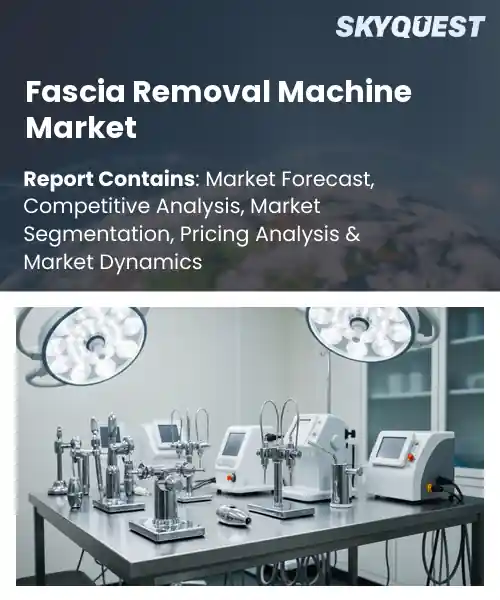
Fascia Removal Machine Market
Report ID: SQMIG35A4260
Report ID: SQMIG35A4260
[email protected]
USA +1 351-333-4748
Report ID:
SQMIG35A4260 |
Region:
Global |
Published Date: July, 2026
Pages:
157
|Tables:
142
|Figures:
78


Global Fascia Removal Machine Market size was valued at USD 238.4 Million in 2024 and is poised to grow from USD 253.18 Million in 2025 to USD 409.66 Million by 2033, growing at a CAGR of 6.2% during the forecast period (2026-2033).
The global fascia removal machine market comprises devices designed to disrupt dense connective tissue, improving mobility and reducing chronic pain for athletes, seniors, and rehabilitation patients. Its significance stems from growing awareness of fascia’s role in musculoskeletal disorders and the shift toward non‑pharmaceutical interventions. Early adoption occurred in elite sports clinics around 2015, where high‑frequency acoustic wave units demonstrated rapid tissue softening. Since then, manufacturers have integrated ergonomic designs and Bluetooth telemetry, expanding applications from postoperative care to wellness spas. This evolution reflects escalating demand for evidence‑based, minimally invasive therapies that accelerate recovery while lowering healthcare costs globally throughout the. A decisive growth catalyst for the fascia removal machine sector is the integration of health ecosystems that enable monitoring and treatment protocols. When clinicians capture biometric feedback, they can adjust acoustic parameters instantly, resulting in faster symptom relief and patient adherence. This feedback loop encourages insurers to reimburse procedures, which in turn fuels clinic investments in units. For example, a physiotherapy chain in Germany reported a 22 % reduction in treatment cycles after deploying cloud‑connected devices, translating into lower operating expenses and increased revenue. Consequently, manufacturers are accelerating R&D to embed AI‑driven analytics, opening new markets in home‑care and sports performance.
How is AI-driven automation influencing the Fascia removal machine market?
AI-driven automation is reshaping the Fascia Removal Machine market by embedding intelligent sensors and adaptive control algorithms into equipment. These technologies enable machines to adjust cutting depth and pressure in real time, reducing operator fatigue and improving precision. The integration of machine‑learning models helps predict tissue response, leading to smoother procedures and faster turnaround times. Vendors are now showcasing platforms that combine data analytics with ergonomic design, making the devices more user‑friendly and cost‑effective. This shift is attracting clinics seeking higher throughput while maintaining patient safety, thereby accelerating market momentum.In July 2024, a leading manufacturer introduced an AI‑enhanced fascia removal system, streamlining workflow and boosting procedural efficiency, supporting broader adoption across surgical centers.
Market snapshot - (2026-2033)
Global Market Size
USD 238.4 Million
Largest Segment
Manual Fascia Removal Machines
Fastest Growth
Automatic Fascia Removal Machines
Growth Rate
6.2% CAGR
To get more insights on this market click here to Request a Free Sample Report
Global fascia removal machine market is segmented by product type, application, processing capacity, end user, installation and region. Based on product type, the market is segmented into Manual Fascia Removal Machines and Automatic Fascia Removal Machines. Based on application, the market is segmented into Meat Processing, Poultry Processing and Seafood Processing. Based on processing capacity, the market is segmented into Small Scale, Medium Scale and Large Scale. Based on end user, the market is segmented into Meat Processing Plants, Food Processing Companies and Slaughterhouses. Based on installation, the market is segmented into Standalone and Production Line Integrated. Based on region, the market is segmented into North America, Europe, Asia Pacific, Latin America and Middle East & Africa.
Manual fascia removal machines segment dominates because operators value the tactile control and low upfront investment, which align with traditional processing layouts. These machines deliver consistent peeling results on varied carcass sizes, fostering confidence among small and medium plants. The simplicity of maintenance and minimal training requirements reduce operational overhead, making them the preferred choice for facilities seeking reliable performance without extensive automation or costly automation solutions in the industry.
However, automatic fascia removal machines segment is witnessing the strongest growth momentum as manufacturers introduce smarter sensors and adaptive algorithms that boost throughput while ensuring precise skin removal. This innovation attracts high volume processors eager to lower labor costs and meet stricter hygiene standards, thus accelerating market expansion and new investment opportunities.
Meat processing application segment dominates because the majority of fascia removal demand originates from beef and pork producers who require high quality skin off cuts for both fresh and further processed products. Established supply chains and rigorous quality protocols incentivize adoption of dedicated machines, ensuring consistent removal that supports downstream value added operations. The critical role of fascia removal in product safety and consumer perception reinforces its central position in processing facilities.
On the other hand, seafood processing application segment emerges as the key high growth area as producers target premium fillet products that demand meticulous skin removal. Advances in corrosion resistant equipment enable operators to handle delicate marine species without compromising texture, spurring adoption across expanding aquaculture supply chains and opening new revenue streams.
To get detailed segments analysis, Request a Free Sample Report
North America leads because of sophisticated medical infrastructure, widespread acceptance of minimally invasive procedures, strong investment in research and development by manufacturers, and comprehensive reimbursement frameworks that encourage adoption. Clinical practitioners in the region prioritize innovative technologies that improve patient outcomes, creating steady demand for advanced fascia removal devices. Regulatory agencies provide clear pathways that reduce time to market, while a dense network of specialty clinics and hospitals ensures rapid diffusion across markets. Additionally, collaborations between device firms and academic institutions drive continuous improvement and customization, reinforcing the region’s position as a benchmark for technology standards. The presence of leading insurance carriers that cover these procedures further amplifies market penetration.
Fascia Removal Machine Market in United States benefits from a large pool of specialized clinics and a culture of early technology adoption. Leading hospitals integrate these systems into multidisciplinary treatment pathways, while an extensive training ecosystem ensures proficiency among surgeons. Partnerships between manufacturers and key research centers foster tailored solutions that address local clinical preferences, reinforcing a robust demand cycle that sustains market momentum. The regulatory environment further supports swift product introductions.
Fascia Removal Machine Market Canada is shaped by a publicly funded health system that emphasizes cost‑effective clinical outcomes. Provincial health authorities evaluate new technologies through rigorous health‑technology assessment, promoting adoption of devices that demonstrate clear patient benefits. Collaboration between manufacturers and university hospitals advances clinical protocols, while a growing network of outpatient centres expands accessibility. This environment cultivates steady uptake and encourages incremental innovation tailored to Canadian practice standards.
The rapid expansion of the fascia removal machine market in Europe is propelled by a confluence of clinical, regulatory and economic factors that favor minimally invasive therapies. Health systems across the continent prioritize procedures that reduce hospital stays and improve recovery, creating strong incentive structures for adopting advanced fascia removal technologies. Harmonized regulatory frameworks within the European Union streamline product approvals, allowing manufacturers to launch across multiple markets with relative ease. Robust academic research networks generate continuous clinical evidence, reinforcing confidence among practitioners. Additionally, reimbursement policies that recognize the long‑term cost savings of less invasive interventions encourage providers to integrate these devices into routine practice. The collaborative culture among manufacturers, clinicians and policy makers further accelerates product refinement and market penetration, establishing Europe as a dynamic hub for innovation and growth.
Fascia Removal Machine Market Germany benefits from a strong engineering heritage and a healthcare environment that values precision medicine. Leading research hospitals integrate these devices into orthopedic and sports‑medicine programs, supported by rigorous clinical trials that underpin reimbursement decisions. Close collaboration between device firms and German medical societies drives specification standards tailored to local practice, while a dense network of specialized clinics ensures wide accessibility. This synergy sustains a prominent market position within the continent.
Fascia Removal Machine Market United Kingdom is experiencing accelerated uptake driven by both public and private healthcare providers seeking efficiency gains. The National Health Service supports adoption through pathways that emphasize evidence‑based outcomes and patient‑centred care, while private clinics leverage the technology to differentiate service offerings. Collaborative research initiatives between universities and manufacturers generate localized clinical data, facilitating swift integration into treatment algorithms. This dynamic ecosystem fuels the fastest growing market momentum across Europe.
Fascia Removal Machine Market France is emerging as a focal point for adoption due to a supportive reimbursement climate and growing patient awareness of minimally invasive options. Leading academic centers conduct pilot programmes that demonstrate clinical benefits, encouraging broader acceptance among general practitioners. Manufacturers tailor device features to align with French surgical protocols, while a burgeoning network of ambulatory surgery centres expands patient access. These factors collectively nurture an emerging market trajectory.
The Asia Pacific region is strengthening its position in the fascia removal machine market through a blend of rising consumer interest in wellness therapies and progressive healthcare investment. Japan and South Korea lead with sophisticated clinical ecosystems that prioritize minimally invasive solutions, fostering rapid integration of advanced devices. Government initiatives that endorse innovative medical technologies accelerate regulatory approvals and encourage domestic manufacturing capabilities. Growing networks of specialized outpatient facilities enhance patient accessibility, while collaborative research programs between academic institutions and device firms generate region‑specific clinical evidence. Cultural emphasis on preventive care and aesthetic improvement further drives demand, positioning Asia Pacific as a vibrant arena for continued technological refinement and market expansion.
Fascia Removal Machine Market Japan leverages a highly regimented clinical culture that values precision and patient safety. Major university hospitals incorporate these devices into multispecialty treatment pathways, supported by extensive procedural training programmes. Domestic manufacturers collaborate closely with clinicians to fine‑tune technology for Japanese anatomical considerations, while government reimbursement schemes reward outcomes that reduce postoperative complications. This ecosystem fosters consistent adoption and drives ongoing innovation within the national market.
Fascia Removal Machine Market South Korea benefits from a technology‑forward healthcare system that rapidly embraces novel therapeutic tools. Leading cancer and orthopedic centres integrate fascia removal devices to enhance minimally invasive interventions, backed by strong insurance coverage that promotes patient uptake. Partnerships between Korean device manufacturers and research hospitals yield customized solutions aligned with local clinical guidelines. The combination of swift regulatory pathways and a culture of continuous professional development sustains expanding market relevance.
To know more about the market opportunities by region and country, click here to
Buy The Complete Report
Increasing Demand for Minimally Invasive Procedures
Advancements in Imaging Guided Technology
High Initial Capital Investment Costs
Limited Clinical Training and Expertise
Request Free Customization of this report to help us to meet your business objectives.
The competitive landscape in the global fascia removal machine market is shaped by established med‑tech leaders leveraging advanced surgical platforms and expanding their device portfolios. Olympus has accelerated tech innovation by integrating high‑precision imaging into its fascia‑removal systems, while Intuitive Surgical is pursuing strategic partnerships to embed robotic assistance in its offerings. Boston Scientific is pursuing M&A activity to acquire niche manufacturers, enhancing its product breadth and market reach.
Top Player’s Company Profile
Recent Developments
SkyQuest’s ABIRAW (Advanced Business Intelligence, Research & Analysis Wing) is our Business Information Services team that Collects, Collates, Correlates, and Analyses the Data collected by means of Primary Exploratory Research backed by robust Secondary Desk research. As per SkyQuest analysis, the market is propelled primarily by the rising demand for minimally invasive procedures, which encourages clinics to adopt fascia removal machines that reduce tissue trauma and recovery time. A second important driver is the rapid progress in imaging‑guided technology that boosts precision and safety, further widening clinical acceptance. The dominant region remains North America, benefitting from strong R&D investment, clear reimbursement pathways and a dense network of specialty centers. Within the product mix, manual fascia removal machines lead the segment due to low cost and tactile control favored by many processors. However, high initial capital investment continues to restrain broader adoption, especially among smaller facilities.
| Report Metric | Details |
|---|---|
| Market size value in 2024 | USD 238.4 Million |
| Market size value in 2033 | USD 409.66 Million |
| Growth Rate | 6.2% |
| Base year | 2024 |
| Forecast period | (2026-2033) |
| Forecast Unit (Value) | USD Million |
| Segments covered |
|
| Regions covered | North America (US, Canada), Europe (Germany, France, United Kingdom, Italy, Spain, Rest of Europe), Asia Pacific (China, India, Japan, Rest of Asia-Pacific), Latin America (Brazil, Rest of Latin America), Middle East & Africa (South Africa, GCC Countries, Rest of MEA) |
| Companies covered |
|
| Customization scope | Free report customization with purchase. Customization includes:-
|
To get a free trial access to our platform which is a one stop solution for all your data requirements for quicker decision making. This platform allows you to compare markets, competitors who are prominent in the market, and mega trends that are influencing the dynamics in the market. Also, get access to detailed SkyQuest exclusive matrix.
Table Of Content
Executive Summary
Market overview
Parent Market Analysis
Market overview
Market size
KEY MARKET INSIGHTS
COVID IMPACT
MARKET DYNAMICS & OUTLOOK
Market Size by Region
KEY COMPANY PROFILES
Methodology
For the Fascia Removal Machine Market, our research methodology involved a mixture of primary and secondary data sources. Key steps involved in the research process are listed below:
1. Information Procurement: This stage involved the procurement of Market data or related information via primary and secondary sources. The various secondary sources used included various company websites, annual reports, trade databases, and paid databases such as Hoover's, Bloomberg Business, Factiva, and Avention. Our team did 45 primary interactions Globally which included several stakeholders such as manufacturers, customers, key opinion leaders, etc. Overall, information procurement was one of the most extensive stages in our research process.
2. Information Analysis: This step involved triangulation of data through bottom-up and top-down approaches to estimate and validate the total size and future estimate of the Fascia Removal Machine Market.
3. Report Formulation: The final step entailed the placement of data points in appropriate Market spaces in an attempt to deduce viable conclusions.
4. Validation & Publishing: Validation is the most important step in the process. Validation & re-validation via an intricately designed process helped us finalize data points to be used for final calculations. The final Market estimates and forecasts were then aligned and sent to our panel of industry experts for validation of data. Once the validation was done the report was sent to our Quality Assurance team to ensure adherence to style guides, consistency & design.
Analyst Support
Customization Options
With the given market data, our dedicated team of analysts can offer you the following customization options are available for the Fascia Removal Machine Market:
Product Analysis: Product matrix, which offers a detailed comparison of the product portfolio of companies.
Regional Analysis: Further analysis of the Fascia Removal Machine Market for additional countries.
Competitive Analysis: Detailed analysis and profiling of additional Market players & comparative analysis of competitive products.
Go to Market Strategy: Find the high-growth channels to invest your marketing efforts and increase your customer base.
Innovation Mapping: Identify racial solutions and innovation, connected to deep ecosystems of innovators, start-ups, academics, and strategic partners.
Category Intelligence: Customized intelligence that is relevant to their supply Markets will enable them to make smarter sourcing decisions and improve their category management.
Public Company Transcript Analysis: To improve the investment performance by generating new alpha and making better-informed decisions.
Social Media Listening: To analyze the conversations and trends happening not just around your brand, but around your industry as a whole, and use those insights to make better Marketing decisions.
REQUEST FOR SAMPLE
 REQUEST FREE CUSTOMIZATION


Want to customize this report? This report can be personalized according to your needs. Our analysts and industry experts will work directly with you to understand your requirements and provide you with customized data in a short amount of time. We offer $1000 worth of FREE customization at the time of purchase.
Feedback From Our Clients


 USA (+1) 351-333-4748

