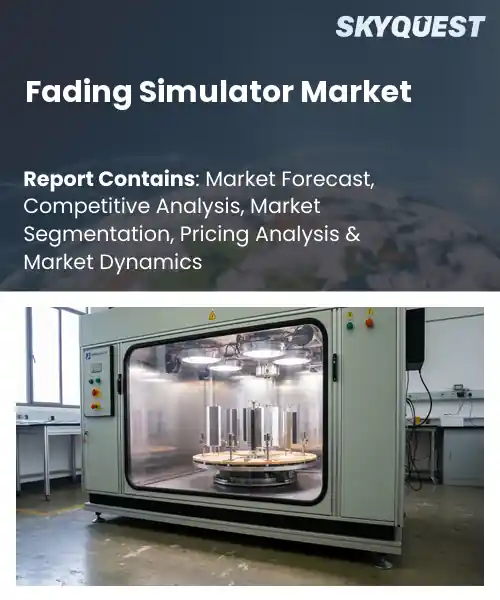
Fading Simulator Market
Report ID: SQMIG45K2244
Report ID: SQMIG45K2244
[email protected]
USA +1 351-333-4748
Report ID:
SQMIG45K2244 |
Region:
Global |
Published Date: March, 2026
Pages:
157
|Tables:
114
|Figures:
77


Global Fading Simulator Market size was valued at USD 150 Million in 2024 and is poised to grow from USD 162.75 Million in 2025 to USD 312.58 Million by 2033, growing at a CAGR of 8.5% during the forecast period (2026-2033).
Wireless technologies have greatly increased in complexity and volume over the past decade, placing high demands on device manufacturers as well as wireless network operators to accurately create realistic multipath, doppler and mobile effects so that all types of devices are verified for proper performance. Hardware and software fading simulators are used extensively to simulate time varying channel impairments thereby allowing engineers to reliably test antennas, radios, MIMO algorithms, and OTA systems in a repeatable and consistent manner which reduces the cost and time of onsite testing and develops more rapidly.
The market has gone from very simple analog testbeds to modern digital real-time channel emulators with a wide bandwidth, millimeter wave, and hardware-in-the-loop capabilities driven by 3GPP (3rd Generation Partnership Project) publisher of global telecommunications standards. One of the major driving forces behind the global fading simulator market is the transition to higher frequency, wider band, and multi-channel radio systems which significantly increase the variability of channels.
Companies that provide both hardware and software fading simulator solutions to Vendors and Test labs are investing heavily into real time (RT) hardware-in-the-loop (HIL) platforms and software delay channel emulators thus significantly decreasing time-to-market for new products while also reducing reliance upon high-cost outdoor testing sites.
How is AI Enhancing Capabilities in the Fading Simulator Market?
AI is revolutionizing the way we simulate fading by providing a data-based approach to channel modeling, adaptive emulation, and automated adjustment of parameters. Some examples of these advances are generative models that learn from real-world data; machine-learning-based predictions of the channel state; and hardware-in-the-loop testing with closed-loop control to create a more realistic simulation experience. One of the most important fading simulator market trends is the move from textbook-style statistical channel models to digital twins that are scenario-aware and represent real-world conditions, such as urban, vehicular, and satellite communications. These developments improve the validation of receivers and shorten development cycles.
For example, machine-learned compression of channel feedback data; synthetic multipath channel generation; and testing flows for neural receiver (i.e., an intelligent learning algorithm) will help make fading simulations much more applicable and ready for use during both 6G research and commercial rollouts. Keysight's PROPSIM channel emulator was on hand at Mobile World Congress March 2026 and provided demonstrations of agentic AI and AI-based channel emulation using neural receiver test flows. These demonstrations will support continued fading simulator market growth by accelerating the creation of realistic and usable scenarios and decreasing the time spent iterating through to complete testing of devices due to use of automated training capabilities for AI models/agents.
Market snapshot - (2026-2033)
Global Market Size
USD 0.56 Billion
Largest Segment
Software Simulators
Fastest Growth
Software Simulators
Growth Rate
11.0% CAGR
To get more insights on this market click here to Request a Free Sample Report
Global fading simulator market is segmented into fading simulator type, application area, end-user industry, deployment mode and region. Based on fading simulator type, the market is segmented into software simulators and hardware simulators. Based on application area, the market is segmented into telecommunications and research and development. Based on end-user industry, the market is segmented into telecommunication providers, academic institutions and government agencies. Based on deployment mode, the market is segmented into on-premises and cloud-based. Based on region, the market is segmented into North America, Europe, Asia Pacific, Latin America and Middle East & Africa.
As per fading simulator market outlook, the software simulators segment dominates the market. Additionally, the rapid configurability of these platforms and their ability to integrate with existing signal processing toolchains make them extremely efficient for iterative algorithm development and verification of system performance, both of which reduce the overall time to develop a new system. As a result of these advantages, a large diversity of users can easily distribute their systems and make frequent enhancements based on current and future evolution of fading scenarios, leading to continued growth in the overall ecosystem related to fading.
As per fading simulator market analysis, hardware simulators have emerged as the fastest growing area in this segment, primarily driven by an increasing demand for physical fidelity and hardware-in-the-loop validation that cannot be achieved with software simulation solutions. The increasing need for impact testing in a real over-the-air environment and certified environments has led to substantial investments being made in both hardware-based platforms that provide repeatable fading conditions in the field.
As per fading simulator market forecast, the on-premises segment dominates the overall market because most operators and institutions require complete control over experimental data, deterministic latency, and a solid connection to local laboratories for testing and to any physical equipment used in fading experiments. By maintaining a test environment in-house, the organization can conduct testing of confidential proprietary protocols and complex hardware integrations while developing an organizational trust and providing justification for additional investments into customized infrastructure and to provide long product validation cycles.
Alternatively, the cloud-based deployment segment continues to grow at the fastest rate as providers are delivering elastic compute, collaboration, and streamlined scaling of complex fading models, which have eliminated barriers to adoption. The simplification of maintenance, continuous updates, and availability of API’s all allow for rapid introduction of agile teams and service providers to utilize new testing-as-a-service offerings along with global participation in the marketplace through remote and on-demand experimentation.
To get detailed segments analysis, Request a Free Sample Report
As per fading simulator market regional outlook, the North America region is the leader in the market due to an abundance of proven technology, developed test facilities, and an infrastructure that fosters rapid innovation. North America also contains many major semiconductor, telecommunications, aerospace, and defense companies that have been involved with fading simulation testing and are dedicated to implementing rigorous channel emulation and testing prior to deployment, creating consistent usage for sophisticated simulators. As well, the availability of facilities and other professionals that can work collaboratively with commercial developers and research institutions to rapidly convert experimental methods into deployable systems.
The U.S. fading simulator market is large due to the presence of a dense population of technology providers, test laboratories, and manufacturers who rely on the use of fading simulation equipment from both defense and commercial telecom markets. Research universities and corporate R&D facilities are developing ways to implement new and innovative channel models into usable testing equipment, while systems integrators are developing tailored systems for validation programs that are extremely complicated.
As per fading simulator industry analysis, the market in Canada is dominated by a collaborative community of academia, specialized test service providers and integrated technology companies that support the validation of wireless technologies. The strong partnership between wireless operators and engineering service consultants has created a growing demand for configurable simulator solutions that can be used for certification and planning of wireless networks.
The fading simulator market in the Asia Pacific is growing rapidly with the implementation of innovative technologies, regional concentrations of semiconductor and device manufacturing activities, and continued investment in advanced wireless testbeds by regional service providers and equipment manufacturers. The regional focus on accurately validating complex propagation scenarios has created a demand for dynamic, scalable emulators for channel emulation and other wireless testing activities. The presence of local engineering talent and a growing number of independent test laboratories allows for rapid development and customization of products. Furthermore, the partnerships between local vendors and global suppliers will hasten the availability of new fading simulator solutions.
As per fading simulator market regional forecast, Japan demonstrates a high degree of sophistication about the types of manufacturers involved (device manufacturers, telecommunications carriers, and automotive electronics suppliers). Organizations with established research and development centers and laboratories are focusing heavily on rigorous channel emulation for complex propagation environments, providing detailed validation of workflows. Furthermore, strong relationships between manufacturers and standards committees support compatibility testing prior to actual use, while the supplier ecosystem is mature and provides highly integrated simulator configurations.
In South Korea, the fading simulator market benefits from the combination of strong capabilities in manufacturing along with research and development in communications and operator-led validation programs. Device manufacturers and chipset suppliers work closely with test labs and systems integrators to refine channel models and specifications for use in densely populated urban environments and inside buildings.
The fading simulator sector in Europe has solidified its position at the forefront of the rapidly evolving technology landscape through collaboration between industry participants, increased innovation spurred by the research and testing facilities enhanced by targeted funding for test infrastructure. Major components manufacturers have developed expansive portfolios focused on providing highly configurable emulation platforms to meet a global demand from automotive, telecommunications and industrial connectivity markets for validation of their products.
In Germany, fading simulators are driving the growth of the fading simulator market due to strong demands from automotive engineers for accurate channel emulation to be used within vehicles for communication and automation processes. Well-known engineering design and laboratory testing companies have formed strategic partnerships with OEMs to provide mutually beneficial simulator configurations and validation frameworks that can be utilized in their engineering projects. Local companies’ emphasize meeting strict engineering standards, meeting all requirements laid out in European testing standards as well as parent company’s strong focus on providing excellent customer service.
The fading simulator industry in the United Kingdom is benefiting from the demand of telecom operators, defence agencies and the academic community. in addition to traditional operations, accredited test centres and service providers provide flexible emulation solutions with many different capabilities, including network trials, device certification, and systems integration projects. The universities, consortia, and private vendors working together to create advanced channel models and scenarios will provide better emulation capabilities for future projects. Through this collaboration, modular solutions and testing as a service will see widespread acceptance throughout both government and commercial sectors.
The fading simulator industry in France is supported by the telecommunication research institutes, aerospace test facilities, and the automotive engineering clusters. National laboratories and private test houses work together to produce comprehensive channel characterization for future certifications and product development, while local manufacturers provide customized simulators with a high level of accuracy. In addition to these two support sectors, strong partnerships established between local telecommunications operators, integrators, and manufacturers assist in the practical implementation of the simulators. Certified testing processes and applications provide continuous activity within the fading simulator market; they also contribute to advanced prototype evaluations.
To know more about the market opportunities by region and country, click here to
Buy The Complete Report
Rising Demand for Realistic Testing
The growing demand for realistic wireless channel emulation drives the widespread use of fading simulators across telecommunications, automotive and aerospace organizations since stakeholders need regulated and repeatable environments to both test devices and protocols. Fading simulators provide developers with a means to replicate varying propagation conditions, numerous multipath scenarios, thus reducing uncertainty throughout design and testing processes; in addition, fading simulators are designed to speed up iterative refinements of both hardware and software and support performance compliance requirements of the system. Organizations are motivated to acquire and implement fading simulation solutions within their respective development workflows due to the perceived benefits offered in decreased risk and improved reliability of product.
Integration with Machine Learning Tools
The integration of fading simulators with machine learning and data analytics tools enhances the strategic utility of fading simulation solutions and increases the demand for these types of products by enabling automated generation of scenarios, parameter tuning, and anomaly detections during the testing phases. Fading simulators support an iterative training workflow to provide high-fidelity labeled data, which facilitates the accelerated development of adaptive algorithms and intelligent radio systems. As such, there is an overall synergy between fading simulators, testing efficiency, and the shortening of development cycles; which ultimately leads organizations to prioritize investment into simulators that enhance validation of advanced algorithms and support the continuous improvement of communication systems when operating under differing channel conditions.
High Cost of Advanced Equipment
High-performance fading simulators and their associated equipment incur a high total cost of ownership which limits their purchase by small companies and research labs when they must wait until they find the funds available for the purchases as some will look for simpler options due to budget restrictions. Cost of entry impedes widespread implementation of fading for early-stage testing environments and does not enable the integration into routine testing processes, thereby delaying the overall expansion of this part of the market. Also, the total cost of ownership, maintenance, and the need for specialized staff to operate such a sophisticated piece of equipment further limits the total addressable market, slowing down the time to procurement across multiple industries.
Complexity In System Configuration
The complex set-up, calibration, and scenario modelling requirements make the implementation and management of fading simulators challenging, further restricting market growth because the majority of businesses do not have the specialized knowledge to effectively operate these simulators. The complexities associated with set-up, calibration, and scenario modelling increase the amount of required training and extend project timelines which discourage organizations from adopting fading technology for their routine testing and/or rapid prototyping needs. Further complications related to the integration of testing tools already available in an organization's product development process and the need for customer configured fading simulators decrease operational flexibility. Therefore, many companies are opting to use simpler or outsourced testing approaches versus investing in the creation of their own in-house fading simulation infrastructure capability.
Request Free Customization of this report to help us to meet your business objectives.
The competitive landscape of the test and measurement industry is dominated by established vendors, who face growing pressure from a new class of software-first vendors that cater to the market with innovative products. The momentum behind standards for the transition to 5G and the emergence of 6G research are driving the marketplace by pushing for faster development of features and deeper integration of technologies to enable new channel emulation capabilities to support the test and measurement industry. Each company has identified specific strategies to implement, including; product led innovation as exemplified by Keysight’s PROPSIM channel emulators and the recent consolidation in the market through acquisitions of or investments in complementary capability companies.
SkyQuest’s ABIRAW (Advanced Business Intelligence, Research & Analysis Wing) is our Business Information Services team that Collects, Collates, Correlates, and Analyses the Data collected by means of Primary Exploratory Research backed by robust Secondary Desk research.
As per SkyQuest analysis, the global fading simulator industry is propelled primarily by the rapid proliferation and complexity of wireless systems that demand realistic, repeatable, channel emulation, while AI-driven simulation optimization acts as a second major driver by enabling adaptive, data-driven scenario generation and automated tuning. Software simulators currently dominate the market owing to their flexibility and rapid configurability and North America remains the leading region supported by deep technical ecosystems and established test infrastructure. A key restraint is the high cost of advanced equipment and associated total cost of ownership, which constrains adoption among smaller firms and early-stage research groups despite the clear value for certification and product development. The market is moderately concentrated, with a few key players holding a significant portion of the fading simulator market share, while several smaller and niche companies contribute to the remaining share, supported by strong demand from telecommunications and research sectors.
| Report Metric | Details |
|---|---|
| Market size value in 2024 | USD 0.56 Billion |
| Market size value in 2033 | USD 1.43 Billion |
| Growth Rate | 11.0% |
| Base year | 2024 |
| Forecast period | (2026-2033) |
| Forecast Unit (Value) | USD Billion |
| Segments covered |
|
| Regions covered | North America (US, Canada), Europe (Germany, France, United Kingdom, Italy, Spain, Rest of Europe), Asia Pacific (China, India, Japan, Rest of Asia-Pacific), Latin America (Brazil, Rest of Latin America), Middle East & Africa (South Africa, GCC Countries, Rest of MEA) |
| Companies covered |
|
| Customization scope | Free report customization with purchase. Customization includes:-
|
To get a free trial access to our platform which is a one stop solution for all your data requirements for quicker decision making. This platform allows you to compare markets, competitors who are prominent in the market, and mega trends that are influencing the dynamics in the market. Also, get access to detailed SkyQuest exclusive matrix.
Table Of Content
Executive Summary
Market overview
Parent Market Analysis
Market overview
Market size
KEY MARKET INSIGHTS
COVID IMPACT
MARKET DYNAMICS & OUTLOOK
Market Size by Region
KEY COMPANY PROFILES
Methodology
For the Fading Simulator Market, our research methodology involved a mixture of primary and secondary data sources. Key steps involved in the research process are listed below:
1. Information Procurement: This stage involved the procurement of Market data or related information via primary and secondary sources. The various secondary sources used included various company websites, annual reports, trade databases, and paid databases such as Hoover's, Bloomberg Business, Factiva, and Avention. Our team did 45 primary interactions Globally which included several stakeholders such as manufacturers, customers, key opinion leaders, etc. Overall, information procurement was one of the most extensive stages in our research process.
2. Information Analysis: This step involved triangulation of data through bottom-up and top-down approaches to estimate and validate the total size and future estimate of the Fading Simulator Market.
3. Report Formulation: The final step entailed the placement of data points in appropriate Market spaces in an attempt to deduce viable conclusions.
4. Validation & Publishing: Validation is the most important step in the process. Validation & re-validation via an intricately designed process helped us finalize data points to be used for final calculations. The final Market estimates and forecasts were then aligned and sent to our panel of industry experts for validation of data. Once the validation was done the report was sent to our Quality Assurance team to ensure adherence to style guides, consistency & design.
Analyst Support
Customization Options
With the given market data, our dedicated team of analysts can offer you the following customization options are available for the Fading Simulator Market:
Product Analysis: Product matrix, which offers a detailed comparison of the product portfolio of companies.
Regional Analysis: Further analysis of the Fading Simulator Market for additional countries.
Competitive Analysis: Detailed analysis and profiling of additional Market players & comparative analysis of competitive products.
Go to Market Strategy: Find the high-growth channels to invest your marketing efforts and increase your customer base.
Innovation Mapping: Identify racial solutions and innovation, connected to deep ecosystems of innovators, start-ups, academics, and strategic partners.
Category Intelligence: Customized intelligence that is relevant to their supply Markets will enable them to make smarter sourcing decisions and improve their category management.
Public Company Transcript Analysis: To improve the investment performance by generating new alpha and making better-informed decisions.
Social Media Listening: To analyze the conversations and trends happening not just around your brand, but around your industry as a whole, and use those insights to make better Marketing decisions.
REQUEST FOR SAMPLE
 REQUEST FREE CUSTOMIZATION
Global Fading Simulator Market size was valued at USD 0.56 Billion in 2024 and is poised to grow from USD 0.62 Billion in 2025 to USD 1.43 Billion by 2033, growing at a CAGR of 11.0% during the forecast period (2026-2033).
Competitive landscape is led by incumbent test and measurement vendors with growing pressure from software first entrants; standards momentum for 5G evolution and early 6G research acts as a market driver by forcing faster feature rollouts and deeper integration of channel emulation. Companies pursue concrete plays such as product-led innovation exemplified by Keysight’s PROPSIM channel emulators and recent sector consolidation and asset deals to absorb complementary emulation capabilities. Note on sourcing and scope: my review shows few pure play fading simulator startups founded since 2019. Most competitive moves, innovation and recent M&A are concentrated among established test vendors and newer firms offering adjacent capabilities such as wireless digital twins and AI driven RF modeling rather than standalone hardware channel emulators. 'FadingTech Innovations', 'Simulatech Dynamics', 'FadeVision Labs', 'SpectraSim Solutions', 'Quantum Fade Systems', 'Illusionary Simulations', 'Fadex Corp', 'Ethereal Simulators', 'FadeForge Technologies', 'VividSim Enterprises', 'Enigma Fading Simulations', 'MirageSoft Developers', 'FadeWave Industries', 'Phantasm Sim Co.', 'Lumina Fading Solutions', 'Simulacra Dynamics', 'Chromatic Fade Technologies', 'Transient Scenes Inc.', 'FadeCraft Innovations', 'Fading Dynamics LLC'
The increasing need for realistic wireless channel emulation in telecommunications, automotive, and aerospace sectors drives adoption of fading simulators because stakeholders require controlled, reproducible environments to validate devices and protocols. By enabling developers to replicate diverse propagation conditions and complex multipath scenarios, these simulators reduce uncertainty during design and testing, accelerate iterative refinement of hardware and software, and support compliance with performance requirements. The perceived value in risk reduction and improved product reliability motivates procurement and integration of fading simulation solutions across varied development workflows.
Ai-Driven Simulation Optimization: Adoption of artificial intelligence and machine learning techniques is reshaping fading simulator capabilities by automating model tuning, generating realistic fading scenarios, and accelerating validation cycles. These methods enable adaptive simulations that learn from operational data, improve prediction of channel behavior, and support scenario prioritization for test planning. Developers benefit from faster optimization of parameters and reduced manual intervention, while organizations gain more actionable insights for system design. The result is more efficient development workflows and improved fidelity in communications testing.
As per fading simulator market regional outlook, the North America region is the leader in the market due to an abundance of proven technology, developed test facilities, and an infrastructure that fosters rapid innovation.


Want to customize this report? This report can be personalized according to your needs. Our analysts and industry experts will work directly with you to understand your requirements and provide you with customized data in a short amount of time. We offer $1000 worth of FREE customization at the time of purchase.
Feedback From Our Clients


 USA (+1) 351-333-4748

