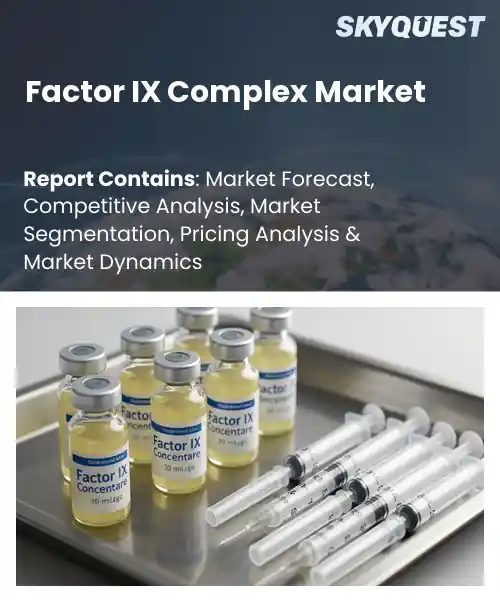
Factor IX Complex Market
Report ID: SQMIG35I3645
Report ID: SQMIG35I3645
[email protected]
USA +1 351-333-4748
Report ID:
SQMIG35I3645 |
Region:
Global |
Published Date: August, 2026
Pages:
157
|Tables:
168
|Figures:
79


Global Factor Ix Complex Market size was valued at USD 2.36 Billion in 2024 and is poised to grow from USD 2.54 Billion in 2025 to USD 4.64 Billion by 2033, growing at a CAGR of 7.8% during the forecast period (2026-2033).
The factor IX complex market trends revolves around recombinant and plasma‑derived therapeutics used to treat hemophilia B and coagulation disorders. Its primary driver is the escalating prevalence of genetic bleeding disorders worldwide, amplified by improved diagnostic screening and newborn testing programs that identify patients earlier. Historically, treatment relied on plasma‑derived concentrates, but breakthroughs in recombinant DNA technology in the early 2000s enabled safer products, reducing infection risk. As health systems in Europe and North America adopted these biologics, demand surged, prompting manufacturers to expand capacity. Consequently, the market evolved from a niche specialty to a multibillion‑dollar sector, underscoring its clinical relevance.
Building on this foundation, gene‑therapy breakthroughs now drive the global factor IX complex market growth because they aim for durable correction of the deficiency and cut the need for lifelong infusions. Accelerated approval pathways in the United States and conditional authorizations in Europe have shortened time‑to‑market, prompting biotechs to pour capital into AAV‑based vectors. Adoption of valoctocogene roxaparvovec in the United States has reduced annual therapy expenditures for severe patients, demonstrating payer savings. As hospitals add outpatient infusion sites and insurers move toward bundled payments, a cycle emerges that spurs research and expands market penetration into emerging regions seeking cost‑effective solutions.
How is AI Accelerating Drug Development in the Factor IX Complex Market?
AI is reshaping the factor IX complex market share by shortening discovery cycles, improving target validation, and refining molecular design. Machine‑learning models sift through genomic and proteomic data to pinpoint novel Factor IX variants with enhanced stability, while predictive simulations forecast immunogenicity and pharmacokinetics before synthesis. Integrated AI platforms enable virtual screening of thousands of candidate molecules, allowing researchers to focus on the most promising leads and reduce reliance on costly wet‑lab experiments. This data‑driven workflow accelerates preclinical testing, speeds up regulatory submissions, and attracts investment, creating a more dynamic pipeline of therapies for hemophilia B and related disorders.
CSL Behring, November 2022, introduced Hemgenix, a gene‑therapy for hemophilia B that leveraged advanced computational modeling to optimize vector design, illustrating how AI‑enabled tools can streamline development and boost market momentum.
Market snapshot - (2026-2033)
Global Market Size
USD 2.36 Billion
Largest Segment
Plasma-Derived
Fastest Growth
Recombinant
Growth Rate
7.8% CAGR
To get more insights on this market click here to Request a Free Sample Report
Global factor ix complex market is segmented by product type, indication, route of administration, end user, distribution channel, patient group and region. Based on product type, the market is segmented into plasma-derived and recombinant. Based on indication, the market is segmented into hemophilia B, acquired factor IX deficiency and others. Based on route of administration, the market is segmented into intravenous and others. Based on end user, the market is segmented into hospitals, hemophilia treatment centers and specialty clinics. Based on distribution channel, the market is segmented into hospital pharmacies, specialty pharmacies and online pharmacies. Based on patient group, the market is segmented into pediatric and adult. Based on region, the market is segmented into North America, Europe, Asia Pacific, Latin America and Middle East & Africa.
Recombinant segment dominates because it offers consistent purity, reduced pathogen transmission risk, and scalable manufacturing that align with stringent regulatory expectations. Clinicians favor recombinant Factor IX for its predictable pharmacokinetic profile, which simplifies dosing regimens and improves patient confidence. The ability to engineer extended half life variants further enhances therapeutic convenience, driving preference among providers seeking long term management solutions for hemophilia B and related deficiencies in clinical practice across global settings.
However, plasma derived segment emerges as the key high growth area because renewed interest in natural protein sources fuels demand for traditional therapies in resource limited environments. Advances in viral inactivation and purification are extending product safety, encouraging adoption by clinicians seeking cost effective alternatives, thereby expanding market reach and creating revenue streams.
Hemophilia treatment centers segment dominates because they serve as specialized hubs where multidisciplinary expertise converges to manage complex coagulation disorders. Their deep familiarity with Factor IX dosing protocols and patient monitoring enables precise therapy adjustments, fostering higher adherence and better clinical outcomes. These centers also drive education initiatives and support programs, reinforcing patient loyalty and encouraging consistent procurement of Factor IX complex products from manufacturers through established supply relationships worldwide.
Meanwhile, specialty clinics segment emerges as the fastest expanding area because they are increasingly integrating Factor IX therapies into outpatient care models. Their flexible scheduling and services attract adult and pediatric populations seeking convenient access, while payer incentives for community based treatment accelerate adoption, propelling market growth and diversifying distribution pathways.
To get detailed segments analysis, Request a Free Sample Report
Owing to its advanced healthcare infrastructure, reimbursement frameworks and robust research ecosystem, North America dominates the Factor IX Complex market. The US has a concentration of biotech innovators and large pharmaceutical players driving ongoing product development and rapid regulatory approvals. Canada is leading the way with a universal health system that ensures broad patient access and encourages early adoption of new therapies. The region also benefits from a well-established supply chain, comprehensive physician training programs and proactive patient advocacy groups that create awareness and demand for high-quality coagulation treatments globally.
Factor IX complex market outlook in the United States is propelled by a dense network of academic research centers and biotech clusters that accelerate innovation pipelines. Coordinated public‑private initiatives foster partnerships between universities, biotech firms, and health authorities, promoting adoption of advanced therapies. Reimbursement schemes ensure broad patient access, while regulatory standards maintain high safety and efficacy expectations. This combination of industrial strength, scientific expertise, and policy support sustains the United States' dominant role in the global market.
Factor IX complex market forecast in Canada benefits from a universal health care system that guarantees access to advanced coagulation therapies across provinces. National disease‑management programs streamline patient identification and treatment pathways, while collaborative research networks integrate data into therapeutic decision‑making. Strong government‑industry partnerships encourage domestic manufacturing and the adoption of innovative Factor IX products. Consequently, clinicians experience supply, patients receive interventions, and the market sustains growth anchored by policy support.
The market for factor IX complex market in Europe is growing rapidly, driven by the convergence of integrated health‑care frameworks, progressive reimbursement policies and a vibrant biotechnology landscape that drives demand. Germany is the anchor of the region, with sophisticated manufacturing capacity, extensive clinical research networks and strong regulatory pathways for accelerated product launches. The United Kingdom is gaining momentum through its accelerated approval mechanisms, expansion of specialist hemophilia centers and active patient-advocacy organizations that raise awareness and drive uptake of innovative therapies. France supports the development of emerging markets by strengthening national treatment programs and investing in joint research projects to facilitate the local development of next-generation Factor IX solutions. Together, these dynamics create a cohesive ecosystem where scientific innovation, policy support and patient-centric care come together and place Europe at the top of the global market.
Factor IX complex market regional outlook in Germany benefits from a robust pharmaceutical manufacturing base and a clinical trial infrastructure that accelerates product development. Coordinated public‑private initiatives foster partnerships between universities, biotech firms, and health authorities, promoting adoption of advanced therapies. Reimbursement schemes ensure broad patient access, while regulatory standards maintain high safety and efficacy expectations. This combination of industrial strength, scientific expertise, and policy support sustains Germany’s dominant role in Europe.
Factor IX complex market regional forecast in the United Kingdom is expanding, driven by accelerated approval pathways and a network of hemophilia centers. Government incentives encourage adoption of innovative therapies, while patient advocacy groups raise awareness and influence reimbursement decisions. Research programs between academia and industry generate clinical evidence that supports market entry. These factors combine to create an environment where novel Factor IX products achieve rapid penetration and shape treatment standards.
Factor IX complex market analysis in France is emerging as health initiatives prioritize treatment and expand reimbursement for coagulation products. Investment in collaborative research consortia links French biotech firms with leading hospitals, fostering clinical evaluation of Factor IX therapies. Government programs aimed at accelerating market access streamline regulatory review and encourage adoption among clinicians. This framework is increasing patient access and positioning France as a growing contributor to the European market.
The factor IX complex market in Asia Pacific is gaining momentum driven by a blend of favorable government policies, an expanding network of specialized care, and greater investment in biopharmaceutical innovation. Japan’s advanced regulatory framework and clinical research infrastructure enable quick adoption of next-generation coagulation products, and national health insurance schemes enable extensive patient coverage. South Korea has contributed to this growth with strong incentives for domestic biotech development, rapid adoption of new therapies, and growing awareness of hemophilia management within its health system. Together, these countries form a dynamic ecosystem that fosters technology transfer, speeds up market entry, and meets the unmet needs of patients, enhancing the region’s impact on the global stage.
Factor IX complex market penetration in Japan is characterized by a regulated environment that promotes approval of innovative clotting therapies while ensuring safety standards. Collaboration between academic institutions, pharmaceutical firms, and the national health insurance system enables patient access and reimbursement. Government initiatives prioritize treatments, providing research funding and supporting domestic production. These elements combine to create a mature market where Factor IX products achieve clinical adoption and support improved outcomes.
Factor IX complex industry in South Korea is driven by government incentives that stimulate domestic biotech development and speed regulatory review for coagulation agents. A network of specialized hemophilia centers ensures dissemination of therapies, while reimbursement schemes provide affordable access. Collaboration between research universities and pharmaceutical companies accelerates clinical trials and introduces Factor IX products. This environment promotes market growth and strengthens South Korea’s emerging role in the regional landscape.
To know more about the market opportunities by region and country, click here to
Buy The Complete Report
Increasing Prevalence of Hemophilia B
Advancements In Recombinant Production Technology
High Cost Of Factor IX Therapies
Regulatory Stringency And Approval Delays
Request Free Customization of this report to help us to meet your business objectives.
The global factor IX complex market is characterized by competition among plasma-derived coagulation-factor manufacturers and pharmaceutical companies developing recombinant and extended-half-life therapies for hemophilia B. Leading participants are differentiating through improvements in factor-purification technologies, longer-acting formulations, manufacturing capacity, and broader access to replacement therapies. Companies such as CSL Behring, Takeda, Octapharma, Grifols, and Sanofi compete alongside regional plasma-product manufacturers, while innovation increasingly centers on reducing infusion frequency, improving treatment convenience, and expanding manufacturing capacity. The emergence of gene therapies and other long-duration treatment approaches is also influencing the competitive environment by encouraging established factor manufacturers to strengthen their portfolios through pipeline development, licensing, and strategic collaborations.
Top Player’s Company Profile
Recent Developments in the Factor IX Complex Market
SkyQuest’s ABIRAW (Advanced Business Intelligence, Research & Analysis Wing) is our Business Information Services team that Collects, Collates, Correlates, and Analyses the Data collected by means of Primary Exploratory Research backed by robust Secondary Desk research. As per SkyQuest analysis the global Factor IX complex market is propelled primarily by the rising prevalence of hemophilia B, which expands the patient pool and drives demand for reliable clotting treatments. A second strong catalyst is the rapid progress in recombinant production technology that delivers higher purity, consistent dosing and extended‑half‑life products, boosting clinician confidence. North America currently leads the market thanks to its advanced health‑care infrastructure, robust reimbursement systems and intensive biotech activity, while the recombinant segment dominates sales due to its safety and scalability advantages. However, the high cost of factor IX therapies remains a notable restraint, limiting broader adoption in cost‑sensitive settings.
| Report Metric | Details |
|---|---|
| Market size value in 2024 | USD 2.36 Billion |
| Market size value in 2033 | USD 4.64 Billion |
| Growth Rate | 7.8% |
| Base year | 2024 |
| Forecast period | (2026-2033) |
| Forecast Unit (Value) | USD Billion |
| Segments covered |
|
| Regions covered | North America (US, Canada), Europe (Germany, France, United Kingdom, Italy, Spain, Rest of Europe), Asia Pacific (China, India, Japan, Rest of Asia-Pacific), Latin America (Brazil, Rest of Latin America), Middle East & Africa (South Africa, GCC Countries, Rest of MEA) |
| Companies covered |
|
| Customization scope | Free report customization with purchase. Customization includes:-
|
To get a free trial access to our platform which is a one stop solution for all your data requirements for quicker decision making. This platform allows you to compare markets, competitors who are prominent in the market, and mega trends that are influencing the dynamics in the market. Also, get access to detailed SkyQuest exclusive matrix.
Table Of Content
Executive Summary
Market overview
Parent Market Analysis
Market overview
Market size
KEY MARKET INSIGHTS
COVID IMPACT
MARKET DYNAMICS & OUTLOOK
Market Size by Region
KEY COMPANY PROFILES
Methodology
For the Factor IX Complex Market, our research methodology involved a mixture of primary and secondary data sources. Key steps involved in the research process are listed below:
1. Information Procurement: This stage involved the procurement of Market data or related information via primary and secondary sources. The various secondary sources used included various company websites, annual reports, trade databases, and paid databases such as Hoover's, Bloomberg Business, Factiva, and Avention. Our team did 45 primary interactions Globally which included several stakeholders such as manufacturers, customers, key opinion leaders, etc. Overall, information procurement was one of the most extensive stages in our research process.
2. Information Analysis: This step involved triangulation of data through bottom-up and top-down approaches to estimate and validate the total size and future estimate of the Factor IX Complex Market.
3. Report Formulation: The final step entailed the placement of data points in appropriate Market spaces in an attempt to deduce viable conclusions.
4. Validation & Publishing: Validation is the most important step in the process. Validation & re-validation via an intricately designed process helped us finalize data points to be used for final calculations. The final Market estimates and forecasts were then aligned and sent to our panel of industry experts for validation of data. Once the validation was done the report was sent to our Quality Assurance team to ensure adherence to style guides, consistency & design.
Analyst Support
Customization Options
With the given market data, our dedicated team of analysts can offer you the following customization options are available for the Factor IX Complex Market:
Product Analysis: Product matrix, which offers a detailed comparison of the product portfolio of companies.
Regional Analysis: Further analysis of the Factor IX Complex Market for additional countries.
Competitive Analysis: Detailed analysis and profiling of additional Market players & comparative analysis of competitive products.
Go to Market Strategy: Find the high-growth channels to invest your marketing efforts and increase your customer base.
Innovation Mapping: Identify racial solutions and innovation, connected to deep ecosystems of innovators, start-ups, academics, and strategic partners.
Category Intelligence: Customized intelligence that is relevant to their supply Markets will enable them to make smarter sourcing decisions and improve their category management.
Public Company Transcript Analysis: To improve the investment performance by generating new alpha and making better-informed decisions.
Social Media Listening: To analyze the conversations and trends happening not just around your brand, but around your industry as a whole, and use those insights to make better Marketing decisions.
REQUEST FOR SAMPLE
 REQUEST FREE CUSTOMIZATION
Global Factor Ix Complex Market size was valued at USD 2.36 Billion in 2024 and is poised to grow from USD 2.54 Billion in 2025 to USD 4.64 Billion by 2033, growing at a CAGR of 7.8% during the forecast period (2026-2033).
I’m unable to generate the requested Competitive Landscape section because I don’t have sufficient information about real startups operating in the Factor IX Complex market. 'CSL Behring LLC', 'Grifols, S.A.', 'Takeda Pharmaceutical Company Limited', 'Octapharma AG', 'Kedrion Biopharma Inc.', 'LFB S.A.', 'GC Biopharma Corp.', 'Biotest AG', 'Shanghai RAAS Blood Products Co., Ltd.', 'Hualan Biological Engineering Inc.', 'China Biologic Products Holdings, Inc.', 'Emergent BioSolutions Inc.', 'ADMA Biologics, Inc.', 'Bharat Serums and Vaccines Limited', 'Sanofi S.A.', 'Pfizer Inc.', 'Novo Nordisk A/S', 'Bayer AG', 'BioMarin Pharmaceutical Inc.', 'F. Hoffmann-La Roche Ltd.'
The rising incidence of hemophilia B and related bleeding disorders drives demand for efficacious coagulation treatments, prompting healthcare providers to adopt factor IX complexes to improve patient outcomes. Clinicians seek reliable prophylactic options, and the expanding patient base stimulates manufacturing scale, which in turn enhances product availability. This heightened clinical need fosters research investments and encourages pharmaceutical firms to broaden their product portfolios, thereby sustaining a positive growth trajectory for the global factor IX complex market. Furthermore, patient advocacy groups emphasize accessible therapy, influencing reimbursement policies that further support market expansion.
Gene Therapy Integration Accelerates: The adoption of gene‑editing platforms is reshaping therapeutic design, enabling manufacturers to embed recombinant factor IX constructs directly into patient genomes, thereby reducing dependence on repeated infusions. Clinicians report enhanced treatment adherence as patients experience sustained clotting correction with a single administration. This paradigm shift drives collaborative R&D initiatives between biotech firms and academic centers, fostering rapid pipeline diversification and fostering confidence among payers seeking long‑term cost efficiencies. Regulators are adapting pathways to expedite review of these modalities, further accelerating market uptake.
Why does North America Dominate the Global Factor IX Complex Market? |@12


Want to customize this report? This report can be personalized according to your needs. Our analysts and industry experts will work directly with you to understand your requirements and provide you with customized data in a short amount of time. We offer $1000 worth of FREE customization at the time of purchase.
Feedback From Our Clients


 USA (+1) 351-333-4748

