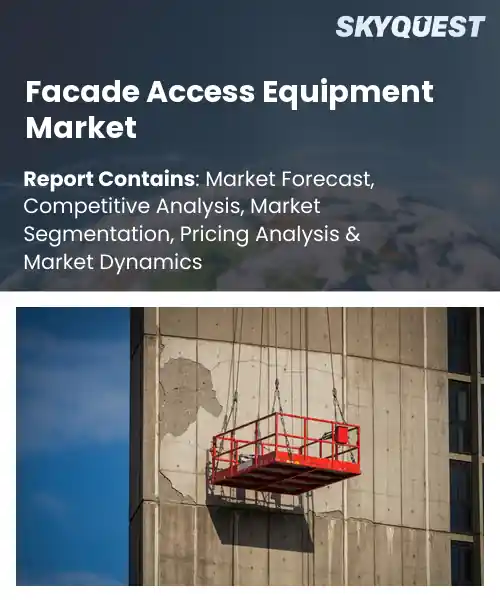
Facade Access Equipment Market
Report ID: SQMIG20C2301
Report ID: SQMIG20C2301
[email protected]
USA +1 351-333-4748
Report ID:
SQMIG20C2301 |
Region:
Global |
Published Date: July, 2026
Pages:
157
|Tables:
118
|Figures:
77


Global Facade Access Equipment Market size was valued at USD 3.74 Billion in 2024 and is poised to grow from USD 3.98 Billion in 2025 to USD 6.54 Billion by 2033, growing at a CAGR of 6.4% during the forecast period (2026-2033).
The façade access equipment market comprises modular scaffolds, suspended platforms, rope‑access systems and related safety gear used to clean, repair or upgrade building exteriors. Its significance stems from the growing need to maintain energy‑efficiency, aesthetics and safety of complex structures, especially as urban skylines age. The primary driver has been stricter building‑envelope regulations that compel owners to retrofit façades for thermal performance and fire protection. Over the past decade the market has shifted from labor‑intensive manual ladders toward reusable platforms, exemplified by adoption of aluminum scaffold systems in Europe and the rise of lightweight suspended rigs on New York’s major refurbishments. Another pivotal factor fueling expansion is the convergence of sustainability mandates with asset management, which encourages owners to adopt access solutions that reduce labor hours and carbon footprints. When regulations require façade insulation upgrades, contractors choose telescopic platforms equipped with sensors that monitor load, positioning and energy consumption, thereby shortening project timelines and lowering emissions. For instance, a German retrofit firm reduced crew exposure by 40 % using a suspended gantry on a 30‑storey office tower. This efficiency gain spurs demand for modular equipment, creates market entry points for manufacturers that can integrate telematics, and opens revenue streams through analytics contracts.
How is AI enhancing safety and efficiency in the facade access equipment market?
AI is reshaping facade access equipment by embedding smart sensors, computer‑vision cameras and edge‑processing units directly into lifts and scaffolding. These technologies continuously monitor platform stability, detect obstacles and predict component wear before failures occur. Operators receive real‑time alerts on handheld displays, allowing them to pause work instantly and avoid accidents. Maintenance crews can schedule service based on actual usage patterns rather than fixed intervals, reducing downtime and extending equipment life. The market’s rapid growth in high‑rise construction creates a strong demand for such safety‑first solutions, making AI a core differentiator for manufacturers seeking to meet stricter regulations and client expectations.Aluma Systems March 2024, introduced an AI‑driven load‑monitoring platform that automatically adjusts lift parameters and flags overload conditions, boosting both safety compliance
Market snapshot - (2026-2033)
Global Market Size
USD 3.74 Billion
Largest Segment
Building Maintenance Units
Fastest Growth
Mast Climbers
Growth Rate
6.4% CAGR
To get more insights on this market click here to Request a Free Sample Report
Global facade access equipment market is segmented by equipment type, operation, application, end user and region. Based on equipment type, the market is segmented into Building Maintenance Units, Suspended Platforms, Mast Climbers and Portable Access Systems. Based on operation, the market is segmented into Manual and Powered. Based on application, the market is segmented into Construction, Building Maintenance, Window Cleaning and Inspection. Based on end user, the market is segmented into Commercial, Residential and Industrial. Based on region, the market is segmented into North America, Europe, Asia Pacific, Latin America and Middle East & Africa.
Building maintenance units segment dominates because they integrate safety, efficiency, and versatility, making them the preferred choice for routine façade upkeep. Their ability to move vertically along a building’s exterior while supporting multiple workers and tools reduces labor hours and minimizes disruption. Design enhancements such as lightweight frames and ergonomic controls further reinforce adoption, while regulatory standards for worker protection drive manufacturers to prioritize this equipment type.
Meanwhile, suspended platforms emerge as the fastest growing equipment type as urban construction projects demand higher reach and flexible positioning. Innovations in modular rail systems and remote controls enable rapid deployment on complex façades, attracting contractors seeking cost effective solutions. This momentum expands market breadth and stimulates new service models.
Manual operation segment leads because it offers simplicity, lower acquisition cost, and direct operator control, which appeal to small scale contractors and maintenance crews. The absence of complex electrical components reduces maintenance downtime and eases compliance with basic safety protocols. Users value the tactile feedback that enhances precise positioning on delicate façades, fostering trust and encouraging widespread adoption in routine service tasks.
Conversely, powered operation is witnessing the strongest growth momentum as high rise developments demand faster and safer lift capabilities. Advances in battery efficiency and integrated safety sensors allow operators to reach greater heights quickly, minimizing labor exposure. This evolution opens opportunities for service contracts and positions the market for accelerated expansion.
To get detailed segments analysis, Request a Free Sample Report
The Asia Pacific region combines a robust construction pipeline with a culture of technological innovation that fuels demand for advanced facade access solutions. Rapid urbanisation and a focus on high‑rise development create a constant need for safe, efficient equipment that can adapt to complex architectural designs. Strong manufacturing capabilities in the region enable local producers to supply customized, high‑performance systems at competitive cost, while a proactive regulatory environment emphasizes worker safety and sustainability. Collaborative partnerships between equipment manufacturers, construction firms, and research institutions further accelerate product refinement and adoption, positioning the region as a benchmark for quality and innovation in the global market.
Facade Access Equipment Market in Japan benefits from a longstanding emphasis on precision engineering and stringent safety standards, encouraging the deployment of sophisticated access solutions. The country’s dense urban environment and prevalence of high‑rise structures demand equipment that can operate efficiently within limited spaces, driving interest in modular and lightweight designs. Ongoing collaboration between manufacturers and architectural firms promotes integration of advanced safety features, reinforcing Japan’s reputation for reliability and technological excellence in this sector.
Facade Access Equipment Market in South Korea is propelled by a dynamic construction sector that prioritises rapid project delivery and adherence to rigorous safety protocols. The nation’s focus on smart building technologies encourages the adoption of intelligent access systems that enhance operational efficiency and worker protection. Strong domestic engineering expertise supports the development of innovative solutions tailored to complex facade geometries, while government incentives for safety upgrades stimulate continuous market expansion and reinforce South Korea’s competitive edge.
North America experiences rapid expansion due to a confluence of high‑rise construction activity, heightened safety awareness, and an evolving regulatory landscape that emphasizes worker protection. The United States and Canada both prioritize innovative building practices, encouraging the integration of adaptable and ergonomic access solutions that can meet diverse project requirements. A strong emphasis on sustainability drives the adoption of equipment that reduces downtime and energy consumption, while collaborative ecosystems between manufacturers, contractors, and safety agencies accelerate the diffusion of best‑practice technologies. These factors collectively foster a market environment where demand for advanced facade access equipment continues to surge across the continent.
Facade Access Equipment Market in the United States reflects a strong commitment to occupational safety and the adoption of cutting‑edge technologies across large‑scale construction projects. The expansive skyline and continuous development of commercial and residential towers create a persistent need for versatile, high‑performance access solutions. Industry partnerships focus on integrating digital monitoring and predictive maintenance capabilities, enhancing reliability and reducing operational risk. This emphasis on innovation and safety reinforces the United States as a leading driver of market growth.
Facade Access Equipment Market in Canada benefits from rigorous safety regulations and a construction landscape that balances urban growth with challenging climatic conditions. The demand for equipment capable of operating efficiently in diverse weather environments encourages the development of robust, weather‑resistant designs. Collaborative efforts between equipment suppliers and local contractors promote the adoption of ergonomic solutions that improve worker productivity while meeting strict safety standards, positioning Canada as a vital contributor to the continent’s market expansion.
Europe strengthens its position through a blend of regulatory leadership, sustainability focus, and a heritage of engineering excellence that drives continuous improvement in facade access technology. The region’s comprehensive safety directives compel manufacturers to embed advanced protective features and ergonomic designs into their product lines. A pronounced commitment to green construction practices encourages the use of lightweight, energy‑efficient equipment that reduces environmental impact. Collaborative research initiatives across several countries facilitate the sharing of best practices and the rapid integration of digital tools such as IoT monitoring, enhancing system reliability and lifecycle management. These strategic priorities collectively elevate Europe’s role as a hub of innovation and quality in the global market.
Facade Access Equipment Market in Germany is characterized by a strong engineering tradition and a proactive approach to occupational safety. German manufacturers emphasize precision, durability, and integration of smart technologies that enable real‑time performance tracking. The country’s extensive high‑rise development, especially in urban centres, fuels demand for adaptable access solutions that meet stringent regulatory requirements. Collaborative networks among industry stakeholders promote continuous product refinement, reinforcing Germany’s leadership in quality and innovation.
Facade Access Equipment Market in the United Kingdom is driven by a rigorous safety culture and a growing emphasis on retrofit projects within historic urban environments. The sector prioritises lightweight, modular systems that can be deployed with minimal disruption to heritage structures while adhering to strict health and safety guidelines. Integration of digital safety monitoring tools enhances compliance and operational efficiency, positioning the United Kingdom as a key player in advancing safe facade access practices.
Facade Access Equipment Market in France benefits from a strong commitment to sustainable building practices and a regulatory framework that underscores worker protection. French firms focus on developing ergonomic, low‑impact equipment that aligns with environmental objectives and urban renovation needs. Partnerships between equipment producers and architectural firms foster the creation of customized solutions that address the aesthetic and functional demands of French construction projects, reinforcing the nation’s reputation for quality and safety in the sector.
To know more about the market opportunities by region and country, click here to
Buy The Complete Report
Increasing Urbanization and High‑Rise Construction
Adoption Of Automation And Smart Controls
High Initial Capital Investment
Complex Installation And Maintenance Requirements
Request Free Customization of this report to help us to meet your business objectives.
The competitive landscape is shaped by intense rivalry among manufacturers and service providers who are leveraging strategic M&A, joint ventures, and advanced automation to capture high‑rise building projects. Recent examples include a leading global lift company acquiring a niche BMU specialist to broaden its product portfolio, and a European façade contractor forming a partnership with a robotics firm to integrate autonomous cleaning and inspection modules into its access systems, directly responding to safety mandates and the push for faster construction cycles.
Top Player’s Company Profile
Recent Developments
SkyQuest’s ABIRAW (Advanced Business Intelligence, Research & Analysis Wing) is our Business Information Services team that Collects, Collates, Correlates, and Analyses the Data collected by means of Primary Exploratory Research backed by robust Secondary Desk research. As per SkyQuest analysis the global façade access equipment market is propelled primarily by increasing urbanization and high‑rise construction which fuels demand for safe, efficient exterior work solutions, while a second strong catalyst is the adoption of automation and smart controls that embed sensors and AI for predictive maintenance and enhanced safety. The market faces a notable restraint in the high initial capital investment required for advanced systems, limiting uptake among smaller contractors. Asia Pacific dominates the landscape thanks to its rapid building pipeline and strong manufacturing base, and the building maintenance units segment leads in volume because of its versatility and regulatory appeal.
| Report Metric | Details |
|---|---|
| Market size value in 2024 | USD 3.74 Billion |
| Market size value in 2033 | USD 6.54 Billion |
| Growth Rate | 6.4% |
| Base year | 2024 |
| Forecast period | (2026-2033) |
| Forecast Unit (Value) | USD Billion |
| Segments covered |
|
| Regions covered | North America (US, Canada), Europe (Germany, France, United Kingdom, Italy, Spain, Rest of Europe), Asia Pacific (China, India, Japan, Rest of Asia-Pacific), Latin America (Brazil, Rest of Latin America), Middle East & Africa (South Africa, GCC Countries, Rest of MEA) |
| Companies covered |
|
| Customization scope | Free report customization with purchase. Customization includes:-
|
To get a free trial access to our platform which is a one stop solution for all your data requirements for quicker decision making. This platform allows you to compare markets, competitors who are prominent in the market, and mega trends that are influencing the dynamics in the market. Also, get access to detailed SkyQuest exclusive matrix.
Table Of Content
Executive Summary
Market overview
Parent Market Analysis
Market overview
Market size
KEY MARKET INSIGHTS
COVID IMPACT
MARKET DYNAMICS & OUTLOOK
Market Size by Region
KEY COMPANY PROFILES
Methodology
For the Facade Access Equipment Market, our research methodology involved a mixture of primary and secondary data sources. Key steps involved in the research process are listed below:
1. Information Procurement: This stage involved the procurement of Market data or related information via primary and secondary sources. The various secondary sources used included various company websites, annual reports, trade databases, and paid databases such as Hoover's, Bloomberg Business, Factiva, and Avention. Our team did 45 primary interactions Globally which included several stakeholders such as manufacturers, customers, key opinion leaders, etc. Overall, information procurement was one of the most extensive stages in our research process.
2. Information Analysis: This step involved triangulation of data through bottom-up and top-down approaches to estimate and validate the total size and future estimate of the Facade Access Equipment Market.
3. Report Formulation: The final step entailed the placement of data points in appropriate Market spaces in an attempt to deduce viable conclusions.
4. Validation & Publishing: Validation is the most important step in the process. Validation & re-validation via an intricately designed process helped us finalize data points to be used for final calculations. The final Market estimates and forecasts were then aligned and sent to our panel of industry experts for validation of data. Once the validation was done the report was sent to our Quality Assurance team to ensure adherence to style guides, consistency & design.
Analyst Support
Customization Options
With the given market data, our dedicated team of analysts can offer you the following customization options are available for the Facade Access Equipment Market:
Product Analysis: Product matrix, which offers a detailed comparison of the product portfolio of companies.
Regional Analysis: Further analysis of the Facade Access Equipment Market for additional countries.
Competitive Analysis: Detailed analysis and profiling of additional Market players & comparative analysis of competitive products.
Go to Market Strategy: Find the high-growth channels to invest your marketing efforts and increase your customer base.
Innovation Mapping: Identify racial solutions and innovation, connected to deep ecosystems of innovators, start-ups, academics, and strategic partners.
Category Intelligence: Customized intelligence that is relevant to their supply Markets will enable them to make smarter sourcing decisions and improve their category management.
Public Company Transcript Analysis: To improve the investment performance by generating new alpha and making better-informed decisions.
Social Media Listening: To analyze the conversations and trends happening not just around your brand, but around your industry as a whole, and use those insights to make better Marketing decisions.
REQUEST FOR SAMPLE
 REQUEST FREE CUSTOMIZATION


Want to customize this report? This report can be personalized according to your needs. Our analysts and industry experts will work directly with you to understand your requirements and provide you with customized data in a short amount of time. We offer $1000 worth of FREE customization at the time of purchase.
Feedback From Our Clients


 USA (+1) 351-333-4748

