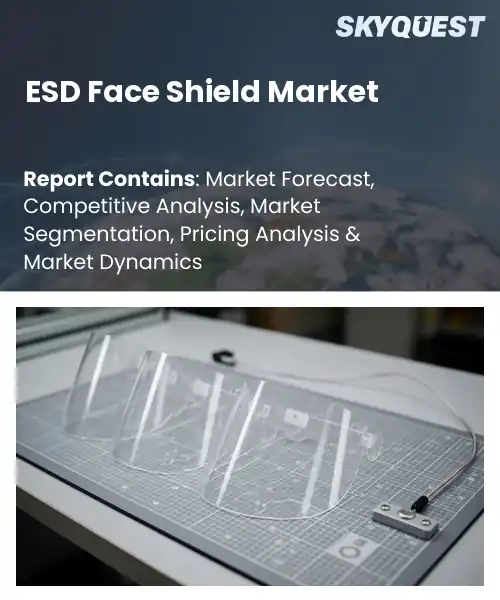
ESD Face Shield Market
Report ID: SQMIG30K2127
Report ID: SQMIG30K2127
[email protected]
USA +1 351-333-4748
Report ID:
SQMIG30K2127 |
Region:
Global |
Published Date: July, 2026
Pages:
157
|Tables:
149
|Figures:
78


Global ESD Face Shield Market size was valued at USD 174.3 Million in 2024 and is poised to grow from USD 184.93 Million in 2025 to USD 296.99 Million by 2033, growing at a CAGR of 6.1% during the forecast period (2026-2033).
Expansion of IoT devices and 5G networks raises need for ESD face shields because each added sensor creates new points that jeopardize assembly yields. Manufacturers responding to higher connectivity targets invest in cleaner production lines, and Foxconn’s recent rollout of reusable, anti‑fog shields on its smartphone factories illustrates how shield adoption directly cuts defect rates.
At the same time, tighter European and North American environmental rules require documented ESD control, spurring demand for integrated monitoring software packaged with shield systems. Regional suppliers gain a chance to offer recyclable designs, while large firms can bundle analytics services, thereby broadening market revenue.
How is AI integration improving defect detection in the ESD face shield market?
AI integration is reshaping quality control in the ESD face shield market by enabling real time visual inspection that spots microscopic flaws invisible to the human eye. Machine learning models trained on thousands of shield images learn to differentiate between acceptable surface finishes and defects such as scratches, uneven coating, or conductive contamination. Sensors coupled with high resolution cameras feed data to algorithms that instantly flag anomalies, allowing operators to intervene before a batch is completed. This reduces waste, shortens cycle times, and improves overall reliability of the protective equipment, which is critical for electronics manufacturers that depend on static free environments. As demand for reliable shielding rises, AI powered inspection becomes a competitive differentiator.
In April 2024, a leading manufacturer introduced an AI driven defect detection system for ESD face shields, cutting inspection time and improving accuracy, which directly supports market growth and operational efficiency. The system integrates deep learning models that continuously learn from production feedback, enabling adaptive quality standards and reducing the need for manual re checks, thereby enhancing throughput and customer confidence.
Market snapshot - (2026-2033)
Global Market Size
USD 174.3 Million
Largest Segment
Full Face Shields
Fastest Growth
Flip-Up Face Shields
Growth Rate
6.1% CAGR
To get more insights on this market click here to Request a Free Sample Report
Global ESD face shield market is segmented by product type, material, application, end user, distribution channel and region. Based on product type, the market is segmented into Full Face Shields, Flip-Up Face Shields, Visor Replacement Shields and Others. Based on material, the market is segmented into Polycarbonate, PET, Acetate and Others. Based on application, the market is segmented into Electronics Manufacturing, Semiconductor Manufacturing, Cleanrooms, Laboratories and Others. Based on end user, the market is segmented into Electronics Manufacturers, Semiconductor Companies, Healthcare Laboratories and Others. Based on distribution channel, the market is segmented into Direct Sales, Industrial Safety Distributors and Others. Based on region, the market is segmented into North America, Europe, Asia Pacific, Latin America and Middle East & Africa.
Full face shields segment dominates with large ESD face shield market share because they provide comprehensive coverage that fully encloses the operator’s head, delivering superior protection against electrostatic discharge while meeting stringent cleanroom requirements. Their robust construction integrates anti‑static coatings and ergonomic designs, which satisfy both safety standards and user comfort, prompting manufacturers to favor them for high‑risk processes. Consequently, they become the preferred choice across diverse electronics and semiconductor production lines, reinforcing their market leadership throughout supply chains.
As per ESD face shield market forecast, flip up face shields are witnessing the strongest growth momentum as manufacturers seek flexible protection that can be quickly deployed and stowed during handling tasks. Their lightweight design and interchangeable lenses address rising demand for adaptable safety solutions in assembly stations, accelerating market expansion and creating opportunities for accessory innovations.
As per ESD face shield market outlook, polycarbonate segment leads because its high impact resistance and antistatic properties make it ideal for shielding sensitive electronic components during manufacturing. The material’s optical clarity ensures users maintain visual precision while working, and its ability to be molded into diverse shapes supports customized designs for various cleanroom protocols. These attributes satisfy stringent safety standards and operational efficiency, prompting widespread adoption across electronics and semiconductor facilities, reinforcing its market prominence throughout supply chains.
On the other hand, PET material is emerging as a growth segment as its lightweight nature and efficiency attract firms aiming to reduce overhead while maintaining performance. Surface treatments now provide sufficient antistatic capability, widening its applicability in cleanroom zones and solutions, thereby spurring market expansion and opening avenues for product lines.
To get detailed segments analysis, Request a Free Sample Report
Asia Pacific region commands a central position in the electronics manufacturing ecosystem, providing a deep pool of technical expertise and a dense network of component suppliers. Robust industrial clusters in semiconductor and consumer‑electronics fabrication create a persistent demand for reliable electrostatic discharge protection. Local manufacturers benefit from close proximity to end‑users, enabling rapid product iteration and cost‑effective distribution. Government initiatives emphasize occupational safety and promote high‑performance protective equipment, reinforcing market adoption. Additionally, strong collaboration between research institutions and equipment producers accelerates innovation, ensuring that Asia Pacific supplies cutting‑edge ESD solutions that set global benchmarks for quality and reliability.
As per ESD face shield market regional outlook, Japan is shaped by a longstanding tradition of precision engineering and a concentration of semiconductor fabs that require stringent discharge control. The market is driven by manufacturers that prioritize integrated safety solutions, often coupling ESD shields with broader protective apparel systems. Collaborative efforts between industry bodies and research universities foster continuous improvement of material performance, while corporate safety cultures reinforce consistent uptake across electronics assembly lines. This environment sustains a high level of demand for advanced shield designs tailored to the nuanced requirements of Japan’s high‑volume production environments.
As per ESD face shield market regional forecast, South Korea evolves alongside the nation’s rapid expansion of display and memory device manufacturing. Companies place strong emphasis on preventing electrostatic damage to high‑value components, prompting widespread integration of face shields within assembly workflows. Innovation hubs and government‑backed safety programs encourage the adoption of ergonomic designs that minimize worker fatigue while delivering reliable protection. Close ties between equipment suppliers and end‑users facilitate swift feedback loops, ensuring that shield specifications remain aligned with the fast‑paced technological advancements characteristic of South Korea’s electronics sector.
North America experiences swift growth in ESD face shield adoption due to heightened awareness of workplace safety and a flourishing high‑tech manufacturing base. Leading electronics and aerospace firms emphasize rigorous quality control, making electrostatic discharge mitigation a non‑negotiable element of production. Regulatory frameworks encourage the implementation of comprehensive protective equipment programs, while corporate sustainability agendas favor reusable, durable shield solutions. Investment in advanced manufacturing facilities and a culture of continuous improvement further spurs demand, positioning the region as a hub for innovative ESD protection that aligns with broader occupational health objectives.
United States benefits from a diverse industrial landscape that includes extensive semiconductor, aerospace, and automotive manufacturing. Companies prioritize robust safety protocols, integrating face shields into standard operating procedures across cleanrooms and high‑throughput assembly lines. Collaborative initiatives between industry associations and safety regulators promote best practices, fostering consistent adoption. The market also reflects a focus on ergonomic optimization, ensuring that shield designs support worker comfort while maintaining stringent electrostatic protection standards.
Canada is reinforced by a growing electronics sector and a proactive approach to occupational health legislation. Manufacturers adopt comprehensive safety solutions to meet both regulatory expectations and client quality requirements. Partnerships between local equipment providers and research institutions drive the development of shield materials that balance durability with environmental responsibility. This collaborative ecosystem supports steady market expansion as Canadian firms increasingly align with global standards for electrostatic discharge protection.
Europe advances its role in the ESD face shield market through a blend of rigorous safety regulations, deep engineering expertise, and a commitment to sustainable manufacturing practices. The region’s strong emphasis on worker protection across high‑precision sectors such as automotive, aerospace, and telecommunications creates a fertile environment for sophisticated shield solutions. Cross‑border industrial collaborations and a well‑established standards framework ensure uniform product quality and facilitate market integration. Ongoing research initiatives in leading universities and design centers push material innovation, while corporate sustainability goals drive the adoption of long‑lasting, recyclable protective equipment, solidifying Europe’s competitive edge.
Germany reflects the nation’s reputation for high‑precision engineering and a robust automotive supply chain. Manufacturers embed stringent electrostatic control measures within production lines, making face shields a standard component of safety gear. Collaborative networks among industry consortia, technical universities, and standards bodies promote continuous refinement of shield performance. The market also benefits from a focus on ergonomic design, ensuring that protective equipment enhances productivity without compromising worker comfort.
United Kingdom is driven by a vibrant electronics and aerospace sector that prioritizes meticulous discharge mitigation. Safety directives from regulatory agencies encourage widespread integration of face shields in both large‑scale factories and specialized labs. Innovation clusters in regions such as the Midlands and Scotland facilitate the development of lightweight, high‑efficiency shield materials. This synergy of regulatory impetus and technical expertise sustains a progressive market trajectory.
France is supported by a strong emphasis on precision manufacturing within the aerospace and telecommunications industries. Companies adopt comprehensive protective strategies that incorporate face shields to safeguard sensitive components. Academic partnerships with industrial partners accelerate material research, yielding shields that combine high durability with environmental consideration. The French market thus reflects a blend of safety rigor and forward‑looking innovation.
To know more about the market opportunities by region and country, click here to
Buy The Complete Report
Increasing Workplace Safety Regulations
Growth In Healthcare Facility Investments
High Production Cost of Advanced Materials
Limited Awareness In Emerging Markets
Request Free Customization of this report to help us to meet your business objectives.
The competitive landscape is shaped by aggressive M&A activity, strategic partnerships, and rapid tech innovation as firms vie for dominance in the ESD face shield segment, with leaders leveraging advanced anti‑static coatings and modular designs to differentiate their offerings and capture market share. Recent collaborations between material suppliers and shield manufacturers, as well as high‑profile acquisitions of niche coating technologies, illustrate the intense focus on enhancing product performance and expanding distribution networks.
SkyQuest’s ABIRAW (Advanced Business Intelligence, Research & Analysis Wing) is our Business Information Services team that Collects, Collates, Correlates, and Analyses the Data collected by means of Primary Exploratory Research backed by robust Secondary Desk research.
As per SkyQuest analysis, the global ESD face shield market growth is propelled primarily by stricter workplace safety regulations that compel manufacturers to adopt compliant protective gear, while expanding healthcare facility investments provide a second boost by demanding dual‑purpose solutions for infection control and static mitigation. The market’s growth is tempered by the high production cost of advanced materials, which can deter price‑sensitive buyers. Asia Pacific dominates the landscape due to its dense electronics manufacturing clusters and supportive government initiatives, and full‑face shields remain the leading segment because they offer comprehensive coverage and meet rigorous clean‑room standards. The global ESD face shield market trend is driven by increasing demand for electrostatic discharge protection in electronics manufacturing, semiconductor production, cleanroom environments, and healthcare-related applications.
| Report Metric | Details |
|---|---|
| Market size value in 2024 | USD 174.3 Million |
| Market size value in 2033 | USD 296.99 Million |
| Growth Rate | 6.1% |
| Base year | 2024 |
| Forecast period | (2026-2033) |
| Forecast Unit (Value) | USD Million |
| Segments covered |
|
| Regions covered | North America (US, Canada), Europe (Germany, France, United Kingdom, Italy, Spain, Rest of Europe), Asia Pacific (China, India, Japan, Rest of Asia-Pacific), Latin America (Brazil, Rest of Latin America), Middle East & Africa (South Africa, GCC Countries, Rest of MEA) |
| Companies covered |
|
| Customization scope | Free report customization with purchase. Customization includes:-
|
To get a free trial access to our platform which is a one stop solution for all your data requirements for quicker decision making. This platform allows you to compare markets, competitors who are prominent in the market, and mega trends that are influencing the dynamics in the market. Also, get access to detailed SkyQuest exclusive matrix.
Table Of Content
Executive Summary
Market overview
Parent Market Analysis
Market overview
Market size
KEY MARKET INSIGHTS
COVID IMPACT
MARKET DYNAMICS & OUTLOOK
Market Size by Region
KEY COMPANY PROFILES
Methodology
For the ESD Face Shield Market, our research methodology involved a mixture of primary and secondary data sources. Key steps involved in the research process are listed below:
1. Information Procurement: This stage involved the procurement of Market data or related information via primary and secondary sources. The various secondary sources used included various company websites, annual reports, trade databases, and paid databases such as Hoover's, Bloomberg Business, Factiva, and Avention. Our team did 45 primary interactions Globally which included several stakeholders such as manufacturers, customers, key opinion leaders, etc. Overall, information procurement was one of the most extensive stages in our research process.
2. Information Analysis: This step involved triangulation of data through bottom-up and top-down approaches to estimate and validate the total size and future estimate of the ESD Face Shield Market.
3. Report Formulation: The final step entailed the placement of data points in appropriate Market spaces in an attempt to deduce viable conclusions.
4. Validation & Publishing: Validation is the most important step in the process. Validation & re-validation via an intricately designed process helped us finalize data points to be used for final calculations. The final Market estimates and forecasts were then aligned and sent to our panel of industry experts for validation of data. Once the validation was done the report was sent to our Quality Assurance team to ensure adherence to style guides, consistency & design.
Analyst Support
Customization Options
With the given market data, our dedicated team of analysts can offer you the following customization options are available for the ESD Face Shield Market:
Product Analysis: Product matrix, which offers a detailed comparison of the product portfolio of companies.
Regional Analysis: Further analysis of the ESD Face Shield Market for additional countries.
Competitive Analysis: Detailed analysis and profiling of additional Market players & comparative analysis of competitive products.
Go to Market Strategy: Find the high-growth channels to invest your marketing efforts and increase your customer base.
Innovation Mapping: Identify racial solutions and innovation, connected to deep ecosystems of innovators, start-ups, academics, and strategic partners.
Category Intelligence: Customized intelligence that is relevant to their supply Markets will enable them to make smarter sourcing decisions and improve their category management.
Public Company Transcript Analysis: To improve the investment performance by generating new alpha and making better-informed decisions.
Social Media Listening: To analyze the conversations and trends happening not just around your brand, but around your industry as a whole, and use those insights to make better Marketing decisions.
REQUEST FOR SAMPLE
 REQUEST FREE CUSTOMIZATION
Global Esd Face Shield Market size was valued at USD 174.3 Million in 2024 and is poised to grow from USD 184.93 Million in 2025 to USD 296.99 Million by 2033, growing at a CAGR of 6.1% during the forecast period (2026-2033).
The competitive landscape is shaped by aggressive M&A activity, strategic partnerships, and rapid tech innovation as firms vie for dominance in the ESD face shield segment, with leaders leveraging advanced anti‑static coatings and modular designs to differentiate their offerings and capture market share. Recent collaborations between material suppliers and shield manufacturers, as well as high‑profile acquisitions of niche coating technologies, illustrate the intense focus on enhancing product performance and expanding distribution networks. '3M Company', 'Honeywell International Inc.', 'Kimberly-Clark Corporation', 'DuPont de Nemours, Inc.', 'MSA Safety Incorporated', 'Uvex Safety Group', 'Delta Plus Group', 'Protective Industrial Products, Inc.', 'Portwest Ltd.', 'Lakeland Industries, Inc.', 'Drägerwerk AG & Co. KGaA', 'Radians, Inc.', 'Alpha Pro Tech, Ltd.', 'Bullard', 'Gateway Safety, Inc.', 'Ergodyne', 'HexArmor', 'Ansell Limited', 'Tarifold SAS', 'ESD Systems Ltd.'
Regulatory bodies across major manufacturing regions have tightened requirements for electrostatic discharge protection, mandating personal protective equipment that can safely dissipate static without compromising visibility. This compels companies to integrate ESD face shields into their safety protocols, driving procurement cycles and encouraging suppliers to expand product lines. The heightened compliance focus also fuels training programs that emphasize shield usage, reinforcing market demand and creating a sustainable growth environment for manufacturers offering compliant, high‑performance solutions in both domestic and international markets.
Sustainable Material Adoption: The industry is rapidly shifting toward bio‑based polymers and recyclable composites, driven by mounting environmental regulations and corporate sustainability pledges. Manufacturers are reformulating shield frames and visors to minimize landfill impact while preserving impact resistance. This transition also opens avenues for partnerships with green‑chemistry firms, enabling differentiated product lines that appeal to eco‑conscious healthcare providers. As procurement criteria increasingly weight life‑cycle performance, suppliers that demonstrate credible sustainability credentials gain competitive advantage and secure long‑term contracts in emerging regional markets today.
Why does Asia Pacific Dominate the Global ESD Face Shield Market? |@12


Want to customize this report? This report can be personalized according to your needs. Our analysts and industry experts will work directly with you to understand your requirements and provide you with customized data in a short amount of time. We offer $1000 worth of FREE customization at the time of purchase.
Feedback From Our Clients


 USA (+1) 351-333-4748

