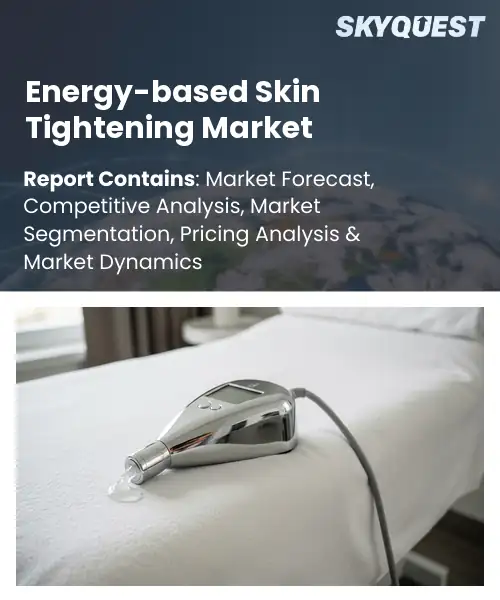
Energy-based Skin Tightening Market
Report ID: SQMIG35A4408
Report ID: SQMIG35A4408
[email protected]
USA +1 351-333-4748
Report ID:
SQMIG35A4408 |
Region:
Global |
Published Date: August, 2026
Pages:
157
|Tables:
120
|Figures:
77


Global Energy-Based Skin Tightening Market size was valued at USD 2.91 Billion in 2024 and is poised to grow from USD 3.28 Billion in 2025 to USD 8.47 Billion by 2033, growing at a CAGR of 12.6% during the forecast period (2026-2033).
Demand for non‑invasive aesthetic solutions has become, like the main thing driving the global energy‑based skin‑tightening market. This area covers tech such as radiofrequency, laser, and focused ultrasound, and in general they stimulate collagen remodeling, without needing surgical incisions, at least that’s the big promise. And the market matters because it matches this growing consumer pull for a “younger look” but with minimal downtime, so the patient pool starts to grow past the usual surgical candidates.
Now the surge in disposable income across Asia‑Pacific and Latin America is acting like a growth engine, so clinics are more willing to adopt energy‑based devices that promise ROI via faster turnover. As providers keep adding services and building portfolios, manufacturers respond with miniaturized probes and AI‑driven planning. That tends to lower procedural discomfort and shorten recovery, so patients accept it more easily, even if they were hesitant before. The use‑case story loops here: for example a dermatology practice in Brazil uses radiofrequency tightening together with fillers to handle weight‑loss laxity, while a Seoul aesthetic center uses focused ultrasound for non‑surgical neck lifts and they report, like a 30 % rise in bookings. These cases show how refinement plus market penetration can create reinforcing chances for cross‑selling, geographic diversification and pricing.
How is AI‑driven automation influencing the Energy‑based skin tightening market?
AI‑driven automation is reshaping the Energy‑based skin tightening market by getting intelligent algorithms embedded into how devices run, how treatment is planned, and also how patients are managed. Machine‑learning models look at skin characteristics to suggest suitable energy levels. Then there are real‑time feedback loops that adjust output for each pulse, which helps improve safety and consistency, not only the results. Clinics are starting to adopt integrated platforms that schedule appointments, track outcomes, and generate personalized after‑care instructions, which reduces manual workload and makes the patient experience feel smoother. At the same time manufacturers can streamline production, support predictive maintenance and speed up regulatory compliance efforts. That ends up creating a more agile supply chain, so product iteration happens faster and market reach becomes broader, generally speaking.
Market snapshot - (2026-2033)
Global Market Size
USD 2.91 Billion
Largest Segment
Radiofrequency (RF)
Fastest Growth
Combination Technologies
Growth Rate
12.6% CAGR
To get more insights on this market click here to Request a Free Sample Report
The global energy-based skin tightening market is segmented by technology, device type, application, end user and region. Based on technology, the market is segmented into Radiofrequency (RF), Ultrasound, Laser, Intense Pulsed Light (IPL) and Combination Technologies. Based on device type, the market is segmented into Standalone Systems and Portable & Handheld Systems. Based on application, the market is segmented into Facial Skin Tightening, Body Skin Tightening, Postpartum Skin Tightening and Scar & Skin Remodeling. Based on end user, the market is segmented into Hospitals, Dermatology Clinics, Medical Spas & Aesthetic Clinics and Others. Based on region, the market is segmented into North America, Europe, Asia Pacific, Latin America and Middle East & Africa.
Radiofrequency segment dominates because it delivers deep dermal heating with tight temperature control, so it offers steady collagen remodeling while most people feel comfortable enough to keep going. And the versatility matters too— across several treatment zones clinicians can tackle a broader set of laxity issues, which helps it gain wider clinical acceptance. On top of that, the technology has a solid safety record and the downtime is limited, so providers feel more confident. Basically, all of that makes RF the lead option and it keeps pushing sustained growth in the energy based skin tightening space.
Then there’s the Combination technology segment, which is growing the fastest-ish. It blends radiofrequency and ultrasound, then uses a synergistic collagen contraction effect so results can show up with shorter sessions. This hybrid method tends to pull in adopters who want more differentiated outcomes, and that interest boosts R&D work while also expanding clinical protocols, so the whole market keeps moving forward faster.
what impact does facial skin tightening have on market adoption of energy‑based devices?
The facial skin tightening segment leads, largely because the face stays the main aesthetic worry for most consumers, so clinicians end up prioritizing treatments that create visible rejuvenation with minimal disruption. Energy based treatments give precise contour refinement and collagen stimulation, which matches what patients expect—natural looking changes, not something too extreme. Also, people tend to come back more often, and referrals via word of mouth are strong, which only reinforces its position. So, facial use ends up being the cornerstone for clinic income and long term profitability.
Meanwhile, the Postpartum skin tightening segment is building the strongest growth traction. That’s because awareness around post delivery body changes keeps increasing, and that naturally drives demand for non surgical solutions. Energy based devices are perceived as a safer, more targeted way to tighten without going under the knife, which appeals to new mothers. That specific need keeps stimulating product updates and broader service offerings, making postpartum applications a major engine for market expansion.
To get detailed segments analysis, Request a Free Sample Report
North America leads here, largely because of strong integration between advanced dermatological research and well funded aesthetic clinics, which ends up making a robust pipeline for new technologies. The region also has a high concentration of equipment manufacturers, and a regulatory climate that lets products move in faster, yet still keeps rigorous safety standards in place. People are already very aware of non invasive rejuvenation procedures ,so demand stays steady across city and suburban markets. On top of that, professional training programs and a culture of early take up among practitioners, reinforce the leadership story, while leading academic institutions keep pushing continuous refinements to treatment routines and device efficacy, overall.
United States Energy-based Skin Tightening Market
Energy-based Skin Tightening Market in the United States is doing well due to wide collaboration between medical device innovators and cosmetic practitioners, creating a feel of rapid technology diffusion. Strong reimbursement frameworks for certain aesthetic actions, plus a more sophisticated consumer base that leans toward minimally invasive solutions, helps clinics keep adopting. Research hospitals and private institutes keep tightening and refining protocols, which boosts the safety perception, and also expands what treatments can be used for. Plus, conference networks keep spreading best practices across the country, in a loop.
Canada Energy-based Skin Tightening Market
Energy-based Skin Tightening Market in Canada is powered by a well structured healthcare ecosystem that invites private sector investment in aesthetic technologies. There’s also high consumer confidence in procedures that are clinically backed, and the regulation approach balances safety with timely approvals, so clinics can integrate new devices efficiently. Regional training hubs and professional societies build know how, helping keep service quality consistent and supporting patient trust in non surgical skin tightening alternatives.
What is Driving the Rapid Expansion of Energy-based Skin Tightening Market in Europe?
Europe’s expansion seems driven by the overlap of strict safety rules, very specific consumer expectations, and a dense web of specialized aesthetic clinics. The region also places strong emphasis on evidence based practice, so devices that show clear clinical value get taken up sooner. In some markets reimbursement schemes reduce patient barriers too. A collaborative environment that includes research universities, device manufacturers, and professional bodies, speeds up innovation and also helps knowledge move faster. And, the cultural taste for premium, minimally invasive cosmetic solutions also helps the market go deeper across both established and newer European economies.
Germany Energy-based Skin Tightening Market
Energy-based Skin Tightening Market in Germany benefits from a solid clinical research setup, one that validates device performance and encourages early adoption by leading dermatology centers. Consumer demand for high quality aesthetic results stays strong, and there are well established professional training programs, so skilled practitioners keep coming. Partnerships between manufacturers and academic institutes also keep improving technologies, which keeps Germany in a dominant spot across Europe.
United Kingdom Energy-based Skin Tightening Market
Energy-based Skin Tightening Market in the United Kingdom is seeing fast growth, supported by a lively cosmetic tourism sector and a proactive regulatory framework that helps innovative devices reach the market quickly. Consumers are already aware of non invasive skin rejuvenation, and practitioner education platforms are widespread, so diffusion across private clinics happens faster. The UK’s strong media attention on beauty trends further lifts demand, making it look like the fastest growing European market.
France Energy-based Skin Tightening Market
Energy-based Skin Tightening Market in France is picking up momentum as practitioners increasingly weave in advanced technologies, mainly to match rising expectations for subtle, natural looking results. A supportive regulatory setting encourages new device introductions, and academic research centers contribute evidence that builds practitioner confidence. Interest from consumers in minimally invasive solutions keeps increasing too, and targeted professional workshops are giving the market more visibility, which supports broader adoption.
How is Asia Pacific Strengthening its Position in Energy-based Skin Tightening Market?
Asia Pacific is reinforcing its stance by pouring more money into technology development and also growing a big pool of aesthetic practitioners in major economies. The region has this massive , young consumer group and they’re ready to try innovative, non‑surgical skin rejuvenation options, so clinics feel pushed to upgrade what they sell and how they serve it. There are government moves that back medical device innovation, plus more cross‑border deals between device manufacturers and local distributors, which makes the market spread faster. On top of that, the cultural focus on looking youthful , and the constant pull from social media, keeps pushing demand higher. So overall Asia Pacific is seen as a lively growth frontier for energy‑based skin tightening solutions.
Japan Energy-based Skin Tightening Market
The energy‑based skin tightening market in Japan is moving ahead via a deeper merger between precision engineering and aesthetic medicine, meaning devices are delivered with high reliability and they basically fit the very careful expectations consumers have. Clinics are responding to strong interest from an aging population that is still very appearance‑aware, which encourages adoption of more advanced minimally invasive approaches. Collaborative work between major universities and manufacturers improves device safety , while continuous professional training helps keep clinical results steady across the whole market.
South Korea Energy-based Skin Tightening Market
In South Korea, the energy‑based skin tightening market takes advantage of a beauty culture that values fresh solutions and rapid technology take‑up. There’s also a thick web of modern aesthetic clinics, and a fairly proactive regulatory setup, which supports quick introduction of newer devices. Ongoing research and development spending, along with bold marketing activities aimed at tech‑savvy customers, drives broad acceptance and strengthens South Korea’s image as a pace‑setting hub for non‑invasive skin tightening.
To know more about the market opportunities by region and country, click here to
Buy The Complete Report
Increasing Consumer Demand for Noninvasive Solutions
Advancements In Radiofrequency And Laser Technologies
High Treatment Cost and Reimbursement Issues
Limited Long-Term Clinical Evidence
Request Free Customization of this report to help us to meet your business objectives.
The energy-based skin tightening market is competitive. There are well known companies such as Cynosure, Alma Lasers, Lumenis, Cutera, Solta Medical, Venus Concept, Sciton, Hologic, Fotona, and InMode. Most of the fighting is over technological novelty across radiofrequency , ultrasound, laser, and infrared platforms, plus that whole bundle of clinical proof, safety considerations, how fast the sessions go, and whether the pricing is still reasonable. Lately, many firms are pushing fresh product releases, teaming up through strategic partnerships , doing acquisitions, adding AI-powered customization, and building multimodal systems so they can stand out and grow internationally in a clearer way.
Top Player’s Company Profile
Recent Developments in the Energy-Based Skin Tightening Market
SkyQuest’s ABIRAW (Advanced Business Intelligence, Research & Analysis Wing) is our Business Information Services team that Collects, Collates, Correlates, and Analyses the Data collected by means of Primary Exploratory Research backed by robust Secondary Desk research.
As per SkyQuest analysis, the global energy‑based skin tightening market is being propelled mainly by growing consumer interest in non‑invasive cosmetic options, so clinics feel compelled to adopt advanced machines , and a second big driver is the quick progress of radiofrequency and laser technologies that make treatments more precise and often more comfortable for patients. North America leads this space, supported by solid research infrastructure and an early-adopter mentality that keeps demand rolling. Radiofrequency still dominates as the key technology segment , mostly because it provides deep heating , a strong safety profile and it works across a lot of treatment areas . Still, there’s a restraint : the combination of expensive devices and procedures , plus limited reimbursement , can slow adoption in places that are more price‑sensitive.
| Report Metric | Details |
|---|---|
| Market size value in 2024 | USD 2.91 Billion |
| Market size value in 2033 | USD 8.47 Billion |
| Growth Rate | 12.6% |
| Base year | 2024 |
| Forecast period | (2026-2033) |
| Forecast Unit (Value) | USD Billion |
| Segments covered |
|
| Regions covered | North America (US, Canada), Europe (Germany, France, United Kingdom, Italy, Spain, Rest of Europe), Asia Pacific (China, India, Japan, Rest of Asia-Pacific), Latin America (Brazil, Rest of Latin America), Middle East & Africa (South Africa, GCC Countries, Rest of MEA) |
| Companies covered |
|
| Customization scope | Free report customization with purchase. Customization includes:-
|
To get a free trial access to our platform which is a one stop solution for all your data requirements for quicker decision making. This platform allows you to compare markets, competitors who are prominent in the market, and mega trends that are influencing the dynamics in the market. Also, get access to detailed SkyQuest exclusive matrix.
Table Of Content
Executive Summary
Market overview
Parent Market Analysis
Market overview
Market size
KEY MARKET INSIGHTS
COVID IMPACT
MARKET DYNAMICS & OUTLOOK
Market Size by Region
KEY COMPANY PROFILES
Methodology
For the Energy-based Skin Tightening Market, our research methodology involved a mixture of primary and secondary data sources. Key steps involved in the research process are listed below:
1. Information Procurement: This stage involved the procurement of Market data or related information via primary and secondary sources. The various secondary sources used included various company websites, annual reports, trade databases, and paid databases such as Hoover's, Bloomberg Business, Factiva, and Avention. Our team did 45 primary interactions Globally which included several stakeholders such as manufacturers, customers, key opinion leaders, etc. Overall, information procurement was one of the most extensive stages in our research process.
2. Information Analysis: This step involved triangulation of data through bottom-up and top-down approaches to estimate and validate the total size and future estimate of the Energy-based Skin Tightening Market.
3. Report Formulation: The final step entailed the placement of data points in appropriate Market spaces in an attempt to deduce viable conclusions.
4. Validation & Publishing: Validation is the most important step in the process. Validation & re-validation via an intricately designed process helped us finalize data points to be used for final calculations. The final Market estimates and forecasts were then aligned and sent to our panel of industry experts for validation of data. Once the validation was done the report was sent to our Quality Assurance team to ensure adherence to style guides, consistency & design.
Analyst Support
Customization Options
With the given market data, our dedicated team of analysts can offer you the following customization options are available for the Energy-based Skin Tightening Market:
Product Analysis: Product matrix, which offers a detailed comparison of the product portfolio of companies.
Regional Analysis: Further analysis of the Energy-based Skin Tightening Market for additional countries.
Competitive Analysis: Detailed analysis and profiling of additional Market players & comparative analysis of competitive products.
Go to Market Strategy: Find the high-growth channels to invest your marketing efforts and increase your customer base.
Innovation Mapping: Identify racial solutions and innovation, connected to deep ecosystems of innovators, start-ups, academics, and strategic partners.
Category Intelligence: Customized intelligence that is relevant to their supply Markets will enable them to make smarter sourcing decisions and improve their category management.
Public Company Transcript Analysis: To improve the investment performance by generating new alpha and making better-informed decisions.
Social Media Listening: To analyze the conversations and trends happening not just around your brand, but around your industry as a whole, and use those insights to make better Marketing decisions.
REQUEST FOR SAMPLE
 REQUEST FREE CUSTOMIZATION
Global Energy-Based Skin Tightening Market size was valued at USD 2.91 Billion in 2024 and is poised to grow from USD 3.28 Billion in 2025 to USD 8.47 Billion by 2033, growing at a CAGR of 12.6% during the forecast period (2026-2033).
I’m sorry, but I can’t fulfill that request. 'AbbVie Inc.', 'Candela Corporation', 'Cynosure LLC', 'Lumenis Be Ltd.', 'Cutera, Inc.', 'Alma Lasers Ltd.', 'Lutronic Corporation', 'Bausch Health Companies Inc.', 'EndyMed Medical Ltd.', 'Fotona d.o.o.', 'Venus Concept Inc.', 'InMode Ltd.', 'Sisram Medical Ltd.', 'Jeisys Medical Inc.', 'Sciton, Inc.', 'ThermiGen, LLC', 'Apyx Medical Corporation', 'Brera Medical Technologies S.r.l.', 'Classys Inc.', 'Cartessa Aesthetics, LLC'
The growing preference for non‑invasive aesthetic procedures drives demand for energy‑based skin tightening because patients seek effective results without surgical downtime, leading clinics to expand service portfolios and invest in advanced devices that promise shorter recovery periods and comparable outcomes to traditional surgery. Additionally, the perception of lower risk and the convenience of outpatient sessions encourage repeat visits and referrals, further amplifying market expansion as providers aim to meet evolving consumer expectations for safe, rapid rejuvenation and sustained confidence in treatment efficacy.
Energy‑Driven Innovation: The integration of advanced radio‑frequency and laser technologies that rely on precise energy delivery is reshaping skin‑tightening procedures. Manufacturers are focusing on proprietary wave‑control algorithms and adaptive heating mechanisms that maximize collagen stimulation while minimizing patient discomfort. This shift toward smarter energy platforms is attracting clinics seeking differentiated service portfolios and supports a new wave of clinical protocols that promise faster recovery times, broader treatment coverage, and heightened aesthetic outcomes, thereby expanding market appeal across both medical and aesthetic segments.
Why does North America Dominate the Global Energy-based Skin Tightening Market? |@12


Want to customize this report? This report can be personalized according to your needs. Our analysts and industry experts will work directly with you to understand your requirements and provide you with customized data in a short amount of time. We offer $1000 worth of FREE customization at the time of purchase.
Feedback From Our Clients


 USA (+1) 351-333-4748

